
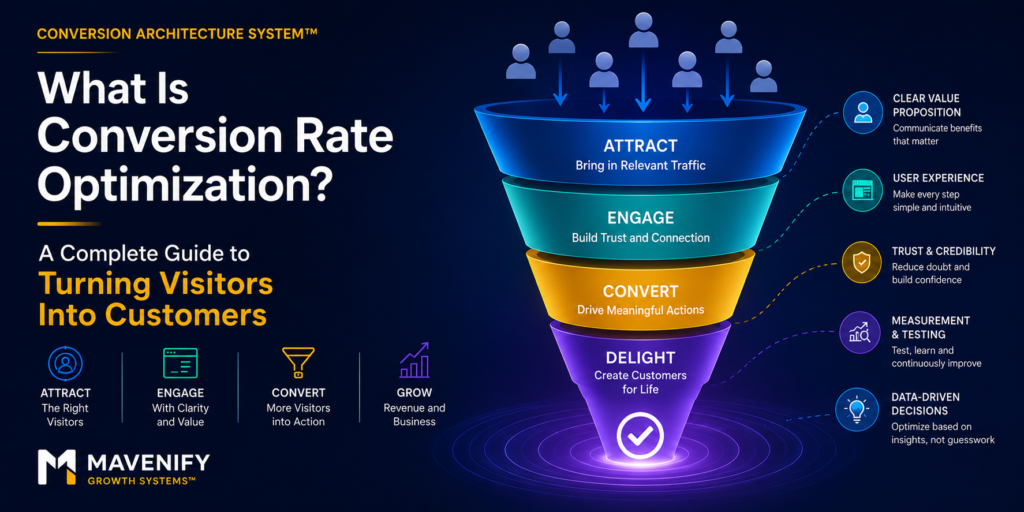
Getting more people to visit a website does not automatically create more business. A website can attract substantial traffic and still generate relatively few enquiries, purchases, bookings, or other meaningful actions. Conversion rate optimization focuses on understanding why visitors do or do not take those actions and improving the experience so that more relevant visitors can move toward a desired outcome.
Conversion rate optimization, commonly called CRO, is not simply about changing buttons, headlines, colours, or page layouts. Effective optimization considers the complete journey a visitor takes through the website, including their intent, expectations, messaging, value proposition, user experience, trust signals, content, calls to action, forms, and the friction that may prevent them from progressing.
The goal is not necessarily to make every visitor convert. A strong conversion strategy aims to make it easier for the right visitors to understand the offer, trust the business, and take an action that is meaningful to both the customer and the organization.
This makes conversion optimization an important bridge between traffic and revenue. Search visibility and paid acquisition can bring relevant visitors to a website, while the website infrastructure provides the technical foundation. Conversion architecture determines how effectively that attention and intent are transformed into meaningful actions.
In this guide, we’ll explore what conversion rate optimization means, what influences conversion rates, how to identify friction, how analytics and testing support optimization, common CRO mistakes, and how a systematic approach can turn more of the website’s existing demand into measurable business outcomes.
Table of Contents
What Is Conversion Rate Optimization?
Conversion rate optimization is the systematic process of improving a website or digital experience so that a greater proportion of relevant visitors complete a desired action.
What Counts as a Conversion?
A conversion is any action that represents meaningful progress toward a defined business objective. For an ecommerce business, that may be a completed purchase. For a service company, it could be a consultation request, qualified enquiry, booking, or quote request. Other websites may define registrations, applications, downloads, or other actions as conversions.
The important point is that a conversion should be defined by the business objective rather than by whichever website interaction is easiest to measure. A page view may indicate interest, but it does not necessarily represent a meaningful business outcome.
Clearly defining conversions gives optimization a measurable objective. Without that definition, businesses can make changes to a website without knowing whether those changes actually improve the outcomes that matter.
How Is Conversion Rate Calculated?
A basic conversion rate can be expressed as:
Conversion Rate = Conversions ÷ Relevant Visitors or Sessions × 100
For example, if 1,000 relevant website sessions produce 40 completed enquiries, the resulting conversion rate would be 4%. This calculation provides a useful starting point for understanding performance, but the number alone does not explain why visitors converted or why others did not.
Conversion rates should therefore be interpreted alongside factors such as traffic source, audience intent, device, page type, offer, customer journey, and the definition of the conversion being measured.
A higher conversion rate is not automatically better if the increase comes from low-value actions or less qualified visitors. Optimization should ultimately focus on meaningful conversions and business value, not simply maximizing a percentage.
CRO Is About More Than Increasing a Percentage
The phrase conversion rate optimization can make the process sound purely mathematical. In reality, conversion behaviour is influenced by human expectations, decision-making, trust, clarity, perceived value, usability, and the context in which someone encounters the offer.
A visitor may leave because the offer is unclear, the page does not answer an important question, the form feels unnecessarily difficult, the website appears untrustworthy, or the next step is not obvious. Increasing conversions therefore often requires understanding the reasons behind behaviour rather than simply changing individual interface elements.
This is why effective CRO combines data, user understanding, business strategy, content, design, technology, and experimentation.
Why Traffic Alone Does Not Guarantee Conversions
A website can receive significant traffic while producing disappointing commercial results. The gap often exists because attracting visitors and persuading relevant visitors to take action are different challenges.
More Visitors Do Not Automatically Mean More Customers
Traffic acquisition determines who arrives at the website, but conversion depends on what happens after they arrive. Visitors need to understand the offer, recognize its relevance, find the information they need, trust the business, and see a clear path toward the next step.
This means a business can sometimes create meaningful growth without dramatically increasing traffic by improving how effectively existing relevant traffic moves through the website.
That does not make traffic acquisition less important. It means acquisition and conversion should be considered complementary parts of the same Performance Marketing System™.
Traffic Quality Influences Conversion
Not every visitor arrives with the same level of intent. Someone searching for a specific solution may be much closer to taking action than someone encountering a business through a broad awareness campaign.
Conversion analysis should therefore consider where visitors came from, what they were looking for, what message attracted them, and whether the landing experience matches the expectation created before they arrived. This connection between search intent and the website experience is central to Search Intelligence Infrastructure™.
A low conversion rate does not always indicate a website problem. In some cases, the traffic itself may be poorly aligned with the offer or business objective.
The Message Before the Click Matters
Visitors form expectations before they reach a website. Search results, advertisements, social content, referrals, email messages, and other acquisition sources can all influence what someone expects to find after clicking.
If the landing experience does not match that expectation, visitors may leave even when the underlying offer is relevant. Strong conversion experiences therefore maintain consistency between the promise that attracted the visitor and the experience that follows.
This is one reason conversion optimization cannot be treated entirely as a page-level activity. The context that brings someone to the page can influence how they interpret everything they encounter after arriving.
What Influences Conversion Rates?
Conversion rates are rarely determined by a single element on a page. They are shaped by the relationship between visitor intent, the offer, messaging, experience, trust, friction, and the path toward taking action.
Visitor Intent
A visitor’s intent influences how they interpret everything they encounter on a website. Someone actively looking for a specific solution may need a very different experience from someone who is only researching a problem or comparing available options.
A conversion experience should therefore reflect the visitor’s likely stage in the decision-making process. High-intent visitors may need clear pricing, proof, availability, specifications, or a straightforward next step, while earlier-stage visitors may need more education before they are ready to act.
Understanding intent helps businesses avoid designing a single conversion path that assumes every visitor has the same needs, expectations, and level of readiness.
Value Proposition and Offer Clarity
Visitors should be able to understand what a business offers, who it is for, and why it is worth considering without having to interpret vague or overly complicated messaging.
A clear value proposition can reduce uncertainty by communicating the relevant benefit, differentiator, or outcome in terms the intended audience can understand.
When the value of the offer is unclear, improving the button, form, or page layout alone is unlikely to solve the underlying conversion problem. The visitor first needs a compelling reason to continue.
Messaging Consistency
The message a visitor encounters before reaching a page creates an expectation about what they will find. That expectation may come from a search result, advertisement, email, social post, referral, or another source.
If the landing page delivers a substantially different message, offer, or experience, the visitor may question whether they have arrived at the right place.
Maintaining continuity between the acquisition message and the landing experience can reduce confusion and help visitors understand that the page is relevant to the reason they arrived.
Trust and Credibility
Conversion often requires a visitor to take some level of risk. They may need to provide personal information, make a payment, schedule a meeting, share business details, or simply commit time to the next stage of the relationship.
Trust signals can help reduce uncertainty. Depending on the business, these may include customer evidence, testimonials, case studies, credentials, transparent information, guarantees where appropriate, clear contact details, security indicators, or other forms of credible proof.
Trust should not be treated as a collection of badges added near a CTA. The entire website experience contributes to how credible and dependable a business appears.
Reducing Friction Across the Conversion Journey
Even when a visitor understands an offer and trusts the business, unnecessary friction can prevent them from completing the next step.
Make the Next Step Obvious
A visitor should not have to determine what to do next after deciding that an offer is relevant. Calls to action should make the intended next step clear and appropriate to the visitor’s level of intent.
The action itself should also match the context. Asking someone who is still evaluating a service to immediately commit to a complex sales process may create unnecessary resistance, while a high-intent visitor may become frustrated if the website provides no direct path to take action.
Effective conversion architecture creates a logical progression between information, confidence, and action.
Simplify Forms and Conversion Steps
Forms are often an important point of friction because they require visitors to invest effort before receiving the next stage of the experience.
Businesses should evaluate whether every field is genuinely necessary at that particular stage of the customer journey. A shorter form may reduce friction, while a more detailed form may sometimes be justified when qualification is important.
The right approach depends on the business objective, lead quality requirements, sales process, and the value of the conversion. The goal is not simply to make every form as short as possible, but to create an appropriate exchange between the information requested and the value provided.
Design for Mobile Conversion
A conversion path that works well on a desktop computer can become difficult on a smaller screen. Small interactive elements, long forms, excessive scrolling, slow-loading pages, or poorly structured content can create friction for mobile visitors.
Mobile conversion should therefore be considered throughout the journey rather than treated as a final responsive-design check.
Important information, calls to action, forms, navigation, and supporting content should remain usable and understandable within the constraints of the device being used.
Remove Unnecessary Steps
Every additional step between visitor intent and the desired action creates another opportunity for abandonment. This does not mean every journey should be reduced to a single click, but each step should have a clear purpose.
Businesses should examine whether visitors are being asked to navigate through unnecessary pages, repeat information, create accounts prematurely, or complete steps that do not contribute meaningfully to the desired outcome.
Reducing unnecessary complexity can make the path easier to understand while preserving the information and controls required for a successful transaction or enquiry.
Conversion Architecture vs. Traditional CRO
Conversion rate optimization and conversion architecture are closely related, but they are not necessarily the same thing.
| Approach | Primary Focus | Typical Question |
| Traditional CRO | Improving measurable conversion performance | “How can we increase the percentage of visitors who convert?” |
| Conversion optimization | Improving specific conversion opportunities | “Where is the journey losing potential customers?” |
| Conversion architecture | Designing the broader system influencing conversion | “How should the entire experience work together to turn intent into action?” |
Traditional CRO often focuses on identifying opportunities to improve measurable conversion performance through research, analysis, experimentation, and optimization.
Conversion architecture takes a broader systems perspective. It considers how traffic intent, messaging, content, page structure, UX, trust, calls to action, forms, technology, analytics, and follow-up work together across the customer journey.
This distinction is important to Mavenify’s positioning. Conversion Architecture System™ is not simply a collection of isolated CRO tactics; it is an approach to designing the conditions that allow relevant visitors to move more effectively from intent to meaningful action.
Designing Pages for Conversion
A page can contain strong information and still fail to convert if the information is presented in an order that does not match how visitors evaluate a decision. Conversion-focused page architecture considers what a visitor needs to understand, believe, and do at each stage of the journey.
Start With the Visitor’s Most Important Questions
Visitors typically arrive with questions, expectations, or problems they want to solve. A conversion-focused page should make it easy to find the information needed to determine whether the offer is relevant.
Depending on the page and audience, those questions may include what the business provides, who the solution is for, what makes it different, what it costs, whether it can be trusted, what results or outcomes are possible, and what happens after taking the next step.
Answering these questions in a logical sequence reduces the amount of interpretation required from the visitor and creates a clearer path toward action.
Build a Clear Information Hierarchy
Important information should not compete equally for attention. The page should establish a hierarchy that helps visitors understand the primary message first, followed by the supporting information needed to evaluate the offer.
This can involve the headline, value proposition, supporting proof, benefits, features, objections, FAQs, calls to action, and other content elements. The specific order will vary according to the page’s purpose and the visitor’s intent.
A clear hierarchy allows visitors to scan the page while still providing enough depth for people who need more information before making a decision.
Match the CTA to Visitor Intent
A call to action should represent a logical next step rather than simply telling every visitor to “buy now” or “contact us.” Different audiences may require different levels of commitment depending on where they are in the decision process.
A visitor researching a complex service may be more comfortable requesting a consultation or exploring a detailed guide, while someone who already understands the offer may be ready to request a proposal or start a purchase.
Matching the CTA to intent can reduce unnecessary friction while making the conversion path feel more natural.
Content Plays a Major Role in Conversion
Design can attract attention, but content often provides the information visitors need to decide whether to continue.
Write for Decisions, Not Just Information
Conversion-focused content should help visitors make progress toward a decision. Instead of simply describing what a business does, the content should explain relevant problems, outcomes, differentiators, evidence, processes, and next steps.
This does not mean turning every page into aggressive sales copy. Useful content can build confidence by answering genuine questions and helping visitors determine whether the business is appropriate for their needs.
The strongest conversion content combines clarity with relevance: it gives the right visitor enough information to understand the opportunity without overwhelming them with unnecessary detail. This connects naturally with AI Content & Authority Systems™, where content is designed to build discoverability, authority, relevance, and trust across the broader customer journey.
Use Proof Where It Reduces Uncertainty
Visitors may hesitate because they are uncertain about whether the business can deliver what it promises. Relevant proof can help reduce that uncertainty by demonstrating experience, outcomes, expertise, customer satisfaction, or successful implementation.
Useful proof can include case studies, testimonials, reviews, client examples, certifications, demonstrations, data, process explanations, or other evidence that is genuinely relevant to the decision being made.
The strongest proof is specific and contextual. A generic claim such as “we deliver excellent results” is usually less informative than evidence that shows what was achieved, for whom, under what circumstances, and why it matters.
Analytics and Testing in Conversion Optimization
Conversion optimization becomes stronger when decisions are informed by evidence rather than assumptions.
Use Analytics to Identify Opportunities
Analytics can reveal where visitors enter the website, which pages they view, where they leave, which interactions they complete, and which journeys are associated with conversions. These patterns can help identify areas worth investigating.
Analytics does not always explain why visitors behave in a particular way, but it can help identify where a potential problem or opportunity exists.
Combining quantitative data with user feedback, usability research, customer conversations, session analysis, and other evidence can provide a more complete understanding of the underlying issue. Our guide to Website Analytics and Conversion Tracking explains how measurement can provide the data layer needed for this process.
Test Before Assuming
A common CRO mistake is assuming that a particular design change will automatically improve performance. A different headline, shorter form, new CTA, or redesigned section may appear better from a design perspective but still fail to improve the desired outcome.
Research from Baymard Institute also emphasizes beginning testing with a clearly defined problem and hypothesis rather than making isolated changes without understanding what they are intended to solve.
Testing creates an opportunity to compare alternatives against a defined objective. Depending on the traffic volume, business model, and testing environment, this may involve controlled experiments, A/B testing, usability testing, qualitative research, or other approaches.
The appropriate testing method depends on the question being investigated. Not every website has enough traffic or conversion volume for every type of statistical experiment, and forcing a testing methodology where the conditions are unsuitable can produce misleading conclusions.
Optimize for Business Value, Not Just Conversion Rate
A change that increases the number of form submissions is not necessarily successful if the additional submissions are poorly qualified. Similarly, increasing checkout completion without considering order value, refunds, repeat purchases, or customer quality may provide an incomplete view of performance.
Conversion optimization should therefore consider the quality and commercial value of the outcomes being generated, not simply the number of people who complete an action.
This is where CRO becomes connected to the wider growth system. The website needs to generate actions that contribute to meaningful business outcomes rather than optimizing isolated metrics for their own sake.
Common Conversion Rate Optimization Mistakes
Changing Things Without Understanding the Problem
Changing page elements without understanding why visitors are struggling can lead to random optimization. A business may repeatedly alter headlines, buttons, images, or layouts without addressing the underlying reason visitors are not progressing.
A stronger process begins by identifying a specific problem or hypothesis and then selecting the appropriate evidence, change, and measurement approach.
Copying Competitors
A competitor’s website may look successful, but copying its design or conversion elements does not guarantee the same results. The audiences, offers, brand positioning, traffic sources, customer expectations, and business models may be completely different.
Competitive research can provide useful context, but conversion decisions should ultimately be based on the business’s own customers, evidence, positioning, and objectives.
Optimizing for Everyone
Trying to create a single message that appeals equally to every visitor can make the website less relevant to everyone. Different audiences may have different needs, objections, levels of awareness, and reasons for taking action.
Where appropriate, businesses can create clearer pathways for different audiences, services, problems, or stages of the buying journey rather than forcing everyone through exactly the same experience.
Ignoring Post-Conversion Behaviour
The conversion itself is not always the end of the customer journey. A lead still needs to be qualified and followed up, while a purchase may need fulfilment, support, retention, or additional engagement.
Understanding what happens after conversion can reveal whether the website is generating genuinely valuable outcomes or simply increasing low-value actions. Connected follow-up and post-conversion workflows can then be supported through AI Automation Infrastructure™ where appropriate.
The Technical Foundation Behind Conversion
Conversion is influenced by more than messaging and UX. If the underlying website is slow, unstable, difficult to use, or unable to support the required customer journey, even strong conversion strategy can be undermined by the technology.
Performance Is Part of the Conversion Experience
Visitors expect websites to respond quickly and behave reliably. Slow pages, delayed interactions, broken functionality, or inconsistent mobile experiences can create friction before a visitor ever reaches the intended conversion point.
Performance should therefore be considered as part of the overall conversion experience rather than as an isolated technical metric. Improving the speed and reliability of important journeys is one reason Revenue-Focused Web Infrastructure™ needs to consider performance alongside architecture, conversion, integrations, and scalability.
This is particularly important for high-intent visitors, where unnecessary delays or technical problems can interrupt an otherwise strong path toward conversion.
Forms, Integrations and Functionality Must Work
A visitor can be completely convinced by a page and still fail to convert if the form does not work, the booking system is unavailable, a payment process breaks, or information fails to reach the appropriate business system.
Conversion architecture therefore needs to account for the technical components supporting the journey. Forms, payment systems, scheduling tools, CRM connections, analytics, APIs, and other integrations need to work reliably at the points where visitors depend on them.
Technical reliability is especially important because visitors may not distinguish between a website problem and a business problem. If a booking fails or a form submission disappears, the business may lose trust along with the conversion.
Measurement Needs to Be Built Into the Experience
A conversion pathway should be measurable from the beginning. Businesses need to know whether important actions are occurring, where visitors are dropping out, and whether changes to the experience are producing better outcomes.
This requires analytics and conversion tracking to be considered during website architecture and development rather than added only after the experience has been launched.
Without reliable measurement, teams may be forced to make conversion decisions based on assumptions instead of evidence.
Conversion Optimization as a Continuous Process
Conversion optimization is not a one-time website project. Customer expectations, traffic sources, offers, competitors, technology, and business priorities change over time, which means the conversion experience needs to evolve as well.
“Improving conversion rates is an ongoing part process for any company.”
This reinforces an important principle: conversion optimization should not be treated as a one-time website exercise. Visitor behaviour, customer expectations, acquisition sources, offers, and business priorities continue to change, so the conversion experience needs to evolve with them.
Measure, Learn and Improve
A mature optimization process begins with measurement, identifies a potential opportunity, develops a hypothesis, implements an appropriate change, and evaluates the resulting behaviour.
The process can then continue as new evidence becomes available. Some changes will produce meaningful improvements, others may have little effect, and some may reveal unexpected behaviour that leads to a better question.
This creates a cycle of continuous improvement rather than treating conversion optimization as a project that ends when a redesigned website goes live.
Prioritize High-Impact Opportunities
Not every conversion issue deserves immediate attention. Businesses should consider factors such as traffic volume, conversion potential, customer value, implementation effort, technical complexity, and the confidence behind the identified opportunity.
A small improvement to a high-volume, high-value journey may have a much greater commercial impact than a larger improvement to a page that receives very little relevant traffic.
Prioritization allows teams to focus limited development, design, content, and testing resources where they are most likely to create meaningful value.
CRO Should Evolve With the Business
A website’s conversion strategy should change as the business changes. New services, audiences, markets, pricing models, acquisition channels, products, and customer expectations can all affect how visitors make decisions.
A conversion system that worked well for an earlier stage of the business may become less effective as the organization grows.
Continuous optimization allows the website and customer journey to evolve alongside those changes rather than requiring a complete redesign every time a new conversion challenge emerges.
Building a Conversion Architecture System
This is where conversion rate optimization becomes a broader strategic capability rather than a collection of isolated page improvements.
Connect Traffic, Experience and Action
Conversion architecture begins before a visitor reaches a page. The source of the traffic, the intent behind the visit, the message that created the expectation, and the landing experience all influence what happens next.
The system then continues through content, UX, trust, calls to action, forms, functionality, measurement, and the business processes that follow the initial conversion.
Looking at these elements together makes it easier to identify where the customer journey is breaking down and where improvements can create the greatest impact.
Connect Conversion With Revenue
The ultimate objective is not simply to increase the number of people who complete a website action. The objective is to increase the number and quality of actions that contribute to meaningful business outcomes.
That may mean generating more qualified leads, increasing completed purchases, improving booking quality, reducing abandonment, or creating stronger customer journeys after the initial conversion.
When conversion is evaluated in terms of business value, CRO becomes part of a broader growth system rather than an isolated website metric.
Make the System Measurable
A conversion architecture should provide enough measurement to understand how visitors move through important journeys and where opportunities are being lost.
That measurement can then inform future design, content, development, acquisition, and optimization decisions.
The result is a feedback loop where traffic creates data, data informs decisions, decisions improve the experience, and the improved experience generates better outcomes.
The Mavenify Approach to Conversion Architecture
At Mavenify, conversion optimization is approached as a system rather than a collection of isolated page changes. The focus is on understanding how visitor intent, acquisition channels, messaging, content, website architecture, user experience, trust, functionality, measurement, and business processes work together to influence meaningful action.
This means the right conversion strategy can differ significantly between businesses. A B2B service company may need to optimize qualification and consultation journeys, while an ecommerce business may need to reduce purchase friction, improve product discovery, and strengthen checkout experiences.
Rather than applying a fixed list of CRO tactics, Mavenify evaluates the business objective, customer journey, existing evidence, technical environment, and opportunities for improvement before determining what the conversion system needs.
Conversion Architecture Within Growth Systems™
Conversion does not exist independently from the other systems responsible for growth. Search visibility can create demand, paid acquisition can bring targeted visitors, website infrastructure provides the environment where those visitors interact with the business, content and authority can build confidence, and automation can support what happens after an action is taken.
Conversion Architecture System™ connects these elements around the customer journey, creating a structured path between visitor intent and meaningful business outcomes.
This is why Mavenify’s broader Growth Systems™ approach treats conversion as a central part of the growth infrastructure rather than a final step added after traffic generation.
Frequently Asked Questions About Conversion Rate Optimization
What is conversion rate optimization?
Conversion rate optimization is the process of improving a website or digital experience so that a greater proportion of relevant visitors complete a meaningful action. It combines data, user understanding, content, UX, testing, technology, and business objectives.
What is a good conversion rate?
There is no universal conversion rate that represents success for every business. Performance depends on factors such as industry, traffic source, visitor intent, offer, conversion definition, customer journey, device, and business model. The most useful benchmark is often the website’s own performance over time and the quality of the resulting outcomes.
How do you improve website conversion rate?
Improving a website’s conversion rate starts with understanding visitor intent and identifying friction in important customer journeys. Businesses can then improve messaging, value propositions, UX, page architecture, trust, calls to action, forms, functionality, and other relevant elements while measuring the resulting outcomes.
Is CRO only about A/B testing?
No. A/B testing is one method used in conversion optimization, but CRO can also involve analytics, user research, usability testing, customer feedback, qualitative analysis, technical investigation, content improvements, and other forms of evidence.
What is the difference between CRO and conversion architecture?
CRO generally focuses on improving conversion performance through analysis, experimentation, and optimization. Conversion architecture takes a broader systems perspective, considering how traffic intent, content, UX, technology, trust, page structure, measurement, and customer journeys work together to influence conversion.
Does CRO require more website traffic?
Not necessarily. Conversion optimization can help a business generate more meaningful outcomes from existing relevant traffic. However, traffic quality and volume still matter because they influence the number and type of opportunities available for conversion.
How does website design affect conversion?
Website design can influence how easily visitors understand information, navigate the website, identify important actions, and develop confidence in the business. Effective conversion-focused design considers the entire experience rather than focusing only on visual appearance.
How does website speed affect conversion?
Slow loading, delayed interactions, and unreliable functionality can introduce friction into the customer journey. Performance should therefore be considered part of the overall conversion experience, particularly on important pages and conversion pathways.
Can CRO improve lead quality as well as lead volume?
Yes. Conversion optimization does not have to focus exclusively on increasing the number of leads. Improving messaging, qualification, forms, offers, and customer journeys can help businesses attract and convert visitors who are more closely aligned with their actual requirements.
When should a business invest in conversion optimization?
CRO can be valuable when a website already receives relevant traffic but is not producing the expected level or quality of business outcomes. It can also be incorporated into a new website or broader digital growth strategy so that conversion considerations are built into the experience from the beginning.
Conclusion
Conversion rate optimization is ultimately about understanding the gap between visitor intent and business outcome. A website may attract the right people, but if the experience creates confusion, friction, uncertainty, or unnecessary complexity, valuable opportunities can still be lost.
Effective optimization looks beyond individual buttons and page elements. It considers the complete journey—from the message that attracts the visitor to the content, experience, trust, functionality, conversion path, measurement, and processes that follow the action.
This is what makes conversion architecture different from simply applying isolated CRO tactics. It treats conversion as a connected system that can be measured, improved, and aligned with the wider objectives of the business.
The goal isn’t to make every visitor convert. The goal is to make it easier for the right visitors to understand, trust, and act on the right opportunity.
Turn More Relevant Traffic Into Meaningful Business Outcomes
If your website is attracting visitors but not generating the level or quality of enquiries, purchases, bookings, or other outcomes your business expects, the problem may not be traffic alone. The experience between arrival and action deserves to be examined as a complete conversion system.
Mavenify’s Conversion Architecture System™ connects visitor intent, messaging, UX, content, trust, page architecture, functionality, measurement, and customer journeys to create clearer paths from attention to meaningful business action.