

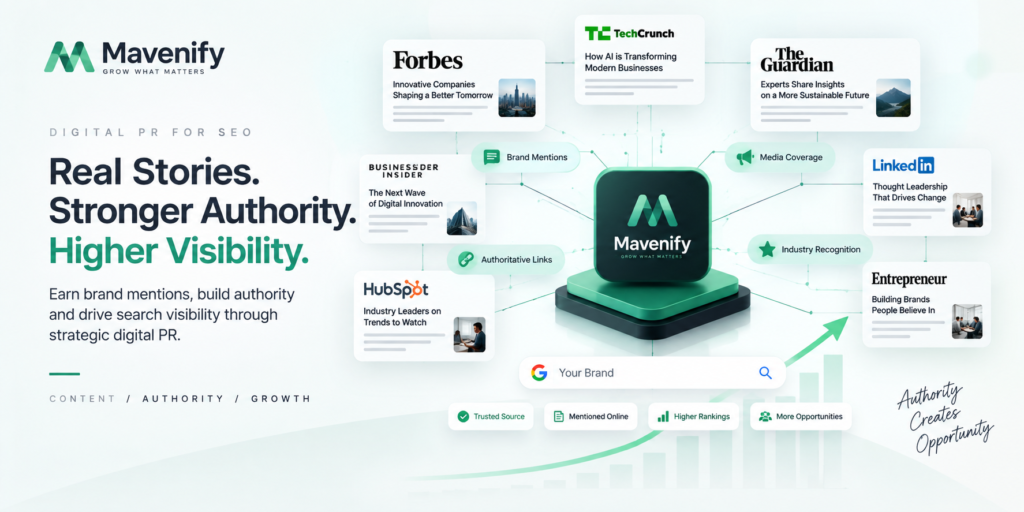
Getting a business mentioned by the right people can be more valuable than simply getting another page indexed by search engines.
When an industry publication references your research, a journalist quotes your expertise, a relevant website cites your data or other businesses begin discussing your brand, those mentions can extend your visibility beyond your own website. They can introduce the brand to new audiences while contributing to the broader authority it builds online.
This is where digital PR for SEO becomes interesting.
Digital PR combines the principles of public relations with digital content, media outreach and search visibility. Instead of relying only on traditional link-building tactics, the goal is to create something genuinely worth mentioning and then get it in front of the people and publications most likely to care about it.
A strong digital PR strategy can therefore do more than generate backlinks. It can help a business build recognition, demonstrate expertise, earn credible mentions and create a stronger presence across the wider web.
But there is an important distinction between earning authority and trying to manufacture it. Not every backlink is valuable, not every media mention strengthens a brand, and simply paying for placements does not create the same kind of credibility as genuine editorial recognition.
This guide explains how digital PR works for SEO, why brand mentions and authoritative links matter, what makes a story newsworthy, how to build a digital PR strategy and how businesses can turn earned visibility into a long-term authority asset.
Table of Contents
What Is Digital PR for SEO?
Digital PR for SEO is the practice of creating and promoting newsworthy, useful or authoritative information that earns attention from relevant publications, websites, journalists and industry communities.
Traditional public relations has often focused on managing reputation and securing media coverage. Digital PR adds another layer: the stories, research, expert commentary and resources created through the process can generate brand mentions, editorial links, referral traffic and wider digital visibility.
The important word is earned.
Digital PR is not simply paying for an article and inserting a backlink. It is about giving publishers and audiences a genuine reason to talk about, reference or cite a business. Google’s spam policies specifically distinguish legitimate editorial activity from practices such as buying links or distributing paid content with links intended to manipulate rankings.
That makes digital PR particularly relevant to modern SEO. Search engines can discover a website through its own content, but a brand’s presence across the wider web can also help establish context around the business, its expertise and the subjects it is associated with.
Digital PR Is More Than Link Building
Link building is often the first thing people associate with digital PR for SEO, but reducing the strategy to backlinks misses much of its value.
A successful campaign can generate coverage in an industry publication, a quotation from an expert, a reference to original research, a mention in a relevant article or discussion within a professional community. Some of these opportunities may produce links, while others may primarily increase brand visibility or introduce the business to a new audience.
That distinction matters because a backlink is an outcome of digital PR, not the entire purpose of it.
The stronger objective is to create something genuinely useful, interesting or credible enough that other people have a reason to reference it. When that happens, links and mentions become earned outcomes of the story rather than the sole reason the story exists.
Brand Mentions Are Part of the Authority Picture
A brand mention occurs when a business, product, expert or organisation is referenced online, whether or not the reference includes a hyperlink.
Mentions can happen in news coverage, industry articles, interviews, research reports, podcasts, expert roundups, professional publications and other relevant environments.
A mention without a link does not automatically provide the same SEO value as an editorial backlink. However, it can still contribute to visibility, discovery and reputation, particularly when the business is being discussed in a relevant context.
This is why digital PR should be viewed as an authority-building activity, rather than simply another method of acquiring links.
When a brand is consistently associated with a particular subject through credible external sources, that recognition can become part of the broader digital presence the business is building.
Earned Authority Is Different From Purchased Visibility
There is an important difference between earning recognition and simply paying to appear somewhere.
A sponsored placement can put a business in front of an audience, and paid media can be an entirely legitimate part of a marketing strategy. But paid visibility and earned editorial recognition serve different purposes.
Digital PR focuses on creating information, stories, expertise or resources that provide a genuine reason for independent publishers and relevant audiences to talk about the brand.
That is why the quality of the underlying story matters so much. If there is nothing interesting, useful or credible to communicate, outreach alone is unlikely to create meaningful authority.
What Makes Content Worth a Digital PR Campaign?
Digital PR works best when there is something worth putting in front of other people.
That might be original research, a new dataset, an expert perspective on an important industry issue, a useful study, a strong customer insight, an interesting trend or a story connected to something people are already discussing.
The common factor is newsworthiness or usefulness. A company announcement that matters only to the company is unlikely to attract much independent coverage. A useful finding that helps an entire industry understand a problem has a much stronger reason to be shared.
Original Research Creates Strong PR Opportunities
Original research can give a business something that journalists, publishers and industry professionals can reference.
A company might analyze its own data, conduct a survey, examine an industry trend or publish findings from a sufficiently broad set of observations. The value comes from turning that information into a meaningful insight rather than simply publishing a collection of numbers.
For example, instead of publishing an article saying that customer acquisition is becoming more expensive, a business could analyze a relevant dataset and identify how acquisition costs have changed across channels, industries or customer segments.
The research becomes the story.
Proprietary Data Can Become a Content Asset
Businesses often have useful information sitting inside their own operations.
Sales teams hear recurring objections. Customer service teams see recurring problems. Marketing teams observe campaign patterns. Product teams understand how customers use a product. Consultants accumulate lessons from repeated projects.
Some of that knowledge can be transformed into original content that provides value beyond the company’s immediate audience.
This is where digital PR connects naturally with a broader AI Content & Authority System™. AI can help analyze and structure information, but the underlying knowledge comes from the business. The combination can turn internal expertise into assets that are useful enough to earn external attention.
Expert Commentary Can Create Media Opportunities
Not every PR asset needs to be a large research project.
Sometimes the most valuable asset is the expertise of a person within the business.
A subject-matter expert who can explain a complicated development, interpret new research or provide a practical perspective on an industry issue can become a useful source for journalists and publishers.
The key is specificity. Saying that a business is “an industry leader” does not give a journalist much to work with. Explaining what is changing, why it matters and what businesses should consider gives them something they can actually use.
Useful Tools and Resources Can Earn Attention
Digital PR can also be built around something practical.
Calculators, original datasets, research libraries, interactive tools, templates, benchmarks and other useful resources can become reference points for people working in a particular field.
These assets have an advantage over promotional pages: their value exists independently of the company selling something.
When a resource genuinely helps someone solve a problem, there is a natural reason for other websites, communities and professionals to reference it.
A Strong Story Matters More Than a Large Company
A common misconception is that digital PR works mainly for well-known brands.
A smaller business may have less existing recognition, but it can still have an interesting story, original data or specialist knowledge that deserves attention.
The question is not simply whether the company is famous enough to receive coverage.
The better question is:
“What does this business know, have, discovered or created that other people would find useful or interesting?”
That question shifts digital PR away from self-promotion and toward creating something the wider market has a reason to care about.
How to Build a Digital PR Strategy for SEO
A digital PR strategy should begin with the asset, not the media list.
Before contacting journalists, publications or industry websites, determine what you actually want to put in front of them and why their audience would care. Once that foundation is clear, outreach becomes much more targeted because you are presenting something useful rather than simply asking for coverage.
The strongest campaigns connect a worthwhile story with the right audience, the right people and the right timing.
Start With a Clear PR Objective
A campaign should have a defined objective before outreach begins.
That objective might be increasing awareness within a particular industry, earning coverage around original research, positioning an expert as a source, generating relevant editorial links or introducing a new piece of proprietary information to the market.
These objectives can overlap, but they should not be treated as interchangeable.
A campaign designed to establish an expert’s reputation may require a different story and outreach strategy from one designed to promote a new industry benchmark. Being clear about the intended outcome makes it easier to decide what kind of asset to create and which publications are actually relevant.
Identify the Audience Before the Publication
A publication’s domain authority or audience size should not be the only reason to target it.
A smaller industry publication read by the exact people a business wants to reach can be more relevant to the campaign than a much larger general-interest website.
The question should therefore be: Who needs to see this story?
Once that is clear, the media and publication research becomes much more focused.
Find the Story Inside the Data
Businesses often have information but no obvious PR story.
The job of digital PR is to find the interesting part.
A dataset might reveal an unexpected trend. Customer research might challenge a common assumption. A survey might expose a significant change in behavior. An expert might have a strong explanation for something happening in the market.
The PR process turns that underlying information into a story that another publication can understand and use.
This is where the distinction between content marketing and digital PR becomes particularly useful. A content marketing asset primarily needs to be useful to its intended reader. A PR asset also needs to give someone outside the business a reason to talk about it.
Build a Targeted Media List
Once the story is defined, identify the journalists, editors, publications and industry platforms that are genuinely relevant.
Look at the subjects they already cover, the type of stories they publish and the audiences they serve. A journalist who regularly writes about business technology may be relevant to a technology research report, while a journalist covering consumer behavior may be more appropriate for a consumer survey.
The objective is relevance, not volume.
Sending the same pitch to hundreds of unrelated contacts is unlikely to produce the kind of meaningful relationships that a focused campaign can create.
Make the Outreach About the Story
A good PR pitch should make the journalist’s job easier.
Instead of beginning with a long description of the company, explain what the story is, why it matters now and what useful information the journalist can take from it.
If the campaign includes original research, provide the key finding. If an expert is available for commentary, explain what they can contribute. If the story challenges an existing assumption, make that distinction clear.
The business should be present in the story, but the story should not exist solely to promote the business.
Build Relationships, Not Just Placements
Digital PR becomes more valuable when outreach develops into genuine relationships.
A journalist who finds a particular expert useful may return to that expert for future commentary. A publication that finds original research valuable may reference future studies. An industry editor may become familiar with the business’s expertise over time.
That means a campaign should not be judged solely by how many placements it generates immediately.
Repeatedly providing useful information can create a network of relationships that makes future PR activity more effective.
How Digital PR Builds SEO Authority
The value of digital PR for SEO becomes clearer when you look beyond individual links and consider what happens when a brand is repeatedly referenced by relevant, credible sources.
A strong campaign can create a combination of editorial links, brand mentions, referral traffic, expert recognition and broader visibility. None of these signals should be treated as a guaranteed ranking shortcut. Together, however, they can contribute to a stronger digital presence around the subjects a business wants to be known for.
Editorial Links Can Strengthen the Website’s Authority
When a relevant publication links to a useful resource because it genuinely supports its story, that link can help users discover the original resource and provide search engines with additional context about the relationship between websites.
The important distinction is why the link exists.
A link earned because a journalist found original research useful is fundamentally different from a link placed simply because someone was paid to manipulate search rankings. Google’s documentation on link spam makes this distinction important when evaluating link-building practices.
This is why digital PR should focus on creating assets that deserve to be referenced rather than designing campaigns around an arbitrary number of backlinks.
Brand Mentions Expand Digital Recognition
Not every valuable PR outcome includes a hyperlink.
When an expert, company or publication repeatedly appears in relevant conversations, the brand becomes more recognizable within that subject area. A journalist may mention the company in one story, another publication may reference its research later and an industry podcast may invite its expert to discuss the same topic.
These individual mentions may look small in isolation. Over time, they can contribute to a broader pattern of recognition.
This is particularly useful for businesses that are trying to establish authority in a defined niche rather than simply generate short-term traffic.
Digital PR Can Support E-E-A-T Signals
Digital PR also has a natural relationship with the principles of E-E-A-T in SEO.
When an expert is quoted by relevant publications, when original research is referenced by others or when a business becomes associated with a particular area of knowledge, those external references can reinforce the credibility surrounding the people and organization behind the content.
Digital PR does not automatically create E-E-A-T. A media mention alone cannot prove expertise or trustworthiness.
But genuine external recognition can become one part of the broader evidence that supports how a brand presents its experience and expertise online.
Referral Traffic Is an Additional Outcome
A digital PR placement can also introduce the business to people who may never have discovered it through search.
Someone reading an industry publication may click through to the original research. A professional discovering an expert through an interview may later visit the company’s website. A useful resource can attract visitors who are already interested in the subject being discussed.
That traffic is valuable because it arrives through a context in which the business has already been introduced and, ideally, established some credibility.
Authority Compounds When Coverage Is Consistent
One successful placement rarely transforms a brand’s authority.
The more meaningful opportunity comes from consistent recognition across relevant sources over time.
A business that publishes useful research once may earn one round of coverage. A business that regularly produces useful insights, provides credible expert commentary and contributes original information to its industry can gradually become a source that journalists and publishers know to approach.
That is where digital PR moves from a campaign tactic to a long-term authority-building system.
How to Earn Media Coverage With Digital PR
Getting media coverage is not simply a matter of sending more pitches. The broader practice of public relations is built around strategic communication and relationship building between organizations and their publics. Journalists and editors are constantly deciding which stories are relevant to their audience, which sources are credible and which information adds something useful to the conversation.
That means the strongest digital PR outreach starts by making the journalist’s decision easier.
Pitch the Story, Not the Company
A common mistake is writing a pitch that spends most of its space introducing the business.
Journalists generally need to understand the story first.
Instead of leading with a company’s history, services and achievements, the pitch should quickly communicate what has happened, why it matters and what information or expertise the business can provide.
The company becomes relevant because it has something useful to contribute to the story—not simply because it wants publicity.
Give Journalists Something They Can Actually Use
A strong PR asset should be easy to understand and easy to reference.
If you have original research, highlight the most interesting finding. If you have an expert available for commentary, explain exactly what they can contribute. If you’ve identified an unexpected trend, make the insight clear rather than forcing the journalist to discover it inside a long report.
This is one reason original data and expert knowledge are so valuable in digital PR. They give the journalist something concrete to work with.
Make Relevance the First Filter
A publication can have millions of readers and still be the wrong target for a particular campaign.
The most useful media opportunities are often those where there is a clear connection between the story and the publication’s audience.
A campaign about enterprise cybersecurity, for example, should be approached differently from a campaign about consumer fitness. The story, expert and supporting evidence all need to fit the publication and the people who read it.
Relevance also protects the quality of the authority being built. A mention from an unrelated website may create a link, but it does little to establish the brand as knowledgeable within its actual market.
Build Relationships Before You Need Them
Digital PR becomes more sustainable when businesses develop relationships with journalists rather than approaching every interaction as a one-time transaction.
A journalist who has previously received useful information from an expert may be more likely to remember that person when a relevant story appears later. Over time, consistently providing accurate information and useful commentary can make the business a more recognizable source.
This requires patience. A relationship built through several useful interactions is more valuable than a database of contacts collected purely for mass outreach.
Follow Up Without Becoming Noise
A thoughtful follow-up can be reasonable when a story is genuinely relevant and the journalist has not responded.
But repeated messages, generic reminders and increasingly urgent language rarely make a weak story stronger.
The best follow-up adds context, a new data point, an additional expert comment or another reason the story may now be more relevant. If there is nothing new to contribute, sometimes the better decision is simply to move on.
Create PR Assets That Journalists Can Actually Use
A journalist does not usually need another promotional article about a company. They need information that helps them explain a story to their audience.
That could be a statistic, a research finding, a clear expert quote, a useful chart, an industry comparison or original data that adds something to the story they are working on. The easier it is to understand and use the information, the more useful the asset becomes from a media perspective.
This is why the format of the PR asset matters. A 40-page report may contain valuable information, but if the most important finding is difficult to identify, it creates unnecessary work for the journalist. A concise summary supported by the underlying research can make the same information much easier to use.
The strongest PR assets therefore answer three questions quickly: What did you discover? Why does it matter? And what can someone use from it?
A business should also make supporting information easy to verify. Where appropriate, provide methodology, source data, expert credentials, relevant background and clear contact information. This helps publishers assess the credibility of the information before deciding whether to use it.
Time the Story Around a Relevant Conversation
Timing can determine whether an otherwise useful story gets attention.
A research report about changing consumer behaviour becomes more relevant when that behaviour is already being discussed. An expert commentary may be particularly useful immediately after an industry announcement. A dataset can become more interesting when new figures or developments create a reason to examine the subject again.
This does not mean forcing every piece of content into a trending news cycle. It means understanding when the information is most relevant to the people you want to reach.
The opportunity may come from a current event, a seasonal trend, a regulatory development, a new technology or simply a question that the industry is actively trying to answer.
Good digital PR therefore combines a strong asset with good timing. The story needs to be useful, but it also needs a reason to matter now.
Make the Expert Behind the Story Visible
The people behind a business can be an important pThe people behind a business can be an important part of its PR strategy.art of its PR strategy.
When a company publishes research, provides commentary or contributes specialist knowledge, the audience should be able to understand who is responsible for that expertise. Clear authorship, professional experience and relevant credentials give journalists and readers more context when evaluating the information.
This also creates opportunities beyond a single campaign. An expert who becomes known for a particular subject can gradually become a useful source for future stories, interviews and commentary.
The objective is not to manufacture authority through personal branding. It is to make genuine expertise easier for the wider market to discover and reference.
Repurpose Successful PR Assets
A successful PR asset should not disappear after the initial media outreach.
Research can become a detailed article, a set of industry insights, social content, presentation material or additional analysis. An expert interview can lead to a deeper resource on the same subject. A dataset can be updated over time and become a recurring industry benchmark.
This gives the original PR investment a longer lifespan.
More importantly, it allows the business to build a consistent body of knowledge around the subject it wants to be associated with. Digital PR can therefore feed into the wider content ecosystem rather than operating as a separate campaign that starts and ends with media outreach.
Digital PR vs Traditional Link Building
Digital PR and traditional link building can overlap, but they are not the same activity.
Traditional link building often starts with the desired link and then looks for opportunities to place it. Digital PR starts with a story, asset, insight or expert contribution that has value beyond the link itself.
That difference changes the entire approach.
A link-building campaign might ask, “Where can we get a link?”
A digital PR campaign asks, “What can we create that people would genuinely want to reference?”
The second question naturally leads to different assets, different outreach and different relationships.
| Traditional Link Building | Digital PR |
| Often starts with a link objective | Starts with a story, insight or useful asset |
| Focuses heavily on link opportunities | Focuses on media relevance and audience interest |
| Outreach may centre on placement | Outreach centres on the value of the story |
| Can be highly transactional | Can develop long-term media relationships |
| A backlink is usually the primary outcome | Links, mentions, coverage and recognition can all be outcomes |
This does not make every traditional link-building activity ineffective, nor does every PR campaign automatically produce valuable SEO results. The distinction is primarily about how the opportunity is created and why another website chooses to reference the business.
Why Relevance Matters More Than Raw Link Volume
A campaign that produces dozens of unrelated mentions may look impressive in a report but tell you very little about whether the business is becoming more authoritative in its market.
A smaller number of relevant references can provide a much clearer connection between the brand and the subject it wants to be known for.
For example, a specialist financial consultancy being referenced by relevant financial publications and industry organisations is a very different digital footprint from receiving large numbers of unrelated links from websites that have little connection to finance.
The objective should therefore be to build relevant authority, not simply accumulate a larger number of links.
Digital PR Should Not Become Manipulative Link Building
The moment a PR campaign becomes primarily about manipulating search rankings, it starts moving away from the principles that make digital PR valuable in the first place.
Paying for guaranteed editorial coverage, creating artificial link placements or producing low-value content solely because it can attract links can create a very different outcome from earning genuine recognition.
The safer strategic approach is to make the underlying asset valuable enough to stand on its own. If journalists, publishers or industry professionals reference it because it genuinely helps their audience, the resulting mention or link is a natural consequence of the value created.
That is ultimately what separates authority building from link acquisition.
How to Measure Digital PR for SEO
A digital PR campaign should not be measured by the number of emails sent or the number of articles published. Those numbers describe activity, but they do not necessarily tell you whether the campaign is building visibility, recognition or authority.
The measurement framework should connect PR activity with the outcomes the business actually wants. For Digital PR for SEO, that means looking beyond backlinks and considering the quality of coverage, relevant online brand mentions, referral traffic, search visibility and the broader signs of authority building.
There is no single metric that can capture the full impact of a campaign. Instead, several signals should be considered together.
Measure Relevant Brand Mentions
Tracking online brand mentions is one of the simplest ways to understand whether a digital PR campaign is increasing recognition.
The important factor is not simply how many times the brand is mentioned. Look at where those mentions appear, what subject the brand is associated with and whether the source is relevant to the audience you are trying to reach.
A mention in a publication that regularly covers your industry may be considerably more meaningful than several mentions from unrelated websites.
Over time, this can reveal whether the business is becoming more consistently associated with the topics and expertise it wants to own.
Track the Quality of Earned Links
Backlinks remain an important part of measuring digital PR, but link building should be evaluated based on quality and relevance rather than volume alone.
When a publication references original research, an expert resource or useful data and links to the underlying source, record the referring domain, the page receiving the link and the context in which the link was earned.
This provides a much better picture of whether the campaign is attracting meaningful editorial references.
It is also worth distinguishing between links that are genuinely earned through coverage and links that come from sponsored or otherwise controlled placements. They may appear similar in a backlink report, but they represent different types of visibility.
Monitor Referral Traffic
A successful PR placement can introduce the business to an audience that may never have discovered it through organic search.
Referral traffic can therefore show whether the coverage is actually bringing interested visitors to the website.
Look beyond the total number of sessions. Pay attention to which publications are sending visitors, which pages those visitors land on and what they do after arriving.
The same principle applies when evaluating PR-driven traffic and conversions: Website Analytics and Conversion Tracking can help connect traffic sources with what visitors actually do after reaching the site.
For example, a smaller publication that sends highly relevant visitors who explore multiple pages may be more useful from a business perspective than a much larger placement that generates a brief spike in low-intent traffic.
Watch Search Visibility and Branded Searches
Digital PR can also influence how people discover and search for a brand.
When a business receives coverage, people may encounter the brand for the first time through a publication, interview or industry discussion. Some of those people may later search directly for the company rather than clicking through from the original article.
Changes in branded search activity can therefore provide useful context when evaluating a longer-term digital PR strategy.
However, search visibility should not be attributed to PR automatically. Other marketing activity, advertising, content publishing, product launches and market developments can influence branded search behaviour as well.
The goal is to look for patterns rather than claim that every movement came from one campaign.
Evaluate Authority Building Over Time
The broader objective of digital PR is often authority building, and authority is difficult to measure through a single number.
A more useful approach is to look for cumulative evidence.
Are respected publications increasingly referencing the business? Are experts from the company being invited to contribute commentary? Are original studies being cited by other websites? Is the brand becoming associated with a specific subject? Are journalists beginning to recognise the business as a useful source?
These developments may not happen immediately after one campaign. But together, they can indicate that the business is developing a stronger position within its digital ecosystem.
That is why a digital PR strategy should be evaluated over months rather than judging its success solely from the results of one outreach campaign.
Common Digital PR Mistakes That Limit SEO Value
Digital PR can create meaningful visibility, but the strategy can easily lose its effectiveness when the focus shifts from creating something valuable to simply trying to generate coverage.
Many campaigns fail not because the business lacks expertise or useful information, but because the PR process becomes too promotional, too broad or too focused on short-term metrics.
Understanding these mistakes helps keep digital PR strategy focused on genuine relevance, credibility and long-term authority building.
Making the Story About the Company Instead of the Audience
One of the most common mistakes is creating a story that mainly explains how great the company is.
A journalist’s audience usually has little reason to care that a business has been operating for ten years, launched a new website or considers itself an industry leader unless there is a broader story behind it.
The company can absolutely be part of the story, but it should contribute something useful to the conversation.
Original research, an expert perspective, customer data, an industry observation or a genuinely interesting development gives the audience a reason to pay attention.
The business becomes the source of the insight rather than the entire subject of the promotion.
Treating Every Backlink as a Success
Another common mistake is measuring a campaign primarily by the number of backlinks it generates.
This can turn digital PR into conventional link building with a different label.
A campaign that produces 30 irrelevant links may look stronger in a spreadsheet than one that earns three highly relevant editorial references, but the raw number doesn’t explain the quality of the opportunities or the context behind them.
The better question is whether the links and mentions are helping the business become more visible within the market it actually serves.
Sending Generic Pitches to Everyone
Mass outreach can make a good story look less valuable.
If the same email is sent to hundreds of journalists without considering what they cover, the pitch is unlikely to demonstrate why the story is relevant to their audience.
A focused digital PR strategy should take the opposite approach.
Research the publication, understand the journalist’s subject area and explain why the specific story fits what they cover. The objective isn’t to reach the largest possible number of contacts. It is to reach the people most likely to find the story useful.
Chasing High-Authority Publications at Any Cost
Large publications can provide substantial exposure, but they should not become the only measure of PR success.
A specialist publication with a highly relevant audience can sometimes provide more meaningful exposure for a business than a much larger publication where the subject has little connection to the readers.
This is particularly important for niche businesses.
The right publication is not necessarily the biggest one. It is the one where the story makes sense.
Chasing coverage without considering whether it reinforces the subjects the business wants to own can also weaken the broader topical authority it is trying to establish.
Publishing PR Content Without Something New to Say
A press release announcing something that nobody outside the company finds interesting is unlikely to create meaningful earned coverage.
Digital PR works better when there is a genuine reason for the information to exist.
That reason could be new data, an emerging trend, an unexpected finding, an expert interpretation or a useful resource. Without that underlying value, outreach becomes an attempt to persuade people to care rather than giving them something worth caring about.
Digital PR becomes even more useful when the stories being promoted are connected to a broader content architecture, such as topic clusters, rather than being isolated campaigns.
Expecting Immediate Results
Not every campaign will generate coverage immediately.
Journalists have their own editorial calendars, deadlines and priorities. Some stories may become relevant weeks after the initial outreach, while others may generate opportunities through relationships developed over several campaigns.
This is another reason to treat digital PR as a long-term authority building activity rather than a one-time traffic tactic.
The objective is not simply to win one placement. It is to gradually create a reputation for producing information, expertise and resources that other people find useful enough to reference.
How Digital PR Can Support AI Search Visibility
Search visibility is no longer limited to traditional blue-link results. People increasingly discover businesses through AI-generated answers, summaries and recommendations, which makes the broader digital presence of a brand more important.
This creates another reason to think about digital PR strategy beyond conventional backlink acquisition.
When a business is mentioned by relevant publications, industry websites, expert sources and other trusted entities, those references become part of the information ecosystem surrounding the brand. They can help establish context about what the business does, what it is known for and which subjects it is associated with.
Google’s current guidance also discusses systems that use information from across the web, while PR professionals are increasingly considering generative-engine optimization as part of their communications strategy.
Brand Mentions Can Extend Beyond Traditional Search
A brand does not exist online only through the pages it publishes on its own website.
An industry publication might describe what the company does. A journalist might quote one of its experts. Another website might reference its research. A podcast might discuss one of its findings. These online brand mentions create additional contexts in which the business can be discovered and understood.
This is particularly relevant when thinking about AI search, because visibility increasingly depends on how information about a business exists across multiple sources rather than solely on what the business says about itself.
That does not mean every mention will influence an AI-generated answer. There is no reliable formula where a certain number of mentions guarantees inclusion. The more useful way to view it is that digital PR can contribute to the broader information footprint from which a brand’s authority and relevance are established.
This connects naturally with the broader concept of brand mentions in AI search, where external references can become part of how a business is represented across AI-driven discovery environments.
Digital PR Can Strengthen the Entity Around a Brand
AI systems need context to understand businesses, people, products and organisations.
Consistent references from relevant sources can help create that context. If a company is repeatedly discussed in connection with a particular industry, expertise area or category, those associations become part of its broader digital footprint.
This is one reason authority building should not be treated as a collection of isolated backlinks.
The stronger objective is to build a consistent network of information around the brand: who it is, what it knows, what it offers and why other credible sources reference it.
That makes Digital PR a natural companion to broader search and content strategies rather than a standalone link-building exercise.
This is also closely connected to Generative Engine Optimization (GEO), where the broader goal is to improve how a brand is understood and surfaced across AI-driven search experiences.
PR, Content and SEO Work Better as a Connected System
The strongest results often happen when PR does not operate separately from the rest of the marketing ecosystem. A strong AI content strategy can help businesses turn proprietary knowledge and research into useful assets that can then be distributed through digital PR.
A business might publish original research as part of its content strategy, use digital PR to get that research in front of journalists, earn relevant coverage and then use the resulting attention to strengthen the research asset, supporting content and broader brand visibility.
That creates a useful cycle:
Original expertise → Valuable content → Digital PR → External recognition → Brand visibility → Stronger authority
The process can then feed back into future content and PR campaigns.
This is where Digital PR for SEO becomes much more strategic than simply acquiring another backlink. The PR campaign helps distribute the expertise, while the content and website provide somewhere for that attention to go.
And as AI-driven discovery continues to develop, this broader ecosystem of content, mentions, expertise and external recognition becomes increasingly relevant to how brands establish digital authority.
Digital PR Is One Part of a Larger Authority Strategy
Digital PR should not be expected to solve every visibility problem on its own.
A business still needs useful content, a technically sound website, strong expertise, clear positioning and a credible user experience. PR can amplify those assets by putting them in front of people and organisations outside the company’s own channels.
That is why authority building works best as a connected process rather than a single campaign.
The goal is not simply to make more people mention the brand. It is to create enough genuine value that the brand becomes increasingly useful to audiences, publishers, journalists and other sources within its market.
And when those relationships begin reinforcing one another, online brand mentions, editorial links, expert recognition and search visibility become parts of the same larger growth system.
Digital PR is therefore most effective when it operates as part of a broader AI Content & Authority System, where content, expertise, distribution, external recognition and trust work together rather than operating as isolated activities.
How to Build a Repeatable Digital PR System
The biggest difference between occasional PR activity and a real digital PR strategy is consistency.
A business does not need a new viral story every month. It needs a repeatable process for finding useful insights, turning them into credible assets, identifying the right audiences and creating opportunities for those assets to be referenced.
That process can start with information the business already has.
Customer research, internal data, expert knowledge, industry observations and proprietary insights can all become potential PR material. The role of the PR process is to identify which of those inputs have enough relevance or originality to become useful outside the business.
Create a Pipeline of Potential Stories
Instead of waiting until there is an obvious announcement, businesses can maintain a running list of potential PR ideas.
A sales team may notice a change in customer behaviour. A marketing team may identify an unusual trend in campaign data. A consultant may repeatedly encounter the same problem across different clients. An executive may have a useful perspective on a development affecting the industry.
Individually, these observations may not look like PR stories.
Collected over time, however, they can become the raw material for original research, expert commentary, industry analysis and useful resources.
This gives a digital PR strategy a much stronger foundation than relying exclusively on company announcements.
Turn Expertise Into Evidence
Expertise becomes more useful for PR when it can be supported with evidence.
Instead of saying that a particular trend is changing the industry, demonstrate what has changed. Instead of simply claiming that customers are behaving differently, examine the available data. Instead of describing an industry problem in general terms, document the patterns the business is actually seeing.
This doesn’t mean every PR campaign needs a massive research study.
Even a focused dataset, carefully documented observation or original analysis can provide a stronger foundation for a story when the methodology and limitations are clear.
That emphasis on evidence is becoming particularly important as publishers deal with an increasingly large volume of AI-generated material. Recent PRSA guidance notes that journalists are paying closer attention to accuracy, fact-checking and the defensibility of research presented to them.
Maintain Relationships With Relevant Media
A repeatable PR system also requires relationships.
That does not mean constantly asking journalists for coverage. It means understanding the subjects they cover, providing useful information when appropriate and becoming a reliable source when the business genuinely has something relevant to contribute.
PRSA’s media-relations guidance similarly emphasizes researching journalists and understanding the audiences and subjects they cover before approaching them.
Over time, this can make outreach more relevant because the business is no longer introducing itself from scratch every time it has a story.
Reuse Insights Without Repeating the Same Story
One strong piece of research can often produce several legitimate stories.
A national finding might lead to an industry-specific analysis. A broader customer survey might reveal an unexpected regional trend. An expert’s interpretation of one development could later be updated when new data becomes available.
The important distinction is between repurposing an insight and repeating the same promotional message.
The first extends the useful life of the original work. The second simply creates more versions of the same announcement.
This is also where digital PR can connect with a broader content strategy: the original research can support articles, expert content, data visualisations, social content and other assets while the PR campaign creates external distribution opportunities.
Create a Feedback Loop Between PR and Content
The relationship between content and PR should work in both directions.
Content can produce the research, expertise and insights that create PR opportunities. PR can then reveal which subjects journalists, publications and audiences find most interesting.
Those responses can inform future content decisions.
If a particular dataset generates significant interest, the business may have discovered a subject worth exploring further. If an expert repeatedly receives requests for commentary on one issue, that expertise may justify deeper resources around the topic.
This creates a useful feedback loop:
Business expertise → Content asset → Digital PR → External response → New insights → Better content
Over time, that process can make both the content strategy and the authority building strategy more focused.
Build a Sustainable Outreach Rhythm
Consistency does not mean sending pitches constantly.
A sustainable rhythm might involve quarterly original research, regular expert commentary, occasional industry analysis and ongoing relationship-building with relevant publications.
The exact frequency will depend on the business, its resources and the amount of genuinely useful information it can produce.
The principle is simple: quality and relevance should determine the cadence, not an arbitrary publishing target.
That keeps digital PR from becoming another content-production treadmill and gives each campaign a clear reason to exist.
What a Strong Digital PR Campaign Looks Like
A strong digital PR campaign is not defined by how much noise it creates. It is defined by whether the campaign gives the right people a genuine reason to pay attention.
The strongest campaigns usually have a clear connection between the business’s expertise, a relevant market conversation and something useful that can be shared externally.
For example, a B2B company might analyze several years of internal customer data and discover a significant shift in buying behaviour. Instead of simply publishing the finding on its own website, the company could turn the research into a concise industry report, make the methodology transparent, prepare expert commentary around the finding and identify journalists who regularly cover that market.
The resulting campaign might generate an industry article, an expert interview, several online brand mentions, editorial references to the original research and referral traffic from interested readers.
The value comes from the entire chain rather than any single placement.
The Asset Comes Before the Outreach
One of the simplest ways to improve a PR campaign is to reverse the usual order of thinking.
Don’t start with:
“Who can give us a backlink?”
Start with:
“What can we create that someone else would genuinely want to reference?”
That change affects everything that follows.
Once the asset is genuinely useful, the media list becomes easier to define, the pitch becomes easier to write and the resulting link building becomes an earned consequence rather than the central objective.
The Best Campaigns Have a Clear Reason to Exist
A PR campaign should be able to answer one simple question:
Why should anyone outside this company care about this?
If the answer is difficult to explain, the campaign probably needs a stronger story.
If the answer is clear, specific and supported by useful evidence, the outreach becomes much easier because the business is no longer asking journalists to promote it. It is giving them something they can potentially use.
That distinction is at the heart of effective Digital PR for SEO.
Success Is Bigger Than a Backlink Report
A backlink report can show where links were earned, but it cannot fully capture what a successful campaign does for a brand.
The business may gain recognition among journalists, become associated with a particular subject, receive invitations for expert commentary, attract referral visitors, generate new relationships or discover topics that deserve further research.
Some of these outcomes may eventually contribute to organic visibility. Others may create value through reputation, referral traffic or future opportunities.
This is why a mature digital PR strategy should measure the complete picture rather than reducing the campaign to a single SEO metric.
Frequently Asked Questions About Digital PR for SEO
What is Digital PR for SEO?
Digital PR for SEO is the practice of creating and promoting useful, newsworthy or authoritative content that earns attention from relevant journalists, publications, websites and industry communities. The resulting coverage can generate brand mentions, editorial links, referral traffic and broader digital visibility.
Is Digital PR the same as link building?
No. Digital PR for SEO and link building can overlap, but they start from different objectives. Traditional link building often begins with finding opportunities to acquire links, while digital PR starts with creating something genuinely useful or interesting enough that other people want to reference it. Links can be an outcome of digital PR, but they are not its only purpose.
How does Digital PR help SEO?
Digital PR can support SEO by helping a business earn relevant editorial links, increase brand visibility, generate referral traffic and build recognition around specific areas of expertise. It can also contribute to broader authority building when credible external sources consistently reference the business and its expertise.
What makes a good Digital PR campaign?
A strong campaign usually has a clear story, useful or original information, a relevant audience and a compelling reason for journalists or publishers to cover it. Original research, proprietary data, expert commentary, industry analysis and useful resources can all provide strong foundations for a digital PR strategy.
Are brand mentions without links useful for SEO?
An online brand mention without a hyperlink does not provide the same direct linking value as an editorial backlink. However, relevant mentions can still contribute to brand awareness and recognition. They can also help establish the wider context in which a business, expert or organisation is discussed online.
How do you measure Digital PR results?
A digital PR strategy can be measured using several signals, including relevant media coverage, quality of earned links, online brand mentions, referral traffic, branded search activity and broader visibility. Looking at these signals together provides a more complete picture than measuring the campaign purely by backlink count.
How long does Digital PR take to build authority?
Digital PR can produce individual coverage relatively quickly, but meaningful authority building is generally a longer-term process. Repeatedly producing useful information, earning relevant coverage and developing relationships with publishers and industry sources can create a stronger cumulative effect than relying on a single campaign.
Build Digital Authority With Mavenify
Digital PR works best when it is connected to the rest of the digital growth system rather than treated as a standalone link-building campaign.
The real opportunity is to combine original expertise, useful content, strategic distribution, media relationships, brand mentions and credible external recognition into a system that strengthens visibility over time. When those elements work together, Digital PR for SEO becomes more than a way to earn backlinks. It becomes part of a broader approach to authority building.
At Mavenify, our AI Content & Authority System™ brings together content strategy, topical authority, E-E-A-T, AI retrieval optimisation, digital PR and intelligent content distribution to help businesses build the kind of digital presence that people—and increasingly AI-driven discovery systems—can understand and trust.
If your business already has expertise, research, data or unique insights but isn’t turning them into meaningful visibility, the opportunity may not be to create more content. It may be to turn what you already know into assets that deserve to be discovered, referenced and shared.