

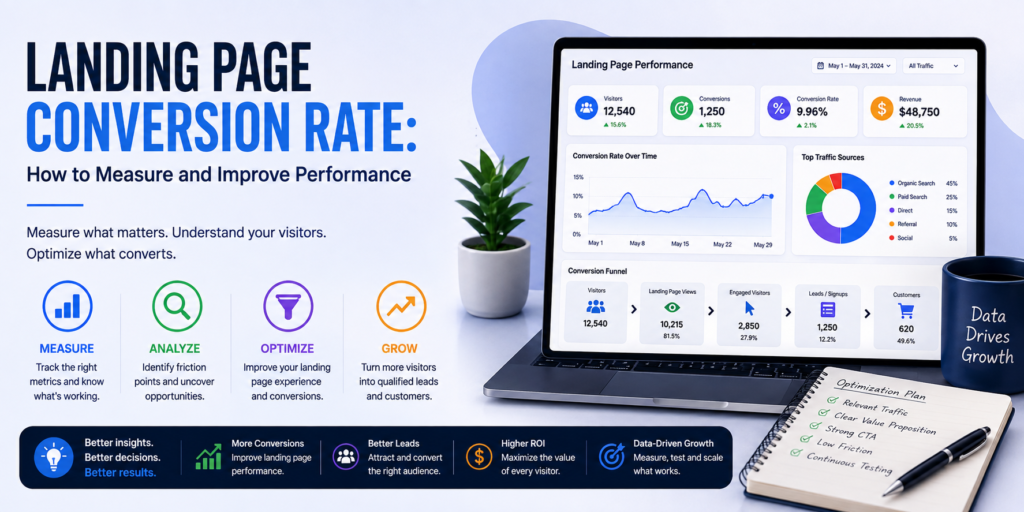
A landing page can attract thousands of visitors and still produce disappointing business results. The number of visitors alone does not tell you whether the page is working. What matters is how many relevant visitors take the intended action, what type of action they take, and whether those actions eventually create meaningful business value.
Landing page conversion rate provides one of the most useful ways to evaluate that performance. It shows the proportion of visitors who complete a defined conversion action after arriving on a landing page. However, the percentage itself is only the beginning. To understand whether a landing page is performing well, businesses also need to consider traffic source, visitor intent, offer complexity, conversion quality, device, customer value, and what happens after the initial conversion.
For example, a landing page generating a 10% conversion rate may appear stronger than one generating 5%. But if the 10% page produces poorly qualified enquiries while the 5% page generates high-value customers, the higher conversion rate may not represent better business performance.
This is why effective landing page measurement should focus on what the conversion means, not simply how often it happens.
In this guide, we’ll explain how to calculate landing page conversion rate, what benchmarks can and cannot tell you, which metrics matter, how traffic sources affect performance, how to identify conversion problems, and how to improve landing pages using evidence rather than assumptions.
Table of Contents
What Is Landing Page Conversion Rate?
Landing page conversion rate is the percentage of visitors who complete a defined action after arriving on a specific landing page.
Landing page conversion rate is one of the practical measurements within Conversion Rate Optimization, helping businesses understand how effectively a page turns relevant visitors into a defined action. Understanding the broader principles of Conversion Rate Optimization provides the foundation for interpreting landing page performance and deciding what should be improved.
That action could be submitting a lead form, requesting a quote, booking a consultation, making a purchase, registering for an event, starting a trial, downloading a resource, or completing another action that the business has defined as valuable.
The important point is that the conversion must be clearly defined before the rate can be interpreted.
Google’s documentation similarly explains conversion rate as the number of conversions divided by the relevant interactions, expressed as a percentage.
Why Conversion Rate Matters
A landing page conversion rate helps businesses understand whether a page is successfully turning relevant visitors into the intended next step.
For example, if 1,000 visitors produce 20 enquiries, the conversion rate is 2%. If the same number of visitors produces 50 enquiries, the conversion rate is 5%. Increasing the percentage can indicate that the landing page is becoming more effective at generating the desired action.
However, conversion rate should never be viewed in isolation.
A higher conversion rate can be valuable when it represents more qualified opportunities, customers, or revenue. But optimizing purely for the percentage can create the wrong incentives if the additional conversions have little commercial value.
That distinction becomes particularly important for B2B businesses and higher-value services, where lead quality can matter considerably more than lead volume.
Landing Page Conversion Rate Formula
The basic calculation is straightforward:
Landing Page Conversion Rate = Conversions ÷ Visitors × 100
For example, suppose a landing page receives 2,000 visitors during a month and generates 80 completed enquiries.
80 ÷ 2,000 × 100 = 4%
The landing page conversion rate is therefore 4%.
The same basic concept is used across established conversion measurement systems, although the exact denominator can vary depending on the platform and measurement configuration.
What Counts as a Landing Page Conversion?
Not every landing page has the same objective. A conversion should be defined according to what the business is trying to accomplish with that particular page.
| Landing Page Objective | Example Conversion | What It Indicates |
| Lead generation | Form submission | Visitor expressed interest |
| Qualified lead | Completed qualification | Stronger potential opportunity |
| Consultation | Meeting booked | Visitor entered the sales process |
| Purchase | Completed transaction | Direct commercial outcome |
| Registration | Event or demo signup | Visitor committed to the next step |
| Download | Resource download | Demonstrated interest |
| Trial | Trial started | Product or service consideration |
| Micro-conversion | CTA interaction | Supporting engagement signal |
The important distinction is between a conversion event and a business outcome. A visitor clicking a CTA is an interaction, while a qualified lead or completed purchase may represent a much more valuable outcome.
For this reason, businesses should establish a conversion hierarchy instead of treating every tracked action as equally important.
A useful measurement framework can distinguish between primary conversions that directly support business objectives and secondary actions that indicate progress toward those objectives.
What Is a Good Landing Page Conversion Rate?
This is one of the most common questions businesses ask—and one of the easiest questions to answer incorrectly.
There is no universal conversion rate that automatically means a landing page is performing well.
Current benchmark research from Unbounce provides useful context, but it also demonstrates why benchmarks need to be interpreted carefully. Its 2024 Conversion Benchmark Report analyzed more than 41,000 landing pages, 464 million visitors, and 57 million conversions, with a reported median conversion rate of 6.6% across industries.
That number can provide a reference point, but it should not become a target that every business blindly tries to reach.
Why There Is No Universal “Good” Conversion Rate
Conversion performance can vary significantly depending on the type of business, offer, audience, traffic source, visitor intent, device, price, sales cycle, conversion definition, and level of customer commitment.
For example, Unbounce’s benchmark data reports a median conversion rate of 6.1% for commercial and professional services, compared with a 6.6% overall median. This demonstrates why comparing a professional services landing page with an ecommerce promotion, free-trial signup, or low-commitment download can produce misleading conclusions.
“Not all conversions are created equal—and neither are conversion rates.”
A benchmark can tell you where your performance sits relative to a broader dataset, but it cannot tell you exactly what needs to change. That’s where landing page optimization becomes important: the goal is to understand the specific reasons visitors are converting or abandoning and then improve the experience accordingly.
Which Landing Page Metrics Should You Measure?
Landing page conversion rate is important, but it is only one part of the measurement picture. A page can generate conversions while still losing valuable opportunities through poor traffic quality, weak engagement, form abandonment, or low-quality leads.
The right measurement framework therefore looks at the complete journey rather than relying on one percentage.
| Metric | What It Measures | Why It Matters |
| Landing Page Conversion Rate | Percentage of visitors who convert | Shows how effectively the page generates the defined action |
| Conversion Volume | Number of conversions generated | Shows the total number of outcomes |
| Qualified Conversion Rate | Percentage of conversions meeting | Shows whether conversions are commercially relevant |
| Cost Per Conversion | Acquisition cost for each conversion | Helps evaluate efficiency |
| Cost Per Qualified Lead | Acquisition cost for qualified | Connects marketing spend with lead quality |
| Form Completion Rate | Visitors completing the form | Helps identify form friction |
| CTA Interaction Rate | Visitors interacting with the primary | Shows whether visitors are progressing toward action |
| Revenue Per Visitor | Revenue generated relative to visitors | Connects traffic with commercial value |
The value of these metrics comes from understanding how they relate to one another. A falling conversion rate may indicate a problem with the landing page, but it may also result from a change in traffic quality or visitor intent.
Similarly, an increasing conversion rate may appear positive while qualified lead volume remains unchanged. Looking at several related metrics makes it easier to understand what is actually happening.
Conversion Rate vs Conversion Volume
Conversion rate tells you the proportion of visitors who convert, while conversion volume tells you how many conversions the page actually produces.
Suppose one landing page receives 10,000 visitors and converts at 3%, generating 300 conversions. Another receives 1,000 visitors and converts at 8%, generating only 80 conversions.
The second page has the higher conversion rate, but the first generates more total conversions.
Neither metric is inherently more important. The appropriate measure depends on the business objective, traffic volume, acquisition cost, and value of each conversion.
Conversion Rate vs Conversion Quality
A landing page can increase its conversion rate without necessarily improving business performance.
Imagine a B2B landing page that changes its messaging and receives significantly more form submissions. If most of the additional enquiries come from people who cannot afford the service, are outside the target market, or have no genuine buying intent, the increase in conversion rate may create more work without creating more revenue.
This is why qualified conversion rate can be more useful than raw conversion rate for businesses with a sales-led customer journey.
The question should not simply be:
“How many visitors converted?”
It should also be:
“How many of those conversions became meaningful business opportunities?”
How Traffic Source Affects Landing Page Conversion Rate
A landing page does not exist independently from the traffic that reaches it. Visitors arriving through organic search may have very different expectations from visitors arriving through a paid advertisement, email campaign, referral, or direct visit.
This means conversion rates should often be analyzed by traffic source rather than combining every visitor into one number.
Organic Search Traffic
Organic visitors often arrive after actively searching for information, a product, service, or solution. Their level of intent can vary significantly depending on the query that brought them to the page.
A visitor searching for a specific commercial service may be much closer to taking action than someone searching for general educational information.
This is why search intent and landing-page experience need to work together.
Understanding the intent behind organic traffic is essential when evaluating landing page performance. Search Intelligence Infrastructure™ helps businesses align search visibility with the intent and expectations of the audiences they want to reach.
Paid Advertising Traffic
Paid traffic can be highly targeted, but its performance depends heavily on the relationship between the advertisement and the landing page.
When an advertisement promises one thing and the landing page communicates something different, visitors may leave before converting.
This connection between acquisition messaging and landing-page experience is particularly important within a Performance Marketing System™, where campaign performance depends not only on generating clicks but also on what happens after those clicks.
Referral and Direct Traffic
Referral and direct visitors can represent a mixture of existing awareness, recommendations, repeat visits, brand familiarity, and other forms of intent.
Because the reason behind the visit may not always be immediately visible, these visitors should be analyzed according to their behaviour and eventual outcomes rather than automatically assumed to have high or low intent.
Why a Landing Page Conversion Rate Can Fall
A declining conversion rate does not automatically mean that the landing page itself has become worse.
Several changes can influence the number and quality of conversions generated by the same page.
Changes in Traffic Quality
If a business expands advertising, changes targeting, launches a new campaign, or begins ranking for broader search terms, the visitor mix may change.
The landing page may remain exactly the same while conversion performance declines because the new visitors are less aligned with the offer.
This is why traffic source and visitor intent should be analyzed before making significant landing-page changes.
Changes in the Offer
A change in pricing, packaging, availability, positioning, guarantees, delivery timelines, or other aspects of the offer can affect conversion behaviour.
Visitors may respond differently to the same landing page when the underlying proposition changes.
In these situations, changing the page design without examining the offer itself may address the wrong problem.
Increased Friction
Conversion can also decline when visitors encounter unnecessary difficulty during the journey.
A complicated form, unclear CTA, slow page, broken integration, confusing navigation, missing information, or unexpected step can interrupt the path between interest and action.
The first task is therefore to identify where the friction occurs before deciding what should be changed.
How to Diagnose a Low Landing Page Conversion Rate
A low conversion rate should be treated as a signal that something deserves investigation rather than as proof that one particular page element is responsible.
A useful diagnostic process begins by examining the traffic entering the page, then the message and offer, followed by the page experience, conversion mechanism, technical implementation, and downstream outcome.
| Diagnostic Area | Key Question |
| Traffic | Are the right visitors reaching the page? |
| Intent | Does the page match why they arrived? |
| Message | Is the value proposition immediately clear? |
| Offer | Is the proposition compelling and relevant? |
| Trust | Is there enough evidence to reduce uncertainty? |
| UX | Can visitors easily understand and navigate the page? |
| CTA | Is the next step obvious and appropriate? |
| Form | Is the conversion process creating unnecessary friction? |
| Technology | Are speed, integrations and functionality working correctly? |
| Outcome | Are conversions becoming meaningful business results? |
This framework prevents teams from jumping immediately to cosmetic changes. Website Analytics and Conversion Tracking can provide the evidence needed to identify where visitors are progressing, where they are dropping out, and which conversion actions are actually being completed.
For example, if qualified traffic is arriving but visitors are leaving before interacting with the CTA, the investigation may need to focus on messaging, offer clarity, trust, or page structure.
If visitors are interacting with the CTA but abandoning the form, the problem may be closer to the conversion mechanism itself.
If conversions are increasing but qualified opportunities are not, the issue may be related to targeting or offer positioning rather than the landing page’s visual design.
How to Improve Landing Page Conversion Rate
Once the underlying problem has been identified, optimization should focus on the part of the experience most likely to influence the outcome. There is no universal change that improves every landing page because the cause of weak performance can differ from one business, audience, and traffic source to another.
The strongest approach is to connect each improvement to a specific observation or hypothesis rather than making multiple unrelated changes at the same time.
Improve Message Match
The first question is whether the landing page delivers what the visitor expected when they arrived.
If someone clicks an advertisement promising a specific service, offer, price, or outcome, the landing page should make that same proposition immediately recognizable. Likewise, an organic visitor should find an experience that addresses the intent behind the search rather than simply repeating the keyword.
Better message alignment can reduce confusion and help visitors quickly determine whether the page is relevant to them.
Strengthen the Value Proposition
If visitors understand what the page is about but still have little reason to continue, the value proposition may need improvement.
A stronger value proposition connects the offer with a meaningful customer problem, desired outcome, or differentiator. It should help the visitor understand not only what the business provides but why the solution deserves consideration.
The objective is not to make the claim more dramatic. It is to make the value more relevant and easier to understand.
Strengthen Trust at the Right Moment
Visitors may hesitate because they are uncertain whether the business can deliver what it promises.
Relevant case studies, testimonials, customer evidence, credentials, transparent processes, guarantees where appropriate, and clear information about what happens next can help reduce that uncertainty.
The placement of proof also matters. Evidence is often most useful near the point where a visitor is making a decision or expressing hesitation rather than being isolated in a separate section that visitors may never reach.
Improve the Primary Call to Action
The primary CTA should make the intended next step clear.
A visitor should be able to understand what happens when they click and what level of commitment is involved. “Request a consultation,” “Get a quote,” “Book a demo,” and “Start your trial” communicate different expectations from a generic “Submit” button.
The CTA should also match the visitor’s intent. Asking an early-stage visitor to make a high-commitment decision can create unnecessary resistance, while giving a high-intent visitor an overly complicated path can create frustration.
Reduce Form Friction
If visitors are reaching the form but failing to complete it, the form itself deserves investigation.
The number of fields, required information, error messages, validation behaviour, mobile usability, privacy expectations, and clarity about what happens after submission can all influence completion.
The objective should not simply be to make every form shorter. A B2B consultation may legitimately require more information than a newsletter signup. The right question is whether every requested piece of information is justified by the value of the next step.
Test Landing Page Changes Systematically
Optimization becomes more useful when changes are treated as experiments or evidence-based improvements rather than subjective design decisions.
Start With a Specific Hypothesis
A useful hypothesis connects an observed problem with a proposed explanation and expected outcome.
For example:
If we make the post-submission process clearer, more qualified visitors who currently hesitate at the form should complete it because uncertainty about what happens next will be reduced.
This is more useful than simply deciding that “the form needs to look better.”
The hypothesis gives the team something specific to investigate and measure.
Change One Meaningful Variable at a Time
Testing too many unrelated changes simultaneously can make it difficult to understand what influenced the outcome.
If a business changes the headline, offer, CTA, form, page structure, imagery, and pricing at the same time, an improvement or decline may be visible without revealing which change caused it.
The appropriate testing approach depends on traffic volume, conversion volume, the size of the expected effect, and the importance of the decision.
Not every landing page has enough traffic to support a reliable A/B experiment. In those situations, qualitative research, usability testing, customer feedback, and behavioural analysis can still provide valuable evidence.
Measure the Outcome That Actually Matters
A landing page test should be evaluated against the business outcome it is intended to improve.
If the objective is qualified lead generation, an increase in form submissions alone may not be enough. If the objective is ecommerce revenue, a higher checkout completion rate may still be insufficient if average order value or profitability declines.
The measurement framework should therefore follow the customer journey beyond the initial click or form submission wherever the business has the data to do so.
Landing Page Performance Is Part of a Larger Conversion System
A landing page rarely operates alone. Its performance is influenced by the traffic entering the page, the website infrastructure delivering the experience, the content supporting the decision, the conversion mechanism itself, and the processes that follow the conversion.
Connect Traffic With Experience
Search and paid acquisition can bring relevant visitors to a landing page, but acquisition success does not end when someone clicks.
The landing page needs to continue the promise established by the acquisition channel and provide an experience appropriate to the visitor’s intent.
This is why conversion performance should be evaluated across the journey rather than treating traffic generation and landing-page optimization as completely separate activities.
Connect the Website Foundation With Conversion
Landing page performance can also be affected by technical factors such as page speed, mobile responsiveness, forms, integrations, analytics implementation, and reliability.
A visually strong landing page cannot compensate for a broken form or an unreliable booking process.
This is where Revenue-Focused Web Infrastructure™ becomes relevant. The website needs to provide the technical foundation through which the conversion experience is delivered.
Connect Content With Conversion
Content can influence whether visitors understand an offer, trust a business, overcome objections, and feel ready to act.
A landing page therefore needs more than persuasive copy. It needs the right information for the visitor’s decision stage.
This creates a natural relationship between conversion and AI Content & Authority Systems™, where content can support relevance, authority, trust, and the broader journey from discovery to decision.
Connect Conversion With What Happens Next
A conversion should not necessarily be treated as the end of the journey.
A submitted enquiry may need qualification, routing, follow-up, scheduling, or sales engagement. A purchase may trigger fulfilment, support, retention, or additional communication.
When these processes are connected, the business can evaluate whether the landing page is generating genuinely valuable outcomes rather than simply increasing the number of completed actions.
This creates a natural connection with AI Automation Infrastructure™, particularly where automated workflows can support lead handling, communication, routing, or post-conversion processes.
Landing Page Conversion Rate Within Conversion Architecture System™
Landing page conversion rate is ultimately one measurement within a much larger system.
A business may improve traffic quality through Search Intelligence Infrastructure™, generate targeted paid demand through Performance Marketing System™, provide the technical foundation through Revenue-Focused Web Infrastructure™, strengthen authority through AI Content & Authority Systems™, and support post-conversion processes through AI Automation Infrastructure™.
Conversion Architecture System™ brings these elements together around the customer journey.
The objective is not simply to produce a higher landing page conversion rate. It is to create a system where relevant visitors can move from intent to understanding, from understanding to confidence, and from confidence to meaningful action.
That distinction is important because the best conversion rate is not necessarily the highest possible percentage.
It is the conversion performance that produces the right outcomes for the business.
Frequently Asked Questions About Landing Page Conversion Rate
What is landing page conversion rate?
Landing page conversion rate is the percentage of visitors who complete a predefined conversion action after arriving on a landing page. The action could be submitting a form, making a purchase, booking a consultation, registering for an event, or completing another business-defined objective.
How do you calculate landing page conversion rate?
The basic formula is conversions divided by visitors multiplied by 100. For example, if 50 visitors convert from 1,000 landing page visitors, the conversion rate is 5%.
What is a good landing page conversion rate?
There is no single conversion rate that represents success for every landing page. Performance depends on factors such as industry, traffic source, visitor intent, offer, price, audience, conversion definition, and sales cycle. Benchmarks can provide context, but a business should also compare performance against its own historical results and commercial outcomes.
Why is my landing page conversion rate low?
A low conversion rate can result from several factors, including poor traffic quality, weak message alignment, unclear value propositions, insufficient trust, confusing page structure, friction in forms or checkout, technical problems, or an offer that does not match visitor expectations. The first step should be diagnosing where the problem occurs rather than immediately changing the page design.
Should I focus on conversion rate or conversion volume?
Both can be useful, but neither should be evaluated without considering business value. Conversion rate shows efficiency relative to visitor volume, while conversion volume shows the total number of actions generated. The more important question is whether those conversions represent qualified opportunities, customers, revenue, or another meaningful outcome.
Can a higher conversion rate be bad for a business?
Yes. A landing page can generate more conversions while producing lower-quality leads or less valuable customers. For this reason, businesses should consider qualified conversion rate, customer value, revenue, and downstream outcomes alongside the headline conversion percentage.
Should I compare my landing page conversion rate with industry benchmarks?
Benchmarks can provide useful context, but they should not be treated as universal targets. Differences in traffic source, audience, offer, conversion definition, and business model can make direct comparisons misleading. Internal trends and commercial outcomes should remain important parts of the evaluation.
How often should I optimize a landing page?
There is no fixed schedule that applies to every landing page. Optimization should be driven by meaningful data, changes in traffic or business objectives, new customer insights, and identified opportunities. A continuously measured page can be improved as new evidence becomes available.
Does landing page speed affect conversion rate?
Yes, technical performance can influence the visitor experience. Slow loading, delayed interactions, broken forms, or unreliable functionality can create friction before visitors complete the intended action. Performance should therefore be considered alongside messaging, UX, and conversion design.
Do different traffic sources need different landing pages?
They can. Visitors arriving from organic search, paid advertising, email, referrals, or other sources may have different expectations and levels of intent. Dedicated landing experiences can make the message more relevant when the differences between audiences or acquisition contexts are significant.
Does every landing page need A/B testing?
No. A/B testing can be useful when a page has sufficient traffic and conversion volume, but it is not appropriate for every situation. Analytics, usability research, customer feedback, qualitative analysis, and other evidence can also help identify opportunities for improvement.
Conclusion
Landing page conversion rate is a useful measurement, but the percentage alone does not tell the complete story.
A landing page should be evaluated based on who is visiting, why they arrived, what the page promises, whether the experience builds confidence, how easily visitors can act, and what happens after the conversion.
This is why a 10% conversion rate is not automatically better than a 5% conversion rate. If the 5% landing page generates significantly more qualified opportunities, customers, or revenue, it may be delivering considerably more value to the business.
Effective optimization therefore combines measurement with context. Businesses need to understand not only what happened but also why it happened and whether the resulting behaviour contributes to the larger customer journey.
When landing page data is connected with acquisition, website infrastructure, content, conversion experience, analytics, and post-conversion processes, optimization becomes much more than improving a percentage.
It becomes a structured way to improve how the business turns relevant attention into meaningful outcomes.
Build a Conversion System, Not Just a Higher Conversion Rate
A landing page should not exist simply to achieve a better number in an analytics dashboard. It should help the right visitor understand the right offer, build enough confidence to take action, and move into the next stage of the customer journey.
Mavenify’s Conversion Architecture System™ approaches this as a connected system, bringing together visitor intent, acquisition, messaging, website infrastructure, content, user experience, conversion paths, measurement, and post-conversion processes.
The objective is not to chase the highest possible conversion percentage.
The objective is to create more meaningful business outcomes from the right visitors.