
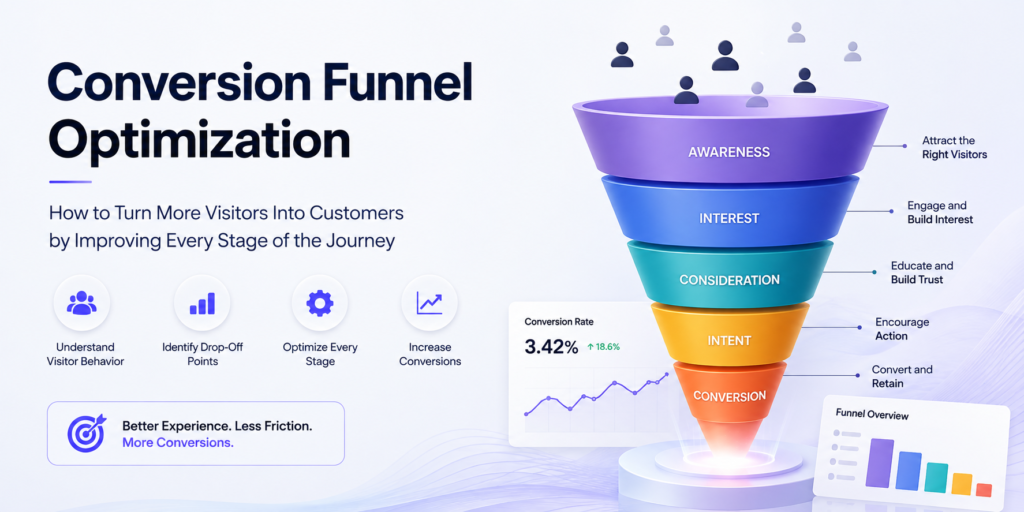
Getting more visitors to a website does not automatically mean getting more customers. A business can attract relevant traffic, generate engagement, and still lose potential customers at several points before the final conversion.
Conversion funnel optimization focuses on understanding those points of loss and improving the journey so that more of the right visitors progress toward a meaningful action.
A conversion funnel is not simply a diagram showing people moving from awareness to purchase. Modern customer journeys are often less linear, with visitors researching, comparing, returning to earlier pages, and interacting with a business across multiple channels before making a decision.
That means optimizing a funnel requires more than changing a button or increasing a landing-page conversion rate. Businesses need to understand what visitors expect at each stage, what information they need, where uncertainty appears, and what prevents them from taking the next step.
The goal is not to force every visitor toward a conversion. It is to create a clearer, more relevant journey for visitors who are genuinely capable of becoming customers.
In this guide, we’ll explain how conversion funnels work, how to identify funnel leaks, what to measure at each stage, how to prioritize optimization opportunities, and how the complete funnel fits into Mavenify’s Conversion Architecture System™.
Table of Contents
What Is Conversion Funnel Optimization?
Conversion funnel optimization is the process of analyzing and improving the different stages a visitor moves through before completing a desired action.
That action could be submitting an enquiry, booking a consultation, requesting a quote, starting a trial, purchasing a product, or completing another meaningful business objective.
The key difference between funnel optimization and simply improving a single conversion page is scope. A page can perform well on its own while the broader journey still contains significant friction. Conversion Rate Optimization provides the broader framework for improving the experiences and interactions that influence whether visitors take meaningful action.
For example, a landing page might generate enquiries effectively, but if those enquiries are poorly qualified, the problem could exist earlier in the funnel. Similarly, a website might attract highly relevant visitors but lose them because the information needed to evaluate the offer is difficult to find.
Funnel optimization therefore looks at the relationship between stages rather than treating every page or interaction as an isolated asset.
Why Conversion Funnel Optimization Matters
A funnel makes it easier to see what happens between initial interest and the final business outcome.
Without this perspective, businesses often respond to weak performance by simply trying to generate more traffic. More traffic can help when acquisition is the problem, but it cannot solve a conversion problem that already exists further down the journey.
Imagine a business doubles its website traffic but the percentage of visitors who become qualified leads falls significantly. The business may appear to be growing at the traffic level while the actual commercial outcome remains unchanged.
Funnel analysis helps expose this kind of situation by examining how visitors progress through the journey and where meaningful drop-offs occur.
The result is a more useful question than simply asking whether traffic or conversions increased:
Where is the customer journey working, and where is it losing valuable opportunities?
What Are the Stages of a Conversion Funnel?
There is no single funnel structure that applies to every business. A high-value B2B service may involve multiple research and evaluation stages, while a simple ecommerce purchase may require far fewer interactions.
A practical framework can nevertheless help businesses understand the different types of decisions visitors make as they progress.
| Funnel Stage | Visitor’s Main Question | Business’s Main Objective |
| Awareness | What is this and does it relate to my problem? | Establish relevance |
| Interest | Could this solution help me? | Build engagement |
| Evaluation | Is this the right solution for me? | Build confidence |
| Intent | Am I ready to take the next step? | Remove uncertainty |
| Conversion | Should I complete the action? | Make conversion easy |
| Post-conversion | What happens now? | Deliver value and continue the relationship |
These stages should not be interpreted as a perfectly straight line. Visitors may move backward, revisit earlier information, compare alternatives, or leave and return later. Modern digital journeys increasingly involve these loops rather than a simple one-directional progression.
The value of the funnel is therefore not in forcing visitors through a predetermined sequence. It is in helping the business understand what visitors need at different points in their decision-making process.
How Visitors Move Through a Modern Conversion Funnel
The journey often begins before a visitor reaches the website.
A person may discover a business through search, an advertisement, a recommendation, social media, an email, an AI-generated answer, or another channel. Each source creates a certain expectation about what the visitor will find next.
When the website experience matches that expectation, the transition can feel natural. When it does not, the visitor may leave before understanding the offer.
Once visitors arrive, their behaviour depends on their intent. Some may immediately understand the solution and look for a way to take action. Others may need to compare options, understand pricing, evaluate credibility, read supporting content, or discuss the decision internally.
This is particularly important for considered purchases, where the visitor may interact with a business several times before becoming a customer.
A strong conversion funnel therefore supports different levels of readiness rather than assuming every visitor is ready to convert immediately.
Awareness Is About Relevance
At the awareness stage, visitors are often trying to understand a problem, opportunity, category, or possible solution.
The objective at this stage is not necessarily to push for an immediate conversion. It is to establish relevance and give the visitor a reason to continue exploring.
For search-driven visitors, this means the content and page experience should reflect the intent behind the query. For paid traffic, the landing experience should deliver on the promise made by the advertisement.
This is where the quality of incoming traffic becomes important. A conversion problem may sometimes be an acquisition problem in disguise.
Evaluation Is About Confidence
Once visitors understand that a solution may be relevant, they begin evaluating whether it is right for them.
This is where value propositions, benefits, evidence, comparisons, case studies, FAQs, pricing information, technical details, and other decision-supporting content can become important.
The exact information required depends on the complexity and risk of the decision.
A visitor considering a simple purchase may need only a small amount of additional information. Someone evaluating a significant business service may need considerably more evidence before taking the next step.
The funnel should therefore provide enough information for the decision, rather than simply trying to make the page shorter.
Conversion Is About Reducing Uncertainty
When visitors reach the point of intent, unnecessary friction can become particularly costly.
They may already understand the offer and believe it could solve their problem, but still hesitate because they are uncertain about price, process, commitment, implementation, timing, privacy, or what happens after they submit their information.
The conversion experience should address the questions that matter most at that moment.
A clear CTA, appropriate form, transparent next step, relevant proof, and predictable post-conversion experience can all help reduce unnecessary uncertainty.
Where Do Conversion Funnels Lose Potential Customers?
Every conversion funnel has points where visitors stop progressing. The challenge is not simply identifying that people are leaving; it is understanding why they are leaving and whether that drop-off represents a genuine business problem.
A visitor who leaves an educational article may not be a lost opportunity at all. They may have found exactly what they needed and simply not been ready to take a commercial action. By contrast, a visitor who reaches a pricing page, opens a consultation form, and then abandons it may represent a much stronger optimization opportunity.
This is why funnel optimization should distinguish between normal visitor behaviour and meaningful conversion friction.
Identify the Stage Where Drop-Off Happens
The first step is to understand how visitors progress between meaningful stages of the journey.
For example, a business might discover that a large percentage of visitors reach its service page but relatively few move to the consultation page. Another business may find that visitors regularly begin a form but abandon it before submission.
These patterns point toward different potential problems and therefore require different investigations.
A useful funnel analysis should answer three questions:
Where are visitors dropping out?
How significant is that drop-off?
What happens to the visitors who continue?
The third question is particularly important because the highest-volume drop-off is not necessarily the most valuable opportunity to fix.
Look Beyond the Overall Conversion Rate
An overall conversion rate can hide important differences between stages.
Imagine a website receives 10,000 visitors and generates 300 enquiries. A 3% overall conversion rate tells you something useful, but it does not explain how visitors reached those enquiries or where the remaining 9,700 visitors left the journey.
Breaking the experience into meaningful stages can reveal a much clearer picture.
| Funnel Transition | Visitors Starting Stage | Visitors Continuing | What It Can Reveal |
| Landing page → Service page | 10,000 | 4,000 | Relevance and engagement |
| Service page → CTA | 4,000 | 900 | Value and decision readiness |
| CTA → Form start | 900 | 650 | CTA effectiveness |
| Form start → Submission | 650 | 300 | Form friction |
| Submission → Qualified lead | 300 | 120 | Lead quality |
| Qualified lead → Customer | 120 | 35 | Sales and commercial fit |
The numbers above are illustrative rather than benchmarks. Their purpose is to show how a funnel can reveal where the journey changes most significantly, rather than relying on a single final percentage.
Not Every Drop-Off Needs to Be Fixed
A common mistake is assuming that every visitor who leaves represents a failed conversion opportunity.
People enter websites with different levels of intent. Some are researching, some are comparing alternatives, some are looking for immediate help, and others may simply be gathering information.
Trying to force all of them through the same conversion path can actually make the experience worse.
The goal of funnel optimization is therefore not to eliminate every drop-off. It is to reduce unnecessary drop-off among visitors who have a realistic likelihood of progressing.
That distinction helps businesses prioritize changes based on commercial value rather than vanity metrics.
How to Measure Conversion Funnel Performance
Once the stages have been defined, the next step is to establish how performance will be measured.
The most useful metrics depend on the business model and conversion objective, but the underlying principle remains the same: measure not only what happens at the end of the funnel, but how visitors progress through it.
A lead-generation business might measure the movement from visitor to enquiry, qualified lead, sales opportunity, and customer. An ecommerce business may instead examine product engagement, cart activity, checkout progression, purchase completion, and revenue.
The measurement framework should reflect the actual journey rather than forcing every business into the same funnel model.
Connect Funnel Measurement With Website Analytics
Website Analytics and Conversion Tracking provides the measurement foundation for understanding how visitors behave across the funnel. Instead of looking only at total sessions or final conversions, businesses can examine how visitors interact with important pages, CTAs, forms, navigation paths, and conversion events.
Rather than looking only at total sessions or final conversions, businesses can examine how visitors interact with important pages, CTAs, forms, navigation paths, and conversion events.
This makes it possible to identify patterns that would otherwise remain hidden inside an overall conversion rate.
Measure Conversion Quality, Not Just Conversion Quantity
A funnel can appear healthy when measured by the number of conversions while producing disappointing commercial results.
For example, increasing form submissions from 100 to 150 may appear to be an improvement. But if the additional 50 enquiries are poorly qualified, the sales team may spend more time processing leads without generating additional customers.
For businesses with longer sales cycles, it can therefore be useful to measure the progression from initial conversion to qualified opportunity and eventually to revenue.
This creates a more complete picture of whether funnel optimization is actually improving business performance.
Compare Funnel Performance by Traffic Source
Visitors arriving through organic search, paid advertising, referrals, email, social media, or direct traffic may have very different expectations and levels of intent.
Combining all of these visitors into one funnel can hide important differences.
For example, paid traffic may produce strong initial engagement but weaker qualification, while highly specific organic search traffic may produce fewer visitors but a greater proportion of qualified enquiries.
Segmenting funnel performance by meaningful traffic source can therefore reveal whether the problem exists within acquisition, the website experience, or the transition between the two.
This is also why Search Intelligence Infrastructure™ and Performance Marketing System™ can influence conversion performance even though they operate earlier in the customer journey.
How to Optimize Each Stage of the Conversion Funnel
Once the funnel has been measured and the major points of friction have been identified, optimization should focus on the specific stage where visitors are struggling.
The goal is not to make every stage convert as aggressively as possible. Each stage has a different purpose, and trying to force an immediate conversion too early can damage the overall experience.
Improve the First Experience
The beginning of the funnel needs to establish relevance quickly.
When visitors arrive from search, advertising, referrals, or another channel, they should be able to understand what the page is about and why it relates to their needs.
The message should also be consistent with the expectation created before the visitor arrived. If an advertisement promotes a specific service but the landing page opens with a generic company message, the visitor may question whether they have reached the right destination.
This is particularly important when traffic comes from multiple acquisition channels because each source can create a different level of intent.
Make the Value Proposition Clear
Once relevance has been established, visitors need a reason to continue.
A strong value proposition explains the problem being addressed, the outcome the visitor can expect, and why the proposed solution deserves consideration.
The most effective value proposition is not necessarily the most elaborate. It is the one that makes the connection between the visitor’s situation and the offer easiest to understand.
If visitors cannot quickly determine what makes the solution useful or different, they may leave before reaching the evaluation stage.
Give Visitors Enough Information to Evaluate the Offer
Visitors who are considering a significant purchase often need more than a headline and CTA.
They may want to understand how the solution works, what is included, who it is designed for, what results may be expected, how implementation works, and what happens after they take the next step.
The amount of information required depends on the complexity of the decision. A simple transaction may require very little explanation, while a high-value B2B service can require substantial evidence before a visitor feels comfortable moving forward.
The objective is not to make the funnel as short as possible. It is to make the decision easier.
Build Trust Before Asking for Commitment
Trust becomes increasingly important as the visitor approaches a meaningful action.
Case studies, testimonials, customer examples, transparent processes, relevant credentials, clear pricing information, guarantees where appropriate, and answers to common objections can all reduce uncertainty.
The strongest trust signals are usually connected to the specific concern the visitor is experiencing.
For example, a case study may help demonstrate capability, while a transparent explanation of the implementation process may reduce concerns about what happens after purchase.
Reduce Friction at the Conversion Point
When visitors are ready to act, unnecessary friction can prevent them from completing the journey.
A complicated form, unclear CTA, unexpected requirement, slow-loading page, confusing checkout, or lack of information about what happens next can all create resistance.
The conversion experience should therefore make the next step obvious and predictable.
The right level of friction depends on the value of the conversion. A high-value consultation may reasonably require qualification information that would be unnecessary for a newsletter signup.
The objective is not zero friction.
It is appropriate friction for the value and purpose of the conversion.
Conversion Funnel Optimization Requires More Than Website Changes
A common mistake is assuming that every funnel problem should be solved by changing the website.
Sometimes the website is working exactly as intended, but the traffic entering the funnel is poorly matched to the offer.
In other situations, the traffic is highly relevant but the offer itself is weak, unclear, poorly positioned, or difficult to justify.
There can also be problems after the conversion. A business may generate plenty of enquiries but fail to respond quickly, qualify opportunities effectively, or provide a consistent follow-up experience.
This means funnel optimization needs to consider the entire system surrounding the conversion, not just the visible webpage.
Align Acquisition With Conversion
The quality of traffic entering the funnel has a direct influence on what happens later.
If visitors arrive with low relevance or weak intent, improving the final conversion step may have limited impact. Conversely, highly relevant traffic can still be lost if the website experience does not meet the expectations created by the acquisition channel.
This is why acquisition and conversion should be evaluated together.
For search-driven acquisition, understanding search intent helps businesses attract visitors who are more likely to find the offer relevant.
For paid acquisition, campaign targeting, advertisement messaging, landing-page experience, and conversion outcomes need to work together.
Connect the Website Experience With Revenue
The website is often the environment where visitors evaluate the business and decide whether to move forward.
That makes website architecture, performance, integrations, analytics, content delivery, forms, and other technical components part of the conversion experience.
A funnel cannot perform consistently if the website underneath it is slow, difficult to use, unreliable, or disconnected from the systems responsible for handling conversions.
This is where Revenue-Focused Web Infrastructure™ becomes relevant: the website should provide the technical and structural foundation required to support the customer journey and the business outcomes behind it.
Connect Content With the Decision Journey
Content can support different stages of the funnel.
Educational content can help visitors understand a problem. Service content can explain a solution. Case studies can provide evidence. FAQs can address objections. Comparison content can help visitors evaluate alternatives.
The important consideration is not simply how much content exists, but whether the right information is available when the visitor needs it.
This creates a natural relationship between conversion architecture and AI Content & Authority Systems™, where content can contribute to visibility, authority, trust, and decision-making across the customer journey.
Automate What Happens After Conversion
The funnel does not necessarily end when someone submits a form or completes a purchase.
A lead may need to be routed to the right person, qualified, contacted, scheduled, or entered into a follow-up process. A customer may need onboarding, communication, support, or additional information.
When these processes are handled consistently, the business can reduce the gap between conversion and the next stage of the customer relationship.
This is where AI Automation Infrastructure™ can extend the conversion system beyond the initial action and help businesses manage repetitive processes more efficiently.
How to Prioritize Conversion Funnel Optimization
Not every funnel problem deserves the same amount of attention. A business may identify several points where visitors drop out, but optimizing everything simultaneously can make the process expensive, confusing, and difficult to measure.
A better approach is to prioritize opportunities based on the size of the problem, the quality of the affected traffic, the potential business impact, and how realistically the issue can be improved.
As Shopify explains, effective funnel analysis is designed to identify where visitors drop off and use that information to prioritize improvements rather than relying on guesswork.
“Identify your largest holes.”
Focus on High-Value Friction
A small drop-off at an important commercial stage can sometimes be more valuable to address than a much larger drop-off at an early awareness stage.
For example, improving the percentage of highly qualified visitors who complete a consultation request may create more commercial value than increasing engagement on a general informational page.
This is why funnel optimization should combine behavioural data with business context.
The question is not simply:
“Where do we lose the most visitors?”
It is:
“Where are we losing the most valuable opportunities?”
Consider Impact, Confidence and Effort
A practical prioritization framework can compare potential improvements according to their expected impact, the evidence supporting the proposed change, and the effort required to implement it.
| Factor | Question |
| Impact | How much could this change improve meaningful outcomes? |
| Evidence | How confident are we that this is actually a problem? |
| Effort | How difficult or expensive is the change? |
| Reach | How many relevant visitors will it affect? |
| Business Value | How valuable are the conversions influenced by the change? |
A change that affects thousands of highly relevant visitors and requires relatively little implementation effort may deserve priority over a complex redesign that affects very few people.
This approach also helps prevent teams from spending excessive time on changes that look impressive but have little measurable business impact.
Test Changes Instead of Relying on Assumptions
Once an opportunity has been prioritized, the next step is to determine whether the proposed change actually improves the funnel.
A business might believe that a weak CTA is responsible for a drop-off, but the data may eventually show that visitors are actually leaving because they do not understand the offer.
This is why optimization should begin with a hypothesis, not a preference.
A useful hypothesis connects an observed behaviour with a possible reason and a measurable expected outcome.
If we make the consultation process clearer and explain what happens after submission, more qualified visitors should complete the form because uncertainty around the next step will be reduced.
The change can then be evaluated against the relevant conversion outcome.
Don’t Test for the Sake of Testing
Testing is valuable when it helps answer an important business question.
Changing button colours, headlines, images, or layouts simply because a different version looks better to the internal team does not necessarily constitute meaningful optimization.
A stronger process starts with evidence, identifies a specific problem, proposes a change, and measures the resulting behaviour.
Not every business will have enough traffic or conversion volume for a reliable A/B test. In those situations, customer feedback, usability research, analytics, sales conversations, and other qualitative evidence can still provide valuable insight.
The method should match the question being investigated.
Conversion Funnel Optimization Is an Ongoing Process
A funnel should not be treated as a project that is optimized once and then forgotten.
Visitor behaviour can change as audiences evolve, acquisition channels change, offers are updated, competitors enter the market, technology changes, and customer expectations develop.
A page that performs well today may encounter new friction later because the context around it has changed.
Continuous measurement allows businesses to identify these changes earlier and investigate them before they become larger problems.
This does not mean constantly redesigning the website. It means maintaining a structured process for understanding performance and making improvements when the evidence supports them.
How Conversion Funnel Optimization Fits Into a Growth System
A conversion funnel does not operate independently from the rest of the digital ecosystem.
The quality of visitors entering the funnel influences what happens inside it. The website infrastructure determines how reliably the experience is delivered. Content helps visitors understand and evaluate the offer. Analytics provides evidence about what visitors are doing. Automation can determine how efficiently the business responds after a conversion.
This makes conversion funnel optimization a natural part of a broader growth system rather than a standalone website activity.
From Discovery to Conversion
A visitor might discover a business through search, encounter it through advertising, read supporting content, visit the website, evaluate a service, submit an enquiry, and eventually become a customer.
Each stage can involve a different system, but the visitor experiences the journey as one connected process.
That is why businesses can create stronger results when acquisition, website experience, content, conversion, measurement, and follow-up are designed to work together rather than optimized independently.
Conversion Architecture System™
Mavenify’s Conversion Architecture System™ approaches this journey as a connected conversion environment.
The focus is not simply on increasing the number of people who click a button or submit a form. It is on understanding the complete path from visitor intent to meaningful business action and improving the points where unnecessary friction prevents that progression.
That can involve the messaging visitors encounter, the structure of the website, the information available during evaluation, the conversion mechanism itself, the measurement infrastructure, and what happens after the conversion.
Frequently Asked Questions About Conversion Funnel Optimization
What is conversion funnel optimization?
Conversion funnel optimization is the process of analyzing and improving the stages visitors move through before completing a desired action. It focuses on identifying unnecessary drop-offs and improving the journey for visitors who have a realistic likelihood of converting.
What is the difference between a conversion funnel and a marketing funnel?
A marketing funnel generally focuses on how people move from awareness toward consideration and demand, while a conversion funnel focuses more specifically on how visitors progress toward a defined action. The two can overlap, but they answer different questions about the customer journey.
How do I know where my conversion funnel is losing customers?
Start by defining the meaningful stages of the journey and measuring how visitors progress between them. Analytics, conversion tracking, form data, customer feedback, and sales information can then help identify significant drop-offs and investigate their likely causes.
Should every drop-off in a funnel be fixed?
No. Some visitors naturally leave because they are researching, comparing options, or simply not ready to take action. The objective is to identify unnecessary drop-off among visitors who are genuinely relevant and likely to progress.
What is the most important conversion funnel metric?
There is no single metric that applies to every business. Overall conversion rate can be useful, but stage-to-stage progression, qualified conversions, revenue, and downstream customer outcomes may provide much more meaningful insight depending on the business model.
Can more website traffic fix a weak conversion funnel?
More relevant traffic can increase the number of conversions, but additional traffic does not automatically solve problems within the funnel. If visitors are encountering friction after arriving, increasing traffic may simply send more people into the same inefficient experience.
How often should a conversion funnel be optimized?
There is no universal schedule. Funnel optimization should respond to meaningful changes in visitor behaviour, business objectives, traffic sources, customer expectations, and measurable performance. Continuous monitoring combined with periodic analysis is generally more useful than making arbitrary changes on a fixed schedule.
Does conversion funnel optimization only apply to ecommerce?
No. Conversion funnels can be useful for ecommerce, B2B services, SaaS businesses, professional services, local businesses, education, healthcare, and many other models. The stages and conversion objectives simply need to reflect the way customers make decisions in that particular business.
Conclusion
A conversion funnel is ultimately a way of understanding how attention becomes action.
The strongest funnel optimization strategies do not focus on forcing every visitor toward the same outcome. They identify the people who are genuinely relevant, understand what they need at each stage, remove unnecessary friction, and create a clearer path toward the action that matters.
That requires more than improving a single landing page or increasing a single conversion percentage.
It requires looking at the relationship between acquisition, website experience, content, trust, conversion mechanisms, measurement, and what happens after someone takes action.
When those elements work together, businesses can make better use of the traffic and opportunities they are already generating instead of relying entirely on acquiring more visitors.
The goal of conversion funnel optimization is not simply to get more people through the funnel. It is to help more of the right people move through it successfully.
Turn Your Customer Journey Into a Better Conversion System
If your website attracts visitors but too many relevant prospects disappear before becoming customers, the problem may not be traffic alone. There may be friction somewhere between the first interaction and the final decision.
Mavenify’s Conversion Architecture System™ helps businesses examine that journey as a connected system, identify where meaningful opportunities are being lost, and create a clearer path from visitor intent to business outcome.