

Making changes to a website based on opinions can be surprisingly easy. Someone believes a headline should be shorter. Another person thinks the CTA should be more prominent. Someone else believes a different layout will generate more leads.
The problem is that none of these opinions necessarily tells you what visitors will actually respond to.
A/B testing provides a structured way to compare different versions of a website experience and use observed behaviour to make better optimization decisions.
Instead of asking which version a team prefers, an A/B test can help answer a more useful question:
Which version produces the better outcome for the visitors and business objective we’re trying to improve?
A/B testing can be used to evaluate headlines, calls to action, page layouts, forms, offers, navigation elements, pricing presentations, and other parts of a digital experience. But effective testing is not simply a matter of creating two versions and waiting for a higher percentage to appear.
The quality of the test depends on what is being tested, why it is being tested, how success is defined, and how the results are interpreted.
That is why A/B testing should be treated as part of a broader conversion optimization process rather than as an isolated tactic.
Table of Contents
What Is A/B Testing?
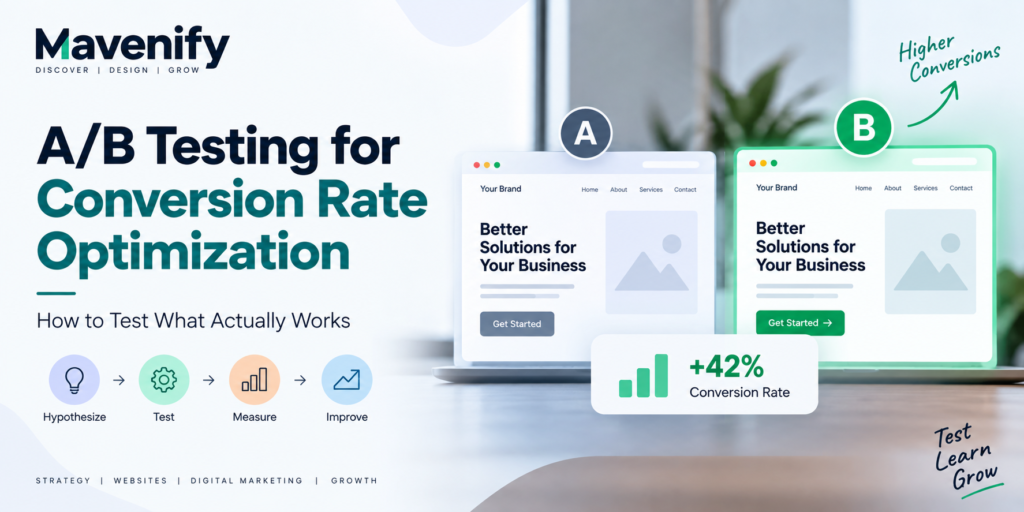
A/B testing is a controlled experiment in which two versions of an experience are compared to determine whether one produces a better result against a defined objective.
The original experience is commonly referred to as Version A, while the modified experience is Version B.
Visitors are assigned to the different versions, and their behaviour is measured against a predetermined conversion goal.
For example, a business might test two versions of a consultation page. Version A could use the existing headline, while Version B could communicate the specific business outcome more clearly. If the test is properly designed and measured, the business can compare how the two experiences perform against the chosen conversion objective.
The important point is that the test should isolate a meaningful difference and measure an outcome that matters.
A/B testing is therefore less about “trying different designs” and more about learning from controlled changes.
A/B testing is one of the practical methods used within Conversion Rate Optimization to evaluate whether a specific change can improve visitor behaviour and business outcomes.
Why A/B Testing Matters for Conversion Optimization
Without testing, businesses often make decisions based on internal preferences, assumptions, or isolated examples.
A design may look cleaner but perform worse. A longer page may appear less efficient but generate more qualified enquiries. A shorter form may increase completion while reducing lead quality.
These outcomes are difficult to predict reliably from appearance alone.
A/B testing creates an opportunity to replace some of that uncertainty with evidence.
It does not eliminate judgment. Someone still needs to identify the problem, develop the hypothesis, select the right test, and interpret the results. But testing can make the decision-making process more disciplined.
The value is especially clear when relatively small changes can affect a large number of visitors. Rather than permanently implementing a change because it seems promising, businesses can first gather evidence about how the experience performs.
What Can You A/B Test on a Website?
Almost any element that can influence visitor behaviour can potentially become a testing variable. However, that does not mean every element deserves to be tested.
The strongest test candidates usually have a clear relationship with the conversion problem being investigated.
| Element | Possible Test | Potential Objective |
| Headline | Different value propositions | Improve engagement |
| CTA | Different wording or placement | Increase action rate |
| Form | Different field structures | Improve completion or lead quality |
| Page layout | Different content hierarchy | Improve progression |
| Offer | Different presentation or incentive | Increase conversions |
| Trust elements | Testimonials, proof or guarantees | Reduce uncertainty |
| Navigation | Different paths or labels | Improve journey progression |
| Pricing presentation | Different structure or explanation | Improve decision confidence |
The right variable depends on the problem.
If visitors are reaching a page but failing to understand the offer, testing a headline or value proposition may be more appropriate than changing the colour of a CTA.
If visitors are beginning a form but abandoning it, the more relevant test may involve the form structure, field requirements, or supporting information.
Testing should follow diagnosis, not replace it.
How to Create a Strong A/B Testing Hypothesis
A good A/B test starts with a clear hypothesis. Without one, testing can quickly turn into a process of trying random changes and selecting whichever version happens to produce a better number.
A useful hypothesis connects an observed problem, a proposed change, and an expected outcome.
For example:
Visitors may be hesitant to request a consultation because the current CTA does not clearly communicate what happens after they click it. Clarifying the next step should increase qualified consultation requests.
This gives the test a purpose. It also makes the eventual result easier to interpret because the business knows what it expected the change to accomplish.
A hypothesis does not need to be correct to be valuable. The purpose of testing is to discover whether the reasoning behind the proposed change is supported by evidence.
Start With a Real Conversion Problem
The strongest tests usually begin with something worth investigating.
Analytics might show that visitors reach a page but rarely click the primary CTA. Session recordings or usability research might reveal confusion around a particular section. Form data might show that visitors frequently abandon after encountering a specific field.
These observations can provide the starting point for a test.
This is much more useful than beginning with a design preference such as:
“Let’s try a different button colour.”
The question should instead be:
What visitor behaviour are we trying to improve, and what evidence suggests that this change could influence it?
Define What You Expect to Change
A hypothesis should identify the variable being changed and the behaviour expected to respond.
If the test changes a headline, for example, the hypothesis might predict that clearer messaging will increase progression to the next stage.
If the test changes a form, the expected outcome could be increased completion without reducing lead quality.
If the test changes the presentation of social proof, the expected outcome might be improved progression among visitors who are still evaluating the offer.
The clearer the relationship between the change and the expected outcome, the more useful the test becomes.
How to Choose What to Test First
A website can contain hundreds of potential testing opportunities. Trying to test everything at once is neither practical nor necessary.
Prioritization helps focus testing resources on changes that have a reasonable chance of producing meaningful insight or business value.
A useful starting point is to consider the potential impact of the page or interaction, the strength of the evidence behind the hypothesis, and the effort required to implement and evaluate the test.
| Testing Opportunity | Potential Impact | Evidence Required | Typical Priority |
| Major conversion page | High | Strong behavioural evidence | High |
| Primary CTA | Medium–High | Clear engagement problem | High |
| Lead form | High | Abandonment or quality issue | High |
| Supporting content | Medium | Engagement evidence | Medium |
| Minor visual element | Low | Limited evidence | Lower |
| Cosmetic change | Uncertain | Weak evidence | Lower |
This does not mean a low-priority element can never produce a meaningful result. It simply means testing resources should generally be directed toward opportunities where the potential learning or commercial impact justifies the effort.
Use Existing Data Before Designing a Test
A/B testing becomes much more useful when it is informed by existing evidence.
Website analytics can reveal where visitors leave, which pages receive meaningful engagement, and how different segments behave. Conversion tracking can show whether important actions are actually taking place.
Website Analytics and Conversion Tracking can provide the evidence needed to identify potential testing opportunities rather than relying entirely on assumptions about visitor behaviour.
Choose the Right A/B Testing Metric
A test needs a clearly defined success metric before it begins.
The right metric depends on what the experiment is intended to improve.
A landing-page test might measure completed enquiries. A CTA test might measure progression to the next stage. A form test might measure completed submissions alongside qualified lead rate.
Choosing the metric after seeing the results creates a risk of interpreting the data in whatever way produces the most favourable conclusion.
The success metric should therefore be established before the test starts.
Primary Metrics vs. Supporting Metrics
A test can influence several behaviours at the same time, so it can be useful to distinguish between a primary metric and supporting metrics.
For example, a business testing a lead form might use qualified lead rate as the primary business metric while monitoring form completion rate as a supporting metric.
This prevents a misleading situation where a change appears successful because more visitors complete the form, even though the quality of the resulting leads has deteriorated.
The metric should ultimately reflect the business outcome the test is intended to improve, not simply the easiest number to increase.
A/B Testing Requires Enough Evidence to Make a Decision
A test result is only useful when there is enough evidence to support the conclusion being drawn from it.
If one version receives only a handful of conversions, a difference between Version A and Version B may be caused by normal variation rather than a genuine performance difference.
This is why businesses should avoid declaring a winner too quickly.
The appropriate sample size and testing duration depend on factors such as existing traffic, conversion volume, expected effect size, audience variability, and the testing methodology being used.
The important principle is simple:
A larger-looking percentage does not automatically mean a better-performing version.
Don’t End a Test Just Because One Version Is Temporarily Ahead
Early results can fluctuate considerably, particularly when the number of visitors or conversions is small.
A test might show Version B leading during the first few days and then move closer to Version A as more visitors are included.
Stopping the experiment based on an early lead can therefore produce a false conclusion.
The testing process should have predefined decision criteria rather than relying on excitement when one version moves ahead. The amount of time required for a reliable test depends on factors such as traffic and conversion rates, so Google recommends running an experiment only as long as necessary to gather enough data for a reliable conclusion.
Avoid Common A/B Testing Mistakes
A/B testing can create misleading conclusions when the experiment is poorly designed.
One common problem is changing multiple major variables simultaneously. If the headline, CTA, page structure, and offer are all changed between Version A and Version B, it becomes difficult to determine which change caused the observed difference.
Another problem is testing without enough traffic or conversion volume to produce useful evidence.
Businesses can also make the mistake of testing too many variations simultaneously, changing the test while it is running, or selecting a winner based on whichever metric looks most favourable.
The solution is not to make testing unnecessarily complicated.
It is to establish a clear question, controlled change, appropriate metric, and predefined evaluation process before the experiment begins.
How to Interpret A/B Test Results
Running an experiment is only half the process. The more important question is what the result actually tells you.
A winning variation may indicate that the change improved the measured outcome under the conditions of the test. A losing variation may provide evidence that the proposed change did not solve the problem. And sometimes the result shows that there is not enough evidence to confidently choose either version.
The outcome should therefore be interpreted in the context of the original hypothesis rather than simply treated as a scorecard showing which version won.
A Winning Test Is a Learning Opportunity
Suppose Version B increases the number of visitors who complete a form. That result is useful, but it should lead to another question:
Why might this change have worked?
Perhaps the new wording made the value of the offer clearer. Perhaps the form became easier to understand. Perhaps the revised layout reduced distraction.
Understanding the possible reason behind the result can help businesses apply the learning to other parts of the customer journey without assuming that the exact same change will work everywhere.
This is one reason a structured testing program can become more valuable over time. Individual experiments create a growing body of evidence about how a particular audience responds to different experiences.
What If Neither Version Wins?
Not every A/B test produces a clear winner.
Sometimes the two versions perform similarly. That does not necessarily mean the experiment was unsuccessful.
The test may have answered the original question by showing that the proposed change did not meaningfully alter the measured behaviour. Alternatively, the difference may have been too small to establish a reliable conclusion with the available evidence.
Either way, the result can help refine the next hypothesis.
For example, if changing a CTA produces little difference, the underlying problem may not be the CTA itself. The more significant issue could be the value proposition, page content, offer, trust signals, or visitor intent.
A test that disproves an assumption can therefore be just as useful as one that produces a clear improvement.
Use A/B Testing to Improve the Entire Conversion Journey
A/B testing becomes more powerful when individual experiments are connected to the broader customer journey.
A change that improves one page may influence what happens at the next stage. For example, improving a landing page may increase the number of visitors who reach a service page, while improving a form may increase submissions without necessarily improving qualified lead volume.
This is why testing should be evaluated beyond the immediate interaction whenever possible.
Looking at these relationships is an important part of Conversion Funnel Optimization, because an improvement at one stage can influence the performance of the stages that follow.
Test the Experience, Not Just Individual Elements
It is tempting to think of A/B testing as changing one button, headline, or image at a time.
Individual element tests can certainly be useful, but sometimes the problem is broader than one component.
Visitors may struggle because the page does not communicate the offer clearly, the information appears in the wrong order, or the transition between sections does not match their decision process.
In those situations, testing a broader experience may provide more useful insight than repeatedly changing individual cosmetic elements.
The appropriate scope depends on the problem being investigated.
Connect Testing With Conversion Rate
A test should ultimately contribute to a better understanding of whether the digital experience is helping visitors take meaningful actions.
This is where Landing Page Conversion Rate can become an important measurement when experiments involve landing pages or other high-intent entry points.
When testing changes to a landing page, Landing Page Conversion Rate can help establish whether the experiment is influencing the intended conversion behaviour.
What to Do After an A/B Test
A test result should lead to a decision, not simply be archived.
If a variation produces a meaningful improvement and the evidence supports the result, the business can consider implementing the change more broadly.
If the result is inconclusive, the next step may be to gather more evidence or develop a different hypothesis.
If the variation performs worse, the business can learn from the result and investigate whether the original assumption was incorrect.
The important thing is to preserve the learning.
A testing program becomes increasingly valuable when the organization remembers what was tested, why it was tested, what happened, and what was learned.
Turn Test Results Into New Hypotheses
One experiment can often reveal the next opportunity.
Suppose a test demonstrates that clearer value messaging improves CTA engagement. The next question might be whether the same messaging improves form completion or qualified lead generation.
This creates a continuous cycle:
Observe → Hypothesize → Test → Measure → Learn → Test Again
Over time, this approach can make conversion optimization more systematic and less dependent on subjective design opinions.
A/B Testing Within a Broader Growth System
A/B testing is most valuable when it is connected to the systems that generate, measure, and respond to customer behaviour.
Search and paid acquisition influence who enters the journey. Content and website experience influence how visitors understand the offer. Conversion architecture influences how they progress toward action. Analytics provides evidence about what happens. Automation helps manage what happens after conversion.
Testing can therefore act as a learning layer across the broader growth system.
Instead of treating experimentation as an isolated marketing tactic, businesses can use it to continuously improve the interactions between these different parts of the customer journey.
From Testing to Continuous Improvement
The ultimate value of A/B testing is not a collection of winning experiments.
It is the creation of a more disciplined way to improve digital experiences.
Some tests will produce clear wins. Others will show that a popular assumption was wrong. Some will reveal that a problem exists somewhere other than where it was initially suspected.
Together, these findings create a more informed optimization process.
That is particularly important for businesses with complex customer journeys, where improving conversion performance may require coordinated changes across messaging, website structure, content, forms, analytics, and follow-up systems.
Conversion Architecture System™
Mavenify’s Conversion Architecture System™ approaches conversion improvement as a connected system rather than a series of isolated page changes.
A/B testing can contribute to that system by providing a structured method for validating hypotheses, learning from visitor behaviour, and improving experiences such as Form Conversion Optimization that move prospects toward meaningful business actions.
The objective is not to test everything.
It is to test the things that matter, learn from the evidence, and use those lessons to build a stronger conversion journey.
Frequently Asked Questions About A/B Testing
What is A/B testing?
A/B testing is a controlled experiment that compares two versions of a digital experience to determine which one performs better against a predefined objective. The versions may differ in areas such as messaging, layout, calls to action, forms, or other conversion-related elements.
What should I A/B test first?
Start with a meaningful conversion problem supported by evidence. High-impact pages, primary CTAs, landing pages, forms, and other interactions with significant traffic or business value are often stronger candidates than minor visual changes.
How long should an A/B test run?
There is no universal testing duration. The appropriate period depends on traffic volume, conversion volume, audience behaviour, expected effect size, and the methodology being used. Tests should generally continue until there is enough evidence to make a reliable decision rather than being stopped simply because one version temporarily performs better.
What is the most important metric in an A/B test?
The most important metric is the one that best represents the objective of the experiment. Depending on the test, this could be completed purchases, qualified leads, form submissions, bookings, or another meaningful conversion. Supporting metrics can provide additional context.
Can I test multiple changes at the same time?
You can, but doing so makes the result more difficult to interpret if the test is intended to isolate the effect of individual changes. When several major elements change simultaneously, it becomes harder to determine which change influenced the outcome.
What if neither version wins?
A test without a clear winner can still provide valuable information. It may show that the proposed change did not meaningfully influence the measured behaviour or that the original hypothesis needs to be reconsidered.
Is A/B testing suitable for every website?
Not always. Websites with very low traffic or conversion volume may not generate enough data for meaningful controlled experiments. In those cases, analytics, usability research, customer feedback, and other qualitative methods can still provide valuable evidence for optimization.
Does A/B testing guarantee higher conversions?
No. A/B testing is a learning method, not a guarantee of improvement. Some experiments will produce positive results, some will show no meaningful difference, and others will demonstrate that a proposed change performs worse than the original experience.
Conclusion
Good conversion optimization should not depend entirely on opinions about what a website should look like.
A/B testing provides a structured way to challenge assumptions, investigate hypotheses, and learn how real visitors respond to meaningful changes.
But the test itself is only one part of the process.
The strongest results come from identifying a genuine problem, developing a clear hypothesis, choosing an appropriate variable, defining the right success metric, collecting sufficient evidence, and using the findings to guide the next improvement.
A winning test is valuable. A losing test can be valuable too. Both can reveal something about the people moving through the conversion journey.
Over time, these individual lessons can become a much stronger source of decision-making than isolated opinions or design preferences.
The goal of A/B testing is not to find a winning version once. It is to build a better understanding of what helps your audience move toward meaningful action.
Build a Conversion System That Gets Better Over Time
If your website is generating traffic but you are relying on assumptions to decide what should be changed, A/B testing can provide a more disciplined path to improvement.
Mavenify’s Conversion Architecture System™ brings together conversion strategy, website experience, measurement, funnel analysis, forms, and experimentation to help businesses turn visitor behaviour into actionable insights and stronger conversion outcomes.