

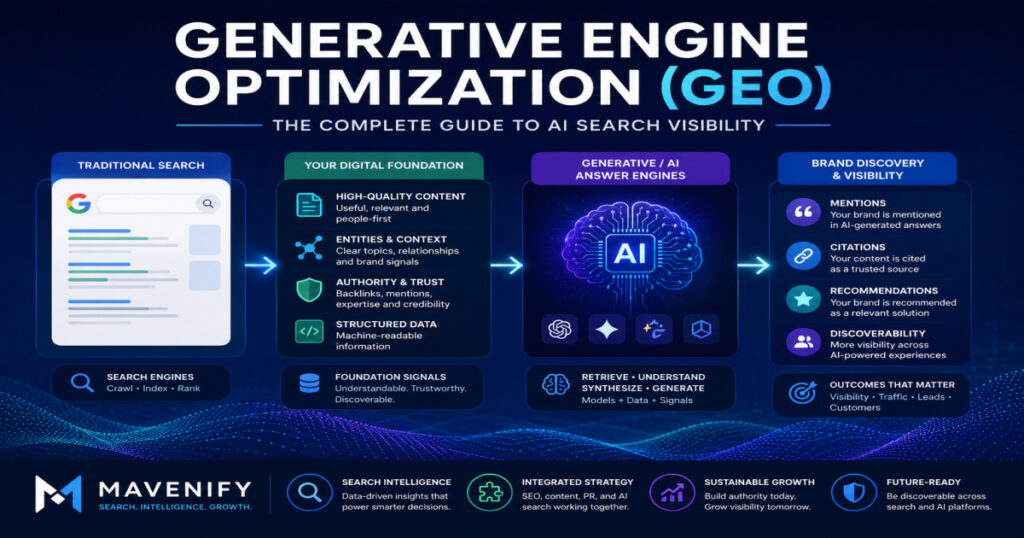
Generative Engine Optimization (GEO) is the practice of optimizing a brand’s digital presence so its content, expertise, products, and services can be discovered, understood, cited, and recommended by AI-powered search and answer engines. While traditional SEO primarily focuses on visibility in search engine results, GEO extends that visibility into AI-generated answers across platforms such as Google AI Overviews, ChatGPT, Perplexity, Microsoft Copilot, and other generative search experiences.
As search evolves from a list of links into direct, synthesized answers, businesses need to think beyond rankings alone. Search engines and AI systems increasingly evaluate entities, topical authority, structured information, source credibility, content relationships, and contextual relevance when deciding which sources to retrieve or reference.
This guide explains how Generative Engine Optimization works, how it differs from traditional SEO, the signals that influence AI search visibility, and how businesses can build a search presence designed for both Google and generative AI platforms.
Table of Contents
What Is Generative Engine Optimization (GEO)?
Generative Engine Optimization (GEO) is a search optimization approach designed to increase the likelihood that a brand, website, or piece of content is discovered, understood, cited, or recommended within AI-generated responses. It focuses on making information easier for generative AI systems and search engines to retrieve, interpret, connect with relevant entities, and use when constructing answers.
Unlike traditional search experiences, where visibility is often measured by a webpage’s position in a ranked list of results, generative search can synthesize information from multiple sources into a single response. This means a business may gain visibility through a citation, brand mention, recommendation, product reference, or inclusion in an AI-generated answer—even when the interaction does not follow the traditional “search → click → website” journey.
What Does GEO Mean in Marketing?
In marketing, GEO means building digital authority and information structures that help AI-powered discovery systems recognize who your brand is, what it offers, which topics it has expertise in, and when it should be considered relevant to a user’s question. It combines elements of technical SEO, entity optimization, structured data, content strategy, topical authority, digital PR, and brand credibility.
How Does Generative Engine Optimization Work?
Generative Engine Optimization works by making a brand’s information easier for search engines and AI systems to discover, understand, validate, retrieve, and reference. Rather than relying on a single optimization factor, GEO strengthens multiple signals across a website and the wider digital ecosystem so that AI systems can develop a clearer understanding of the brand, its expertise, its services, and its relevance to specific queries.
When an AI-powered search or answer engine responds to a question, it may retrieve information from multiple sources, evaluate the context and credibility of those sources, identify relevant entities and relationships, and synthesize the information into an answer. GEO aims to strengthen the signals that help a brand’s content become a useful and trustworthy source during this process.
1. Content Discovery and Crawlability
AI visibility begins with discoverability. Search engines and other retrieval systems need to be able to access, crawl, and interpret a website’s important pages. Technical SEO foundations such as indexability, XML sitemaps, internal linking, canonicalization, clean site architecture, and crawl accessibility help ensure that valuable content can be discovered efficiently.
2. Entity and Context Understanding
AI systems need to understand not only what a page says, but also the entities and relationships behind the information. Consistent brand information, clearly defined services, organization details, authorship, structured data, contextual internal links, and semantically connected content can help establish stronger relationships between a brand and the topics for which it wants to become known.
3. Topical Authority
Publishing one optimized page is rarely enough to establish meaningful authority around a competitive topic. GEO benefits from building interconnected clusters of useful content that answer related questions and demonstrate depth of expertise. Over time, these content relationships can strengthen the association between a brand and the subjects it consistently covers.
4. Structured and Extractable Information
Generative systems work best when information is clear, contextual, and easy to extract. Descriptive headings, concise definitions, question-and-answer formats, lists, tables, statistics, supporting evidence, and structured data can make important information easier for both search engines and AI systems to interpret and retrieve.
5. Authority and Trust Signals
Visibility in generative search is not purely a content optimization exercise. Brand mentions, authoritative backlinks, expert contributions, citations, reviews, digital PR, third-party references, and consistent information across trusted sources can contribute to the broader credibility signals surrounding a brand or entity.
6. AI Retrieval and Citation
The ultimate objective of GEO is to increase the probability that a brand’s information becomes relevant during AI-powered retrieval and answer generation. Depending on the platform and query, this visibility may appear as a citation, linked source, brand mention, recommendation, summarized insight, product reference, or other inclusion within an AI-generated response.
Generative Engine Optimization (GEO) vs Traditional SEO
Generative Engine Optimization and traditional Search Engine Optimization share the same fundamental objective: increasing a brand’s visibility when people search for information, products, services, or solutions. However, the environments in which that visibility occurs are becoming increasingly different.
Traditional SEO primarily focuses on improving visibility within search engine results pages, while GEO extends optimization into AI-powered search and answer environments. This means businesses must think not only about rankings and clicks, but also about whether their brand and content can be understood, retrieved, cited, mentioned, or recommended within AI-generated responses.
What Is the Difference Between GEO and SEO?
The primary difference between SEO and GEO lies in how information is discovered and presented to users. SEO traditionally optimizes webpages to rank prominently for relevant searches, whereas GEO focuses on increasing the likelihood that information about a brand is retrieved and incorporated into generative AI responses.
These disciplines should not be treated as competing strategies. Strong technical SEO, high-quality content, topical authority, internal linking, structured data, backlinks, and brand credibility remain important foundations for AI search optimization. GEO builds upon these foundations by considering how information is interpreted, connected, retrieved, and referenced by generative systems.
| Factor | Traditional SEO | Generative Engine Optimization |
| Primary Goal | Improve organic search visibility and rankings | Increase visibility within AI-generated answers and recommendations |
| Discovery Environment | Traditional search engine results | AI search engines, answer engines, and generative search experiences |
| Typical Visibility | Rankings, featured snippets, organic listings | Citations, mentions, recommendations, linked sources, and generated answers |
| Optimization Focus | Keywords, content, technical SEO, links | Entities, context, authority, retrievability, structured information, and citations |
| Content Approach | Search-intent-focused content | Search intent plus answer-oriented, contextual, and extractable content |
| Authority Signals | Backlinks, content quality, domain and topical authority | Brand/entity authority, citations, mentions, expert signals, trusted sources, and backlinks |
| Measurement | Rankings, clicks, impressions, traffic, conversions | AI mentions, citations, referral visibility, brand presence, assisted discovery, and conversions |
| Target Platforms | Google, Bing and other search engines | Google AI experiences, ChatGPT, Perplexity, Copilot and other AI-powered discovery platforms |
Does GEO Replace SEO?
No. GEO does not replace SEO. Instead, it represents an expansion of search optimization as discovery moves beyond traditional search results into AI-generated experiences. Websites still need strong technical foundations, crawlability, indexability, useful content, internal linking, authority, and conventional search visibility.
The strongest long-term approach is therefore not SEO versus GEO, but an integrated search strategy that combines traditional SEO with AI search optimization. This allows a brand to compete for visibility across both conventional search journeys and emerging generative discovery experiences.
Why Is Generative Engine Optimization Important?
Generative Engine Optimization is becoming increasingly important because the way people discover information is changing. Search is no longer limited to browsing a list of webpages. Users can now ask complex questions and receive synthesized answers, recommendations, comparisons, and explanations directly from AI-powered search and answer platforms.
For businesses, this creates an additional layer of digital visibility. A brand may still compete for traditional organic rankings while simultaneously competing to be cited, mentioned, referenced, or recommended within AI-generated responses. Building AI search visibility therefore extends search strategy beyond rankings alone and helps brands prepare for a discovery environment where traditional search and generative AI increasingly overlap.
Search Behavior Is Changing
Search behavior is becoming more conversational and complex. Instead of entering only short keyword-based queries, users can ask detailed questions that include their goals, preferences, constraints, location, industry, or specific business requirements. Generative systems can interpret these queries and produce synthesized responses rather than simply returning a list of matching webpages.
This shift means businesses need content that answers questions comprehensively while clearly communicating their expertise, services, entities, and relationships. Traditional keyword optimization remains valuable, but contextual relevance and information clarity become increasingly important when content may be retrieved as part of a generated answer.
AI Search Can Influence Brand Discovery
AI-powered search can introduce users to brands they may not have previously encountered. When a generative system references a company, recommends a solution, cites its content, or includes its expertise within an answer, that exposure can create a new discovery path between the user and the brand.
This makes AI visibility relevant not only for traffic acquisition but also for brand awareness and consideration. In some search journeys, users may discover a business through an AI-generated recommendation before ever visiting a traditional search results page.
Search Visibility Is Expanding Beyond Rankings
Organic rankings remain an important part of search marketing, but they are no longer the only form of search visibility. AI-powered search experiences, including Google AI Overviews, can surface information through citations, source links, brand mentions, product references, summaries, recommendations, and other answer formats.
As these experiences develop, businesses need a broader definition of search performance—one that considers where and how their brand appears across both traditional search results and AI-generated discovery environments.
GEO Helps Build Long-Term Search Resilience
GEO encourages businesses to strengthen the underlying assets that make their digital presence understandable and trustworthy: technically accessible websites, authoritative content, clear entity relationships, structured information, credible references, topical depth, and consistent brand signals.
These foundations are valuable beyond any individual AI platform or search feature. Rather than optimizing for a single algorithm, businesses can build a stronger information ecosystem that supports visibility as search technologies and user behaviors continue to evolve.
What Factors Influence AI Search Visibility?
AI search visibility is influenced by a combination of technical accessibility, content quality, contextual relevance, entity understanding, authority, and external credibility signals. There is no single optimization factor that guarantees inclusion in an AI-generated response. Different platforms may use different retrieval systems, indexes, models, ranking mechanisms, and source-selection processes.
A strong GEO strategy therefore focuses on building multiple signals that make a brand and its information easier to discover, understand, verify, and retrieve. The following factors can contribute to stronger visibility across traditional search and AI-powered discovery environments.
1. Entity Recognition and Brand Clarity
Search engines and AI systems benefit from being able to clearly identify the organization, people, products, services, locations, and topics associated with a website. Consistent brand naming, organization information, About pages, author profiles, structured data, service descriptions, and references from external sources can help establish clearer entity relationships.
For businesses, this means communicating consistently who the organization is, what it does, which markets it serves, and what areas of expertise it represents across both owned and third-party digital properties.
2. Topical Authority and Content Depth
Websites that consistently publish useful information around a defined set of related topics can build stronger topical relationships than websites containing isolated articles with little supporting context. Comprehensive pillar content, supporting articles, FAQs, case studies, research, guides, and internally connected resources can collectively demonstrate depth around an area of expertise.
For GEO, topical authority also helps create a richer information environment from which search and AI systems can understand how different concepts, services, problems, and entities relate to one another.
3. Content Quality and Information Value
High-quality content should provide meaningful information rather than simply repeat what already exists across the web. Clear explanations, original perspectives, practical examples, expert insights, supporting evidence, relevant statistics, methodologies, and first-hand experience can make content more valuable to both users and retrieval systems.
Content should also directly satisfy the intent behind a question. Pages that provide precise answers while offering sufficient supporting context are generally more useful than content created primarily to reach a particular word count or keyword density.
4. Structured Data and Semantic Clarity
Structured data can provide search engines with additional machine-readable context about webpages and the entities they describe. Appropriate schema markup for organizations, articles, people, services, breadcrumbs, FAQs, and other supported content types can help clarify relationships between information on a website.
Schema markup does not guarantee visibility or citation within generative search, but when implemented accurately it can complement strong content architecture and make important information more explicitly structured for machines.
5. Brand Mentions and Third-Party References
A brand’s digital authority extends beyond its own website. Mentions and references across reputable publications, industry websites, professional profiles, directories, research, interviews, podcasts, communities, and other relevant sources can contribute to the wider information ecosystem surrounding an organization.
These external references can reinforce associations between a brand and particular topics, services, industries, people, or areas of expertise. This makes digital PR and brand authority development increasingly relevant to both conventional SEO and generative search strategies.
6. Backlinks and Source Authority
Backlinks remain an important part of establishing authority and relationships across the web. However, link quality and contextual relevance are generally more valuable than simply accumulating large quantities of links from unrelated or low-quality websites.
Links from credible and contextually relevant sources can support traditional organic visibility while also strengthening the broader authority signals surrounding a brand, its content, and its expertise.
7. Experience, Expertise, Authority and Trust Signals
Demonstrating genuine experience and expertise can strengthen the credibility of content. Clear authorship, expert biographies, transparent company information, original examples, case studies, methodologies, references, editorial standards, and evidence of real-world experience can help users and search systems better evaluate the source behind information.
Trust is especially important for content that influences significant decisions. Businesses should therefore make it easy for visitors to understand who created the information, why they are qualified to discuss the subject, and how the organization can be verified.
8. Internal Linking and Content Relationships
Internal links help establish relationships between pages and guide both users and crawlers toward relevant supporting information. A strategically connected website can communicate which pages are most important while also helping search systems understand how topics, services, case studies, methodologies, and resources relate to each other.
For GEO-focused content, internal linking should be contextual rather than mechanical. Relevant anchor text can connect informational articles with deeper resources and commercial pages while creating a clearer knowledge structure across the website.
9. Technical Accessibility and Indexability
Strong content provides limited search value if search engines cannot reliably access or understand it. Crawlability, indexability, canonicalization, XML sitemaps, robots directives, HTTPS, mobile usability, page performance, clean URL structures, and properly rendered content remain important technical foundations.
Technical SEO therefore remains a fundamental component of GEO. Generative optimization should build upon a technically healthy website rather than being treated as a replacement for established search-engine optimization practices.
10. Content Freshness and Accuracy
Information can lose value when it becomes outdated, particularly in rapidly changing fields such as artificial intelligence, technology, search, regulations, products, and market data. Reviewing important content periodically helps ensure that facts, examples, references, terminology, and recommendations remain accurate.
Content should not be updated merely to change its publication date. Meaningful updates should improve the usefulness, accuracy, completeness, or relevance of the information being provided.
How to Optimize for Generative AI Search: A GEO Framework
Optimizing for generative AI search requires more than adding keywords to webpages or publishing additional content. A strong GEO strategy connects technical SEO, entity optimization, content architecture, structured information, authority development, and measurement into a coordinated search system.
The objective is to make a brand easier for search engines and AI systems to discover, understand, contextualize, verify, and retrieve when relevant questions are asked. The following framework provides a practical approach businesses can use to strengthen their presence across both traditional and AI-powered search environments.
1. Establish a Strong Technical Search Foundation
Begin by ensuring that important website content can be reliably crawled, rendered, and indexed. Review XML sitemaps, robots directives, canonical tags, HTTP status codes, internal links, mobile usability, HTTPS, page performance, and other technical factors that may prevent search engines from accessing or interpreting important pages.
Technical issues should be addressed before more advanced GEO initiatives are scaled. If important information cannot be discovered or indexed effectively, investments in content and authority development may deliver significantly less value.
2. Define Your Brand and Core Entities
Clearly define the entities associated with the business, including the organization itself, its services, products, founders or experts, industries, locations, methodologies, and areas of expertise. These relationships should be communicated consistently across the website and relevant external properties.
Important entity information should not be buried in vague marketing language. About pages, service pages, author profiles, contact information, structured data, case studies, and other supporting content should help establish a consistent understanding of who the organization is and what it is qualified to discuss or provide.
3. Map Search Intent and AI Prompt Patterns
Traditional keyword research remains useful, but generative search requires businesses to consider a broader range of conversational questions and prompt patterns. Users may ask AI systems to explain concepts, compare solutions, recommend providers, evaluate alternatives, solve problems, create strategies, or identify the best option for a specific situation.
Mapping these patterns helps identify the questions and decision journeys surrounding a topic. Keyword data, customer conversations, sales questions, search results, related queries, industry terminology, and real-world use cases can all contribute to a more comprehensive understanding of search intent.
4. Build Topic Clusters Around Core Expertise
Instead of publishing disconnected articles, organize content around strategic topic clusters. A comprehensive pillar resource can cover the primary subject while supporting articles explore related questions, comparisons, definitions, methodologies, use cases, challenges, and emerging developments.
These pages should be connected through contextual internal links so that users and search systems can understand the relationships between them. Over time, this creates a stronger knowledge structure around the subjects for which the brand wants to establish authority.
5. Create Answer-First, Extractable Content
Important questions should receive clear answers without forcing users to read through unnecessary introductions before reaching the relevant information. Definitions, concise explanations, step-by-step processes, lists, comparisons, tables, FAQs, and supporting examples can make information easier to consume and interpret.
This does not mean every paragraph should be shortened into fragments. Strong content should provide direct answers first and then add the context, evidence, examples, and nuance required to make those answers genuinely useful.
6. Strengthen Entity Relationships With Structured Data
Implement appropriate structured data to provide additional machine-readable context about the organization and its content. Depending on the page, this may include Organization, Person, Article, Breadcrumb, Service, and other applicable schema types supported by search engines.
Structured data should accurately represent information that is genuinely present on the page. Schema should support the underlying content and entity structure rather than being used to make claims that the visible page does not substantiate.
7. Build Evidence, Experience and Original Value
Content becomes more defensible when it contains information that reflects genuine knowledge or experience. Original research, proprietary data, expert commentary, case studies, methodologies, experiments, examples, observations, and first-hand insights can differentiate a resource from pages that merely summarize existing information.
Businesses should therefore look beyond content volume and identify what information they can contribute that competitors cannot easily reproduce. This can strengthen both user value and the broader authority of the brand.
8. Develop External Authority and Brand Mentions
GEO should extend beyond the website itself. Digital PR, expert contributions, relevant publications, industry partnerships, interviews, podcasts, research citations, reputable directories, and other legitimate third-party references can expand the information available about a brand across the web.
The goal should not simply be to manufacture links or mentions. External authority is most valuable when references come from credible and contextually relevant sources that reinforce the relationship between the brand and its areas of expertise.
9. Create Strategic Internal Linking
Internal linking should connect informational resources with related guides, methodologies, case studies, service pages, industry pages, and other relevant content. Descriptive anchor text helps users understand what they will find while also providing search systems with additional contextual signals about the relationship between pages.
Priority pages should receive links from relevant supporting content, but internal linking should remain useful and natural. Repeating the same keyword-rich anchor excessively across a website is unnecessary and can make content feel mechanically optimized.
10. Measure Search and AI Visibility
GEO measurement should combine established SEO metrics with emerging indicators of AI visibility. Traditional measures such as organic impressions, rankings, clicks, traffic, conversions, branded search demand, and referring domains remain valuable, while AI-focused measurement may examine brand mentions, citations, linked references, referral traffic, and visibility across relevant generative queries.
Because generative search experiences can vary by platform, query, user context, and time, AI visibility should not be reduced to a single universal ranking position. Businesses should instead monitor patterns across strategically important prompts and evaluate whether their overall presence is strengthening over time.
11. Continuously Improve and Refresh the Search Ecosystem
GEO should be treated as an ongoing process rather than a one-time optimization project. Search experiences, AI platforms, competitors, content, and user behavior continue to evolve, which means important pages and strategies should be reviewed periodically.
Performance data, new customer questions, emerging search behaviors, industry developments, competitive changes, and new evidence can all inform future improvements. The objective is to continuously strengthen the quality, accuracy, authority, and connectedness of the brand’s search ecosystem.
How Does GEO Work Across Different AI Search Platforms?
Generative search does not operate through a single universal system. Google, ChatGPT, Perplexity, Microsoft Copilot, and other AI-powered discovery platforms can use different models, search indexes, retrieval technologies, source-selection methods, and citation formats when generating responses.
As a result, GEO should not be approached as optimization for one specific AI platform. The stronger strategy is to build technically accessible, authoritative, well-structured, and contextually relevant information that can support visibility across multiple search and generative discovery environments.
Google AI Overviews and AI-Powered Search
Google’s AI-powered search experiences can combine information from multiple web sources to generate answers directly within the search journey. Traditional SEO foundations therefore remain highly relevant because crawlability, indexability, content quality, relevance, internal linking, authority, and overall search visibility can all contribute to how content is discovered and understood.
Businesses should focus on creating useful content that directly addresses search intent while providing sufficient context, evidence, and supporting information. Clear page structure, descriptive headings, concise answers, strong topical coverage, and technically accessible content can help make information easier to interpret across both traditional and AI-powered Google search experiences.
ChatGPT Search and AI Discovery
ChatGPT can support discovery through AI-generated responses that may incorporate information retrieved from the web and provide links or references to relevant sources. This creates another potential discovery environment where businesses can gain visibility beyond conventional search engine results.
ChatGPT search optimization should not be treated as a collection of tricks designed specifically for one language model. A stronger approach is to improve the accessibility, clarity, authority, entity consistency, and usefulness of information available about a brand across its website and credible external sources.
Comprehensive content, clearly defined entities, third-party mentions, authoritative references, original expertise, and consistent brand information can contribute to a stronger digital presence that is easier for AI-powered discovery systems to understand and retrieve when relevant.
Perplexity and Citation-Based AI Search
Perplexity provides an answer-oriented search experience that commonly presents source citations alongside generated responses. For brands and publishers, this highlights the importance of producing information that is not only relevant but also sufficiently clear and useful to function as a supporting source.
Original research, statistics, expert insights, detailed explanations, current information, and well-structured resources can strengthen the value of a page as a reference. External authority and contextual relevance also remain important because AI search visibility exists within a wider ecosystem of sources rather than exclusively on a brand’s own website.
Microsoft Copilot and AI-Powered Discovery
Microsoft Copilot integrates generative AI into a broader ecosystem that includes web search and other Microsoft experiences. As with other generative discovery platforms, visibility should be approached through strong search fundamentals rather than isolated platform-specific tactics.
Businesses can strengthen their overall discoverability by maintaining technically accessible websites, publishing authoritative and relevant information, building clear entity relationships, earning credible external references, and ensuring that important brand information remains consistent across the web.
Should Businesses Optimize Separately for Every AI Platform?
Not necessarily. Different AI platforms may retrieve, rank, interpret, and present information differently, so visibility can vary significantly from one system or query to another. Attempting to reverse-engineer every platform individually can therefore lead to fragmented and short-lived optimization tactics.
A more sustainable GEO strategy focuses on the underlying signals that strengthen discoverability across the broader search ecosystem: technical accessibility, high-quality information, entity clarity, topical authority, structured content, credible mentions, authoritative links, and genuine expertise.
Platform-specific monitoring can then be used to identify opportunities and understand where a brand is gaining or losing visibility without rebuilding the entire search strategy around the behavior of a single AI system.
How Do You Measure GEO and AI Search Performance?
Measuring Generative Engine Optimization requires a broader approach than tracking traditional keyword rankings alone. AI-generated responses can vary by platform, query wording, user context, location, and time, which makes generative visibility less predictable than a conventional search ranking position.
A useful GEO measurement framework combines traditional SEO performance with AI-specific visibility signals. The objective is to understand whether a brand is becoming more discoverable across relevant search journeys, how frequently it appears within AI-generated experiences, and whether that visibility contributes to meaningful business outcomes.
1. AI Brand Mentions
Track whether the brand appears within AI-generated responses for strategically important questions and prompts. A mention may occur even when the platform does not provide a direct citation or link, making brand presence itself an important visibility signal.
Monitoring should focus on commercially and topically relevant prompts rather than random questions. Over time, businesses can evaluate whether their brand is appearing more consistently across the subjects, services, industries, and problems they want to be associated with.
2. AI Citations and Source Links
When AI-powered search experiences provide citations or source links, businesses can monitor which pages are being referenced and for which types of queries. This can help identify content that is successfully functioning as a useful source within generative discovery environments.
Citation monitoring can also reveal content gaps. If competing sources are repeatedly referenced for important topics while a brand remains absent, the underlying content, authority, evidence, or topical coverage may require improvement.
3. AI Referral Traffic
Website analytics can help identify visitors arriving from AI-powered platforms when referral information is available. Monitoring this traffic can provide insight into which generative discovery environments are actually sending users to the website.
Traffic volume should not be evaluated in isolation. Businesses should also examine engagement, enquiries, leads, conversions, and other meaningful actions to understand whether AI-referred visitors contribute to business outcomes.
4. Prompt Visibility
Keyword tracking can be extended into prompt tracking by creating a defined set of questions that represent important customer journeys. These may include informational prompts, comparisons, recommendations, problem-solving questions, service searches, and industry-specific scenarios.
Running these prompts periodically across relevant AI platforms can help identify patterns in brand visibility, competitor mentions, cited sources, and answer composition. Because AI responses can change, prompt visibility should be evaluated as a trend rather than treated as a fixed ranking position.
5. Traditional Organic Search Performance
Traditional SEO metrics remain essential to GEO measurement. Organic impressions, clicks, rankings, indexed pages, search queries, click-through rates, and conversions continue to provide valuable information about how effectively a website performs within conventional search environments.
GEO and SEO should therefore be measured together rather than through completely separate reporting systems. Improvements in technical health, content authority, brand recognition, and topical relevance can support visibility across both traditional and generative search experiences.
6. Branded Search Demand
Increased exposure across AI search, digital PR, content, social channels, and other discovery environments may contribute to more users searching directly for a brand. Monitoring branded search queries can therefore provide an additional indication of growing awareness and consideration.
Branded search growth cannot always be attributed to GEO alone, but when evaluated alongside AI mentions, citations, referral traffic, and broader marketing activity, it can provide useful context around changes in brand discovery.
7. Leads and Business Conversions
Ultimately, search visibility should contribute to meaningful business outcomes. Form submissions, qualified enquiries, booked consultations, purchases, sign-ups, pipeline opportunities, and revenue provide a more commercially useful measure of success than visibility metrics alone.
Businesses should connect GEO measurement with analytics and conversion tracking wherever possible so they can evaluate not only whether the brand is being discovered, but whether that discovery is contributing to customer acquisition and growth.
8. Don’t Reduce GEO to a Single Score
GEO does not currently have one universal metric equivalent to a traditional keyword ranking position. Different platforms can produce different answers for similar prompts, and those responses may change as source information, retrieval systems, models, and search experiences evolve.
A stronger measurement approach therefore combines multiple indicators—AI mentions, citations, prompt visibility, referral traffic, organic search performance, branded demand, and conversions—to evaluate whether a brand’s overall search presence is strengthening over time.
Common Generative Engine Optimization Mistakes to Avoid
As interest in Generative Engine Optimization grows, businesses can easily fall into the trap of treating GEO as a collection of shortcuts for influencing AI platforms. In reality, many of the strongest GEO practices depend on the same fundamentals that support sustainable search visibility: useful information, technical accessibility, clear entities, genuine authority, and a strong user experience.
Avoiding the following mistakes can help businesses build a more sustainable AI search strategy rather than chasing temporary tactics or attempting to manipulate individual generative platforms.
1. Treating GEO as Keyword Stuffing
Repeating terms such as “AI search,” “GEO,” or “Generative Engine Optimization” throughout a page does not automatically make the content more useful or more likely to appear in AI-generated responses. Excessive repetition can reduce readability and weaken the quality of the content.
Keywords should help establish relevance, but they should appear naturally within comprehensive information that genuinely satisfies the user’s intent.
2. Publishing Large Volumes of Generic AI-Generated Content
Generative AI can support research, ideation, outlining, and content production, but publishing large quantities of generic content without meaningful editorial input can create pages that add little new value to the web.
Businesses should prioritize accuracy, expertise, original perspectives, examples, evidence, and human review. The objective should be to create resources worth retrieving and referencing—not simply to increase the number of indexed pages.
3. Ignoring Traditional SEO Foundations
GEO should not be implemented while basic search issues remain unresolved. Poor crawlability, incorrect indexing directives, broken internal links, duplicate content, weak site architecture, canonicalization problems, or other technical issues can limit the discoverability of otherwise valuable information.
Traditional technical and on-page SEO therefore remain foundational components of a broader generative search strategy.
4. Optimizing Only for One AI Platform
Focusing exclusively on ChatGPT, Google AI experiences, Perplexity, or any other individual platform can create an overly narrow strategy. Generative systems continue to evolve, and each platform may use different models, indexes, retrieval technologies, and source-selection processes.
Businesses should strengthen their overall digital information ecosystem first and use platform-specific monitoring to identify additional opportunities.
5. Overusing or Misrepresenting Structured Data
Structured data should accurately describe the content and entities that genuinely exist on a webpage. Adding unnecessary schema types or using markup to represent information that users cannot actually see does not create genuine authority.
Schema is most effective when it supports clear content and a well-defined entity structure rather than being treated as a shortcut to AI visibility.
6. Chasing Low-Quality Backlinks and Brand Mentions
Building large numbers of links or mentions from irrelevant, low-quality, or artificial sources can create noise without strengthening genuine authority. Sustainable search visibility is better supported by credible references from sources that are contextually relevant to the brand’s expertise, industry, or audience.
Businesses should therefore focus on earning meaningful authority through useful content, digital PR, expert contributions, partnerships, research, and legitimate industry relationships.
7. Ignoring Entity and Brand Consistency
Conflicting company descriptions, inconsistent naming, outdated information, unclear service definitions, or disconnected profiles can make it more difficult to establish a coherent understanding of a brand across the web.
Core information about the organization, its people, services, expertise, locations, and methodologies should remain accurate and reasonably consistent across important owned and third-party properties.
8. Measuring GEO With Rankings Alone
Traditional keyword rankings remain useful, but they cannot fully represent visibility within generative search. AI responses may include brands through citations, recommendations, mentions, summaries, or source links without producing a conventional ranking position.
GEO measurement should therefore consider a combination of traditional organic performance, AI visibility, citations, brand mentions, referral traffic, prompt monitoring, and business conversions.
What Is the Future of SEO and Generative Search?
The future of search is unlikely to be defined by traditional SEO disappearing and Generative Engine Optimization replacing it. Instead, search is expanding across multiple discovery environments where conventional search results, AI-generated answers, recommendations, citations, and conversational experiences increasingly coexist.
Search engines will continue to require accessible websites, relevant information, clear site architecture, useful content, and signals of authority and trust. At the same time, generative experiences create additional opportunities for brands to be discovered through synthesized answers, cited sources, entity relationships, and AI-powered recommendations.
This evolution means businesses should think beyond optimizing individual webpages for individual keywords. Stronger search strategies will increasingly connect technical SEO, semantic relevance, entity optimization, topical authority, structured information, brand credibility, digital PR, and high-quality content into a broader search ecosystem.
The organizations best positioned for this shift will be those that build durable digital authority rather than chasing every new search feature or AI platform independently. Technologies and interfaces will continue to change, but making a brand easier to discover, understand, trust, and retrieve remains a sustainable foundation for long-term search visibility.
Frequently Asked Questions About Generative Engine Optimization
What Is GEO in Digital Marketing?
GEO, or Generative Engine Optimization, is the practice of improving a brand’s digital presence so its information can be more easily discovered, understood, retrieved, cited, or recommended by AI-powered search and answer systems. It complements traditional SEO by extending search visibility into generative discovery environments.
What Is the Difference Between GEO and SEO?
SEO primarily focuses on improving visibility within traditional search engine results, while GEO also considers how information is retrieved and presented within AI-generated responses. The two disciplines overlap significantly, and strong technical SEO, content quality, authority, and entity clarity provide important foundations for both.
Does GEO Replace Traditional SEO?
No. GEO does not replace traditional SEO. Search engines still depend on crawlable websites, indexable content, relevance, internal linking, authority, and other established search signals. GEO builds on these foundations by considering how brands and information can also become visible within generative search experiences.
How Do You Optimize Content for AI Search?
AI search optimization involves creating technically accessible, authoritative, well-structured, and contextually relevant information. Clear answers, strong topical coverage, entity relationships, structured data, internal linking, credible external references, original expertise, and consistent brand information can all contribute to a stronger AI search presence.
How Can a Business Appear in ChatGPT Search?
There is no guaranteed method for making a business appear in ChatGPT responses. Businesses can strengthen their overall discoverability by maintaining accessible and useful website content, establishing clear brand and entity information, earning credible external mentions and links, demonstrating expertise, and building authority around relevant topics.
Can GEO Help With Google AI Overviews?
GEO practices can strengthen many of the underlying signals that support search visibility, including technical accessibility, relevant content, topical depth, entity clarity, authority, and structured information. However, no GEO technique can guarantee inclusion in Google AI Overviews, and visibility can vary depending on the query and search environment.
How Long Does Generative Engine Optimization Take?
There is no fixed timeline for GEO results. The timeframe depends on factors such as the website’s existing authority, technical health, competitive landscape, content depth, brand recognition, external references, and the platforms or queries being monitored. GEO should generally be approached as an ongoing search and authority-building strategy rather than a one-time optimization task.
Is Structured Data Important for GEO?
Structured data can provide additional machine-readable context about a website, its content, and its entities. Accurate schema markup can complement a strong GEO strategy, but structured data alone does not guarantee that a brand will be cited or recommended by an AI system.
How Do You Measure AI Search Visibility?
AI search visibility can be evaluated using a combination of brand mentions, citations, source links, prompt monitoring, AI referral traffic, traditional organic search performance, branded search demand, and conversions. Because generative responses can vary, performance is better measured as a pattern over time rather than as a single fixed ranking.
What Types of Businesses Need GEO?
GEO can be relevant to organizations whose customers use search or AI-powered platforms to research problems, compare solutions, evaluate providers, discover products, or make purchasing decisions. Its importance is likely to vary by industry, audience, search behavior, and the role digital discovery plays in the customer journey.
Building Search Visibility for an AI-Powered Future
Generative Engine Optimization represents an evolution in how businesses approach search visibility. As discovery expands beyond traditional search results into AI-generated answers, citations, recommendations, and conversational experiences, brands need to consider not only how their webpages rank, but also how their information is discovered, understood, trusted, and retrieved.
The strongest approach is not to choose between SEO and GEO. It is to build a connected search ecosystem that combines technical SEO, high-quality content, entity clarity, topical authority, structured information, credible external signals, and continuous measurement. These foundations can support visibility across both established search engines and emerging AI-powered discovery environments.
As search continues to evolve, sustainable visibility will come from building genuine authority and useful digital infrastructure rather than chasing individual algorithms or temporary optimization tactics.
Build Your Search Intelligence Infrastructure™
Mavenify’s Search Intelligence Infrastructure™ brings together traditional SEO, technical search foundations, semantic and entity optimization, content authority, and AI search optimization within one connected search strategy. The objective is to help businesses build sustainable discoverability across Google, AI-powered search, and emerging search experiences.
If your organization is evaluating how search and AI-driven discovery fit into its broader growth strategy, we can help you identify the gaps, opportunities, and infrastructure required to strengthen your visibility.