

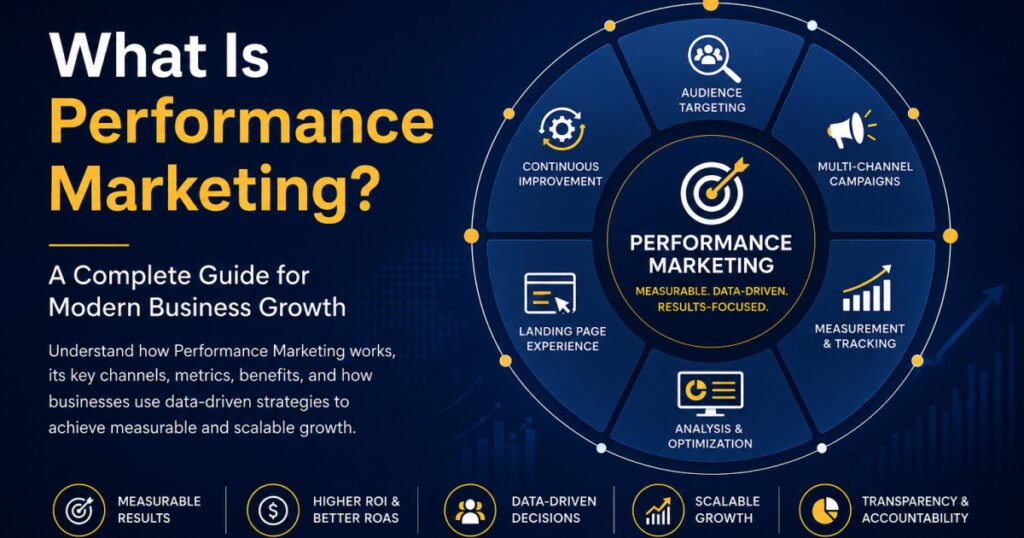
Traditional marketing often measures success through impressions, reach, or brand awareness, but modern businesses need more than visibility—they need measurable business outcomes. Whether the goal is generating qualified leads, increasing online sales, acquiring customers, or improving return on investment (ROI), every marketing activity should contribute directly to business growth.
This is where Performance Marketing has transformed the way businesses approach customer acquisition. Instead of relying on assumptions or broad advertising campaigns, Performance Marketing focuses on measurable results such as clicks, leads, conversions, sales, and revenue. Every campaign is continuously tracked, analyzed, and optimized to maximize performance.
However, successful Performance Marketing is about far more than simply running Google Ads or Meta Ads. It combines audience intelligence, data-driven decision-making, conversion-focused landing pages, creative optimization, analytics, and continuous improvement to create predictable customer acquisition systems that scale with your business.
In this guide, you’ll learn what Performance Marketing is, how it works, its key channels, essential performance metrics, common mistakes to avoid, and why modern businesses achieve the best results when Performance Marketing operates as part of a connected Growth Infrastructure rather than an isolated marketing activity.
Table of Contents
What Is Performance Marketing?
Performance Marketing is a data-driven marketing approach where businesses pay for measurable outcomes rather than simply paying for advertising exposure. Instead of focusing only on impressions or brand awareness, every campaign is designed to achieve specific business objectives such as generating qualified leads, driving online sales, increasing app installs, or acquiring new customers. Every click, conversion, and customer interaction is tracked, measured, and continuously optimized to improve return on investment (ROI).
Unlike traditional marketing, where success is often difficult to quantify, Performance Marketing relies on real-time data to evaluate campaign effectiveness. Marketers can monitor key performance indicators (KPIs) such as click-through rate (CTR), conversion rate, cost per acquisition (CPA), return on ad spend (ROAS), and customer lifetime value (CLV) to understand exactly how marketing investments contribute to business growth.
Performance Marketing extends far beyond Google Ads. It includes multiple customer acquisition channels such as Google Search Ads, Meta Ads, LinkedIn Ads, YouTube Ads, Microsoft Advertising, Amazon Ads, affiliate marketing, native advertising, and other digital platforms where campaigns can be measured, optimized, and scaled based on performance data.
For modern businesses, Performance Marketing is no longer just about running advertisements. It is about building an intelligent customer acquisition system that combines audience research, campaign strategy, creative testing, landing page optimization, analytics, attribution, and continuous optimization to generate predictable and sustainable business growth.
Why Is It Called Performance Marketing?
The term Performance Marketing comes from the fact that every marketing activity is evaluated based on measurable performance rather than assumptions. Instead of paying solely for advertising visibility, businesses invest in campaigns that are optimized around defined objectives such as clicks, leads, purchases, sign-ups, phone calls, or revenue.
Because campaign performance can be monitored in real time, marketers can identify what’s working, eliminate underperforming campaigns, optimize budgets, refine audience targeting, improve ad creatives, and continuously increase marketing efficiency. This data-driven approach makes Performance Marketing one of the most accountable and scalable forms of digital marketing available today.
How Performance Marketing Differs from Traditional Marketing
Traditional marketing often focuses on creating awareness through channels such as television, radio, newspapers, magazines, billboards, and print advertising. While these methods can increase brand visibility, measuring their direct impact on customer acquisition or revenue is often difficult.
Performance Marketing, on the other hand, is built around measurable business outcomes. Every campaign is tracked using analytics and conversion data, allowing businesses to understand exactly how their marketing budget contributes to leads, sales, and revenue. This transparency enables continuous optimization, better budget allocation, and improved marketing performance over time.
| Traditional Marketing | Performance Marketing |
| Focuses on brand awareness | Focuses on measurable business outcomes |
| Success is difficult to measure | Every campaign is fully measurable |
| Limited optimization after launch | Continuous optimization using real-time data |
| Broad audience targeting | Highly targeted audience segmentation |
| Budget based on estimated exposure | Budget optimized based on actual performance |
| ROI often difficult to calculate | ROI measured using real business metrics |
How Performance Marketing Works
Performance Marketing follows a structured process where every marketing decision is guided by data rather than assumptions. Instead of launching campaigns and hoping for results, businesses continuously analyze customer behavior, optimize campaigns, improve conversion experiences, and allocate budgets based on measurable performance. This systematic approach helps maximize return on investment while reducing wasted advertising spend.
Unlike traditional marketing, where campaigns often end after launch, Performance Marketing is an ongoing cycle of testing, learning, optimization, and scaling. Every interaction provides valuable insights that help improve future campaigns and customer acquisition strategies.
1. Audience Research and Market Intelligence
Every successful Performance Marketing campaign begins with understanding the audience. Businesses need to identify who their ideal customers are, what problems they are trying to solve, how they search for solutions, which platforms they use, and what influences their purchasing decisions.
This research helps marketers create highly targeted campaigns that reach the right audience at the right stage of the buying journey, resulting in higher engagement, better lead quality, and improved conversion rates.
2. Campaign Strategy and Traffic Acquisition
Once the audience has been defined, businesses choose the most suitable marketing channels based on their objectives. Depending on the target audience and campaign goals, this may include Google Search Ads, Meta Ads, LinkedIn Ads, YouTube Ads, Microsoft Advertising, Amazon Ads, or other performance-driven platforms.
Rather than spreading budgets across every platform, Performance Marketing focuses on investing where campaigns generate the strongest business outcomes. Every campaign is built around a well-defined Performance Marketing strategy, clear objectives, audience targeting, compelling creatives, and measurable conversion goals.
3. Landing Pages and Conversion Experience
Driving traffic is only one part of the equation. Visitors need a seamless experience after clicking an advertisement. High-performing landing pages are designed to build trust, communicate value clearly, reduce friction, and guide visitors toward taking a specific action.
Whether the objective is generating leads, scheduling consultations, or completing online purchases, the landing page plays a critical role in determining campaign success. Even the most effective advertising campaign can underperform if the post-click experience fails to convert visitors.
4. Measurement, Optimization, and Scaling
After campaigns go live, Performance Marketing becomes a process of continuous improvement. Marketers monitor campaign performance, evaluate key metrics, test new creatives, refine audience targeting, optimize bidding strategies, and improve landing pages based on real user behavior.
Campaigns that consistently deliver positive business outcomes receive additional investment, while underperforming campaigns are refined or discontinued. This continuous optimization enables businesses to improve marketing efficiency over time while creating a scalable customer acquisition system.
Performance Marketing isn’t a one-time advertising campaign. It’s a continuous process of understanding audiences, attracting qualified visitors, optimizing customer experiences, and improving measurable business outcomes through ongoing data-driven decisions.
The Core Channels of Performance Marketing
Performance Marketing is not limited to a single advertising platform. Modern businesses use multiple digital channels to reach potential customers at different stages of the buying journey. Each channel offers unique targeting capabilities, campaign objectives, and opportunities to generate measurable business outcomes. The most effective Performance Marketing strategies combine multiple channels into a connected customer acquisition system rather than relying on a single platform.
Google Ads
Google Ads enables businesses to reach people who are actively searching for products, services, or solutions. Campaigns can appear across Google Search, Shopping, Display, YouTube, and other Google properties, allowing businesses to capture high-intent traffic at the moment customers are expressing demand. With advanced targeting, bidding strategies, and conversion tracking, Google Ads remains one of the most effective channels for generating qualified leads and sales.
Meta Ads
Meta Ads help businesses reach audiences across Facebook, Instagram, Messenger, and the Meta Audience Network. Unlike search advertising, Meta focuses on demand generation by introducing products and services to users based on demographics, interests, online behavior, and engagement patterns. It is particularly effective for brand awareness, lead generation, remarketing, and ecommerce campaigns.
LinkedIn Ads
LinkedIn Ads provide highly targeted advertising opportunities for B2B organizations. Businesses can target professionals based on job titles, industries, company size, seniority, skills, and professional interests, making LinkedIn one of the most effective platforms for lead generation, account-based marketing (ABM), and executive-level outreach.
YouTube Ads
YouTube Ads enable businesses to engage audiences through video content across the world’s largest video platform. Whether the objective is increasing brand awareness, educating potential customers, or driving conversions, video advertising allows businesses to communicate complex messages more effectively while reaching highly targeted audiences through Google’s advertising ecosystem.
Microsoft Advertising
Microsoft Advertising allows businesses to reach users across Bing, Yahoo, AOL, and Microsoft partner networks. Although it often receives less attention than Google Ads, it can provide lower competition, competitive cost-per-click (CPC), and access to audiences that may not be reached through Google alone, making it a valuable addition to a diversified Performance Marketing strategy.
Amazon Ads
For ecommerce businesses and product-based brands, Amazon Ads provide direct access to customers who are already searching for products with strong purchase intent. Sponsored Products, Sponsored Brands, and Sponsored Display campaigns help businesses increase product visibility, improve sales, and compete effectively within Amazon’s marketplace.
Affiliate Marketing
Affiliate Marketing enables businesses to partner with publishers, creators, influencers, and industry websites that promote products or services in exchange for a commission on successful sales or conversions. Since businesses typically pay only when predefined actions occur, affiliate marketing aligns naturally with the performance-based approach.
Native Advertising
Native Advertising delivers promotional content that matches the design and user experience of the platform where it appears. Because these advertisements integrate naturally into the surrounding content, they often generate higher engagement while creating a less disruptive experience for users.
Successful Performance Marketing doesn’t rely on a single advertising platform. Businesses achieve sustainable growth by selecting the right mix of channels based on customer behavior, business objectives, and measurable performance data.
Performance Marketing Metrics That Actually Matter
One of the biggest advantages of Performance Marketing is the ability to measure almost every stage of the customer journey. Unlike traditional marketing, where success is often based on estimated reach or impressions, Performance Marketing relies on measurable business data to evaluate campaign effectiveness and identify opportunities for continuous improvement. Platforms such as Google Analytics help businesses understand user behavior, traffic sources, conversion paths, and campaign performance, enabling more informed marketing decisions.
However, not every metric deserves equal attention. While metrics such as impressions, clicks, and engagement provide useful campaign insights, they don’t always indicate business success. Modern businesses should prioritize metrics that directly influence customer acquisition, profitability, and long-term growth.
Return on Ad Spend (ROAS)
Return on Ad Spend (ROAS) measures how much revenue is generated for every dollar spent on advertising. It is one of the most widely used performance indicators because it directly reflects the profitability of advertising campaigns. A higher ROAS generally indicates that campaigns are generating stronger business returns, although the ideal benchmark varies depending on industry, business model, and profit margins.
Cost Per Acquisition (CPA)
Cost Per Acquisition (CPA) represents the average cost of acquiring a new customer or lead. Rather than focusing only on traffic volume, CPA helps businesses understand how efficiently their advertising budget converts into meaningful business outcomes. Reducing CPA while maintaining lead quality is often a primary objective of Performance Marketing optimization.
Conversion Rate
Conversion Rate measures the percentage of visitors who complete a desired action, such as submitting a contact form, purchasing a product, scheduling a consultation, or downloading a resource. A strong conversion rate often reflects effective audience targeting, compelling messaging, and a well-optimized user experience.
Customer Acquisition Cost (CAC)
Customer Acquisition Cost (CAC) calculates the total investment required to acquire a new customer across marketing and sales activities. Unlike campaign-specific metrics, CAC provides a broader understanding of how efficiently a business is growing and whether its customer acquisition strategy remains financially sustainable.
Customer Lifetime Value (CLV)
Customer Lifetime Value (CLV) estimates the total revenue a customer is expected to generate throughout their relationship with a business. Understanding CLV helps organizations make better decisions about advertising budgets, customer retention strategies, and long-term marketing investments. Businesses with higher lifetime value can often invest more aggressively in customer acquisition while remaining profitable.
Click-Through Rate (CTR)
Click-Through Rate (CTR) measures the percentage of users who click on an advertisement after seeing it. While CTR helps evaluate the effectiveness of ad copy, creatives, and audience targeting, it should never be viewed in isolation. High click-through rates without meaningful conversions rarely contribute to sustainable business growth.
| Metric | What It Measures | Why It Matters |
| ROAS | Revenue generated from advertising | Measures campaign profitability |
| CPA | Cost to acquire a lead or customer | Evaluates acquisition efficiency |
| Conversion Rate | Percentage of visitors completing a desired action | Measures website and campaign effectiveness |
| CAC | Total customer acquisition investment | Indicates long-term business sustainability |
| CLV | Revenue generated throughout the customer relationship | Supports long-term growth decisions |
| CTR | Percentage of users clicking an advertisement | Evaluates ad relevance and engagement |
Performance Marketing isn’t about maximizing clicks—it’s about maximizing profitable business outcomes. The most successful businesses focus on metrics that directly impact revenue, customer acquisition, and long-term growth rather than chasing vanity metrics.
Benefits of Performance Marketing
Performance Marketing has become one of the most effective approaches to customer acquisition because every decision is supported by measurable data rather than assumptions. Instead of relying on fixed campaigns that cannot easily be adjusted, businesses can continuously improve performance by analyzing real customer behavior, optimizing campaigns, and investing in strategies that generate the strongest business outcomes.
Whether the objective is generating qualified leads, increasing online sales, improving return on investment, or expanding into new markets, Performance Marketing provides businesses with the flexibility and accountability needed to support sustainable growth.
Measurable Return on Investment
One of the biggest advantages of Performance Marketing is complete transparency. Every campaign can be measured using business-focused metrics such as leads, sales, revenue, customer acquisition cost, and return on ad spend. This visibility allows businesses to understand exactly how their marketing investment contributes to growth and make informed decisions based on measurable results.
Highly Targeted Customer Acquisition
Modern advertising platforms allow businesses to reach highly specific audiences based on demographics, interests, online behavior, search intent, professional roles, purchasing habits, and previous interactions. This precision helps reduce wasted advertising spend while increasing the likelihood of attracting qualified prospects who are more likely to convert.
Continuous Campaign Optimization
Unlike traditional advertising, Performance Marketing campaigns are continuously monitored and refined. Audience targeting, bidding strategies, ad creatives, messaging, and landing pages can all be improved based on real-time performance data, allowing businesses to increase efficiency and maximize campaign performance over time.
Scalable Business Growth
As campaigns become more profitable, businesses can confidently increase investment while maintaining performance. Because decisions are supported by measurable data, Performance Marketing provides a structured path for scaling customer acquisition without relying on guesswork or assumptions.
Faster Market Validation
Performance Marketing allows businesses to test new products, services, offers, messaging, audiences, and creative concepts quickly. Instead of waiting months to evaluate marketing effectiveness, organizations can gather meaningful insights within days or weeks and use that information to improve future campaigns.
Better Marketing Decisions Through Data
Every campaign generates valuable customer insights that extend beyond advertising. Businesses gain a deeper understanding of customer behavior, buying intent, audience preferences, conversion patterns, and campaign performance, enabling smarter decisions across sales, marketing, website optimization, and future growth initiatives.
| Traditional Marketing | Performance Marketing |
| Limited campaign visibility | Complete performance transparency |
| Broad audience targeting | Precision audience targeting |
| Difficult ROI measurement | Real-time ROI measurement |
| Fixed campaign execution | Continuous optimization |
| Limited testing capabilities | Ongoing experimentation and improvement |
| Decisions based on assumptions | Decisions based on measurable data |
Performance Marketing gives businesses the ability to measure, optimize, and scale customer acquisition with confidence. Instead of relying on assumptions, every marketing decision is supported by real performance data that drives continuous business growth.
Performance Marketing vs Digital Marketing
Although the terms Performance Marketing and Digital Marketing are often used interchangeably, they are not the same. Performance Marketing is a specialized approach within Digital Marketing that focuses exclusively on measurable business outcomes. Digital Marketing, on the other hand, is a broader discipline that includes every online marketing activity, regardless of whether its impact can be directly measured.
Digital Marketing encompasses channels and strategies such as search engine optimization (SEO), content marketing, email marketing, social media marketing, online public relations, influencer marketing, video marketing, and paid advertising. Some of these activities aim to build long-term brand awareness and customer relationships, while others focus on immediate customer acquisition.
Performance Marketing specifically emphasizes accountability. Every campaign is designed around measurable objectives such as leads, sales, app installs, or revenue, allowing businesses to optimize marketing investments based on real performance data.
Rather than replacing Digital Marketing, Performance Marketing complements it. Businesses that combine long-term brand-building strategies with data-driven customer acquisition often achieve stronger and more sustainable growth than those relying on a single marketing approach.
| Digital Marketing | Performance Marketing |
| Broad marketing discipline | Specialized customer acquisition approach |
| Includes organic and paid channels | Focuses primarily on measurable campaigns |
| Supports long-term brand growth | Optimizes measurable business outcomes |
| Success measured through multiple business objectives | Success measured through predefined performance metrics |
| May not always produce immediate results | Designed for continuous optimization and measurable ROI |
| Includes SEO, content, email, social media, PR, and advertising | Includes Google Ads, Meta Ads, LinkedIn Ads, YouTube Ads, Amazon Ads, affiliate marketing, and other measurable acquisition channels |
Digital Marketing defines the overall strategy, while Performance Marketing focuses on measurable customer acquisition. Businesses achieve the strongest results when both work together as part of a connected growth strategy rather than operating independently.
Performance Marketing vs Brand Marketing
Performance Marketing and Brand Marketing are often positioned as competing strategies, but the most successful businesses understand that they serve different purposes. Rather than replacing one another, they work together to support sustainable business growth.
Brand Marketing focuses on building awareness, credibility, trust, and long-term customer relationships. It influences how people perceive a business, strengthens brand recognition, and increases the likelihood that customers will choose a company when they are ready to buy. While these outcomes are valuable, they are often difficult to measure directly and typically require a longer investment horizon.
Performance Marketing, on the other hand, is designed to generate measurable business outcomes. Every campaign is optimized around specific objectives such as leads, sales, registrations, appointments, or revenue. Businesses can track campaign performance in real time, measure return on investment, and continuously improve results through testing and optimization.
The strongest businesses do not choose between Brand Marketing and Performance Marketing—they integrate both. Brand Marketing creates trust before customers are ready to purchase, while Performance Marketing converts that trust into measurable business outcomes. As brand awareness and credibility grow, Performance Marketing campaigns often become more efficient, resulting in lower customer acquisition costs, higher conversion rates, and stronger long-term returns.
| Brand Marketing | Performance Marketing |
| Builds awareness and trust | Generates measurable business outcomes |
| Long-term strategic investment | Immediate and measurable customer acquisition |
| Success measured through perception and recognition | Success measured through leads, sales, and revenue |
| Focuses on emotional connection | Focuses on measurable performance |
| Difficult to attribute directly | Fully measurable and continuously optimized |
| Supports long-term brand equity | Supports scalable business growth |
Brand Marketing builds trust. Performance Marketing converts trust into customers. Businesses that combine both create stronger competitive advantages than those relying on either approach alone.
Common Performance Marketing Mistakes Businesses Should Avoid
Many businesses invest significant budgets into Performance Marketing but fail to achieve consistent results. In most cases, the problem isn’t the advertising platform—it’s the absence of a connected strategy. Running campaigns without clear objectives, optimized customer experiences, accurate measurement, or continuous optimization often leads to wasted budget and disappointing business outcomes.
Understanding these common mistakes can help businesses build a more sustainable and scalable customer acquisition system.
Running Campaigns Without a Clear Strategy
Many businesses launch advertising campaigns simply because their competitors are doing so or because they want immediate results. Without clearly defined business objectives, audience research, budget planning, and performance benchmarks, campaigns often generate traffic without delivering meaningful business outcomes.
Successful Performance Marketing begins with a well-defined strategy that aligns marketing activities with overall business goals.
Sending Traffic to Poorly Optimized Landing Pages
Even highly targeted advertising campaigns can underperform when visitors arrive on slow, confusing, or poorly structured landing pages. If the user experience creates friction or fails to communicate value clearly, potential customers are likely to leave without taking action.
A high-performing landing page should match the user’s intent, build trust, communicate value quickly, and make the next step simple and intuitive.
Ignoring Conversion Optimization
Driving more traffic does not automatically generate more customers. Businesses that focus only on increasing clicks while ignoring conversion optimization often see rising advertising costs without meaningful improvements in revenue.
Small improvements in user experience, messaging, calls-to-action, and conversion journeys can significantly improve campaign performance without increasing advertising spend.
Measuring Vanity Metrics Instead of Business Outcomes
High impressions, likes, shares, or click-through rates may appear encouraging, but they do not always indicate business success. Businesses should focus on metrics that directly influence growth, including qualified leads, customer acquisition cost, return on ad spend, customer lifetime value, and revenue.
Performance Marketing becomes far more valuable when marketing decisions are driven by business outcomes rather than vanity metrics.
Treating Every Marketing Channel as an Independent Activit
Many organizations manage SEO, paid advertising, website optimization, content marketing, and automation as separate initiatives. This fragmented approach often creates inconsistent customer experiences, duplicated efforts, and missed growth opportunities.
The most successful businesses integrate these activities into connected growth systems where every marketing function supports the next stage of the customer journey.
Failing to Continuously Test and Optimize
Performance Marketing is not a “set it and forget it” strategy. Customer behavior, competition, advertising costs, and market conditions change continuously. Businesses that fail to test creatives, optimize campaigns, refine audience targeting, and improve landing pages often experience declining performance over time.
Continuous experimentation and optimization allow businesses to adapt, improve efficiency, and maintain long-term growth.
The biggest Performance Marketing mistake isn’t choosing the wrong advertising platform—it’s treating customer acquisition as a collection of disconnected activities instead of a connected growth system.
Performance Marketing Delivers Better Results as Part of a Connected Growth System
Performance Marketing is highly effective at generating measurable business outcomes, but advertising alone cannot create sustainable growth. Businesses often invest heavily in paid campaigns while overlooking the systems that influence customer experience, conversion, brand trust, and long-term visibility. As a result, campaigns may generate traffic but fail to deliver their full business potential.
The highest-performing businesses don’t treat Performance Marketing as an isolated activity. Instead, they integrate it with the systems that support every stage of the customer journey—from attracting the right audience and creating exceptional digital experiences to building authority and improving operational efficiency. This connected approach enables every marketing investment to work harder and deliver greater long-term value.
At Mavenify, Performance Marketing is one component of The Mavenify Growth System™, where each Growth System supports the others to create sustainable business growth.
Search Intelligence Infrastructure™ improves long-term discoverability across search engines and AI-powered search experiences.
Revenue-Focused Web Infrastructure™ creates fast, scalable, and conversion-ready digital experiences.
Conversion Architecture System™ transforms more visitors into qualified leads and customers.
AI Content & Authority System™ builds trust, credibility, and topical authority that strengthen both organic and paid marketing efforts.
AI Automation Infrastructure™ streamlines operations, improves efficiency, and supports business scalability.
This systems-first approach is what transforms Performance Marketing from a collection of advertising campaigns into a scalable Growth Infrastructure that supports long-term business success.
Performance Marketing generates demand, but sustainable business growth happens when advertising, websites, search visibility, customer experience, authority, and automation work together as connected systems rather than isolated marketing activities.
Final Thoughts
Performance Marketing has fundamentally changed the way businesses approach customer acquisition. Instead of relying on assumptions or measuring success through vanity metrics, organizations can make informed decisions based on real customer behavior, measurable business outcomes, and continuous optimization. Whether the objective is generating qualified leads, increasing online sales, or expanding into new markets, Performance Marketing provides the transparency and accountability needed to support sustainable growth.
However, successful Performance Marketing is about much more than launching advertising campaigns. Long-term success depends on understanding your audience, creating exceptional digital experiences, optimizing conversion journeys, building trust, and continuously improving every stage of the customer journey. Businesses that treat Performance Marketing as an isolated activity often struggle to achieve consistent results, while those that integrate it with broader business systems create stronger competitive advantages over time.
At Mavenify, we believe that sustainable growth comes from connected systems rather than disconnected marketing activities. Our Performance Marketing System™ works alongside Search Intelligence Infrastructure™, Revenue-Focused Web Infrastructure™, Conversion Architecture System™, AI Content & Authority System™, and AI Automation Infrastructure™ to help businesses build scalable customer acquisition strategies that support long-term business growth.
If your business is ready to move beyond running advertisements and start building a measurable customer acquisition system, the right strategy can transform marketing from a cost centre into a sustainable growth engine.