

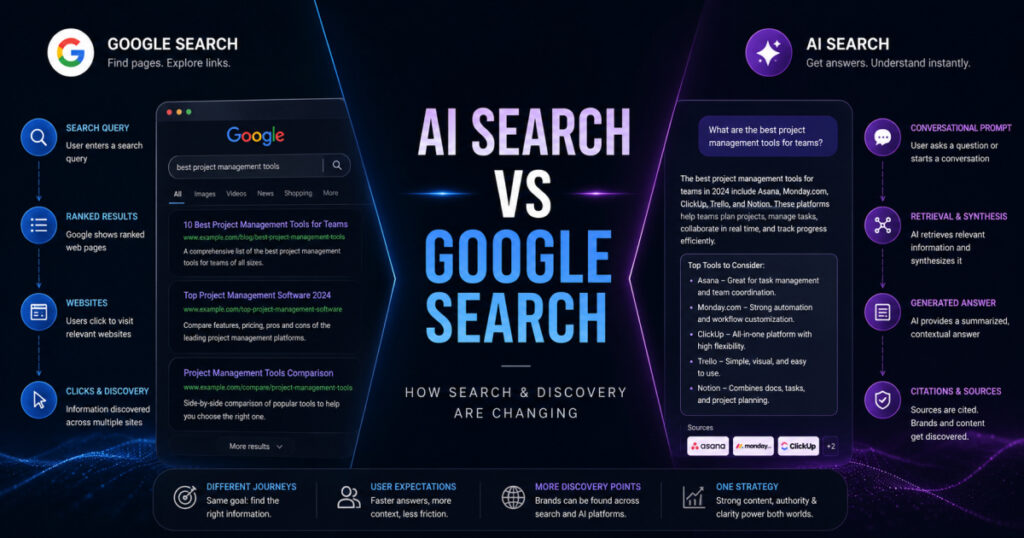
Search is changing from a system built primarily around ranked webpages into a broader discovery environment that increasingly includes AI-generated answers. Traditional Google Search helps users discover information through search results, while AI-powered search can interpret complex questions, retrieve information from multiple sources, and synthesize responses directly within the search experience.
This shift has created an important distinction between AI search and traditional search. Instead of simply deciding which webpage should rank first, AI-powered discovery systems may summarize information, compare options, cite sources, recommend brands, and respond to conversational follow-up questions. At the same time, traditional search remains a critical part of how people discover websites, businesses, products, and information online.
Understanding AI Search vs Google Search is therefore not about deciding which one will “win.” It is about understanding how the two discovery models differ, where they increasingly overlap, and what those changes mean for businesses, marketers, content creators, and SEO strategies.
Table of Contents
What Is AI Search?
AI search is a form of information discovery in which artificial intelligence helps interpret a user’s question, retrieve relevant information, and generate or synthesize a response. Rather than presenting only a ranked list of webpages, an AI search experience can combine information from multiple sources into a direct answer tailored to the context of the query.
AI search can also support more conversational interactions. Users may ask detailed questions, refine their requirements, request comparisons, add constraints, or continue with follow-up prompts without starting an entirely new search journey. Depending on the platform and query, the response may include citations, source links, recommendations, products, images, or other supporting information.
How Is AI Search Different From a Traditional Search Engine?
A traditional search engine primarily helps users identify relevant webpages and resources, leaving the user to visit and evaluate those sources. AI search can move part of that evaluation process into the search experience itself by extracting, combining, and presenting information as a synthesized response.
The distinction is not absolute. Modern search engines increasingly incorporate generative AI features, while AI assistants can retrieve information from the web and provide source links. As a result, traditional search and generative AI search are increasingly converging rather than developing as completely separate systems.
What Is Google Search and How Does It Work?
Google Search is a search engine that discovers, organizes, and ranks information from across the web to help users find relevant answers, websites, businesses, products, images, videos, and other resources. Traditionally, the search experience has centered on a search results page where users evaluate different results and choose which sources to visit.
Behind that experience, Google uses automated systems to discover and crawl webpages, understand and index their content, and determine which results are most relevant and useful for a particular search. Factors such as query intent, content relevance, page quality, usability, context, and many other signals can influence what appears within search results.
How Does Traditional Google Search Present Information?
Traditional Google Search generally presents multiple results and search features rather than generating one consolidated answer from all available information. Depending on the query, users may encounter organic listings, featured snippets, local results, images, videos, shopping results, knowledge panels, advertisements, and other search features.
This model gives users access to multiple sources and allows them to decide which websites they want to explore. For businesses, visibility has therefore traditionally focused heavily on achieving prominent organic rankings, appearing within relevant search features, and attracting qualified clicks from search results.
Is Google Search Still a Traditional Search Engine?
Google can no longer be described only as a traditional list-based search engine. Its search experience has evolved to incorporate machine learning, natural language understanding, rich search features, and generative AI experiences that can provide synthesized responses alongside conventional search results.
This makes the distinction between AI search and Google Search increasingly nuanced. Google continues to operate a large-scale search and discovery ecosystem while simultaneously integrating AI-generated experiences into that ecosystem. In practice, users may encounter both traditional search results and AI-assisted discovery within the same search journey.
AI Search vs Google Search: What Is the Difference?
The fundamental difference between AI search and traditional Google Search is how information is presented and how much of the discovery process occurs within the search interface itself. Traditional search primarily connects users with relevant sources, while AI search can retrieve information from sources and synthesize it into a direct response.
However, this distinction is becoming less rigid as Google introduces more AI-powered search experiences and AI platforms incorporate web search, citations, and source links. The comparison is therefore best understood as two different discovery models that are increasingly beginning to overlap.
| Factor | Traditional Google Search | AI Search |
| Primary Experience | Ranked search results and search features | Generated or synthesized responses |
| User Interaction | Keywords and search queries | Conversational questions and prompts |
| Information Delivery | Users visit and evaluate multiple sources | AI can combine information from multiple sources |
| Follow-Up Questions | Often requires another search | Can support conversational follow-up prompts |
| Source Visibility | Websites are prominently displayed as results | Sources may appear as citations, links, mentions, or references |
| Brand Discovery | Rankings, local results, ads, snippets and other search features | Mentions, citations, recommendations and generated answers |
| Optimization Focus | SEO, content relevance, technical health and authority | SEO foundations plus entities, retrievability, authority and answer-oriented content |
| User Journey | Search → evaluate results → visit website | Ask → receive answer → refine, verify or visit sources |
Which Is Better: AI Search or Google Search?
Neither model is universally better. The most useful experience depends on what the user is trying to accomplish. Traditional search can be particularly valuable when users want to explore multiple sources, navigate directly to a website, find local businesses, shop, or conduct their own research across different perspectives.
AI search can be particularly useful for complex questions, summaries, comparisons, exploratory research, and conversational discovery where synthesizing information can reduce the effort required to understand a topic. In many cases, users may move between both experiences during the same decision journey.
For businesses, the more important question is therefore not which search model will dominate, but whether the brand can be discovered across both traditional and AI-powered search environments.
How Do AI Search Engines Generate Answers?
AI search engines can combine language models with information retrieval systems to interpret a user’s question, identify relevant information, and construct a response. The exact process varies between platforms, but many AI-powered search experiences involve some combination of query understanding, information retrieval, source evaluation, response generation, and citation or attribution.
Unlike a conventional search results page that primarily presents sources for users to evaluate, generative AI search can synthesize information during the discovery process itself. This makes the quality, clarity, relevance, and authority of retrievable information increasingly important for brands that want to participate in AI-powered discovery.
1. Understanding the Query
The process begins with understanding what the user is actually asking. AI systems can interpret conversational language, relationships between concepts, context, and detailed constraints that may extend beyond a short keyword phrase.
For example, instead of searching only for “SEO agency,” a user might ask for an agency experienced in B2B SaaS, capable of supporting both traditional SEO and AI search visibility, and suitable for a particular market or growth stage. The additional context changes what information is relevant to the request.
2. Retrieving Relevant Information
Depending on the platform and query, an AI-powered search system may retrieve information from web indexes, webpages, databases, structured sources, or other available information systems. Retrieval helps ground the generated response in information relevant to the user’s question.
This is one reason technical accessibility remains important in an AI-search environment. Valuable information provides limited search visibility if relevant systems cannot reliably discover, access, or interpret it.
3. Evaluating Context and Sources
Retrieved information must then be considered in relation to the user’s question. Relevance, context, source quality, corroborating information, freshness, and other signals may influence which information is useful when constructing an answer.
Different platforms can evaluate and select sources differently, so there is no universal formula that guarantees a particular website will be used within an AI-generated response.
4. Synthesizing the Response
Generative AI can organize retrieved information into a response designed to address the user’s question directly. Depending on the query, this might involve explaining a concept, summarizing information, comparing alternatives, identifying options, or presenting recommendations.
This changes the discovery experience because users may receive substantial information before deciding whether they need to visit an individual website.
5. Providing Sources, Citations or Further Discovery
Some AI search experiences provide citations, source links, or other references that allow users to explore the information behind a generated response. In other situations, a brand or source may be mentioned within the answer without becoming the primary destination of the search journey.
For businesses, this expands the meaning of search visibility. Success may include not only earning a traditional organic click, but also being cited, referenced, mentioned, recommended, or otherwise surfaced during an AI-assisted discovery journey.
Do All AI Search Engines Work the Same Way?
No. AI search platforms can differ significantly in the models, search indexes, retrieval systems, data sources, ranking mechanisms, citation practices, and interfaces they use. Their behavior can also change as products and underlying technologies evolve.
Businesses should therefore avoid building their entire strategy around assumptions about one AI platform. A stronger approach is to develop accessible, authoritative, well-structured information and a credible digital presence that can support discoverability across a broader search ecosystem.
How Is AI Changing Search Behavior?
AI-powered search is changing not only how information is presented, but also how people formulate questions and move through the discovery process. Traditional keyword searches remain common, but conversational interfaces allow users to express more context, requirements, preferences, and follow-up questions within a single search journey.
This creates search behavior that can be more exploratory and iterative. Instead of repeatedly modifying short keyword queries and visiting multiple webpages, users can ask increasingly specific questions while an AI system helps refine, summarize, compare, or expand the information they receive.
Search Queries Are Becoming More Conversational
Traditional search often encourages concise queries such as “best CRM software” or “SEO agency London.” AI search allows users to express the underlying need in considerably more detail, including their industry, budget, objectives, constraints, existing technology, or preferred approach.
For businesses, this means search visibility increasingly depends on understanding the broader questions surrounding customer problems rather than optimizing only for isolated keyword phrases.
Search Journeys Can Include More Follow-Up Questions
Conversational search allows users to refine a question without completely restarting the discovery process. Someone researching a solution might first ask what options exist, then compare several approaches, request recommendations for a particular situation, and finally investigate specific providers.
These follow-up interactions create a broader set of discovery opportunities. Content that clearly addresses related questions, comparisons, use cases, objections, and decision criteria can support visibility across more stages of that journey.
Users May Receive Answers Before Visiting a Website
In traditional organic search, reaching the answer often requires clicking a search result and consuming information on the destination website. AI-powered search can provide substantial information directly within the search experience before a website visit occurs.
This does not eliminate the value of websites. Instead, the website increasingly needs to function as the authoritative destination where users can verify expertise, explore deeper information, evaluate services, review evidence, and ultimately take action.
Search Discovery Is Becoming More Contextual
AI systems can interpret relationships between multiple elements of a request rather than relying exclusively on exact keyword matching. A user may describe a problem, business type, location, objective, constraints, and desired outcome within the same prompt.
This makes contextual relevance increasingly important. Businesses need to communicate clearly not only what they offer, but also who they serve, which problems they solve, where they operate, and the situations in which their expertise or products are relevant.
Brand Discovery Can Happen Inside an AI Answer
A user does not necessarily need to search for a company’s name to discover that company. AI-generated comparisons, recommendations, citations, and explanations can potentially introduce brands during broader informational or commercial research.
This expands the role of search from capturing existing demand to participating in the discovery and consideration process. Strong brand authority, clear positioning, useful content, credible third-party references, and consistent entity information can therefore become increasingly valuable.
Will AI Search Replace Google Search?
AI search is unlikely to make traditional search disappear entirely. Different search experiences serve different user needs, and many search journeys still depend on navigation, local discovery, shopping, real-time information, comparison across multiple sources, and direct access to websites.
What is changing is the role of the search results page itself. AI-generated answers can handle more of the research and interpretation that users previously performed by opening multiple search results. At the same time, conventional search results remain valuable when users want to explore sources independently, verify information, visit a specific destination, or complete an action.
AI Search and Traditional Search Are Converging
The distinction between AI search and traditional search is also becoming less clear. Search engines are incorporating generative AI into their existing experiences, while AI assistants are adding web retrieval, citations, links, shopping capabilities, and other search-oriented features.
Rather than viewing the future as “AI search versus Google,” it is more useful to think of search as becoming a hybrid discovery environment. Ranked webpages, AI-generated answers, citations, recommendations, local results, product listings, videos, images, and other formats can all contribute to how users discover information and businesses.
Websites Still Matter in an AI Search Environment
Even when an AI system provides the initial answer, websites remain important sources of detailed information, evidence, expertise, products, services, case studies, and conversion experiences. Businesses still need destinations where users can evaluate credibility, understand an offering in depth, and take meaningful action.
The strategic shift is therefore not from “websites to AI.” It is from optimizing only for website clicks toward building a digital presence that can support discovery both within search experiences and beyond them.
How Is AI Search Changing SEO?
AI search is expanding the scope of SEO rather than making search optimization irrelevant. Traditional SEO remains essential for helping search engines discover, crawl, understand, index, and rank website content, but businesses increasingly need to consider how their information may also be retrieved, interpreted, cited, or referenced within AI-generated experiences.
This creates a broader optimization challenge. Search visibility can no longer be viewed exclusively through keyword rankings and organic clicks; it can also include entity recognition, topical authority, citations, brand mentions, source references, and visibility across conversational search journeys.
1. Keywords Are Becoming Part of a Larger Intent Model
Keyword research remains valuable because search queries reveal demand, language, topics, and customer intent. However, conversational AI allows users to express significantly more context than a traditional short-form query.
SEO strategies should therefore connect individual keywords to broader topics, questions, use cases, comparisons, problems, and decision journeys rather than treating each keyword as an isolated optimization target.
2. Topical Authority Is Becoming More Important
A single optimized page may answer one query, but sustained visibility around a subject requires broader coverage. Businesses can strengthen topical relevance by developing connected resources that address the major concepts, questions, comparisons, use cases, and decisions surrounding their areas of expertise.
Strategic internal linking can then connect these resources into a coherent knowledge structure, helping users and search systems understand how individual pages relate to the broader topic.
3. Entity Clarity Matters Alongside Keyword Relevance
Search systems increasingly need to understand the people, organizations, products, services, locations, concepts, and relationships represented within digital content. Businesses should therefore communicate clearly who they are, what they offer, who they serve, and how their expertise relates to the topics they discuss.
Consistent organization information, clear service definitions, expert profiles, structured data, contextual internal links, and credible external references can all contribute to a stronger understanding of these relationships.
4. Content Needs to Be Useful Beyond the Search Result
Winning a ranking remains valuable, but content increasingly needs to function as useful information that can be understood, extracted, referenced, and evaluated across different discovery environments.
Clear definitions, direct answers, logical headings, comparisons, supporting evidence, examples, original insights, and well-organized information can improve the usefulness of content for both human readers and machine-driven retrieval systems.
5. Brand Authority Extends Beyond Your Own Website
Search visibility is influenced by more than what a business publishes about itself. Relevant third-party mentions, authoritative links, expert contributions, reviews, research citations, industry coverage, and other credible references can strengthen the broader digital footprint surrounding a brand.
This makes digital PR, reputation, expertise, and authority-building increasingly connected with modern search strategy rather than completely separate marketing activities.
6. SEO Measurement Is Expanding
Rankings, impressions, clicks, organic traffic, and conversions remain important performance indicators. However, businesses may increasingly need to monitor additional signals such as AI citations, brand mentions, prompt visibility, AI referral traffic, and the sources appearing within generative responses.
These metrics should complement traditional SEO reporting rather than replace it, creating a broader view of how a brand is being discovered across search environments.
This broader approach to search visibility is commonly associated with Generative Engine Optimization (GEO), which focuses on strengthening how information and brands can be discovered across generative and AI-powered search environments.
What Should Businesses Do to Stay Visible in Google and AI Search?
Businesses should not build completely separate strategies for traditional Google Search and AI-powered discovery. Many of the foundations that make information valuable and discoverable—technical accessibility, relevance, authority, clear entities, useful content, and credible external signals—can support visibility across both environments.
The objective is to build a connected search ecosystem where important information can be discovered, understood, trusted, and retrieved regardless of whether the customer begins with a traditional search query or a conversational AI prompt.
1. Maintain Strong Technical SEO Foundations
Ensure important content can be crawled, rendered, indexed, and understood by search engines. XML sitemaps, robots directives, canonicalization, internal linking, mobile usability, page performance, HTTPS, structured data, and overall site architecture remain important foundations.
AI search does not make technical SEO obsolete. If valuable information is difficult for search systems to discover or access, its potential visibility can be limited regardless of how useful the content may be.
2. Build Content Around Topics, Not Just Individual Keywords
Keyword research should inform content strategy, but businesses should also identify the broader topics, questions, comparisons, problems, and decisions surrounding their customers’ search journeys.
Comprehensive topic clusters can connect pillar resources with supporting articles, service pages, case studies, industry content, and other relevant information. This creates a stronger knowledge structure than publishing isolated pages for individual keywords.
3. Make Important Information Easy to Extract and Understand
Important questions should receive clear and direct answers. Descriptive headings, concise definitions, logical sections, lists, comparison tables, FAQs, examples, and supporting evidence can make information easier for both users and search systems to interpret.
This does not mean writing exclusively for machines. Content should remain useful and natural for human readers while presenting important information with enough clarity and structure to be understood outside the context of a single paragraph.
4. Strengthen Brand and Entity Signals
Clearly communicate the relationships between the organization, its services, people, expertise, industries, locations, methodologies, and other important entities. These relationships should remain reasonably consistent across the website and credible external properties.
About pages, expert profiles, service pages, case studies, structured data, contact information, industry pages, and third-party references can collectively strengthen the digital context surrounding a brand.
5. Build Authority Beyond Your Website
Businesses should look for legitimate opportunities to earn recognition from relevant external sources. Digital PR, expert commentary, industry publications, partnerships, research, interviews, reputable directories, podcasts, and other credible references can expand the information available about a brand across the web.
The goal is not simply to manufacture backlinks. External references are most valuable when they genuinely reinforce the connection between the organization and the subjects for which it wants to be recognized.
6. Connect Informational Content With Commercial Pages
Informational visibility becomes more valuable when users can naturally continue from education into evaluation and action. Relevant articles should therefore connect contextually with service pages, industry solutions, case studies, methodologies, and other commercial resources.
Internal links should support the user’s journey rather than functioning purely as an SEO tactic. The destination should genuinely help the reader take the next logical step.
7. Measure Both Search Visibility and Business Outcomes
Monitor traditional indicators such as rankings, impressions, clicks, organic traffic, conversions, and branded search demand alongside emerging AI-search signals such as citations, mentions, source links, prompt visibility, and referral traffic from AI platforms.
More importantly, connect visibility to commercial outcomes wherever possible. Qualified enquiries, consultations, opportunities, purchases, sign-ups, and revenue provide a clearer picture of whether increased discoverability is creating meaningful business value.
Businesses that approach Google Search and AI search as parts of the same evolving discovery ecosystem can build more resilient visibility than those optimizing for individual platforms in isolation.
SEO vs AI Search Optimization: What’s the Difference?
SEO and AI search optimization are closely connected, but they emphasize different aspects of digital discovery. Traditional SEO focuses primarily on improving visibility within search engine results, while AI search optimization also considers how information may be retrieved, interpreted, cited, mentioned, or recommended within AI-generated experiences.
These approaches should not be treated as competing strategies. Strong technical SEO, useful content, authority, internal linking, and clear site architecture provide important foundations for both. AI search optimization extends those foundations by placing additional emphasis on entity clarity, answer-oriented information, retrievability, external brand signals, and visibility across conversational discovery journeys.
| Area | Traditional SEO | AI Search Optimization |
| Primary Goal | Visibility within search results | Visibility within AI-powered discovery and generated responses |
| Typical Discovery | Search queries and ranked results | Conversational prompts and generated answers |
| Visibility Signals | Rankings, snippets, search features and clicks | Citations, mentions, recommendations, source links and referrals |
| Content Focus | Relevance, intent, quality and topical coverage | Clear answers, context, entities, evidence and retrievable information |
| Technical Foundation | Crawlability, indexability, architecture and performance | Builds on the same technical search foundations |
| Authority | Backlinks, expertise and trusted signals | Broader brand authority, citations, mentions and credible references |
| Measurement | Rankings, impressions, clicks, traffic and conversions | AI visibility plus traditional SEO and business outcomes |
Do Businesses Need Both SEO and AI Search Optimization?
In most cases, yes. Businesses should continue investing in established SEO practices while adapting their search strategies to account for AI-powered discovery. Abandoning traditional SEO in favor of platform-specific AI tactics can weaken the very foundations that help information become discoverable and authoritative.
A more resilient approach combines both disciplines within a broader search strategy, allowing the organization to compete for traditional organic visibility while also strengthening its presence across emerging AI search experiences.
How Mavenify Approaches Search Visibility
Mavenify approaches traditional and AI-powered search as parts of the same evolving discovery ecosystem. Rather than separating SEO, content, technical optimization, entity signals, and AI visibility into disconnected activities, our approach is designed to connect these elements within a broader search infrastructure.
Through Search Intelligence Infrastructure™, we combine technical search foundations, semantic and entity optimization, content authority, internal information architecture, AI search optimization, and performance measurement to help businesses build discoverability across both established and emerging search environments.
The objective is not to optimize a business for one algorithm or AI platform. It is to create a stronger digital information ecosystem that makes the organization easier to discover, understand, trust, and evaluate wherever relevant search journeys occur.
Frequently Asked Questions About AI Search vs Google Search
What Is the Main Difference Between AI Search and Google Search?
Traditional Google Search primarily helps users discover relevant webpages and search features, while AI search can retrieve information and synthesize it into generated responses. However, the distinction is becoming less rigid as Google integrates generative AI into Search and AI platforms add web retrieval, citations, and source links.
Is AI Search Better Than Google Search?
Neither is universally better. AI search can be useful for conversational questions, summaries, comparisons, and exploratory research, while traditional search remains valuable for navigating websites, discovering local businesses, shopping, evaluating multiple sources, and conducting independent research. Users may increasingly use both during the same search journey.
Will AI Search Replace Traditional Search Engines?
AI search is more likely to change and expand search than completely replace traditional search engines. Ranked webpages, AI-generated answers, local results, shopping experiences, videos, images, citations, and other discovery formats can coexist as search platforms continue to evolve.
Does Google Search Use Artificial Intelligence?
Yes. Google has used machine learning and AI technologies across Search for years and continues to integrate generative AI into its search experiences. As a result, Google Search increasingly combines established search and ranking systems with newer AI-powered discovery experiences.
How Do AI Search Engines Find Information?
AI search systems can use information retrieval technologies to identify relevant sources and combine retrieved information with language models to construct responses. The exact process, sources, indexes, models, and citation practices vary between platforms and can change as their technologies evolve.
How Can Businesses Appear in AI Search Results?
There is no guaranteed method for appearing in AI-generated responses. Businesses can strengthen their overall discoverability through technically accessible websites, useful and authoritative content, clear entity information, topical expertise, structured information, credible external references, and a strong digital presence across relevant sources.
Is SEO Still Important With AI Search?
Yes. Technical accessibility, indexable content, relevance, authority, internal linking, site architecture, and useful information remain important foundations for search visibility. AI-powered discovery expands what businesses may need to optimize and measure rather than making established SEO practices irrelevant.
What Is Generative Engine Optimization?
Generative Engine Optimization (GEO) is an approach to improving how brands and information can be discovered, understood, retrieved, cited, or recommended within generative and AI-powered search experiences. It complements traditional SEO by extending search strategy into emerging forms of AI-driven discovery.
The Future of Search Is Both AI and Traditional Search
AI search and Google Search should not be viewed as competing systems where one must eventually eliminate the other. Search is evolving into a broader discovery ecosystem where ranked webpages, AI-generated answers, citations, recommendations, local results, products, images, videos, and other experiences can all help users find and evaluate information.
For businesses, this evolution expands what search visibility means. Ranking prominently in traditional search remains valuable, but organizations increasingly need to consider whether their information can also be understood, retrieved, referenced, and surfaced within AI-powered discovery experiences.
The strongest long-term strategy is therefore not to chase individual algorithms or optimize exclusively for one search platform. It is to build technically accessible, authoritative, well-structured, and genuinely useful digital information that can support discovery wherever customers choose to search.
Build Search Visibility Across Google and AI
Mavenify helps businesses build connected search infrastructure designed for both traditional and AI-powered discovery. If you’re evaluating how your search strategy needs to evolve, we can help identify the technical, content, authority, and AI visibility opportunities that matter most.