

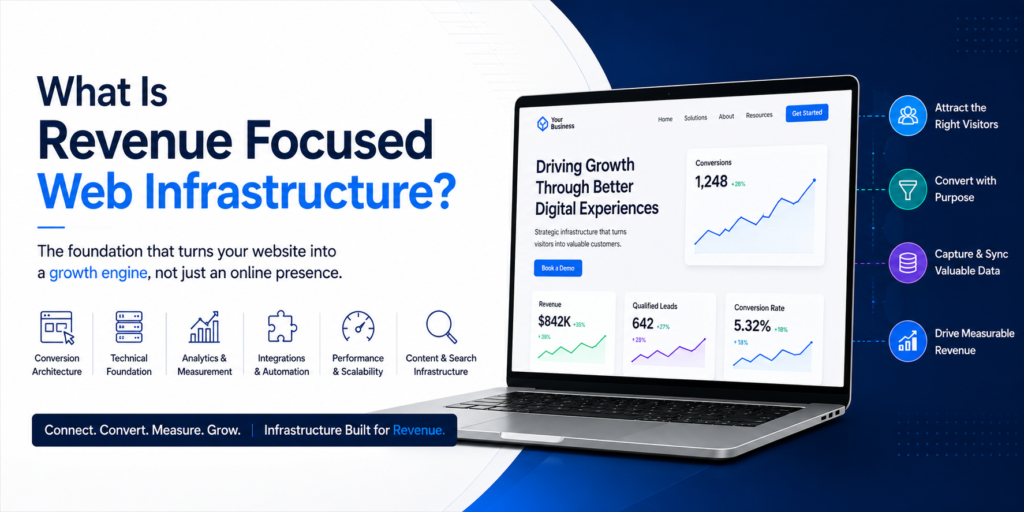
A website can look impressive, load quickly, and rank in search results without becoming a meaningful growth asset for the business behind it. Revenue focused web infrastructure takes a different approach by treating the website and its underlying systems as part of the company’s revenue engine rather than simply as a digital brochure.
A modern website sits at the intersection of multiple business functions. It can attract visitors through search and paid channels, communicate the value of an offer, capture leads, support transactions, collect customer data, connect with CRM and marketing systems, and provide the information businesses need to understand what is driving growth.
When these components operate as disconnected systems, businesses can lose opportunities between acquisition and revenue. Traffic may arrive without converting, leads may enter forms without reaching the right sales process, analytics may fail to capture meaningful actions, and teams may struggle to understand which parts of the digital experience are actually contributing to business performance. Mavenify’s Growth Strategy Framework addresses this fragmentation by connecting the systems that influence visibility, acquisition, conversion, authority, and scalability.
Revenue focused web infrastructure is designed to address this gap. It brings together the website, technical foundation, conversion pathways, integrations, analytics, performance, and supporting systems around a common objective: creating a digital environment that can attract the right users, move them toward meaningful actions, and support measurable business outcomes.
In this guide, we’ll explore what revenue focused web infrastructure means, how it differs from conventional website development, which components make up the infrastructure, why technical decisions can influence revenue, and how businesses can build a web environment that supports growth instead of simply existing online.
Table of Contents
What Does Revenue Focused Web Infrastructure Actually Mean?
Revenue focused web infrastructure is the combination of technology, website architecture, conversion systems, data, integrations, and operational foundations that enable a website to contribute directly to business growth.
It goes beyond the visible interface of a website. The front end may be what customers see, but the infrastructure behind it determines how effectively the website can collect information, process actions, connect systems, support marketing, and provide reliable data for business decisions.
More Than a Website Design
Traditional website projects often concentrate heavily on appearance, page structure, content, and basic functionality. Those elements matter, but they represent only one layer of what a business needs from its digital presence.
A revenue-focused approach asks additional questions: Can the website turn relevant traffic into meaningful actions? Can leads reach the right systems? Can marketing and sales teams access useful data? Can the site support changing campaigns and offers? Can the business identify where potential customers are being lost?
The objective is therefore not to make a website do everything. It is to ensure that the website and the systems surrounding it are deliberately designed around the business journey from acquisition to revenue.
The Website as Part of a Growth System
A website rarely operates in isolation. Visitors can arrive through paid advertising, organic search, social media, email, referrals, direct traffic, or other channels, and each source may bring people with different levels of intent.
The website needs to respond to those different journeys while maintaining a consistent path toward the appropriate next action. For one visitor that may mean making a purchase; for another, requesting a consultation, downloading information, booking a call, or starting a sales conversation.
This is why web infrastructure should be considered alongside acquisition and conversion strategy. The more effectively these systems work together, the easier it becomes to turn digital activity into measurable business outcomes.
Infrastructure Determines What the Website Can Support
The technical foundation of a website influences much more than page loading and visual performance. Architecture, hosting, content management, integrations, data structures, analytics, security, forms, APIs, and third-party systems can all affect what the website is capable of supporting as the business grows.
A website built only around today’s requirements can become difficult to adapt when the business introduces new campaigns, services, markets, customer journeys, or technology. A stronger infrastructure anticipates the need for change without turning every new requirement into a complete rebuild.
This makes scalability an important part of revenue-focused web infrastructure. The goal is to create a foundation that can evolve alongside the business while keeping the customer experience, data flow, and commercial objectives connected.
The Core Components of Revenue Focused Web Infrastructure
Revenue focused web infrastructure is not a single technology or website feature. It is a connected set of systems that allows the digital experience to support acquisition, conversion, measurement, and ongoing growth.
The exact technology will vary by business, but the underlying principles remain consistent: the infrastructure should support the customer journey, make important actions measurable, allow systems to exchange useful information, and remain flexible enough to evolve as the business grows.
Conversion Architecture
A website can attract substantial traffic and still generate limited business value if visitors are not given a clear and relevant path toward action. Conversion architecture focuses on how pages, offers, messaging, calls to action, forms, navigation, and other elements work together to move visitors toward meaningful outcomes.
The objective isn’t to make every page aggressively sales-focused. Different pages can serve different purposes depending on the visitor’s intent and stage in the buying journey. What matters is that the next logical action is clear and that unnecessary friction doesn’t prevent interested visitors from progressing.
This makes conversion architecture an important layer of revenue focused web infrastructure. Acquisition brings people into the digital environment, but the architecture of that environment influences what happens next.
Technical Website Foundation
The technical foundation determines how reliably and efficiently the website operates. This can include the content management system, hosting environment, code structure, database configuration, security, integrations, APIs, and other technical components that support the visible website experience.
A strong foundation should also make the website manageable as requirements change. New landing pages, campaigns, integrations, content, functionality, and tracking requirements should be possible without repeatedly creating technical bottlenecks or compromising the existing experience.
Technical decisions therefore have a broader commercial impact than they may initially appear to have. A fragile foundation can slow down experimentation and growth, while a well-structured one can give marketing and business teams more room to adapt.
Analytics and Measurement
A revenue-focused website needs to make important user actions measurable. Analytics can help businesses understand where visitors come from, how they interact with the website, which actions they complete, and where potential customers may leave the journey.
Measurement becomes more valuable when it goes beyond traffic volume. Businesses need visibility into meaningful events such as enquiries, purchases, bookings, downloads, qualified leads, and other actions that connect the website experience with commercial outcomes.
Reliable measurement also creates a feedback loop. Data can reveal where the experience is working, where friction exists, and which areas deserve further testing or improvement. Without that feedback, website optimization can become driven primarily by assumptions.
Marketing and CRM Integrations
A website becomes significantly more useful when it can exchange information with the systems responsible for marketing, sales, customer management, and operations. Forms, lead capture, CRM platforms, email systems, advertising platforms, payment systems, scheduling tools, and other applications can all play a role in the broader revenue journey.
The goal isn’t to connect every possible tool. It’s to make sure the systems that matter to the customer journey can communicate reliably. When a prospect submits an enquiry, for example, the information should reach the appropriate system, trigger the right process, and remain available for the teams responsible for qualification and follow-up.
Well-designed integrations can also reduce manual work and improve data consistency. Instead of repeatedly moving information between disconnected tools, businesses can create more reliable flows that allow marketing and sales teams to act on information while it is still useful.
Performance and Scalability
Website performance affects more than user experience. Slow or unreliable experiences can create friction during important moments in the customer journey, particularly when visitors are evaluating an offer, completing a form, making a purchase, or accessing the website from mobile devices.
Scalability is equally important. A website that performs well under normal conditions may struggle when traffic increases because of a campaign, product launch, seasonal demand, or other growth event. Revenue focused web infrastructure therefore needs to account for both current performance and future requirements.
Performance should also be considered alongside functionality. Removing useful features simply to make a website faster isn’t always the right answer. The better objective is to build an efficient technical environment where the features that contribute to customer and business outcomes can operate without creating unnecessary performance costs.
Content and Search Infrastructure
A revenue-focused website also needs an infrastructure that allows valuable content to be discovered, understood, maintained, and connected to the wider customer journey. This includes information architecture, page relationships, internal linking, structured content, metadata, and technical foundations that support search visibility.
Search visibility matters because many customer journeys begin before someone has any direct relationship with a brand. A potential customer may search for a problem, compare solutions, research a service, or look for specific information before they are ready to convert.
The website therefore needs to support both discoverability and decision-making. Content can attract relevant visitors, while well-structured pages and clear pathways can help those visitors understand the offer and move toward the appropriate next step. This is appropriate because Search Intelligence Infrastructure™ is specifically concerned with long-term discoverability across Google Search, AI search platforms, semantic search, and future search experiences.
Why Revenue Focused Web Infrastructure Matters for Growth
The components above become most valuable when they work together. A technically strong website with poor conversion paths may struggle to turn traffic into opportunities. A high-converting website with weak tracking may generate results that the business cannot properly measure. And a well-measured website with disconnected CRM and sales systems can still leave valuable opportunities sitting outside the growth process.
Revenue focused web infrastructure addresses these gaps by treating the website as a connected business system rather than a collection of pages.
Turning Traffic Into Meaningful Actions
Acquiring website traffic is only the beginning of the digital customer journey. The website needs to help relevant visitors understand what the business offers, determine whether it meets their needs, and take an appropriate next step.
That next step will depend on the business and the visitor’s intent. It might be a purchase, enquiry, consultation, booking, application, registration, or another meaningful action. Infrastructure should support these journeys without creating unnecessary complexity or friction.
Connecting Customer Data Across the Journey
A website can generate valuable customer information at multiple points in the journey. Forms, purchases, bookings, downloads, account activity, and other interactions can provide signals about customer needs and behaviour.
When that information can move reliably into the systems responsible for marketing, sales, and customer management, businesses gain a stronger foundation for follow-up, personalization, reporting, and optimization.
This is particularly important when multiple acquisition channels are involved. The website can become the connective layer between traffic sources, customer interactions, conversion events, and downstream business outcomes.
Creating a Foundation That Can Scale
Growth often introduces complexity. More traffic can require stronger infrastructure, more campaigns can create additional landing-page requirements, new services can change the customer journey, and expanding teams can introduce new systems and workflows.
A revenue-focused infrastructure is designed with this evolution in mind. Instead of treating every change as a separate website project, businesses can build a foundation that makes it easier to introduce new capabilities while maintaining consistency across the digital experience.
This is where infrastructure becomes a strategic asset. Website infrastructure for business growth isn’t simply about maintaining the current digital experience; it is about developing an environment that can support the next stage of growth.
Revenue Focused Web Infrastructure vs Traditional Website Development
A traditional website can be perfectly functional while still being poorly positioned to support measurable growth. The difference isn’t necessarily the visual quality of the website or the technology used to build it. It is the role the website is designed to play within the business.
A conventional website project often begins with questions about pages, design, functionality, and launch requirements. A revenue-focused approach starts with a broader question:
How should the digital environment contribute to the business’s growth and revenue objectives?
From Website Project to Business Infrastructure
Traditional website development often treats the website as a defined project with a beginning, a build phase, and a launch. Once the site goes live, ongoing improvements may happen periodically as new requirements emerge.
Revenue focused web infrastructure treats the website as an evolving business system. The infrastructure needs to support ongoing marketing, conversion optimization, analytics, integrations, content, experimentation, and changes in the customer journey.
This doesn’t mean every website needs complex technology or constant development. It means the technical and strategic decisions should be made according to what the business needs the website to accomplish.
From Pages to Customer Journeys
A traditional website is often organized primarily around pages and navigation. A revenue-focused website is also designed around the journeys visitors need to complete.
A visitor arriving from a search query may need educational information before considering a service. Someone arriving through a paid campaign may need a focused offer and a clear conversion path. An existing prospect may need access to pricing, proof, case studies, or a booking process.
Understanding these different journeys helps determine how pages should connect, what information should appear at each stage, and which actions should be measured. The website becomes an environment designed around user intent and business outcomes, rather than simply a collection of pages.
From Functionality to Measurable Outcomes
Traditional website requirements often focus on whether a feature works. A form should submit, a payment should process, a page should display correctly, and a navigation menu should function as expected.
A revenue focused website asks an additional question: what business outcome does the functionality support? A lead form isn’t valuable simply because it submits successfully. Its value comes from helping capture a relevant opportunity and moving that information into the appropriate follow-up process.
This way of thinking changes how technical decisions are evaluated. Features are not added simply because they are available; they are considered in relation to customer experience, operational requirements, measurement, and commercial value.
From Launch to Continuous Improvement
A website should not be considered finished simply because it has launched. Customer behaviour, market conditions, campaigns, technology, offers, and business priorities change over time.
A revenue-focused infrastructure makes continuous improvement easier by providing the systems and data needed to identify opportunities, test changes, and understand their impact. This creates a cycle of measure → learn → improve → scale.
Over time, this approach can help the website become more aligned with how the business actually acquires, converts, and retains customers rather than remaining fixed around the assumptions made when it was first built.
How Revenue Focused Web Infrastructure Supports Different Growth Channels
A business may use several channels to generate demand, but those channels ultimately depend on the website and supporting systems to handle what happens after someone arrives. Revenue focused web infrastructure provides the foundation that connects those acquisition activities with the next stages of the customer journey.
Paid Acquisition
Paid advertising can generate targeted traffic quickly, but the website determines much of what happens after the click. Landing experiences, conversion paths, tracking, forms, offers, and integrations all influence whether paid traffic can become a measurable business outcome.
The infrastructure should therefore support campaign-specific experiences while making important actions measurable. This allows businesses to evaluate not only how much traffic campaigns generate, but also what happens after that traffic reaches the website.
Organic Search
Organic search can introduce potential customers to a business at different stages of the research and decision-making process. The website needs to provide useful information while also creating clear pathways toward relevant services, products, or other commercial actions.
This makes technical structure, content organization, internal linking, page relationships, and discoverability important parts of the overall infrastructure rather than isolated SEO tasks.
Social and Referral Traffic
Social media, partnerships, referrals, email, and other channels can introduce visitors with very different levels of familiarity and intent. Some may already know the brand, while others may be encountering it for the first time.
A flexible web infrastructure allows these visitors to enter relevant experiences without forcing every audience through the same generic journey. This can include dedicated landing pages, campaign-specific experiences, personalized pathways, or content designed around specific needs.
Direct and Returning Visitors
Not every valuable interaction starts with a trackable campaign. Existing customers, prospects, referrals, and people who already know the brand may return directly to the website when they are ready to take another action.
A revenue-focused website should therefore support both first-time discovery and returning visitors. Clear navigation, useful content, accessible service information, trust signals, and straightforward conversion pathways can help visitors progress without unnecessary friction.
How to Build Revenue Focused Web Infrastructure
Building revenue focused web infrastructure starts with the business rather than the technology. The right architecture depends on what the business is trying to achieve, how customers make decisions, which systems are already in place, and what the digital experience needs to support over time.
1. Start With Revenue Objectives
The first step is to define what the website needs to contribute to the business. That might mean generating qualified leads, increasing ecommerce revenue, improving bookings, supporting sales teams, increasing repeat purchases, or creating a more efficient path from marketing investment to customer acquisition.
These objectives provide a framework for evaluating every major website and infrastructure decision. Instead of asking whether a feature looks impressive or whether a technology is popular, the more useful question is whether it supports a meaningful customer or business outcome.
2. Map the Customer and Conversion Journey
Once the business objectives are clear, map how potential customers move from their first interaction with the brand toward conversion and beyond. Identify the major acquisition sources, information needs, conversion points, sales interactions, and post-conversion activities that form the journey.
This mapping exercise can expose gaps that aren’t obvious when looking only at individual website pages. A visitor may have plenty of information available but no clear next step, or a lead may be captured successfully but fail to reach the right sales workflow.
Understanding the complete journey creates a stronger foundation for deciding what the website needs to do, which systems need to connect, and where measurement should be introduced.
3. Design the Website Architecture Around Intent
Website architecture should reflect how users search, evaluate, compare, and make decisions. Important pages should be easy to discover, logically connected, and structured around the questions and actions that matter at different stages of the customer journey.
This includes navigation, information architecture, page relationships, internal linking, content hierarchy, calls to action, and pathways between informational and commercial pages.
The result should be an environment where visitors can move naturally from understanding a problem to evaluating a solution and taking meaningful action.
4. Connect the Systems That Support Revenue
The website should connect with the systems that support the broader customer and revenue journey. Depending on the business, these may include CRM platforms, analytics systems, marketing automation, advertising platforms, payment processors, scheduling tools, customer databases, and other business applications.
The goal is not to create a complicated technology stack. It is to establish reliable information flows so that important customer actions can move into the systems responsible for follow-up, analysis, automation, and decision-making.
When these connections are designed properly, businesses can reduce manual processes, improve data consistency, respond faster to customer actions, and create better visibility across the journey from acquisition to revenue. The connection is natural because AI automation infrastructure is relevant when we’re discussing reliable information flows, workflows, and system-to-system processes.
5. Build Measurement Into the Infrastructure
Measurement should not be treated as something added after the website is built. Important conversion events, customer actions, traffic sources, and business outcomes should be considered during the architecture and implementation process.
This allows businesses to establish a clearer baseline before making changes and creates the data required to understand whether those changes are improving performance.
Good measurement also requires consistency. Conversion events should have clear definitions, tracking should be tested, and important information should remain connected across the systems that use it.
6. Optimize for Performance and Reliability
A growth-oriented website needs to remain reliable as traffic, content, functionality, and integrations increase. Performance optimization should therefore be considered throughout development rather than treated as a final technical cleanup.
This includes evaluating loading behaviour, mobile performance, technical efficiency, hosting, third-party scripts, media, caching, and other factors that can influence the user experience.
Reliability matters as well. Broken forms, failed integrations, unavailable pages, payment errors, or tracking failures can directly interfere with customer journeys and business operations.
7. Create a Continuous Improvement Loop
Revenue focused web infrastructure should evolve as the business learns more about its customers and performance. Analytics, customer feedback, sales data, testing, and marketing results can all reveal opportunities to improve the digital experience.
A useful improvement loop is straightforward:
Measure → Identify → Test → Learn → Improve → Repeat
This approach prevents the website from becoming a static asset that only receives attention when something breaks. Instead, it becomes an environment that can continuously adapt to customer behaviour, business priorities, and changing market conditions.
Signs Your Website Needs Revenue Focused Infrastructure
Not every business needs to rebuild its website or introduce a complex technology stack. But certain patterns can indicate that the current digital infrastructure is limiting growth. These problems often become visible when marketing activity increases and the website is expected to handle more traffic, conversions, data, and integrations.
Your Website Generates Traffic but Few Meaningful Outcomes
A steady flow of visitors is useful only when a meaningful portion of that traffic can progress toward relevant business outcomes. If the website attracts visitors but consistently produces few enquiries, purchases, bookings, or other valuable actions, the issue may extend beyond traffic acquisition.
The problem could involve message alignment, page structure, conversion pathways, technical friction, offer positioning, or the way different parts of the customer journey connect. Looking at the infrastructure around the conversion process can reveal opportunities that traffic reports alone cannot.
Your Leads Are Getting Lost Between Systems
If leads are being captured through forms, landing pages, chat tools, advertising campaigns, or other channels but then require manual movement between systems, valuable opportunities can be delayed or missed.
Disconnected systems can also create inconsistent customer information. Marketing may have one version of the lead’s journey, sales may have another, and the business may have limited visibility into what happened between the initial enquiry and the final outcome.
A more connected infrastructure can reduce these gaps by creating reliable flows between lead capture, CRM, marketing automation, sales processes, and reporting.
You Cannot Clearly Connect Marketing Activity to Revenue
If the business can see website traffic and campaign conversions but cannot confidently connect those activities with qualified opportunities, sales, and revenue, measurement may be too fragmented to support strategic decisions.
This becomes increasingly important as businesses invest across multiple acquisition channels. A structured Performance Marketing Attribution approach can help businesses understand how different interactions contribute to conversions and revenue rather than evaluating every channel in isolation.
our Website Becomes Difficult to Change
A website can become a constraint when even relatively simple changes require extensive development work or create unexpected problems elsewhere. Adding a new landing page, campaign, integration, tracking event, service, or conversion flow shouldn’t consistently feel like rebuilding the entire system.
This can happen when the original architecture was designed only around the immediate requirements of the business rather than the possibility of future growth.
A scalable infrastructure should make change more manageable while protecting the reliability and consistency of the existing digital experience.
Your Website Performance Degrades as Complexity Increases
Adding pages, functionality, tracking scripts, integrations, media, and third-party tools can gradually increase technical complexity. If that complexity isn’t managed carefully, the website may become slower, less reliable, or more difficult to maintain.
Performance problems can become particularly costly when they affect high-intent pages or important conversion points. A technical issue that appears minor from a development perspective can still create friction during a commercially important part of the customer journey.
Your Website and Marketing Strategy Operate Separately
One of the clearest warning signs is when marketing teams are generating campaigns, content, and traffic while the website is treated as a separate technical project. This can create a disconnect between what marketing promises and what the digital experience delivers.
A growth-oriented infrastructure should allow marketing and website decisions to reinforce each other. Campaigns should be able to use appropriate landing experiences, content should support relevant journeys, conversion data should feed back into optimization, and technical systems should support the business’s broader acquisition strategy.
How to Evaluate Your Current Web Infrastructure
Before rebuilding or replacing anything, businesses should understand where the existing infrastructure is helping growth and where it is creating constraints. A structured assessment can prevent unnecessary technology changes and help prioritize the improvements most likely to create meaningful business value.
Review the Customer Journey
Start by following the journey from the first interaction through to conversion and, where possible, the eventual customer outcome. Look for unnecessary friction, unclear next steps, disconnected experiences, and points where valuable information is lost.
The goal is to understand the experience from the customer’s perspective rather than evaluating individual website components in isolation.
Audit the Technical Foundation
Review the website’s platform, hosting, architecture, integrations, security, performance, content management, tracking implementation, and technical dependencies. The objective isn’t simply to identify technical issues but to understand whether the current foundation can support the business’s future requirements.
A technically functional website may still have structural limitations that become visible only when traffic, campaigns, content, integrations, or operational requirements increase.
Evaluate Measurement and Data Flow
Determine whether important customer actions are being tracked consistently and whether the resulting information reaches the systems that need it. Check how website analytics, advertising data, CRM records, sales information, and other sources connect.
If teams cannot confidently answer questions such as where qualified customers came from, what they did before converting, and what happened after the conversion, there may be opportunities to improve the measurement infrastructure.
Prioritize Based on Business Impact
Not every infrastructure issue deserves immediate attention. A useful assessment should prioritize problems based on their potential impact on revenue, customer experience, operational efficiency, measurement quality, and the ability to scale.
A broken high-value conversion path, for example, may deserve attention before a minor visual issue on a low-traffic page. Similarly, a disconnected CRM integration may have greater commercial significance than a feature that simply makes the website more convenient to manage.
This approach keeps infrastructure decisions connected to business priorities rather than turning the process into a checklist of technical improvements.
The Mavenify Approach to Revenue Focused Web Infrastructure
At Mavenify, Revenue-Focused Web Infrastructure™ is treated as more than website development. It is the digital foundation that connects user experience, conversion optimization, technical performance, measurement, and scalability so the website can actively support the broader business growth strategy.
This approach starts with the understanding that websites rarely operate independently. Search visibility can bring the right audience to the website, performance marketing can accelerate acquisition, conversion architecture can improve the customer journey, and automation can help move information and processes beyond the website itself.
The infrastructure therefore needs to support these systems rather than exist separately from them. When the website, marketing, conversion, data, and operational layers work together, businesses can create a more connected path from discovery to trust, acquisition, conversion, and sustainable growth.
Built Within a Connected Growth Strategy
The infrastructure is also designed within a broader strategic framework rather than developed as an isolated website project. Mavenify’s methodology connects search intelligence, digital infrastructure, customer acquisition, conversion, authority, and automation so that each system can strengthen the next.
This matters because disconnected execution can create disconnected results. A website may generate traffic without converting it, marketing may generate leads without sufficient follow-up, or analytics may provide data without connecting that information to meaningful business outcomes.
One System Within a Larger Growth Ecosystem
Revenue-Focused Web Infrastructure™ is one of six connected Mavenify Growth Systems. It works alongside Search Intelligence Infrastructure, Performance Marketing System, Conversion Architecture System, AI Content & Authority System, and AI Automation Infrastructure to create a broader integrated growth environment.
This means the website isn’t expected to solve every growth problem by itself. Its role is to provide a strong digital foundation that allows the other systems to work more effectively and gives the business a reliable environment for acquisition, conversion, measurement, and scale.
Designed for Measurable Business Outcomes
The ultimate objective is not simply to create a technically sophisticated website. It is to create infrastructure that supports measurable outcomes such as qualified lead generation, stronger conversion performance, better customer experiences, more reliable data, improved marketing efficiency, and scalable business growth.
That requires decisions to be evaluated according to their contribution to the broader customer and revenue journey. Technology, design, integrations, content, analytics, and performance should work together rather than being optimized independently.
When the digital foundation is built around these principles, the website becomes more than a destination people visit. It becomes an active component of the business growth system.
Frequently Asked Questions About Revenue Focused Web Infrastructure
What is revenue focused web infrastructure?
Revenue focused web infrastructure is the combination of website technology, architecture, conversion systems, analytics, integrations, performance, and supporting digital systems designed to help a website contribute to measurable business outcomes.
How is revenue focused web infrastructure different from website development?
Traditional website development may focus primarily on design, functionality, and launching a website. Revenue focused infrastructure considers the website as part of a larger growth system, connecting acquisition, conversion, measurement, integrations, and scalability to business objectives.
Why does website infrastructure matter for business growth?
Website infrastructure determines how effectively a business can support customer journeys, capture and process information, measure meaningful actions, integrate with other systems, and adapt as traffic and business requirements increase.
What should revenue focused web infrastructure include?
Depending on the business, it can include website architecture, conversion pathways, analytics, CRM integrations, marketing automation, technical performance, security, scalability, search infrastructure, tracking, and other systems that support the customer and revenue journey.
Can an existing website be transformed into revenue focused infrastructure?
Yes. A business does not necessarily need to rebuild its website from scratch. An assessment can identify weaknesses in the existing architecture, conversion experience, tracking, integrations, performance, and scalability, allowing improvements to be prioritized according to business impact.
Does revenue focused web infrastructure replace SEO or paid marketing?
No. It provides the digital foundation that allows acquisition systems such as search and paid marketing to work more effectively. Search visibility, paid acquisition, conversion, content, and automation can all interact with the underlying web infrastructure.
How does revenue focused infrastructure support conversion?
It connects elements such as page structure, messaging, navigation, calls to action, forms, landing experiences, analytics, and integrations so visitors have clearer paths toward meaningful actions and businesses can measure what happens along those paths.
How do I know if my website needs better infrastructure?
Common signs include traffic without meaningful conversions, disconnected marketing and CRM systems, unreliable tracking, slow or fragile performance, difficulty launching new campaigns or functionality, leads being lost between systems, and limited visibility into how website activity contributes to revenue.
Conclusion
A website should do more than establish an online presence. It should provide the infrastructure needed to attract relevant audiences, support meaningful customer journeys, capture useful data, connect business systems, and contribute to measurable growth.
Revenue-Focused Web Infrastructure™ brings these requirements together by treating the website as part of a broader business growth system rather than as an isolated digital asset.
The most effective infrastructure isn’t necessarily the one with the most technology. It is the one where technology, experience, conversion, data, and operations work together around the outcomes the business actually needs.
When the digital foundation is built this way, the website can evolve from something the business simply maintains into something that actively supports acquisition, conversion, measurement, and sustainable growth.
Build a Web Infrastructure Designed for Revenue
If your website is generating traffic but struggling to convert, relying on disconnected systems, becoming difficult to scale, or providing limited visibility into business outcomes, the issue may not be another isolated marketing tactic. The underlying digital infrastructure may need to be redesigned around how your business actually grows.
Mavenify’s Revenue-Focused Web Infrastructure™ is designed to connect the digital foundation with acquisition, conversion, measurement, and broader growth systems so businesses can build a website environment engineered for measurable, scalable growth.
Ready to turn your website into a growth asset?