

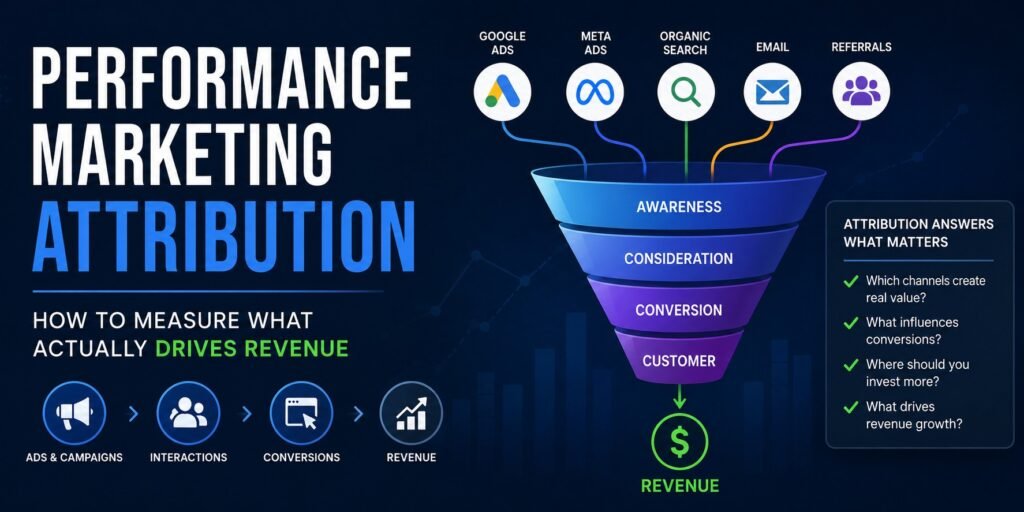
Performance marketing attribution helps businesses understand which marketing activities contribute to conversions and revenue. Instead of looking only at the final click or the number of leads generated, attribution examines the interactions that happen throughout the customer journey and helps connect those interactions with measurable business outcomes.
This matters because customers rarely make a decision after interacting with a business through only one channel. A potential customer might discover a brand through a paid advertisement, return through organic search, visit the website several times, engage with another campaign, and eventually become a customer. If all of the credit is assigned to only one interaction, businesses can develop an incomplete picture of what is actually influencing growth.
Without a reliable attribution approach, marketing decisions can become heavily dependent on surface-level metrics. A campaign may appear successful because it generates inexpensive clicks or leads, while another channel that contributes significantly to the eventual customer journey may receive less investment because its influence is harder to see.
A strong attribution framework creates a clearer connection between marketing activity, customer behaviour, conversions, and revenue. This allows businesses to make more informed decisions about budget allocation, channel strategy, campaign optimization, and where additional investment is most likely to produce valuable business outcomes.
In this guide, we’ll explain what performance marketing attribution is, why it matters, how common attribution models work, where attribution can become misleading, which metrics businesses should evaluate, and how to build a measurement approach that focuses on what actually drives revenue.
Table of Contents
What Is Performance Marketing Attribution?
Performance marketing attribution is the process of evaluating how different marketing interactions contribute to a desired business outcome. Those interactions can include advertisements, organic search visits, social media engagements, email interactions, website visits, content consumption, and other touchpoints that occur before a customer converts.
The purpose is not simply to identify where a conversion happened. It is to understand what influenced that conversion and how different parts of the customer journey contributed to the final outcome. This distinction becomes especially important when customers interact with multiple campaigns or channels before making a decision.
For example, a potential customer might first discover a company through a Google Ads campaign, return several days later through an organic search result, visit a service page, and eventually submit an enquiry after clicking a remarketing advertisement. Looking only at the final interaction would give one version of the story. Looking at the broader journey can reveal a much more complete picture.
This makes attribution an important component of a broader performance marketing funnel. The funnel helps businesses understand how people move from acquisition to conversion, while attribution helps identify which interactions along that journey contributed to the outcome.
Why Attribution Matters in Performance Marketing
Performance marketing becomes significantly harder to optimize when businesses cannot clearly understand which activities contribute to valuable outcomes. Attribution helps move the conversation from “what generated activity?” to “what contributed to business results?”
Clicks Don’t Tell the Whole Story
Clicks can indicate that an advertisement is attracting attention, but they don’t reveal whether the resulting visitors are genuinely interested in the offer or likely to become customers. A campaign can generate inexpensive traffic while contributing very little to revenue if the audience has weak intent or the post-click experience fails to convert.
This is why click-based reporting should be treated as one part of the performance picture rather than the final measure of success. Understanding what happens after the click provides greater insight into whether advertising investment is creating meaningful commercial value.
Leads Don’t Tell the Whole Story
Lead volume can also create a misleading picture of performance. Two campaigns may generate the same number of leads while producing very different outcomes if one attracts prospects who are significantly more qualified or more likely to become high-value customers.
Connecting marketing activity with downstream sales outcomes helps businesses distinguish between lead generation and revenue generation. This allows marketing teams to understand which campaigns are creating genuine opportunities rather than simply producing a higher number of form submissions.
Revenue Requires a Bigger Picture
Revenue is the outcome that ultimately gives marketing performance its commercial context. A campaign that generates fewer conversions can still be more valuable if those conversions consistently produce higher customer value, stronger margins, or greater long-term revenue.
Attribution helps businesses examine these relationships across the customer journey. Instead of evaluating channels independently, they can begin to understand how different interactions work together to influence a customer before and after conversion.
How Performance Marketing Attribution Works
Attribution works by connecting the interactions a customer has with a business to the action the business ultimately wants to measure. Depending on the setup, those interactions can include ad clicks, website visits, search activity, content engagement, and other measurable touchpoints that occur before a conversion.
The important point is that attribution doesn’t simply ask where the customer converted. It attempts to understand how the interactions along the customer’s journey contributed to that conversion.
Tracking the First Interaction
The first interaction represents the point at which a potential customer initially enters the measurable journey. This could happen when someone clicks a paid advertisement, discovers the business through organic search, visits through a referral, or interacts with another marketing channel.
Understanding the first interaction can provide useful context about how customers initially discover a business. However, the first interaction alone doesn’t necessarily explain why someone eventually converted. A prospect may discover a company through one channel and interact with several others before becoming a customer.
Tracking the Conversion
The next step is identifying the action that represents a meaningful outcome for the business. Depending on the business model, this could be a purchase, qualified lead, consultation booking, application, subscription, or another defined conversion event.
Once the conversion event is properly defined and tracked, attribution can evaluate the interactions that occurred along the path leading to that outcome. This is important because a customer may interact with several advertisements or channels before completing the action the business considers valuable.
Connecting Marketing Activity to Revenue
The most useful attribution systems go beyond identifying which interaction preceded a conversion. They help businesses connect marketing activity with the commercial value generated by those conversions. This makes it possible to evaluate whether campaigns and channels are contributing to outcomes that justify their investment.
For example, two campaigns may generate a similar number of conversions but produce very different amounts of revenue. If one campaign consistently attracts higher-value customers, evaluating both campaigns only by conversion volume could lead to the wrong investment decision.
This is why attribution should ultimately support better marketing decisions, not simply produce another reporting dashboard. When businesses understand how different interactions contribute to valuable outcomes, they can make more informed decisions about budget allocation, campaign optimization, audience strategy, and scaling.
Common Marketing Attribution Models
Attribution models determine how credit is assigned to the different interactions that occur before a customer completes an important action. The model you use can significantly change how you interpret channel and campaign performance, which means the same customer journey can look very different depending on the attribution approach.
One important distinction for this article: some attribution models commonly discussed in marketing education are no longer available in Google Ads or Google Analytics. Google has deprecated first-click, linear, time-decay, and position-based attribution in its current platforms. Google Ads currently supports Last Click and Data-Driven Attribution, while Google Analytics attribution reporting provides Data-Driven and last-click options depending on the channel configuration.
Last-Click Attribution
Last-click attribution assigns all of the conversion credit to the final eligible interaction before the customer completes the desired action. This makes the model relatively simple to understand because it answers a straightforward question: which interaction happened immediately before the conversion?
The limitation is that the final interaction may not represent the entire customer journey. A prospect might have discovered the brand through an earlier advertisement, returned through organic search, interacted with another campaign, and then converted after the final click. Giving all the credit to that last interaction can therefore undervalue earlier marketing activity.
First-Touch Attribution
First-touch attribution gives the initial interaction credit for a conversion. From a conceptual perspective, it is useful when a business wants to understand which channels or campaigns are responsible for introducing customers to the brand in the first place.
However, first-touch attribution can overlook everything that happens after the initial discovery. A channel may be excellent at generating awareness but less influential in moving prospects toward a purchase, so assigning all conversion credit to the first interaction can create an incomplete view of performance.
Linear Attribution
Linear attribution historically distributed conversion credit evenly across the relevant touchpoints in a customer’s journey. If a customer interacted with four marketing touchpoints before converting, each interaction would receive an equal share of the credit.
The advantage of this approach is that it recognizes multiple interactions instead of focusing entirely on the first or last touchpoint. The weakness is that it assumes every interaction contributed equally, even when some interactions may have had considerably more influence on the final decision.
Time-Decay Attribution
Time-decay attribution historically gave greater credit to interactions that occurred closer to the conversion and progressively less credit to earlier touchpoints. The underlying assumption was that interactions closer to the final decision may have had a stronger influence on the outcome.
This approach can be conceptually useful for understanding longer customer journeys, particularly when the timing of interactions may matter. However, like linear attribution, it is no longer a supported attribution model in Google’s current advertising and analytics platforms.
Position-Based Attribution
Position-based attribution historically placed greater emphasis on the first and last interactions in a customer journey, while distributing the remaining credit among interactions that occurred between them. The idea was to recognize both the interaction that introduced the customer and the interaction closest to conversion.
This model can still be useful for understanding the evolution of attribution methodology, but it should not be presented as a current Google Ads option. Google has deprecated position-based attribution alongside first-click, linear, and time-decay models.
Data-Driven Attribution
Data-driven attribution takes a fundamentally different approach. Instead of applying a fixed rule to every customer journey, it uses available account data to estimate how different interactions contribute to conversions. Google describes its data-driven model as using conversion-path data to determine the contribution of individual ad interactions.
This makes data-driven attribution particularly useful when customer journeys involve multiple interactions and businesses want a more evidence-based view of what is influencing conversions. Rather than automatically giving all credit to the first or last interaction, the model evaluates patterns across converting and non-converting paths to estimate the contribution of different touchpoints.
The important point is that data-driven attribution doesn’t make attribution perfect. It provides a model-based estimate of contribution, and the quality of the resulting insight depends on the data, conversion setup, tracking, and business context available to the system.
The Problem With Relying on a Single Attribution Model
No attribution model tells the entire customer journey from a single perspective. Each model applies a particular method for assigning credit, which means the same conversion can produce different channel valuations depending on the model being used. Google itself notes that comparing attribution models can reveal campaigns or keywords that may be undervalued under a last-click approach.
Different Models Can Produce Different Conclusions
The same customer journey can look very different depending on how conversion credit is assigned. A channel that appears highly valuable under a last-click model may receive less credit under a data-driven approach, while an earlier interaction that rarely receives final-click credit may prove to have a meaningful role in the conversion path.
This means businesses should be careful about treating any single attribution model as an absolute representation of marketing performance. Attribution is a way of interpreting customer journeys, not a perfect record of exactly why every customer decided to convert.
Last Click Can Undervalue Earlier Interactions
Last-click attribution is easy to understand because it assigns all conversion credit to the final eligible interaction. However, this can overlook the earlier interactions that introduced the customer to the brand or helped move them toward a decision.
For example, a customer might first discover a business through a paid campaign, return through organic search, read several pages, and then convert after another advertising interaction. Looking only at the final interaction can make the earlier touchpoints appear less valuable than they may actually have been.
More Attribution Data Does Not Automatically Mean Better Decisions
Having more attribution data can create a stronger analytical foundation, but data alone doesn’t guarantee better marketing decisions. Businesses still need to define meaningful conversion events, maintain reliable tracking, understand their sales cycle, and interpret attribution results within the context of their business model.
A short ecommerce buying journey, for example, can behave very differently from a B2B sales process that involves multiple stakeholders and weeks or months between the first interaction and the final purchase. The attribution approach needs to reflect those differences rather than applying the same assumptions to every business.
Attribution Should Inform Decisions, Not Replace Judgment
The purpose of attribution is to improve marketing decisions, not to create a single number that determines where every dollar should be spent. Attribution results should be considered alongside conversion quality, customer value, sales data, margins, and the broader business strategy.
When these sources of information are evaluated together, businesses can make more informed decisions about which campaigns to scale, which audiences to prioritize, where conversion problems exist, and where additional investment may create the strongest opportunity for growth.
Performance Marketing Attribution vs Traditional Campaign Reporting
Traditional campaign reporting tells you what happened within a particular campaign or channel. It can show impressions, clicks, spend, conversions, and other performance indicators, but those numbers don’t necessarily explain how different marketing interactions contributed to the customer’s eventual decision.
Attribution takes a broader view by connecting interactions across the customer journey. That can include paid search, paid social, organic search, email, referrals, direct visits, remarketing, content interactions, and other measurable touchpoints.
The distinction becomes especially important when several channels influence the same customer. A person might discover a company through a social advertisement, return through organic search, read an article, receive an email, and eventually convert through a direct visit. Looking at each channel independently can make the journey appear fragmented even though all of those interactions may have contributed to the outcome.
Reporting Answers “What Happened?”
Campaign reporting is primarily designed to show what happened within a marketing activity. It can tell you how much was spent, how many people were reached, how many clicks were generated, how many conversions occurred, and how those numbers changed over time.
This information is essential for managing campaigns, but it doesn’t necessarily explain the complete customer journey. A channel can generate strong reported performance while another channel contributes important interactions that aren’t visible when the analysis remains limited to individual campaign dashboards.
Attribution Answers “What Contributed?”
Attribution goes one step further by examining how different interactions contributed to a conversion or other defined outcome. Instead of looking only at the campaign that reported the final conversion, attribution can consider the sequence of interactions that occurred before that outcome.
This broader perspective can reveal that a channel doesn’t necessarily need to generate the final conversion to have influenced the customer. An awareness campaign, content interaction, search visit, remarketing touchpoint, or referral may contribute to a journey even when another channel receives the final conversion credit.
Revenue Analysis Answers “What Created Business Value?”
Attribution becomes significantly more useful when it is connected to actual business outcomes. A conversion may be valuable, but the ultimate question is whether the customers generated through those interactions create enough revenue or profit to justify the investment.
This means businesses should ideally connect marketing interactions with downstream information such as qualified opportunities, closed deals, purchases, customer value, revenue, and acquisition costs. The further attribution moves toward actual business outcomes, the more useful it becomes for making investment decisions.
The goal is not to produce a perfect number for every interaction. The goal is to build a more informed view of how marketing contributes to growth and use that understanding to improve budget allocation, channel strategy, customer acquisition, and overall performance.
What Should You Measure in Performance Marketing Attribution?
Attribution becomes useful when the data being measured reflects the actual customer journey and the business outcomes that matter. Instead of focusing on a single platform or metric, businesses should look at how acquisition, engagement, conversion, customer quality, and revenue connect across channels.
Acquisition and Engagement
At the beginning of the journey, businesses can evaluate metrics such as impressions, reach, click-through rate, cost per click, cost per thousand impressions, traffic volume, and engagement. These indicators help explain how effectively different channels and campaigns are attracting potential customers.
However, acquisition metrics should be interpreted as signals rather than final outcomes. A channel generating inexpensive traffic may appear efficient at the top of the funnel while producing relatively little commercial value further down the journey.
Conversion and Customer Acquisition
Once visitors begin taking meaningful actions, businesses can evaluate conversion rate, cost per lead, cost per acquisition, purchase rate, booking rate, qualified lead volume, and other conversion events relevant to the business model.
The quality of those conversions matters just as much as their quantity. A performance marketing system should distinguish between a basic conversion and a conversion that represents a realistic opportunity to generate revenue.
This is particularly important when different channels attract customers with different buying behaviour. One channel may generate a large number of initial conversions, while another generates fewer but produces customers with stronger retention, higher order values, or greater lifetime value.
Revenue and Customer Value
Revenue metrics provide the commercial context needed to evaluate attribution properly. Depending on the business model, these can include customer acquisition cost, return on ad spend, revenue per customer, average order value, customer lifetime value, profit contribution, and revenue generated from qualified opportunities.
Looking at customer value is particularly important when comparing channels. A channel that appears expensive based on cost per acquisition may actually be more valuable if it consistently generates customers with higher revenue or stronger long-term value.
This helps shift attribution away from simply asking which channel generated the most conversions toward a more useful question: which combination of marketing interactions is contributing to the most valuable business outcomes?
Customer Journey and Assisted Interactions
A customer journey can include multiple interactions that influence the final decision. A person may see a paid social advertisement, search for the brand later, read an article, return through a remarketing campaign, and eventually complete a purchase. Measuring only the final interaction can hide the role played by the earlier touchpoints.
Businesses should therefore consider the broader sequence of interactions when evaluating attribution. This doesn’t mean every touchpoint deserves equal credit. It means the customer journey should be examined as a connected sequence rather than a collection of unrelated channel reports.
Offline and Downstream Outcomes
For businesses with longer sales cycles, the customer journey often continues beyond the website. A paid advertisement or organic search visit may generate a lead, but the eventual outcome may depend on a sales call, consultation, proposal, store visit, contract, or another offline interaction.
This makes it important to connect marketing data with downstream sales information wherever possible. Without that connection, businesses may optimize campaigns around leads or online conversions without knowing which activities actually contribute to closed business and revenue.
Common Performance Marketing Attribution Mistakes
Attribution can provide valuable insight, but poor measurement practices can make the data misleading. The biggest problems usually occur when businesses focus on platform-reported conversions, incomplete customer journeys, or individual metrics without connecting them to the broader commercial outcome.
Giving All Credit to the Last Interaction
One of the most common attribution mistakes is assuming that the final interaction deserves all of the credit for a conversion. While the last interaction may have played an important role in moving the customer toward action, it may not have been responsible for creating the original demand or influencing earlier stages of the decision.
A customer may interact with several channels before converting, including paid advertising, organic search, social content, email, referrals, or remarketing. Treating the final interaction as the complete explanation of the conversion can therefore lead businesses to underestimate the contribution of earlier touchpoints.
Measuring Leads Without Connecting Them to Sales
A lead is an intermediate business outcome, not necessarily the final commercial result. If marketing teams measure success based only on the number or cost of leads generated, they may end up prioritizing campaigns that produce volume rather than campaigns that produce qualified opportunities and customers.
Connecting marketing data with CRM and sales information can provide a much clearer picture of lead quality. It allows businesses to understand which campaigns contribute to qualified opportunities, closed deals, customer revenue, and other outcomes that matter beyond the initial conversion.
Ignoring Offline Conversions
Not every customer journey ends online. For many businesses, especially those with sales teams or longer buying cycles, an online interaction may generate a lead that eventually becomes a customer through a phone call, meeting, proposal, appointment, or offline transaction.
If those downstream outcomes aren’t connected back to the original marketing activity, attribution can significantly underestimate the value of campaigns that generate high-quality opportunities. The result is a measurement system that optimizes for what is easiest to track rather than what actually creates revenue.
Treating Every Conversion as Equal
Not every conversion represents the same level of business value. A newsletter signup, product purchase, consultation request, and qualified sales opportunity can all be recorded as conversions, but their commercial significance can be very different.
Attribution becomes more useful when businesses distinguish between conversion types and assign greater importance to the outcomes that genuinely contribute to revenue. This allows marketing decisions to reflect business value rather than conversion volume alone.
Using Incomplete or Inconsistent Tracking
Attribution is only as useful as the data available to the system. Missing tracking parameters, disconnected analytics platforms, inconsistent conversion definitions, broken event tracking, or gaps between marketing and CRM data can all create an incomplete picture of the customer journey.
Businesses should therefore establish consistent definitions for important events and regularly review whether the data being used for attribution accurately represents what is happening across the customer journey.
Optimizing Based on One Platform’s Data Alone
Another common mistake is treating the reporting from a single advertising platform as the complete picture of marketing performance. Different platforms can measure and attribute conversions according to their own tracking environments, which can result in overlapping claims when several channels influence the same customer.
A more reliable approach is to evaluate platform data alongside website analytics, CRM information, sales outcomes, customer value, and broader business performance. This creates a more balanced view of how different marketing activities contribute to revenue.
How to Build a Better Attribution System
A useful attribution system starts with the business outcome and works backward through the customer journey. The goal isn’t to collect as much data as possible. It’s to create a reliable connection between marketing interactions, meaningful conversions, customers, and revenue so that the information can actually improve decision-making.
1. Define the Business Outcome
Start by identifying what the business actually wants to measure. For one company, that may be completed purchases. For another, it could be qualified sales opportunities, signed contracts, booked consultations, applications, or recurring customer revenue.
The outcome needs to be specific enough that marketing and sales teams can agree on what constitutes success. Without a clearly defined outcome, attribution can become focused on easily measurable activities rather than the results the business actually cares about.
2. Map the Customer Journey
Next, identify the major interactions that can occur before and after conversion. Depending on the business, the journey may include paid search, paid social, organic search, content, email, referrals, remarketing, direct visits, sales conversations, and offline interactions.
Mapping these interactions helps reveal where data needs to be collected and how different channels may influence one another. It also prevents the business from designing attribution around a single advertising platform while ignoring the rest of the customer journey.
3. Identify Meaningful Conversion Events
Not every interaction should be treated as a conversion. Businesses should identify the actions that represent meaningful progress toward the desired outcome, such as a qualified enquiry, completed purchase, booked appointment, demo request, or sales opportunity.
Separating meaningful conversion events from lower-value actions makes attribution more useful. It allows businesses to evaluate marketing activity based on the quality and commercial significance of the outcomes being generated.
4. Connect Marketing and Sales Data
For businesses with longer sales cycles, attribution shouldn’t stop when someone submits a form or books a call. Marketing data needs to connect with CRM and sales information so the business can understand what happens after the initial conversion. This also requires the website and underlying Revenue Focused Web Infrastructure to support reliable conversion tracking and the movement of data between marketing and sales systems.
This connection can reveal which campaigns and customer journeys produce qualified opportunities, closed deals, repeat purchases, or higher-value customers. Without it, marketing teams may optimize for leads while sales teams are working with a very different picture of performance.
5. Choose the Right Attribution Approach
The right attribution approach depends on the business model, customer journey, sales cycle, available data, and level of measurement maturity. A short ecommerce journey may require a different approach from a complex B2B journey involving multiple stakeholders and offline sales activity.
Businesses should therefore avoid choosing an attribution model simply because it produces the most favourable results for a particular channel. The objective is to select an approach that provides useful evidence for making better decisions about investment, optimization, and growth.
6. Review Attribution Against Actual Revenue
The final step is to compare attribution insights with actual business performance. If a channel appears highly effective according to campaign-level reporting but consistently produces lower-value customers, the business needs to understand why the two views differ.
Revenue, customer acquisition cost, customer value, sales outcomes, and profitability can provide important context when interpreting attribution data. The goal is to identify patterns that remain useful beyond a single campaign or reporting period.
This creates a more mature measurement process in which attribution becomes part of the decision-making system rather than a standalone reporting exercise. The insights can then inform improvements to Conversion Architecture Systems, landing experiences, and other parts of the customer journey. Over time, businesses can use those insights to improve channel allocation, campaign strategy, conversion experiences, and overall marketing efficiency.
How Attribution Improves Marketing Decisions
Attribution becomes valuable when the insights it produces actually change what a business does next. The purpose isn’t simply to know which campaigns received credit for conversions. It is to use that information to make better decisions about where to invest, what to improve, and when to scale.
Better Budget Allocation
Attribution can help businesses understand how different channels and campaigns contribute to valuable outcomes, providing a stronger basis for deciding where marketing budget should be increased, maintained, or reduced.
For example, a channel with a higher cost per acquisition may still deserve additional investment if it consistently generates customers with greater revenue or lifetime value. Looking only at acquisition cost without considering customer value can therefore lead to poor budget decisions.
Smarter Channel Selection
Different channels can play different roles within the same customer journey. Paid search may capture existing demand, paid social may introduce the brand to new audiences, organic search may support research and discovery, while email or remarketing may help move an interested prospect toward conversion.
Attribution can help businesses understand these roles instead of evaluating every channel using the same expectations. The objective isn’t necessarily to find one channel that does everything, but to understand which paid channels contribute most effectively to the broader acquisition mix.
More Effective Campaign Optimization
Attribution insights can also influence how campaigns are optimized. Instead of optimizing exclusively for clicks or immediate conversions, businesses can use customer quality, revenue, and downstream outcomes to identify which campaigns are producing the most valuable results.
This can change the way marketers evaluate audiences, creative, offers, landing experiences, and campaign structures. A campaign that appears weaker on a surface-level metric may deserve further investment if it consistently produces stronger customers or higher-value opportunities.
Better Decisions About Scaling
Scaling should happen when the business has enough evidence that the underlying economics can support additional investment. Attribution can contribute to that decision by showing which combinations of channels, campaigns, audiences, and customer journeys are associated with valuable outcomes.
But attribution should not be used in isolation when deciding whether to scale. Businesses should also consider profitability, operational capacity, sales capacity, customer experience, market demand, and whether additional volume can be generated without significantly weakening acquisition economics.
The Mavenify Approach to Performance Marketing Attribution
At Mavenify, attribution is not treated as a reporting exercise limited to a single advertising platform. A meaningful measurement system needs to look across the broader acquisition journey and connect marketing interactions with conversions, customer quality, and revenue.
That means paid search, paid social, organic search, remarketing, content, referrals, email, website interactions, and sales activity can all form part of the picture. The objective is to understand how these components work together rather than allowing each platform to define performance independently.
This approach also recognizes that not every customer journey follows the same path. Some customers may convert after a single interaction, while others may require multiple visits, campaigns, content interactions, and sales conversations before becoming customers. The measurement system needs to accommodate that complexity without losing sight of the commercial outcome.
The result is a more connected approach to performance marketing where attribution informs decisions about channel investment, campaign optimization, conversion experiences, and growth opportunities rather than simply appearing as another report at the end of the month.
From Marketing Data to Revenue Intelligence
The real value of attribution emerges when marketing data becomes useful for making revenue decisions. Instead of asking only which campaign generated a conversion, businesses can begin asking which combinations of channels, interactions, audiences, and experiences are consistently contributing to valuable customers.
This creates a more complete feedback loop. Marketing activity generates data, customer behaviour provides additional context, sales outcomes reveal customer quality, and revenue provides the commercial benchmark against which the system can be evaluated.
For businesses investing across multiple acquisition channels, this connected view can help reduce fragmented decision-making and create a clearer understanding of where growth is actually coming from.
Attribution as Part of a Broader Growth System
Attribution works best when it is connected to the systems surrounding it. Accurate measurement can reveal an opportunity, but the business still needs the right acquisition strategy, web infrastructure, conversion experience, follow-up process, and optimization framework to turn that insight into growth.
This is why Mavenify approaches performance marketing as a connected system rather than a collection of individual campaigns. Performance Marketing System™ brings acquisition, conversion, measurement, and optimization together so that marketing activity can be evaluated in the context of measurable business outcomes.
Frequently Asked Questions About Performance Marketing Attribution
What is performance marketing attribution?
Performance marketing attribution is the process of evaluating how different marketing interactions contribute to conversions and business outcomes. It helps businesses understand the role of different channels and touchpoints throughout the customer journey rather than looking only at the final interaction.
Why is attribution important in performance marketing?
Attribution helps businesses make better decisions about marketing investment by connecting campaign activity with conversions, customer quality, and revenue. Without attribution, businesses may optimize for clicks or leads without understanding which activities are actually contributing to valuable customers.
What is the best attribution model?
There is no universally best attribution model for every business. The appropriate approach depends on the customer journey, sales cycle, business model, available data, conversion structure, and measurement objectives. Attribution should be selected based on how useful it is for making better business decisions.
What is the difference between first-touch and last-touch attribution?
First-touch attribution gives credit to the initial interaction in the customer journey, while last-touch attribution gives credit to the final eligible interaction before conversion. Both approaches provide useful perspectives but can overlook other interactions that influence the customer along the way.
What is multi-touch attribution?
Multi-touch attribution refers to approaches that consider multiple interactions within a customer’s journey rather than assigning all conversion credit to a single touchpoint. The objective is to provide a broader view of how different marketing activities may contribute to an outcome.
Can attribution measure offline conversions?
Yes, attribution can incorporate offline outcomes when marketing, analytics, CRM, and sales data are connected appropriately. This can be particularly important for businesses where an online lead eventually becomes a customer through calls, meetings, proposals, contracts, or other offline sales processes.
How does attribution improve marketing ROI?
Attribution can help businesses identify which marketing activities contribute to valuable outcomes, allowing them to make more informed decisions about budget allocation, campaign optimization, channel strategy, and scaling. It doesn’t guarantee better ROI by itself, but it can provide better evidence for improving marketing investment decisions.
Conclusion
Performance marketing attribution is ultimately about understanding more than where a conversion happened. It is about building a clearer picture of how marketing interactions contribute to customers and revenue.
The strongest attribution approach doesn’t treat Google, Meta, LinkedIn, organic search, email, referrals, or any other channel as an isolated source of truth. It looks at the broader customer journey and connects acquisition, conversion, customer quality, sales outcomes, and revenue wherever reliable data is available.
Attribution will never remove every uncertainty from marketing measurement. Customer journeys are complex, tracking can be imperfect, and different models can produce different interpretations. But a well-designed attribution system can give businesses a much stronger foundation for deciding where to invest, what to optimize, and when to scale.
The goal isn’t to find the platform that deserves the most credit.
The goal is to understand what is actually contributing to business growth.
Build a Performance Marketing System Around Measurable Revenue
If your marketing reports show clicks, leads, and conversions but don’t clearly explain how those activities contribute to revenue, the problem may be bigger than campaign optimization. Your acquisition, conversion, measurement, and sales systems may need to work together more closely.
Mavenify’s Performance Marketing System™ is designed to connect those components into a more measurable growth infrastructure—helping businesses move beyond isolated campaign metrics toward a clearer understanding of what drives valuable business outcomes.
Ready to connect your marketing activity to measurable revenue?