

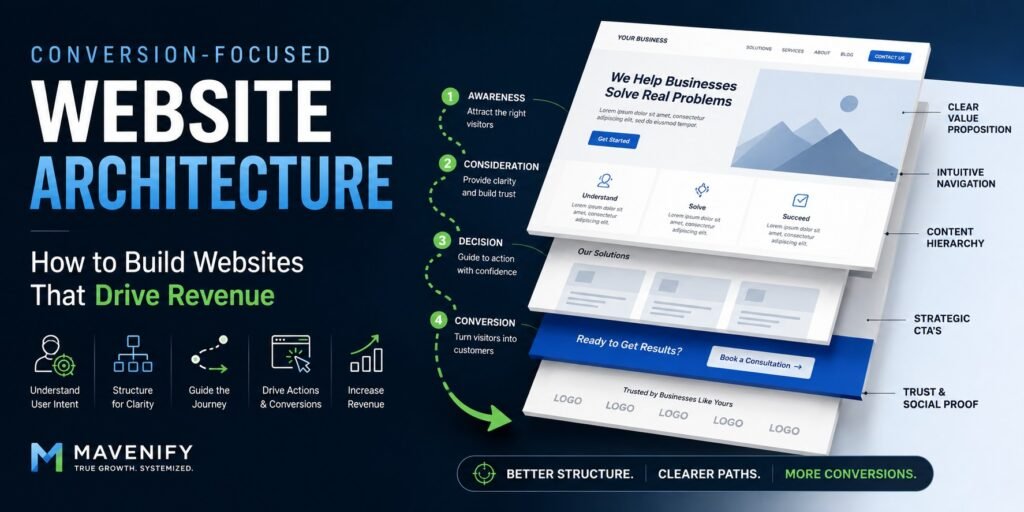
A website can have attractive visuals, strong content, and a steady flow of visitors while still failing to turn enough of that attention into meaningful business outcomes. Conversion focused website architecture addresses this problem by designing the structure of a website around how visitors navigate, evaluate information, build confidence, and ultimately decide what to do next.
Conversion does not begin with a button or a form. It starts much earlier with the way information is organized, how clearly a visitor understands the offer, how easily they can find relevant answers, and whether the next step feels logical. Every page and pathway can influence whether someone continues exploring or leaves without taking action.
This makes website architecture an important component of Revenue-Focused Web Infrastructure. The structure of the website influences how acquisition traffic is received, how information is presented, how visitors move toward conversion, what interactions can be measured, and how the digital experience connects with the systems supporting business growth.
In this guide, we’ll explore what conversion-focused website architecture means, how it differs from traditional website structure, which elements influence conversion, how to map architecture to customer intent, common mistakes to avoid, and how businesses can build websites that are designed to support measurable growth.
Table of Contents
What Is Conversion-Focused Website Architecture?
Within a broader revenue-focused web infrastructure, conversion architecture provides the structural layer that connects visitors with the information, experiences, and actions that matter to the business. It does not operate independently; it works alongside technical infrastructure, analytics, acquisition systems, automation, and other components of the digital growth environment.
It considers more than whether users can technically move from one page to another. It considers why they are visiting, what information they need, what objections may prevent action, and what the most appropriate next step should be.
Architecture Is More Than Navigation
Website architecture is often associated with menus, URLs, categories, and page hierarchy. These are important structural elements, but conversion-focused architecture goes further by considering how those elements guide visitors through the decision-making process.
A visitor may arrive on a service page with strong commercial intent, while another may enter through an educational article and still be researching a problem. Treating both visitors identically can create unnecessary friction because they may need different information and different next steps.
A conversion-focused structure therefore creates logical pathways between related pages and experiences. Informational content can lead toward relevant solutions, service pages can provide supporting proof and clear actions, and high-intent visitors can reach conversion points without having to search unnecessarily for what to do next.
Conversion Begins With Understanding User Intent
Visitors arrive with different questions, expectations, and levels of readiness. Someone searching for an explanation may not be ready to request a consultation, while someone comparing providers may already be evaluating specific solutions.
Understanding these differences allows the website to present information according to the visitor’s likely intent. The goal is not to force every visitor toward an immediate conversion, but to provide the right next step for where they are in the decision process.
This can involve educational content, comparison pages, service information, case studies, pricing information, FAQs, demonstrations, consultation pathways, or direct purchase options. The architecture connects these experiences so visitors can progress naturally as their level of intent develops.
Every Page Should Have a Purpose
A conversion-focused website does not require every page to generate an immediate lead or sale. Different pages can perform different roles within the customer journey, including attracting visitors, answering questions, building trust, demonstrating expertise, addressing objections, or moving prospects toward a commercial decision.
What matters is that each important page has a clear purpose and a logical relationship with the pages around it. A page that attracts significant traffic but has no relevant next step can become a dead end, while a commercial page with insufficient supporting information may struggle to convert visitors who are still evaluating the offer.
Defining the role of each page makes it easier to build a website where content and conversion pathways work together rather than operating as separate elements.
Why Website Architecture Affects Conversion
The structure of a website influences how easily visitors can find information, understand an offer, evaluate alternatives, and move toward an appropriate action. Even strong marketing campaigns can lose effectiveness when the destination experience creates confusion or friction.
Clear Information Reduces Friction
Visitors rarely read every page in sequence. They scan headings, navigation, content sections, calls to action, proof points, and other signals to determine whether a website is relevant to their needs.
Clear information hierarchy helps visitors identify what matters without requiring unnecessary effort. Important information should be easy to discover, supporting details should appear where they are useful, and the relationship between related pages should be understandable.
When visitors can quickly understand where they are, what the business offers, why it may be relevant, and what they can do next, the website creates a clearer path toward action.
Stronger Paths From Discovery to Decision
A visitor’s first interaction with a website may not occur on the page where the eventual conversion happens. Someone may discover an article through search, explore a service page later, review a case study, return through a campaign, and finally request a consultation.
The architecture needs to support these journeys by creating meaningful relationships between content and commercial pages. Each interaction should make it easier for the visitor to continue learning, evaluating, or taking the next appropriate action.
Contextual links also help users understand where a page leads before they click. Google recommends using concise, descriptive anchor text so that both users and search engines can understand the destination and its relationship to the surrounding content.
This is where conversion architecture connects directly with Revenue Focused Web Infrastructure. The conversion pathway is one component of the broader infrastructure that connects acquisition, customer experience, measurement, and revenue outcomes.
Architecture Can Influence What Gets Measured
The structure of the website also affects measurement. If important conversion actions are scattered across inconsistent pathways or key interactions are not clearly defined, it becomes harder to understand how visitors move through the experience.
A more deliberate architecture makes it easier to identify important stages in the customer journey and establish meaningful events around them. This can improve the quality of the data available for testing, optimization, and performance analysis.
Measurement should therefore be considered during architectural planning rather than added as an afterthought once the website is already live.
Core Components of Conversion-Focused Website Architecture
A conversion-focused website is built from multiple structural elements that work together to guide visitors toward appropriate actions. No single component guarantees conversion. The objective is to create a connected experience in which page structure, content, navigation, trust, and calls to action reinforce one another.
Clear Website and Page Hierarchy
A clear hierarchy helps visitors understand how different parts of a website relate to one another. Core service or product pages should be easy to identify, supporting content should connect logically to those pages, and important conversion pathways should not be buried beneath unnecessary layers of navigation.
The hierarchy should also reflect the way customers think about the business. Instead of organizing pages purely around internal departments or technical categories, businesses should consider how visitors search for information, evaluate solutions, and move toward a decision.
This creates a structure where users can move from broad information toward more specific content without losing context. It also gives search engines and other discovery systems a clearer understanding of how the website’s topics and pages relate to one another. Search Intelligence Infrastructure™ can strengthen this layer by connecting information architecture, search intent, semantic relationships, and long-term discoverability.
Navigation Designed Around User Intent
Navigation should help visitors find what they need without forcing them to understand how the business has organized its internal services or departments. Labels should be clear, familiar, and aligned with the information visitors are actually looking for.
Primary navigation should make important commercial destinations easy to reach, while contextual navigation can guide visitors toward related information as they explore. This reduces the need for visitors to repeatedly return to the main menu when they are already engaged with a particular topic.
Good navigation doesn’t simply provide more choices. It provides the right choices at the right point in the journey, helping visitors continue toward greater understanding or a meaningful action.
Strategic Calls to Action
Calls to action should reflect the visitor’s level of intent. Asking every visitor to “Book a Call” or “Buy Now” may be appropriate for some pages but can be premature for visitors who are still researching a problem or comparing potential solutions.
A more effective architecture provides different next steps based on context. An educational article might guide a visitor toward a related service page, a service page might encourage an enquiry, and a high-intent landing page might focus almost entirely on completing a conversion.
The important principle is that calls to action should feel like a natural continuation of the visitor’s journey rather than an interruption to it.
Content That Supports the Decision
Visitors often need more than a description of what a business sells before they are comfortable taking action. They may need evidence of expertise, answers to common questions, examples of previous work, comparisons, pricing information, implementation details, or reassurance about potential risks.
A conversion-focused architecture places this supporting information where it can help the decision rather than forcing visitors to search through unrelated pages. Relevant case studies, FAQs, proof points, educational content, and service information can all become part of the conversion pathway.
This also creates stronger relationships between informational and commercial content. Instead of treating a blog, service page, case study, and FAQ as separate assets, the website can connect them around the questions a potential customer needs answered before taking action. This content layer can work alongside an AI Content & Authority System to build useful information pathways that support both discovery and decision-making.
Forms and Conversion Friction
Forms are often one of the most important conversion points on a lead-generation website. Their structure can influence whether an interested visitor completes the process or abandons it before submitting their information.
The appropriate form length depends on the value of the conversion and the information the business genuinely needs. Asking for unnecessary information can introduce friction, while collecting too little information may make qualification and follow-up more difficult.
The surrounding experience matters as well. Visitors should understand what happens after submission, what information they will receive, and why providing their details is worthwhile. Confirmation messages, follow-up workflows, and CRM integration should be considered part of the conversion experience rather than separate technical tasks.
Trust and Decision Support
Conversion often depends on confidence as much as convenience. Visitors may hesitate because they are unsure whether a company has the expertise, experience, reliability, or capability to deliver what it promises.
Trust signals can include case studies, testimonials, reviews, credentials, guarantees where appropriate, transparent information, recognizable client experience, detailed service explanations, and evidence that addresses common concerns.
These elements should be positioned where they support the decision. A testimonial placed next to a relevant offer can be more useful than the same testimonial buried on a separate page that visitors may never discover.
How to Map Website Architecture to the Customer Journey
A strong website structure should reflect the different stages through which potential customers move. The exact journey varies by business, but most visitors need some combination of discovery, understanding, evaluation, confidence, and action before they become customers.
Discovery and Awareness
At the discovery stage, visitors may have a problem or question without knowing exactly which solution or provider they need. Search content, educational resources, social content, referrals, and other entry points can introduce them to the business. This is where Search Intelligence Infrastructure™ can help ensure that the website’s content and structure are aligned with how people discover and evaluate information.
The architecture should make it easy for these visitors to move from the initial topic into related information without immediately forcing a sales decision. Relevant internal links, related content, clear navigation, and contextual calls to action can help them continue exploring.
Evaluation and Consideration
As visitors become more aware of their options, their information needs change. They may begin comparing approaches, evaluating providers, reviewing services, examining proof, or looking for answers to specific objections.
The website should make this information easy to access and connect related resources around the decision being made. A service page can lead to case studies, FAQs, methodology information, comparison content, or other evidence that helps the visitor evaluate the offer.
This is where a well-designed information architecture can reduce friction. Visitors don’t have to restart their research every time they move between pages because the website itself provides a logical path through the decision.
Decision and Conversion
When a visitor has developed sufficient understanding and confidence, the architecture should make the desired action straightforward. Whether that action is a purchase, enquiry, consultation, booking, application, or another conversion, unnecessary steps can create avoidable friction.
The conversion page should reinforce the decision rather than introduce new uncertainty. Clear messaging, relevant proof, concise forms, transparent expectations, and an obvious next step can help the visitor complete the intended action.
The conversion page should reinforce the decision rather than introduce new uncertainty. Clear messaging, relevant proof, concise forms, transparent expectations, and an obvious next step can help the visitor complete the intended action. These principles form a core part of Conversion Architecture System™, where the conversion experience is designed around user behaviour, journey structure, and measurable business outcomes.
Post-Conversion Experience
The architecture of the customer journey shouldn’t stop at the first conversion. Confirmation pages, onboarding information, follow-up communications, account areas, support resources, and opportunities for additional engagement can all influence what happens after the initial action.
For businesses with longer customer relationships, this post-conversion layer can be particularly important. The website and connected systems may continue supporting onboarding, education, retention, upselling, referrals, or repeat purchases.
This reinforces an important principle: conversion architecture should support the broader customer lifecycle, not just the moment when a form is submitted or a transaction is completed.
The surrounding experience matters as well. Visitors should understand what happens after submission, what information they will receive, and why providing their details is worthwhile. Confirmation messages, follow-up workflows, and CRM integration should be considered part of the conversion experience rather than separate technical tasks. AI Automation Infrastructure can support the workflows that connect these customer actions with the systems responsible for follow-up and operational processes.
Conversion-Focused Website Architecture vs Traditional Website Design
A visually polished website and a conversion-focused website are not necessarily the same thing. Design can influence perception and usability, but conversion architecture considers the deeper structure that determines how visitors move through information and toward meaningful actions.
Design Starts With the Experience; Architecture Connects the Journey
Traditional website design often begins with the visual experience: layouts, typography, imagery, colours, components, and page-level presentation. These elements are important because they influence usability and perception, but they do not by themselves determine whether the overall website provides a logical path toward conversion.
Conversion architecture looks at how those individual experiences connect. It considers where visitors arrive, what they need to understand next, which page should support that decision, and what action should follow.
The distinction is important because a website can have excellent individual pages while still creating a fragmented customer journey. Website conversion architecture brings those pages together around the movement from intent to understanding, confidence, and action.
More Pages Do Not Automatically Create Better Conversion Paths
Adding more pages can sometimes make a website appear more comprehensive without making it easier to navigate. If those pages are poorly connected, visitors may have more information available but less clarity about what they should do next.
A stronger approach is to determine which information genuinely supports the customer’s decision and then connect those resources in a logical sequence. This can result in fewer but more purposeful pathways rather than a website filled with disconnected content.
Conversion Architecture Should Reflect Business Objectives
The ideal conversion path depends on what the business is trying to achieve. An ecommerce company may prioritize product discovery and purchase completion, while a B2B company may need to guide visitors toward a consultation, qualified enquiry, or sales conversation.
This means architecture should be designed around meaningful business outcomes rather than generic conversion patterns. The right structure for one business may be completely different from the right structure for another.
This is also why conversion architecture needs to work alongside the broader Revenue Focused Web Infrastructure rather than being treated as an isolated design exercise.
Common Conversion-Focused Website Architecture Mistakes
Even websites with strong content and good design can create unnecessary barriers to conversion. The most common problems tend to come from disconnected page structures, unclear priorities, excessive friction, and a lack of alignment between user intent and business objectives.
Making Every Page Sell
Not every visitor is ready to buy, book a call, or submit an enquiry when they first arrive. Treating every page as a direct sales opportunity can make the experience feel repetitive and can prevent visitors from finding the information they need to build confidence.
A better architecture allows different pages to perform different roles. Educational pages can build understanding, comparison content can support evaluation, service pages can explain the offer, and high-intent pages can focus more directly on conversion.
Creating Dead-End Pages
A page becomes a dead end when visitors reach it without a useful next step. This can happen with blog articles, landing pages, service pages, campaign destinations, and even confirmation pages.
Every important page should have a logical relationship with the wider website. That doesn’t mean every page needs multiple calls to action. It means visitors should have a clear opportunity to continue their journey when they are ready.
Using Generic Calls to Action Everywhere
Repeating the same call to action across every page can ignore differences in visitor intent. Someone reading an introductory article may need more information, while someone reviewing a detailed service page may already be ready to speak with the business.
Calls to action should therefore reflect context. A relevant article might point toward deeper educational content or a related service, while a commercial page can provide a stronger conversion action.
This creates a more natural progression and reduces the pressure to force an immediate conversion from every visitor.
Hiding Important Information Behind Too Many Clicks
Visitors should not have to navigate through several unrelated pages to find information that is essential to their decision. Excessive clicks can create friction, particularly when the visitor already knows what they are looking for.
Important information should be accessible from the appropriate context. This may involve clearer navigation, contextual links, page sections, comparison content, FAQs, or other mechanisms that reduce unnecessary movement through the site.
The goal is not to eliminate every click. It is to ensure that each step has a clear purpose and moves the visitor closer to understanding or action.
Ignoring Mobile Conversion Paths
A conversion path that works well on a desktop screen can become difficult to use on a mobile device. Navigation, forms, buttons, content density, media, and page layouts all need to remain usable when the available screen space changes.
Mobile optimization should therefore be considered part of the conversion architecture rather than a separate visual adjustment made at the end of development.
How to Build a Conversion-Focused Website Architecture
Building a conversion-focused architecture requires more than rearranging pages. It starts with understanding the business objectives, customer journeys, information requirements, and technical environment that support the conversion process.
Define Primary Conversion Goals
Start by identifying the actions that represent meaningful progress for the business. These may include purchases, qualified enquiries, consultations, bookings, applications, registrations, or other outcomes relevant to the business model.
Then distinguish primary conversions from secondary actions. A newsletter signup or content download may be useful, but it should not necessarily be treated as equivalent to a qualified sales opportunity or completed purchase.
Map Entry Points to Relevant Journeys
Identify where visitors are likely to enter the website and what they are likely to expect when they arrive. Search traffic, paid campaigns, social referrals, direct visitors, email campaigns, and returning customers can all require different experiences. For businesses using paid acquisition, the destination experience also needs to work with the broader Performance Marketing System so that campaign intent and on-site conversion paths remain aligned.
Mapping these entry points helps determine which pages should receive traffic, what information should appear first, and where visitors should be directed next.
It also creates a stronger connection between acquisition and conversion. Instead of sending every visitor to the same generic destination, businesses can build pathways that reflect the intent behind different sources and campaigns.
Build Logical Page Relationships
Once entry points and customer journeys are understood, organize pages around the relationships between them. Educational content should connect to relevant commercial information, service pages should connect to supporting proof, and high-intent pages should provide clear routes toward conversion.
This creates an architecture where visitors can move between related information without losing the context of their original journey.
It also makes the website easier to expand because new content and pages can be added into an existing structure rather than becoming isolated destinations.
Design and Test the Conversion Path
After the structure is established, review the actual path a visitor takes from entry to conversion. Look for unnecessary steps, unclear messaging, competing calls to action, weak proof, difficult forms, and points where visitors may lose confidence.
Testing can then be used to evaluate changes to page structure, messaging, calls to action, forms, offers, and other elements that influence the journey.
Testing should also account for the technical experience of the page. Google’s Core Web Vitals provide standardized measurements related to loading performance, responsiveness, and visual stability, which can be useful alongside conversion and behavioural data when evaluating important page experiences.
The objective is not to assume that one architecture will remain optimal forever. Customer behaviour changes, and the website should provide the measurement and flexibility required to continue learning and improving.
Connect Architecture With Measurement
The final step is to ensure that important stages of the conversion journey can be measured. Businesses should know which entry points generate meaningful engagement, which pathways lead toward conversion, where visitors drop out, and which outcomes ultimately create business value.
This is where architecture becomes part of a broader performance system. The structure determines the journey, measurement reveals what happens within that journey, and insights from Performance Marketing Attribution can help inform future optimization.
How Conversion-Focused Website Architecture Fits Into Revenue-Focused Web Infrastructure
At Mavenify, conversion-focused website architecture is treated as one important layer within Revenue-Focused Web Infrastructure™. The objective is to create a website structure that connects user intent, content, navigation, conversion pathways, measurement, and the technical systems supporting the broader customer journey.
This means conversion decisions are considered alongside the website’s technical foundation, acquisition strategy, search visibility, analytics, and automation requirements. The architecture needs to support the systems around it rather than creating another disconnected layer.
Conversion Architecture as a Connected Layer
A conversion pathway rarely exists independently of acquisition and infrastructure. Search can introduce a visitor to the website, paid campaigns can bring targeted traffic, content can build understanding, and automation can support what happens after an enquiry or transaction.
The role of conversion architecture is to create the connective experience between these activities. It helps ensure that the visitor who arrives from one of these channels encounters a relevant, coherent, and measurable path toward the next appropriate action.
This is why Mavenify positions conversion architecture within its broader Growth Systems™ approach rather than treating it as a standalone website design service.
Designed Around Business Outcomes
The purpose of conversion-focused architecture is ultimately to help the website support meaningful business outcomes. A website should make it easier for the right visitors to understand the offer, develop confidence, take an appropriate action, and continue into the next stage of the customer relationship.
That doesn’t mean maximizing every possible conversion at the expense of customer experience. A meaningful conversion is one that aligns with both visitor intent and business objectives.
The strongest architecture therefore balances user experience, business goals, information clarity, technical performance, and measurable outcomes.
Frequently Asked Questions About Conversion-Focused Website Architecture
What is conversion-focused website architecture?
Conversion-focused website architecture is the strategic organization of a website’s pages, content, navigation, calls to action, and customer pathways around meaningful conversion goals and user intent.
Is conversion-focused architecture the same as web design?
No. Web design focuses heavily on the visual and interactive experience, while conversion architecture considers how the entire website guides visitors through discovery, evaluation, trust-building, and action.
How does website architecture affect conversions?
Architecture affects how easily visitors find relevant information, understand an offer, navigate between related pages, evaluate a business, and reach an appropriate next step. Poor structure can create friction even when individual pages are well designed.
Should every website page have a call to action?
Every important page should provide a logical next step, but that doesn’t mean every page needs the same sales-oriented call to action. The appropriate action should reflect the visitor’s intent and the page’s role within the customer journey.
How do I know if my website has poor conversion architecture?
Common signs include visitors reaching dead-end pages, unclear navigation, high-intent visitors struggling to find relevant information, excessive form abandonment, disconnected content, inconsistent calls to action, and difficulty understanding how website activity contributes to business outcomes.
Can conversion architecture improve an existing website?
Yes. An existing website can often be improved by analyzing user journeys, page relationships, navigation, conversion paths, content hierarchy, calls to action, forms, and measurement rather than automatically rebuilding the entire site.
How does conversion architecture work with SEO?
SEO can bring relevant visitors to a website, while conversion architecture helps determine what happens after they arrive. Strong information architecture can support both discoverability and user journeys when pages are logically organized and internally connected.
How does conversion-focused website architecture support revenue growth?
It can help create clearer paths from visitor intent to meaningful actions, reduce unnecessary friction, improve the customer experience, and make conversion journeys easier to measure and optimize.
Conclusion
A conversion-focused website is not simply a website with more buttons, shorter forms, or stronger calls to action. It is a digital environment where structure, content, navigation, user intent, trust, and conversion pathways work together. Conversion-focused website architecture is one of the key structural layers within a revenue-focused web infrastructure.
The most effective architecture gives visitors the information they need at the right stage, provides logical next steps, and makes meaningful actions easier without sacrificing the quality of the customer experience.
When conversion architecture is connected with the underlying web infrastructure, acquisition systems, measurement, and automation, the website becomes better equipped to support the broader journey from discovery to revenue.
The goal isn’t to force every visitor to convert immediately.
The goal is to make the right next step clear at every stage of the journey.
Build a Website Architecture Designed to Convert
If your website generates traffic but visitors struggle to find the right information, move between relevant pages, understand your offer, or take the next step, the problem may be structural rather than purely promotional.
Mavenify’s Revenue-Focused Web Infrastructure™ is designed to connect website architecture, conversion pathways, technical foundations, measurement, and supporting systems into a digital environment built for measurable business growth.