

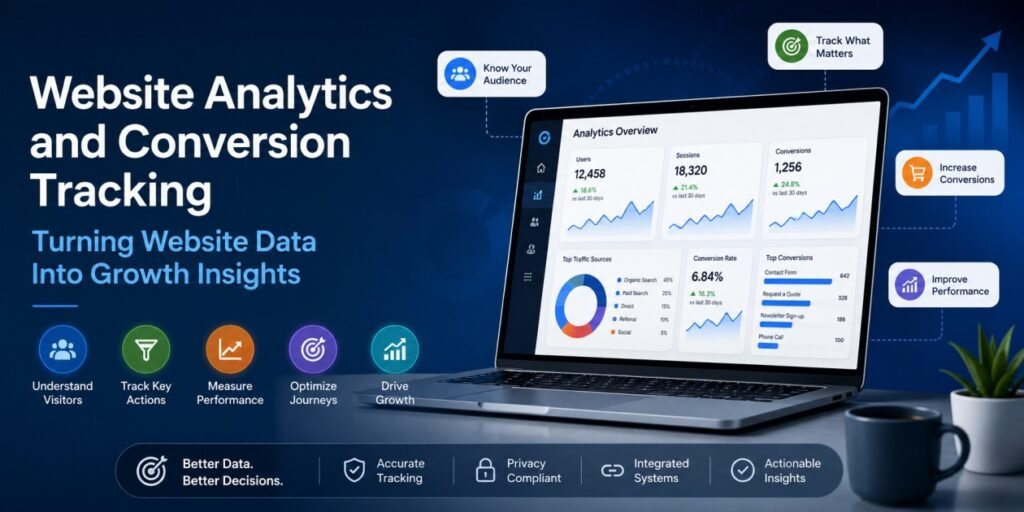
A website can generate thousands of visits and still leave a business uncertain about what is actually working. Traffic numbers can show how many people arrived, but they do not necessarily explain what visitors did, which journeys led to meaningful actions, where people abandoned the experience, or which channels contributed to business outcomes. Website analytics and conversion tracking provide the measurement layer needed to understand what happens after visitors arrive.
Effective measurement goes beyond counting page views. Businesses may need to understand interactions such as form submissions, consultation requests, purchases, bookings, downloads, calls, registrations, or other actions that represent meaningful progress toward a business objective.
When these interactions are measured consistently, website data can become more useful for decision-making. Teams can identify which pages attract attention, which journeys create friction, which acquisition sources produce valuable actions, and where improvements may have the greatest commercial impact.
This makes measurement an important component of Revenue-Focused Web Infrastructure™. A website should not only attract and convert visitors; it should also provide the data needed to understand how effectively the digital experience is supporting the business.
In this guide, we’ll explore how website analytics works alongside conversion tracking, what businesses should measure, how tracking fits into website development, where common measurement gaps occur, and how data can be used to improve the website and the broader customer journey.
Table of Contents
What Is Website Analytics and Conversion Tracking?
Website analytics helps businesses understand how visitors interact with a digital experience, while conversion tracking focuses specifically on actions that matter to the business.
Together, they provide a more useful picture of what happens between the moment someone arrives and the moment they complete—or abandon—a meaningful action.
Analytics Shows What Visitors Do
Website analytics can provide information about where visitors come from, which pages they view, how they move through the website, what devices they use, and how they interact with different parts of the experience.
This information can reveal patterns that are difficult to identify from individual conversations or assumptions. A service page may receive significant traffic but very few enquiries, for example, while a less visited page may consistently contribute to qualified leads.
The value of analytics therefore comes from using the information to understand behaviour and identify opportunities for improvement rather than simply reporting larger traffic numbers.
Conversion Tracking Measures Meaningful Actions
Conversion tracking focuses on the actions that represent progress toward a defined business objective. Depending on the website, this could include submitting a lead form, completing a purchase, booking an appointment, requesting a quote, downloading a resource, creating an account, or contacting the business through another tracked channel.
The definition of a conversion should come from the business objective rather than from whatever actions are easiest to measure. A page view may be useful information, but it is not necessarily a conversion.
A well-designed website conversion tracking setup distinguishes between general engagement and actions that have meaningful commercial or operational value.
Analytics and Conversion Tracking Work Together
Analytics and conversion tracking answer different but connected questions. Analytics can help explain what visitors are doing, while conversion tracking helps identify which interactions represent progress toward a desired outcome.
Together, they can help businesses move from:
“How much traffic did we receive?”
to:
“Which visitors took meaningful actions, what influenced those actions, and where are opportunities being lost?”
That shift is important because website optimization should ultimately be based on meaningful behaviour and business outcomes rather than traffic volume alone. This measurement layer also helps evaluate whether the Conversion-Focused Website Architecture is guiding visitors toward the actions the website is designed to support.
What Should a Business Track on Its Website?
The right measurement framework depends on what the website is designed to accomplish. Tracking everything possible can create large amounts of data without necessarily producing useful insight. The objective should be to measure the interactions that help the business understand performance and make better decisions.
Track Business-Critical Conversions
Start with the actions that directly support the website’s purpose. For a lead-generation website, this may include qualified enquiries, consultation requests, quote requests, or calls. For ecommerce, purchases and revenue may be central. For a service business, completed bookings or applications may be more meaningful than general engagement.
These primary conversions should be clearly distinguished from secondary interactions. A visitor viewing a pricing page may indicate interest, while submitting a consultation request may represent a much stronger commercial signal.
Separating primary and secondary actions helps teams understand which behaviours matter most rather than treating every tracked interaction as equally valuable.
Track Important Micro-Conversions
Not every visitor is ready to complete the primary conversion on their first visit. Micro-conversions can provide useful signals about progression through the customer journey.
Examples can include viewing key service pages, interacting with pricing information, watching an important video, downloading a resource, starting a form, using a calculator, or reaching a particular stage of a booking or checkout process.
Track the Source of Important Actions
Knowing that a conversion occurred is useful, but understanding where the converting visitor came from can make the data considerably more actionable. Businesses may want to distinguish between organic search, paid campaigns, referrals, social channels, email, direct traffic, and other acquisition sources.
Source information can help teams compare the quality of traffic rather than simply comparing traffic volume. A channel generating fewer visitors may produce substantially more valuable actions than a channel generating large amounts of low-intent traffic.
This is where website measurement begins to connect with broader acquisition and attribution analysis. Performance Marketing Attribution provides a deeper framework for understanding how marketing interactions can be evaluated against business outcomes.
Building an Effective Conversion Tracking Setup
Conversion tracking should be designed around the actual customer journey rather than added as an afterthought. The objective is to make important interactions measurable without creating unnecessary complexity or collecting data that the business does not actually need.
Define What Counts as a Conversion
Before implementing tracking, identify the actions that represent meaningful progress for the business. A lead-generation website may define a qualified enquiry or consultation request as a primary conversion, while an ecommerce website may focus on completed transactions and revenue.
It is also useful to distinguish primary conversions from secondary actions. A form submission may be a primary conversion, while viewing a service page, downloading a guide, or beginning a form may provide supporting behavioural signals.
Clearly defining these actions prevents analytics platforms from becoming filled with events that are technically measurable but difficult to interpret from a business perspective.
Map the Conversion Journey
Once important conversions are identified, map the steps a visitor typically takes before completing them. This could include an acquisition source, landing page, service or product page, supporting content, form interaction, confirmation page, and subsequent business process.
Mapping the journey makes it easier to identify which interactions need to be measured and where visitors may be abandoning the process.
It also creates a common framework for marketing, design, development, and analytics teams to understand how individual website interactions contribute to the broader customer journey. This connected approach is central to Revenue-Focused Web Infrastructure, where the website and its supporting systems are designed around measurable business outcomes.
Implement Tracking at the Right Points
Tracking should be implemented at the points where meaningful interactions occur. Depending on the website, this may include form submissions, button interactions, purchases, bookings, downloads, account creation, calls, or important stages within a multi-step process.
The implementation should also distinguish between an interaction occurring and a conversion actually being completed. For example, opening a form is different from successfully submitting it, and adding a product to a cart is different from completing a purchase.
This distinction improves the quality of the resulting data and gives businesses a clearer understanding of where users progress or drop out of important journeys.
Tracking Lead Generation and Enquiries
For businesses that depend on leads rather than direct ecommerce transactions, the website often represents the first measurable point in the customer relationship.
Track More Than Form Submissions
A form submission is an important signal, but it does not necessarily tell the full story. Businesses may need to understand which form was submitted, which service the visitor was interested in, where the visitor originated, and whether the enquiry ultimately became a meaningful opportunity.
This additional context can help teams distinguish between high-value enquiries and interactions that create little commercial value.
Where appropriate, website data can be connected with CRM information so that the business can understand what happens after the initial conversion rather than treating the form submission as the end of the journey. Our guide to Website Integrations explores how these connections can link website interactions with the wider systems supporting the business.
Connect Website Leads With Business Outcomes
The most useful measurement frameworks go beyond counting leads. If the business can connect website enquiries with qualification, sales progression, bookings, or revenue, it becomes easier to understand which website interactions and acquisition sources are producing meaningful results.
This requires coordination between the website, analytics systems, CRM, sales processes, and other relevant business systems. The exact implementation will vary depending on the organization’s technology and data requirements.
The principle remains consistent: measure the journey far enough to understand business value, not simply the first action a visitor takes.
Ecommerce and Transaction Tracking
For ecommerce websites, measurement needs to extend throughout the purchasing journey because individual interactions can influence whether a visitor ultimately completes a transaction.
Track the Complete Purchase Journey
Important ecommerce interactions can include product views, searches, product selections, cart activity, checkout progression, payment completion, refunds, and other transaction-related events.
Tracking these stages can help identify where customers encounter friction. A large number of product views followed by limited cart activity may indicate one type of problem, while significant cart activity followed by checkout abandonment may point to another.
The objective is to understand the complete journey rather than evaluating ecommerce performance only through completed transactions.
Connect Transactions With Revenue Data
Transaction tracking becomes more useful when it captures the information necessary to understand commercial value. Depending on the business model, this may include transaction value, product information, customer type, order status, or other relevant attributes.
This allows teams to distinguish between activities that generate engagement and those that contribute directly to revenue.
The resulting data can then support decisions around website experience, product presentation, acquisition, conversion pathways, and broader marketing performance.
Analytics Implementation Is Part of Website Development
Analytics and conversion tracking are often treated as marketing tasks that happen after a website is built. In practice, important measurement requirements can influence the architecture, functionality, integrations, and development decisions made during the project.
Plan Measurement Before Launch
When tracking requirements are defined before development is complete, developers can build important interactions with measurement in mind. Forms, buttons, checkout steps, booking flows, downloads, and other actions can be structured so that the required data can be captured consistently as part of High-Performance Website Development.
This is usually more reliable than trying to reconstruct the measurement framework after the website has already launched.
Early planning also makes it easier to establish naming conventions, event structures, data requirements, testing procedures, and responsibilities across the teams involved.
Test Tracking Before Going Live
Tracking should be tested in the same way that other website functionality is tested. Teams should verify that important events trigger correctly, required information is recorded, conversions are attributed appropriately, and unexpected interactions do not create misleading data.
Testing should cover different devices, browsers, forms, customer journeys, transaction states, and other conditions relevant to the website.
A website can function correctly from a visitor’s perspective while still producing incomplete or inaccurate analytics data, which is why measurement testing deserves its own quality-assurance process.
Maintain Measurement as the Website Changes
Tracking can become inaccurate as websites evolve. New forms may be added, URLs may change, checkout processes may be redesigned, third-party tools may be replaced, or developers may introduce new functionality without updating the measurement framework.
Analytics should therefore be reviewed whenever meaningful changes are made to the website or the customer journey.
Ongoing maintenance helps prevent measurement gaps from accumulating and ensures that the data remains useful for future optimization.
Common Website Analytics and Conversion Tracking Mistakes
Good measurement can become unreliable when tracking is implemented without a clear strategy. The biggest problems are often not caused by a lack of data, but by collecting the wrong data, missing important interactions, or interpreting measurements without enough business context.
Tracking Everything Without a Measurement Strategy
Modern analytics platforms can capture a large number of interactions, but more data does not automatically create better insight. Tracking every click, scroll, page view, and interaction without defining what matters can make reports difficult to interpret.
A better approach is to begin with business objectives and customer journeys, then determine which interactions provide useful evidence about progress toward those objectives.
This keeps the measurement framework focused on decisions the business actually needs to make rather than creating a large collection of disconnected metrics.
Treating Every Event as a Conversion
An event and a conversion are not necessarily the same thing. A visitor opening a form, watching a video, or viewing a pricing page may demonstrate interest, but those actions do not automatically represent a business conversion.
When every interaction is classified as a conversion, the resulting reports can overstate performance and make it harder to identify the actions that actually matter.
Primary conversions should therefore be defined separately from supporting interactions so that teams can understand both engagement and meaningful business outcomes.
Ignoring Tracking Gaps
A website can appear to have strong performance in analytics while important interactions remain untracked. Form submissions may not be recorded correctly, phone enquiries may be invisible, checkout steps may be incomplete, or attribution information may be lost between platforms.
These gaps can create an inaccurate picture of how visitors move through the website and which channels contribute to results.
Regular measurement audits can help identify missing events, broken tracking, inconsistent naming, and other issues before they significantly affect business decisions.
Making Decisions From Traffic Alone
Traffic is useful context, but it does not tell a business whether visitors are qualified, engaged, or commercially valuable.
A page attracting thousands of visitors may contribute fewer meaningful outcomes than a lower-traffic page attracting highly relevant prospects. This is why website analysis should consider behaviour, conversion rates, lead quality, revenue, and other business-specific measures alongside traffic.
The goal is to understand what the traffic does, not simply how much traffic the website receives.
Privacy, Consent and Responsible Measurement
Website analytics often involves collecting information about visitor interactions, which means measurement strategies need to account for applicable privacy, consent, and data-handling requirements.
Collect Only What You Need
Businesses should understand what information their analytics and tracking systems collect and why that information is required. Following data protection principles such as data minimization can help businesses avoid collecting unnecessary information and reduce additional privacy and governance responsibilities.
A measurement framework should therefore focus on the information needed to understand customer journeys, website performance, conversions, and business outcomes.
The appropriate approach depends on the business, the data being processed, the technologies involved, and the jurisdictions in which the website operates.
Consent Should Be Considered as Part of the Implementation
Where consent is required for specific tracking technologies or data processing activities, the website’s measurement architecture should account for those requirements from the beginning.
This can affect how analytics scripts, marketing tags, cookies, forms, and other technologies are implemented. Consent management should therefore be considered alongside the technical tracking setup rather than treated as a separate issue after implementation.
Businesses should also review their own legal and regulatory requirements because privacy obligations can differ according to location, audience, industry, and the type of information being processed.
Turning Website Data Into Better Decisions
Collecting data is only the beginning. The real value of analytics comes from using the information to identify opportunities, test improvements, and make better decisions about the website and customer journey.
Identify Where Visitors Drop Off
Conversion tracking can help businesses identify stages where visitors frequently stop progressing. A visitor may reach a service page but fail to begin a form, start a checkout but not complete payment, or interact with an important element without taking the expected next step.
These patterns can indicate areas worth investigating, although the data alone does not always explain why the drop-off occurs.
Teams can combine analytics with user feedback, usability research, technical testing, and other evidence to develop stronger hypotheses about what may be creating friction.
Use Data to Prioritize Website Improvements
Not every website problem deserves the same level of attention. Analytics can help identify high-traffic pages, high-value conversion paths, significant drop-off points, and other areas where an improvement may have meaningful impact.
For example, improving a frequently visited service page with a high commercial intent may create greater value than spending the same development effort on a low-traffic page that rarely contributes to customer journeys.
This allows website optimization to become more evidence-based, with development and design priorities informed by actual visitor behaviour and business objectives.
Measure the Impact of Changes
After a website change is implemented, measurement can help determine whether the change produced the expected outcome. Depending on the objective, teams may compare conversion rates, engagement, form completion, revenue, customer behaviour, or other relevant measures before and after the change.
This creates a feedback loop where the website is continuously evaluated rather than redesigned based entirely on assumptions.
The process becomes:
Measure → Identify → Improve → Validate → Repeat
This is one of the foundations of a more mature website optimization process.
How Analytics Fits Into Revenue-Focused Web Infrastructure
Website analytics and conversion tracking become significantly more valuable when measurement is connected to the wider digital environment rather than treated as an isolated reporting function.
Connect Measurement With the Website Experience
The website’s architecture, content, performance, conversion pathways, and integrations all influence the data that analytics systems receive. If important interactions are difficult to measure or critical customer journeys are disconnected, the resulting data may provide an incomplete picture of performance.
This means measurement requirements should influence website planning and development from the beginning. The technical foundation needs to make important interactions both functional and measurable.
Analytics therefore becomes part of the website infrastructure itself rather than simply a reporting tool used after the website has been built.
Connect Website Data With Business Systems
Website data can become more valuable when relevant information is connected with CRM, marketing, sales, ecommerce, or other business systems. This can help businesses understand what happens beyond the initial website interaction.
For example, a lead may begin with a website form but only become commercially meaningful after qualification, sales activity, or eventual purchase. Connecting these stages can provide a more complete view of the relationship between website activity and business outcomes.
This is where analytics connects naturally with the broader Revenue-Focused Web Infrastructure™ approach: the objective is to understand and improve the complete system rather than optimizing isolated website metrics.
Use Measurement to Support Continuous Growth
A website should evolve as customer behaviour, business priorities, acquisition channels, and market conditions change. Measurement provides evidence that can help determine which areas deserve attention and which improvements are producing meaningful results.
When analytics is connected with development, conversion, integrations, and business objectives, the website becomes an environment that can be continuously improved rather than a static asset that is only revisited when a redesign becomes necessary.
That is the broader role of measurement within revenue-focused website infrastructure: turning website activity into evidence that can guide better digital and business decisions.
The Mavenify Approach to Website Analytics and Conversion Tracking
At Mavenify, analytics and conversion tracking are treated as part of the website’s infrastructure rather than something added only after development is complete. The goal is to create a measurement foundation that connects website interactions, customer journeys, business systems, and meaningful outcomes.
This starts with understanding what the website is expected to accomplish and which interactions provide useful evidence of progress. Measurement requirements can then inform website architecture, development, integrations, conversion pathways, and the systems used to analyze what happens after visitors take action.
The result is a website environment where data is not simply collected for reporting, but can be used to understand performance, identify opportunities, and guide ongoing improvements.
Measurement Within the Growth Systems™ Framework
Website data becomes more valuable when it works alongside the other systems responsible for growth. Acquisition can bring relevant visitors, conversion architecture can guide their experience, website development provides the technical foundation, integrations connect information across platforms, and measurement provides evidence about what is happening.
This is why Mavenify connects measurement with its broader Growth Systems™ framework rather than treating analytics as a separate reporting activity.
Built Around Business Outcomes
The purpose of measurement is ultimately to help businesses make better decisions. That may mean identifying high-value customer journeys, improving lead generation, understanding acquisition quality, reducing conversion friction, improving ecommerce performance, or prioritizing development work.
Different businesses will require different measurement frameworks because their customers, sales cycles, conversion models, and operational systems are different. A useful analytics strategy therefore starts with business requirements rather than copying a standard list of metrics.
When the measurement layer reflects those requirements, website data becomes a practical input into growth decisions rather than a collection of disconnected numbers.
Frequently Asked Questions About Website Analytics and Conversion Tracking
What is website analytics and conversion tracking?
Website analytics helps businesses understand how visitors interact with their websites, while conversion tracking measures actions that represent meaningful progress toward defined business objectives. Together, they provide a clearer picture of website behaviour and outcomes.
What should a business track on its website?
Businesses should track interactions that help them understand important customer journeys and business outcomes. These may include enquiries, purchases, bookings, downloads, form submissions, calls, registrations, and meaningful supporting interactions.
What is website conversion tracking?
Website conversion tracking is the process of measuring specific website actions that a business defines as conversions, such as submitting a lead form, completing a purchase, booking an appointment, or requesting a consultation.
Is website analytics the same as conversion tracking?
No. Analytics provides broader information about visitor behaviour and website activity, while conversion tracking focuses on defined actions that represent meaningful business outcomes. The two work together to provide a more complete view of website performance.
Why is conversion tracking important for website development?
Conversion tracking can influence how forms, buttons, checkout processes, booking journeys, and other interactions are designed and implemented. Planning measurement during development can make important customer actions easier to capture accurately.
Can analytics show which marketing channel generates conversions?
Analytics and attribution systems can help businesses understand the sources and interactions associated with conversions. The level of insight depends on the tracking architecture, attribution methodology, data quality, and systems being used.
How can businesses improve their website using analytics?
Analytics can help identify high-value pages, conversion drop-offs, behavioural patterns, and other opportunities. Businesses can use these insights to prioritize changes, test improvements, and evaluate whether those changes produce better outcomes.
Can an existing website have conversion tracking added?
Yes. Existing websites can usually have analytics and conversion tracking implemented or improved. The exact approach depends on the website technology, existing tracking configuration, business objectives, integrations, and the interactions that need to be measured.
Does website analytics require Google Analytics?
No. Google Analytics is one analytics platform, but businesses can use different analytics and measurement technologies depending on their requirements. The important consideration is whether the chosen system can reliably capture and analyze the information the business needs.
Conclusion
Website traffic is only the beginning of understanding digital performance. Without reliable measurement, businesses can struggle to determine which visitors are valuable, which journeys create friction, which channels contribute to meaningful actions, and where development resources should be invested.
Effective website analytics and conversion tracking connect these pieces by turning website activity into structured information that can support better decisions. The goal is not to measure everything, but to measure the interactions and outcomes that matter to the business.
When measurement is planned alongside architecture, development, conversion, integrations, and customer journeys, analytics becomes part of the website’s infrastructure rather than an isolated reporting function.
That creates a continuous improvement cycle:
Measure → Understand → Improve → Validate → Grow
Build a Website That Can Be Measured and Improved
If your business knows how much traffic its website receives but cannot clearly identify what visitors do, which journeys produce opportunities, or where meaningful conversions are being lost, the problem may be a measurement gap rather than a traffic problem.
Mavenify’s Revenue-Focused Web Infrastructure™ combines website strategy, architecture, development, integrations, conversion, performance, and measurement to create a digital foundation designed around measurable business growth.