

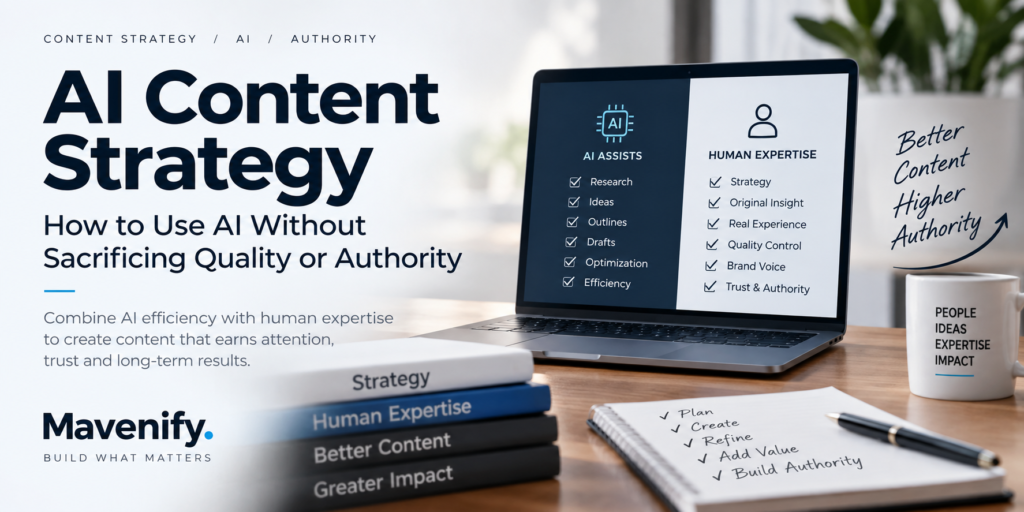
AI has changed the way businesses approach content. Research that once took hours can be accelerated, ideas can be developed quickly, and first drafts can be produced in minutes. For teams responsible for publishing consistently, that efficiency can be extremely valuable.
But faster content production does not automatically create better content.
As more businesses use generative AI, the real challenge is becoming less about how much content can be produced and more about whether that content is useful, original, accurate and worth trusting. Publishing hundreds of AI-generated pages without adding meaningful value can create a larger website without creating a stronger brand.
This is why an effective AI content strategy needs to go beyond content generation. AI should support research, planning, analysis and production while human expertise remains responsible for the ideas, judgment, experience and quality behind the final content.
The strongest approach combines the efficiency of AI with the things that make a business genuinely worth listening to: real expertise, original insight, practical experience and a clear understanding of its audience.
In this guide, we’ll explore how businesses can build an AI content strategy that improves efficiency without sacrificing quality or authority, where AI can add the most value, where human input remains essential, and how to create content that continues to build trust over time.
Table of Contents
What Is an AI Content Strategy?
An AI content strategy is a structured approach to using artificial intelligence throughout the content lifecycle while keeping the strategy, quality and purpose of the content under human direction.
It goes beyond using an AI tool to generate blog posts. A complete strategy considers what content should be created, who it is for, what expertise it should demonstrate, how AI can support the process and how the finished content will be reviewed, distributed and improved.
The key distinction is between AI-assisted content strategy and AI-led content production. In the first approach, AI helps the team work more efficiently while people remain responsible for the decisions that determine what gets published. In the second, the process can become centered on generating as much content as possible, often without enough attention to originality, accuracy or audience value.
AI Should Support the Content Strategy, Not Become the Strategy
AI is a tool within the larger content system. It can help identify patterns, organize information, develop ideas, summarize research, assist with drafts and analyze existing content.
But it cannot determine the most valuable perspective for a business simply by generating text. The strategy still needs to come from an understanding of the audience, the business’s expertise, its market and the problems it is qualified to solve.
This distinction keeps AI focused on improving the process rather than replacing the thinking behind the content.
An AI Content Strategy Covers More Than Content Creation
Content creation is only one part of the process.
A practical AI content strategy can influence research, topic planning, content briefs, drafting, editing, optimization, repurposing, distribution and performance analysis. Different stages can use AI in different ways depending on where automation actually improves efficiency without reducing quality.
The result is a more systematic approach to content production, where AI contributes to the workflow while people remain accountable for the final outcome.
Human Expertise Remains at the Center
The most valuable content often contains something that cannot be produced effectively through generic generation alone: genuine knowledge and experience.
A subject-matter expert can recognize which details matter, challenge weak assumptions, add practical examples and explain why one approach works better than another. Those contributions give content a perspective that is difficult to reproduce through automated text generation alone.
An effective AI content strategy therefore does not remove human expertise. It creates more opportunities for experts to contribute where their judgment has the greatest value.
Why Businesses Need an AI Content Strategy Now
AI has made content production significantly faster, but it has also made the internet more crowded with similar-looking information. When almost any business can generate an article, product description or social post in minutes, simply producing content at scale becomes less of a competitive advantage.
The advantage increasingly comes from what a business adds to the content that AI alone cannot provide: expertise, experience, original thinking, useful evidence and a clear understanding of its audience.
An AI content strategy helps businesses use the efficiency of these tools without allowing efficiency to become the only objective.
AI Has Lowered the Cost of Content Production
Research, outlining, drafting and repurposing can all take less time with AI assistance. For smaller teams in particular, this can make it possible to maintain a more consistent content operation without dramatically increasing resources.
But lower production costs can also create a temptation to publish more simply because publishing has become easier.
The strategic question is therefore no longer just how to produce content efficiently. It is which content deserves to be produced in the first place.
More AI Content Makes Differentiation More Important
When many businesses use similar tools and prompts, generic topics can quickly produce similar answers.
A business needs a reason for its content to stand apart. That might come from first-hand experience, proprietary data, original research, expert commentary, practical examples or a distinctive point of view.
AI can help organize and communicate those inputs, but the underlying differentiation needs to come from the business itself.
Quality Becomes More Important as Volume Increases
Publishing more content creates more opportunities to reach an audience, but it also creates more opportunities for errors, repetition and low-value information.
A scalable content operation therefore needs quality controls alongside production workflows. Research should be checked, important claims should be supported, content should be reviewed by knowledgeable people where appropriate and outdated information should be corrected.
The goal is not to slow AI-assisted production unnecessarily. It is to make sure that greater production capacity does not come at the expense of content quality.
Content Should Build an Asset, Not Just Fill a Calendar
A strong content strategy should create value that remains useful after publication.
An article can answer a customer question, strengthen a broader topic area, support another resource, contribute to brand authority or help a prospect make a decision. When these roles are considered together, content becomes part of a larger business asset rather than simply another item marked as published.
That is the real opportunity behind an AI content strategy: using AI to make the content operation more efficient while making every meaningful piece of content contribute to something larger.
Where AI Adds the Most Value in Content Strategy
AI is most useful when it removes repetitive work, helps teams process information faster and gives content specialists more time to focus on strategy and quality.
The objective is not to hand every stage of content production over to AI. It is to identify where AI can make the workflow faster while keeping the decisions that require expertise, context and judgment with the right people.
Content Research and Information Organization
Research can involve collecting large amounts of information, identifying recurring themes and organizing ideas before writing begins. AI can help summarize material, categorize information and surface potential areas worth investigating further.
Human review remains important, particularly when research involves factual claims, industry-specific information or sources that require interpretation. AI can help organize the research, but the business should remain responsible for deciding which information is reliable and relevant.
Topic Discovery and Content Planning
AI can help analyze existing content, identify recurring questions and generate potential topic ideas from a broader subject.
This can make content planning more efficient, especially when combined with search data, customer questions and subject-matter expertise. The final decision about what deserves a dedicated resource should still come from the overall content strategy.
This is where AI can support a topic cluster by helping identify relationships between subjects without replacing the strategic judgment behind the content architecture.
Briefs, Outlines and First Drafts
Creating a structured brief or first draft can be one of the most practical uses of AI.
AI can help organize headings, establish a logical flow and turn research notes into an initial structure. Writers and subject-matter experts can then spend more time improving the substance rather than starting from a blank page.
The first draft should be treated as a starting point, not the finished article.
Content Repurposing
A strong piece of content can often be adapted into different formats.
An in-depth article might become a short social post, newsletter section, video outline or presentation structure. AI can accelerate these transformations while preserving the core ideas of the original resource.
Human review is still important to ensure that the repurposed version fits the channel and does not simply reproduce the same content everywhere without adapting it for the audience.
Content Audits and Optimization
AI can also help analyze an existing content library.
It can identify potential duplication, summarize large collections of pages, highlight missing topics or help organize content by themes. This can make large-scale content audits considerably more manageable.
The important decisions should still be based on actual performance data, business priorities and editorial judgment rather than AI recommendations alone.
Performance Analysis and Content Improvement
AI can help turn large amounts of content and performance data into patterns that deserve human attention.
For example, it can help identify pages with declining visibility, recurring questions in user feedback or areas where several resources overlap. These observations can then inform decisions about updating, consolidating or expanding content.
The role of AI here is to surface opportunities. The content team still needs to determine what action makes sense.
Where Human Expertise Matters Most in AI-Assisted Content
AI can accelerate many parts of content production, but some decisions depend heavily on context, experience and judgment. These are the areas where human involvement can make the greatest difference to the quality and credibility of the final content.
The goal is not to keep humans involved in every repetitive task. It is to make sure people remain responsible for the parts of the process where expertise creates the actual value.
Choosing What Is Worth Saying
AI can generate hundreds of potential topics, angles and headlines. It cannot reliably determine which ideas are genuinely important to a particular audience or strategically relevant to a particular business without meaningful context.
A subject-matter expert can identify the questions customers repeatedly struggle with, the misconceptions that need correcting and the perspectives that are missing from existing content.
That judgment should shape the content strategy before AI is asked to produce anything.
Adding First-Hand Experience
First-hand experience can turn generic information into something substantially more useful.
A business may have lessons from projects, customer interactions, experiments, implementation challenges or industry experience that cannot be found in generic online sources. Bringing first-hand experience into the content gives readers something they are less likely to find in another AI-generated article.
AI can help structure those insights, but the underlying experience has to come from the people who actually possess it.
Challenging AI-Generated Information
AI-generated drafts can contain inaccurate, incomplete or oversimplified information. This is particularly important when content includes statistics, technical explanations, industry claims or recommendations.
A knowledgeable reviewer can question whether a statement is actually correct, whether the source supports it and whether an important qualification has been missed.
This is not simply proofreading. It is expert judgment applied to the substance of the content.
Protecting Brand Voice and Original Perspective
A business should sound like itself.
AI can reproduce common writing patterns very effectively, but that can also make content feel interchangeable. Human contributors can add the language, examples, opinions and perspectives that reflect how the business actually thinks and communicates.
The goal is not to hide the use of AI. It is to ensure that the final content contains enough genuine perspective that the business has a recognizable voice.
Making the Final Editorial Decision
Someone should remain accountable for what ultimately gets published.
That person may be a subject-matter expert, editor, strategist or another qualified contributor depending on the content. Their role is to determine whether the piece is accurate, useful, appropriate for the audience and genuinely worth publishing.
AI can make the process faster, but accountability should remain human.
AI Content Strategy vs. AI-Generated Content: What’s the Difference?
AI-generated content and an AI content strategy are not the same thing.
AI-generated content describes how content is produced. An AI content strategy describes why the content is being created, what role AI should play, what the business wants the content to achieve, and how quality and authority will be maintained throughout the process.
This distinction matters because a business can publish hundreds of AI-generated articles without actually having a content strategy. The result may be a large content library, but not necessarily a useful one.
A strategic approach starts with the business, audience and subject matter. AI then becomes part of the workflow rather than the decision-maker.
| AI-Generated Content | AI Content Strategy |
| Focuses primarily on production | Focuses on business and audience outcomes |
| Often starts with a prompt | Starts with a topic, audience need or business objective |
| Can increase publishing speed | Uses AI to improve the overall content process |
| May rely heavily on generic information | Incorporates expertise, experience and original insight |
| Measures output in pages or words | Measures usefulness, authority and business impact |
| Can be produced without deep subject knowledge | Requires human subject-matter and editorial judgment |
The difference is similar to the difference between having a tool and having a system for using that tool. AI can help produce the content, but the strategy determines whether that content deserves to exist in the first place.
AI Does Not Decide What Your Audience Actually Needs
A prompt can ask an AI system to write about almost any subject. That does not mean the resulting topic is valuable to your audience.
A strong content strategy begins with questions that require business judgment. What are customers trying to understand? What prevents them from making a decision? Which questions repeatedly appear during sales conversations? Where does the company have genuine experience? Which subjects are important enough to support the brand’s long-term positioning?
AI can help organize and analyze information around these questions, but the underlying decisions should come from people who understand the business and its customers.
Strategy Creates the Context AI Cannot Invent
AI can identify patterns across existing information, generate variations and help structure ideas. What it cannot automatically provide is genuine experience your business has accumulated.
Consider a software company that has spent five years solving a particular implementation problem. A generic AI article can explain the problem. A strategically developed article can explain how the company encountered it, what approaches failed, what changed the outcome and what other businesses should consider before making the same mistake.
That difference is important because original experience gives content a reason to exist beyond repeating information already available elsewhere.
The Goal Is Not More AI Content
The most useful question is not, “How much content can AI help us produce?”
It is, “What content can we create with AI that would genuinely be useful to our audience and valuable to our business?”
That shift changes the entire workflow. Instead of using AI to fill a publishing calendar, businesses can use it to accelerate research, improve content operations and help subject-matter experts turn their knowledge into useful resources.
That is where AI becomes a strategic advantage rather than simply a production shortcut.
How to Build an Effective AI Content Strategy
An effective AI content strategy does not begin with choosing an AI tool. It begins with deciding what the business wants its content to accomplish, who the content needs to help and what knowledge the brand can contribute that people cannot get from another generic article.
AI then becomes part of the operating process. It can accelerate research, organize information, identify patterns, support content development and help teams improve existing resources. But the strategic decisions remain human: what deserves to be published, what perspective the brand should bring, what evidence is trustworthy and what will genuinely help the audience.
This distinction is becoming increasingly important as AI makes content production easier. Google’s guidance on generative AI content specifically notes that AI can be useful for researching topics and adding structure to original content, while generating many pages without adding value can fall under its scaled content abuse policies.
The practical answer is not to avoid AI. It is to build a workflow where AI increases the efficiency of a people-first content strategy rather than replacing the strategy itself.
Start With Business and Audience Goals
Before asking AI to generate topics or articles, define what the content needs to achieve.
A business might want to increase qualified organic visibility, establish expertise in a particular market, educate prospects before a sales conversation, support product decisions or generate more qualified enquiries. Those objectives should influence which subjects receive attention and what type of content is worth creating.
The audience matters just as much. A topic may have significant search demand and still be the wrong topic for a particular business if it attracts people who have no relationship with its products, services or expertise.
This is why an AI content strategy should begin with the intersection of business relevance and audience usefulness.
Google’s guidance on people-first content asks a similar question: whether a site has an existing or intended audience that would find the content useful if they came directly to the business.
Identify Where the Brand Has Something Valuable to Say
Once the audience and business objectives are clear, the next question is where the brand has genuine knowledge to contribute.
AI can help identify related questions, search themes, competing content and gaps in existing coverage. But identifying a keyword opportunity is not the same as identifying a worthwhile content opportunity.
The strongest opportunities usually sit where customer questions overlap with the company’s experience.
A software company might have learned how a particular implementation failed and what eventually fixed it. A marketing company may have tested different acquisition models across multiple campaigns. A professional services firm may have seen the same mistake repeatedly across client engagements.
Those experiences create material that generic AI-generated content cannot simply reproduce from existing information.
This is also where topic clusters become useful. Instead of creating isolated articles around whatever topic happens to look interesting, businesses can organize related subjects around areas where they want to establish deeper knowledge and authority.
Build a Content Architecture Before Building Content
An AI content strategy becomes considerably more useful when individual topics are connected to a broader information architecture.
Instead of asking AI to produce one article after another, determine the major subjects the business needs to own, the questions surrounding those subjects and how individual pieces of content should support one another.
This creates a structure in which a comprehensive resource can introduce a subject, while supporting content answers more specific questions around it. Internal links then help readers move naturally between related information.
The objective is not to create links simply because SEO requires internal linking. The objective is to make the website easier to understand and easier to navigate while building depth around subjects that matter to the business.
That approach also makes the content library more useful to AI-driven search experiences. Google’s guidance for generative AI features in Search emphasizes valuable, unique and non-commodity content rather than simply producing more pages.
Create a Human-Led Content Brief
Once the architecture is established, each piece of content should have a clear brief before production begins.
The brief should establish the audience, search intent, central question, business objective, important supporting subjects and the perspective the brand wants to contribute. It should also identify any first-hand knowledge, data, examples or expert input that should appear in the final piece.
AI can then help expand the research, organize questions and develop a working outline.
This creates an important division of responsibility. AI helps answer “How can we develop this efficiently?” while the human strategist answers “Why are we creating this, and what should it say?”
Use AI to Accelerate Research and Content Development
AI can be particularly valuable once the strategic foundation is established.
It can help organize research, compare information, identify related concepts, turn notes into an outline, summarize large amounts of material and create an initial draft. It can also help transform one substantial resource into different formats for other channels.
The value comes from reducing repetitive work rather than removing human thinking from the process.
For example, an expert who already understands a subject may spend hours turning scattered knowledge into a structured article. AI can help organize that knowledge into a usable first draft, allowing the expert to spend more time improving the substance rather than starting from a blank document.
Add Original Expertise Before Publication
The AI-assisted draft should never be treated as the finished product.
The most important stage is where the business adds what it actually knows.
That may include project experience, customer questions, original observations, proprietary processes, data, expert commentary or lessons learned from real-world implementation. These details give the content substance that goes beyond summarizing information already available online.
Google puts this principle quite clearly: “Create valuable, non-commodity content for your audience.”
Google’s guidance for AI search specifically highlights unique points of view and first-hand experience as ways to create content that goes beyond commodity information.
This is also where E-E-A-T in SEO becomes relevant. Experience and expertise are demonstrated through what the content actually contains—not simply by mentioning that a business is experienced.
Establish a Review and Quality-Control Process
Before content is published, it needs a human review stage.
That review should examine factual accuracy, originality, usefulness, evidence, tone and whether the content actually delivers what the title and introduction promise.
The reviewer should also ask a more fundamental question: Would this content still be worth publishing if search engines did not exist?
If the answer is no, the problem is probably strategic rather than technical.
Google’s guidance offers a useful framework here, asking creators to consider whether content provides original information, substantial value, insightful analysis and demonstrable expertise rather than simply rewriting information found elsewhere.
For businesses building long-term authority, this quality-control stage is what prevents AI efficiency from gradually turning into content sameness.
How to Create an AI Content Workflow That Scales
A scalable AI content workflow is not simply a faster way to produce articles. It is a repeatable process that determines where AI should be used, where human expertise is required and how every piece of content moves from an initial idea to a published and measured asset.
The workflow should make production more efficient without making the content less thoughtful. When the process is designed correctly, AI handles tasks that are repetitive or information-heavy while people remain responsible for strategy, expertise, quality and the final editorial decision.
Stage 1: Research and Content Discovery
The process begins before writing.
AI can help analyze existing content, organize research, identify related questions and surface patterns across search results, customer conversations and other available information. This can significantly reduce the time required to understand a subject.
But research should lead to a decision, not automatically to an article.
The content team still needs to determine whether the opportunity is relevant to the audience, whether it supports a broader business objective and whether the brand has enough knowledge to contribute something useful.
Stage 2: Build the Topic and Content Plan
Once the opportunity has been validated, the next step is deciding how the subject fits into the broader content structure.
Some topics deserve a comprehensive resource. Others are better handled through focused supporting content that answers a specific question. The relationship between these resources should be considered before production begins so that the content library becomes increasingly connected as it grows.
This is where a well-planned content strategy becomes more valuable than simply maintaining a publishing calendar. The broader approach is explained in our guide to AI Content & Authority Systems, which looks at how content, topical authority, expertise and distribution can work together as a long-term system rather than as disconnected publishing activities.
Stage 3: Create the Brief
A detailed brief gives both the human team and AI a clear direction.
The brief should establish the intended reader, search intent, central question, business objective, important supporting concepts and the unique information the article should contain. It should also identify relevant internal resources, evidence and first-hand expertise that should be incorporated.
This prevents AI from determining the structure entirely on its own.
Instead, the strategic direction is established first and AI is used to help execute it.
Stage 4: Draft With AI Assistance
Once the brief is ready, AI can accelerate the production stage.
It can turn research notes into an initial structure, expand an outline into a rough draft, simplify complex explanations and suggest ways to make information easier to understand.
The important word here is assistance.
The first AI draft should be treated as working material. It gives the writer or subject-matter expert something to improve rather than something that automatically deserves publication.
This approach also makes it easier for experts who understand their subject deeply but do not have unlimited time for writing to contribute their knowledge to the content process.
Stage 5: Add Expertise, Evidence and Original Perspective
The next stage is where the content should become distinctly yours.
An expert should review the draft and add the information that AI could not know from generic training data: actual experiences, customer questions, implementation lessons, original observations, proprietary processes, research and informed opinions.
This is often the difference between AI-assisted content and genuinely valuable content.
A useful article should not merely explain what something is. It should help the reader understand what matters, why it matters and what they should consider based on the author’s actual knowledge of the subject.
Stage 6: Editorial and Fact Review
Before publication, the content should go through a deliberate review process.
Claims should be checked. Sources should be verified. Repetition should be removed. Generic statements should be challenged. Examples should be accurate. The tone should match the brand. Most importantly, the article should be reviewed from the reader’s perspective.
A polished AI draft can still contain weak reasoning or incorrect information. Editorial review is therefore not simply proofreading. It is a quality-control stage that protects the credibility of the entire content operation.
Stage 7: Publish, Connect and Distribute
Publishing should also be considered part of the content strategy.
A new article should connect naturally with relevant existing resources where those resources genuinely help the reader. It may also be repurposed into social content, email material, sales enablement resources or other formats where appropriate.
The objective is not to push the same article everywhere. It is to make useful knowledge available in the places where the audience is most likely to need it.
This is where content begins working as part of a broader digital growth system rather than remaining isolated on a blog.
Stage 8: Measure and Improve
The final stage is learning from what happens after publication.
Performance data can show which topics attract relevant visitors, which pages contribute to meaningful interactions and where the audience may be showing stronger or weaker interest.
Those insights should then influence future research and planning.
Over time, the workflow becomes a feedback loop:
Research → Strategy → Brief → Create → Review → Publish → Measure → Improve
AI can support almost every stage of that loop, but it should not own the loop. The strategy still belongs to the people responsible for the business, the audience and the brand.
How to Keep AI-Generated Content Original and Authoritative
Using AI does not automatically make content generic. The problem begins when the same research, prompts and instructions produce essentially the same article that many other businesses could publish.
Originality therefore has to be designed into the workflow.
The strongest AI-assisted content starts with information, perspectives and experiences that belong to the business, then uses AI to help structure and communicate them effectively. This gives the content a distinctive foundation before optimization or distribution even begins.
Start With First-Hand Knowledge
One of the simplest ways to make AI-assisted content more original is to begin with what the business actually knows.
Customer questions, project experiences, implementation challenges, internal processes, experiments and lessons learned can all provide material that generic research cannot replicate.
Instead of asking AI to invent an example, give it a real example and ask it to help explain the underlying lesson. Instead of asking it to produce an opinion, provide the reasoning behind the company’s position and use AI to make that reasoning clearer.
The result is content that uses AI for efficiency while retaining genuine business knowledge at its core.
Add Original Data and Evidence
Original data can make an article substantially more useful.
This could include results from internal research, anonymized customer observations, campaign data, surveys, experiments or other information the business is legitimately able to share.
Even relatively small datasets can provide a perspective that is difficult for generic content to reproduce.
The important point is that the data should be real and appropriately explained. AI can help analyze or visualize findings, but it should not manufacture statistics to make an article appear more authoritative.
Develop a Distinctive Point of View
Authority is not created simply by covering a subject comprehensively.
A business can become more recognizable by developing a clear point of view based on its experience and understanding of the market.
That does not mean every article needs to make a controversial claim. It means the content should explain how the business understands the problem, what it has learned and why it approaches the subject in a particular way.
When that perspective appears consistently across related content, individual articles begin reinforcing the identity of the broader brand.
Use AI to Strengthen Ideas, Not Manufacture Them
AI is often most useful when there is already something valuable to work with.
An expert can provide a rough explanation, interview notes, research findings or a collection of observations. AI can then help organize those ideas, identify missing explanations, simplify complex sections or explore alternative ways of communicating them.
This reverses the common workflow of asking AI for an idea first and trying to make it sound authoritative afterward.
The better sequence is often expertise first, AI assistance second, editorial judgment throughout.
Make Every Article Earn Its Place
Before publishing another AI-assisted article, ask whether it contributes something the existing content library does not already provide.
If an existing page already answers the question adequately, creating another page with slightly different wording may add little value. The better decision may be to improve the existing resource, combine related information or approach the subject from a genuinely different angle.
This creates a healthier content library because growth comes from depth and usefulness, rather than simply increasing the number of URLs.
AI Content Strategy and Google: What Businesses Need to Know
One of the biggest questions businesses have about AI-assisted content is whether using AI will negatively affect their visibility in Google.
The answer is more nuanced than simply asking whether content was written by a person or an AI system.
Google’s guidance focuses on the quality and purpose of the content rather than treating the use of AI as an automatic reason for a page to perform poorly. The concern is content created primarily to manipulate search rankings or large-scale production of pages that provide little or no additional value.
That distinction is important because it means businesses do not need to choose between using AI efficiently and maintaining a strong search presence. They need to make sure AI is being used within a content process that produces genuinely useful information.
Google summarizes the principle behind its guidance simply: “Focus on creating original, helpful content that provides real value to people.”
AI Assistance Is Not the Same as Search Manipulation
There is a meaningful difference between using AI to help a subject-matter expert research and structure an article and automatically generating hundreds of pages because the technology makes that possible.
In the first case, AI is supporting a legitimate content process. In the second, the primary objective may simply be increasing the number of pages indexed by search engines.
Google’s spam policies identify scaled content abuse as a problem when large amounts of content are produced primarily to manipulate search rankings, regardless of whether the content is created by humans, automation or a combination of both.
This makes the strategic role of AI particularly important. The question is not “Was AI used?” but whether the resulting content provides meaningful value.
Quality Still Determines the Value of the Content
AI can make a weak content strategy more productive, but it cannot make a weak strategy valuable simply by increasing its output.
If the underlying research is shallow, the perspective is generic and the content does not answer the reader’s actual need, producing it faster only increases the amount of low-value material being created.
The opposite is also true. When AI is used to support strong research, expert knowledge, editorial review and useful content architecture, it can help a business create valuable resources more efficiently.
This is why AI content optimization should not be reduced to keyword placement or automated rewriting. Optimization should improve the usefulness, clarity and accessibility of content while preserving the original value that made it worth creating.
Search Optimization Still Matters
Using AI does not eliminate the fundamentals of search optimization.
Pages still need clear topics, useful structures, descriptive titles, logical internal links and content that satisfies the underlying intent of the searcher.
For businesses also thinking about visibility in AI-generated search experiences, the same foundation remains important. Google’s guidance for AI features in Search states that there are no additional technical requirements or special markup needed specifically for inclusion in AI Overviews or AI Mode. The emphasis remains on creating valuable content and following established search best practices.
That means an AI content strategy should not become a completely separate SEO discipline. It should strengthen the underlying content and information architecture that already supports search visibility.
Don’t Create Content Simply Because AI Makes It Easy
The easiest content to produce is not necessarily the content worth producing.
Before publishing an AI-assisted article, businesses should be able to explain why the page exists, who it is intended to help and what it contributes that existing resources do not already provide.
That simple discipline can prevent one of the biggest problems associated with AI-assisted publishing: turning content production into an exercise in filling a website rather than building a useful knowledge resource.
How AI Content Strategy Supports AI Search Visibility
Search is no longer limited to a list of blue links.
People increasingly use AI-powered experiences to explore topics, compare options, ask follow-up questions and discover businesses. That creates another reason to build content around genuine expertise rather than treating every article as an isolated search-ranking opportunity.
An effective AI content strategy helps create the underlying knowledge that search engines and AI systems can use to understand what a business knows, what it offers and which subjects it has genuine authority around.
AI Search Needs More Than Keyword-Focused Content
Traditional keyword targeting can help a search engine understand the subject of a page, but visibility in AI-driven experiences depends on a broader understanding of the information surrounding a subject.
A business should be able to explain its expertise consistently across related topics, answer the questions customers actually ask and provide useful information that can be understood in context.
This is one reason connected content architecture matters. A single article can answer one question, but a well-developed body of related content can demonstrate much deeper knowledge around an entire subject.
Build Content That Can Be Understood in Context
AI systems need context to understand relationships between concepts.
For example, a business discussing conversion optimization may need supporting content around landing pages, forms, testing, analytics and user behavior. Each resource addresses a different question, while together they create a clearer picture of the company’s knowledge.
This does not mean creating content for the sake of covering every possible keyword. It means developing useful resources around the subjects that genuinely matter to the audience and the business.
Connect Expertise Across the Website
The website itself should reinforce the relationship between related knowledge.
A detailed article can link to another resource that explains a concept in greater depth. A service page can connect the business’s expertise to the problem the visitor is trying to solve. Supporting content can then lead readers toward more practical information.
These relationships make the website easier for people to navigate and provide stronger contextual signals about the subjects the business covers.
GEO Is Part of a Broader Content Strategy
Generative Engine Optimization is not a separate replacement for content strategy. It is concerned with improving a brand’s visibility and representation within generative AI search experiences.
That makes the quality of the underlying content especially important.
Businesses that want to become more visible in AI-driven discovery need more than pages containing target keywords. They need clear expertise, consistent information, credible sources, useful answers and a recognizable body of knowledge.
This is where Generative Engine Optimization (GEO) connects naturally with a broader AI content and authority strategy.
Don’t Create Content Just to Be Mentioned by AI
It can be tempting to treat AI search visibility as the new version of keyword ranking: identify prompts, create pages and attempt to engineer mentions.
That approach misses the larger opportunity.
The stronger objective is to become a useful source of information within a subject area. When a business consistently publishes credible, relevant and genuinely useful material, its content has a stronger foundation for being discovered, understood and referenced across different search experiences.
The strategy therefore remains fundamentally human. Create knowledge worth finding first; optimize how that knowledge is discovered second.
How to Measure the Performance of an AI Content Strategy
An AI content strategy should be measured by more than the amount of content produced or the time saved during production.
AI may allow a team to research and draft content twice as quickly, but that efficiency only matters if the resulting content attracts the right audience, builds authority and contributes to business outcomes. The measurement framework therefore needs to connect content activity with actual impact.
Measure Search Visibility
Organic visibility is an important starting point.
Monitor impressions, clicks, rankings and the range of relevant queries for which important content becomes visible. More importantly, look at whether visibility is increasing around the subjects the business actually wants to be known for.
A growing number of impressions is not necessarily a success if those impressions come from irrelevant searches. The quality and relevance of the audience matter as much as the volume of visibility.
Measure Engagement With the Content
Once people reach a page, examine what happens next.
Engagement can help reveal whether the content is answering the visitor’s question and whether it encourages them to explore related information. Depending on the type of page, useful signals can include engaged sessions, interaction with important elements, navigation to related resources and return visits.
These metrics need context. A visitor who reads a short article, gets the answer they needed and leaves is not necessarily a failed interaction.
The objective is to understand whether the content is useful for the intended audience, not to maximize a single engagement metric.
Measure Content’s Contribution to Conversions
Content should ultimately connect with the business.
For some companies, that may mean generating qualified enquiries. For others, it could mean product demonstrations, registrations, sales conversations or transactions.
This is where content measurement needs to connect with conversion tracking rather than stopping at traffic and rankings.
A page that receives modest traffic but consistently contributes to qualified enquiries may be considerably more valuable than a high-traffic article that attracts visitors with little commercial relevance.
Measure Authority as a Long-Term Asset
Authority is more difficult to measure than traffic because it develops over time.
Look for evidence that the brand is becoming more visible around important subjects, that related content is gaining traction and that the website is increasingly associated with the areas in which the business has genuine expertise.
Brand mentions, relevant backlinks, citations, direct traffic and growing visibility across a subject area can all provide useful context.
No single metric proves authority. The stronger approach is to look at several signals together and assess whether the overall digital presence is becoming more credible and recognizable.
Measure AI Efficiency Without Losing Sight of Quality
AI-specific operational metrics can also be useful.
A team can measure research time, drafting time, content production costs and the amount of material that can be produced within a given period. These measurements can show whether AI is actually improving the efficiency of the workflow.
But production efficiency should never become the primary objective.
If a team reduces drafting time by 60 percent but needs significantly more time to correct weak research, inaccurate claims or generic content, the apparent efficiency gain may not represent a real improvement.
The better question is whether AI allows the team to produce more useful content with the same or better quality standard.
Create a Feedback Loop
The most effective measurement systems do not simply report what happened. They influence what happens next.
If certain topics consistently attract qualified visitors, those subjects may deserve deeper coverage. If an article receives visibility but fails to satisfy visitors, it may need improvement. If content contributes to conversions, related resources may deserve further investment.
This creates a continuous feedback loop between performance and strategy.
Research → Plan → Create → Publish → Measure → Improve
AI can help analyze this information and identify patterns, but the strategic decisions should remain with the people who understand the business and its customers.
Common Mistakes to Avoid in an AI Content Strategy
The biggest problems with AI-assisted content rarely come from the technology itself. They usually come from using the technology without a clear strategy, editorial process or understanding of what makes the content valuable in the first place.
As AI makes publishing easier, these mistakes can also happen at a much greater scale. A weak workflow that produces one poor article at a time becomes a much bigger problem when it produces fifty.
Publishing Content Without a Clear Purpose
A new article should have a reason to exist.
If the only reason for creating a page is that a keyword has search volume or an AI tool can produce the article quickly, the content strategy is already starting from the wrong place.
Every piece should serve a clear audience need, business objective or authority-building purpose. If it does none of these things, producing it faster does not make it more valuable.
Treating AI Output as the Final Draft
An AI-generated draft can sound complete while still being shallow.
It may cover the obvious points, use familiar explanations and appear well structured, but that does not mean it contains enough insight to deserve publication.
The draft should therefore be treated as raw material. Human review should challenge the assumptions, improve the reasoning, add relevant experience and remove anything that does not genuinely help the reader.
Letting AI Invent Experience or Evidence
AI should never be asked to manufacture case studies, statistics, customer experiences or expert opinions.
If a business did not conduct an experiment, achieve a particular result or work through a specific situation, the content should not imply that it did.
Trust is difficult to build and easy to damage. A smaller amount of accurate, experience-based information is more valuable than an impressive-looking article built around invented authority.
Creating Too Much Similar Content
AI can make content duplication particularly easy.
A business may create several articles targeting slightly different keyword variations while answering essentially the same question. Over time, this can make the website larger without making it more useful.
Before creating a new page, review what already exists. Sometimes the better decision is to strengthen an existing resource, consolidate overlapping content or add genuinely useful depth to a subject that has already been covered.
Optimizing for Search at the Expense of the Reader
AI can make it easy to add keywords, related phrases and sections to an article. But optimization becomes counterproductive when it starts dictating the content instead of supporting it.
The reader should never have to work through repetitive explanations simply because a content tool identified another related phrase worth including.
Search optimization should help the right people discover useful information. It should not determine how much unnecessary information they have to read once they arrive.
Measuring Production Instead of Impact
The number of articles published is an operational metric, not proof that the strategy is working.
A business can publish more efficiently while attracting the wrong audience, producing weaker content or generating no meaningful business results.
AI should therefore be evaluated on whether it helps the organization create better outcomes, not merely more output.
Automating Before the Process Is Proven
There is also a temptation to automate the entire content workflow as soon as AI tools become available.
That can create problems when the underlying process has not been tested.
It is usually better to establish a reliable workflow first, understand where human judgment creates the most value and then automate the repetitive parts. Otherwise, automation simply makes an inefficient or low-quality process operate faster.
Building a Sustainable AI Content Strategy
The long-term value of AI in content marketing will not come from producing content indefinitely faster. It will come from building a system that becomes more intelligent, more efficient and more valuable over time.
A sustainable strategy treats content as a business asset. Every new resource should strengthen the knowledge already published, contribute something useful to the audience and create opportunities for the next stage of the customer journey.
Build Around Expertise, Not Publishing Frequency
Publishing frequency can be useful operationally, but it should not determine the strategy.
A business that has deep expertise in five important subjects may create far more value by developing those areas thoroughly than by publishing about fifty unrelated subjects.
This is where the combination of content strategy and authority becomes important. The objective is to create a recognizable body of knowledge around the subjects where the business has something meaningful to contribute.
Turn Existing Knowledge Into Reusable Assets
Not every valuable piece of knowledge needs to begin as a new article.
A customer question can become an FAQ. A recurring sales objection can become an educational resource. A successful project can provide material for a case study. An expert conversation can become an article, video or social resource.
AI can help transform these existing knowledge sources into different formats while preserving the original insight.
This makes content creation less dependent on continuously coming up with new ideas and more connected to the knowledge the business is already generating.
Keep Improving the Content Library
A sustainable strategy also includes maintenance.
Industries change, customer expectations evolve and previously useful information can become incomplete. Important pages should therefore be reviewed when new information, experience or performance data gives the business a reason to improve them.
AI can help identify outdated sections, compare newer information and surface potential content gaps. Human review should determine whether an update is actually necessary and what needs to change.
The result is a content library that becomes progressively more useful instead of simply becoming larger.
Connect Content With the Rest of the Growth System
Content does not operate independently from the rest of a business’s digital presence.
Search visibility can bring the audience to the website. The website can establish trust and communicate the offer. Paid channels can introduce new audiences. Conversion systems can turn interest into action. Content and authority can then strengthen the brand’s credibility across the entire journey.
This interconnected approach is particularly important when AI is involved because content can now be created and distributed across more channels than ever.
The opportunity is not simply to automate content production. It is to create a connected growth system in which useful knowledge supports discovery, trust, conversion and long-term authority.
Frequently Asked Questions About AI Content Strategy
What is an AI content strategy?
An AI content strategy is a structured approach to using artificial intelligence across content research, planning, creation, optimization and analysis while keeping human expertise and editorial judgment at the center. The goal is to improve efficiency without sacrificing originality, quality or authority.
Is AI-generated content good for SEO?
AI-generated content can perform well when it provides genuine value to the audience and meets the same quality standards expected of any other content. The use of AI itself is not the central issue; the quality, purpose and usefulness of the finished content matter more.
Should businesses use AI to write all their content?
Not necessarily. AI can be useful for research, outlining, drafting, repurposing and optimization, but humans should remain responsible for strategy, expertise, fact-checking, originality, brand voice and final editorial decisions.
How can AI improve content marketing?
AI can accelerate research, help identify related topics, organize information, develop content briefs, support initial drafts, repurpose existing material and analyze performance. When these capabilities are combined with a clear strategy, they can make the overall content operation more efficient.
How do you maintain content quality when using AI?
Start with clear strategic direction, give AI relevant business context, incorporate original expertise and first-hand experience, verify important claims and maintain a human editorial review process. AI should assist the creation process rather than determine what is ultimately published.
Does AI replace human content writers?
AI can automate parts of content production, but it does not eliminate the need for human judgment. Subject-matter expertise, strategic thinking, original perspectives, editorial decisions and understanding of the audience remain important parts of producing authoritative content.
How do you measure an AI content strategy?
Measure both efficiency and outcomes. Useful indicators can include organic visibility, relevant traffic, engagement, qualified leads, conversions, content-assisted revenue and production efficiency. The right metrics depend on the business objective, but publishing volume alone is not enough.
Conclusion: Build With AI, But Keep Strategy Human
AI has fundamentally changed how efficiently businesses can research, create and distribute content. But efficiency alone does not create valuable content.
A strong AI content strategy combines the speed and analytical capabilities of AI with human expertise, first-hand experience, editorial judgment and a clear understanding of the audience. The result is not simply a faster publishing process. It is a more deliberate system for turning business knowledge into useful content that can build visibility, trust and authority over time.
The businesses that approach AI this way will be better positioned to use the technology as it evolves. Instead of chasing publishing volume or the latest AI tool, they can build a content operation that continuously learns, improves and compounds its value.
The fundamental principle is simple: use AI to make good content more efficient to create, not to make mediocre content easier to produce.
Build an AI Content & Authority System™ That Scales With Your Business
At Mavenify, we help businesses turn AI into a practical part of their content and authority-building process. Our AI Content & Authority System™ combines AI-assisted content strategy, topical authority, semantic content architecture, E-E-A-T optimisation, AI Retrieval Optimisation (GEO), digital PR and intelligent content distribution to build a stronger digital presence over time.
The focus is not on publishing more content simply because AI makes production faster. It is on creating useful, credible and strategically connected content that demonstrates expertise, strengthens authority and helps the brand become more visible across both traditional search and AI-driven discovery.