

Brand mentions in AI search are becoming a new part of the customer discovery journey. A potential buyer may now ask an AI system to recommend providers, compare solutions, explain a market, identify leading companies, or suggest the best approach to solving a particular problem—sometimes before visiting a traditional search results page.
For businesses, this creates a new visibility question: what makes an AI-powered search experience mention one brand while overlooking another? There is no universal formula. Different platforms can use different models, search indexes, retrieval systems, sources, ranking processes, and methods for generating responses.
Businesses can, however, strengthen the information environment surrounding their brand. Clear entity information, authoritative content, credible third-party references, original expertise, technically accessible webpages, and strong relationships between a company and the topics it genuinely serves can all improve the conditions for discovery across modern search experiences.
Table of Contents
What Does It Mean to Be Mentioned in AI Search?
An AI search mention occurs when a brand, organization, product, service, expert, or other identifiable entity appears within an AI-generated response to a relevant user query. Depending on the platform and experience, that appearance may take the form of a recommendation, comparison, description, citation, linked source, product reference, or inclusion within a broader generated answer.
Brand mentions and source citations are not necessarily the same thing. An AI response may mention an organization without linking directly to its website, while another response may cite a webpage as an information source without prominently recommending the organization behind it.
AI Mention vs AI Citation
An AI mention refers to the brand or entity appearing within the generated response. An AI citation refers to a source being referenced or linked as supporting information. A business can receive one without necessarily receiving the other.
This distinction matters when measuring AI visibility. Tracking only website citations can overlook brand appearances that influence awareness, while tracking only mentions can overlook which websites and publications are actually supplying information to AI-powered search experiences.
AI Recommendation vs Brand Mention
A brand being mentioned does not automatically mean it has been recommended. AI-generated responses may list companies as examples, describe alternatives, summarize information, compare providers, or reference an organization while answering a broader question.
Businesses should therefore evaluate the context and relevance of their visibility, not simply count how often the company name appears.
Where Do AI Search Systems Get Information About Brands?
AI search systems can encounter information about brands across a much wider digital ecosystem than the company’s own website. Depending on the platform and query, information may be discovered through search indexes, webpages, publications, structured databases, product information, third-party sources, and other retrieval systems available to the AI experience.
This means a business cannot approach AI visibility solely as an on-page optimization exercise. Its website remains an important source of first-party information, but the way the organization is described, referenced, and validated elsewhere can also shape the information environment surrounding the brand.
1. Your Own Website
A company’s website is one of the clearest places to establish first-party information about the organization. About pages, service and product pages, expert profiles, research, case studies, articles, FAQs, contact information, and other core resources can help communicate what the business does and where its expertise lies.
Important information should be technically accessible, clearly written, internally connected, and kept accurate over time.
2. Search Engines and Search Indexes
Some AI-powered search experiences are connected with web search or retrieval systems that can surface current information from indexed webpages. Strong technical SEO and conventional organic visibility therefore remain relevant foundations rather than separate disciplines that become obsolete in an AI-search environment.
Businesses should continue investing in crawlability, indexability, content quality, internal architecture, and organic authority alongside newer AI visibility initiatives.
3. Third-Party Publications and Media
Industry publications, news coverage, interviews, expert commentary, research references, podcasts, partner websites, and other reputable third-party sources can provide independent information about a brand and its expertise.
These references are particularly valuable when they exist because the organization has contributed something genuinely useful, newsworthy, authoritative, or relevant to the publication’s audience.
4. Business and Professional Profiles
Relevant business listings, professional profiles, industry directories, organization databases, and other established platforms can provide additional factual context about a company or its people.
The objective should not be to create hundreds of low-quality directory listings. Focus instead on sources that are legitimate, relevant to the organization, and likely to be useful to real users.
5. Reviews and Customer Discussions
Reviews, forums, communities, social discussions, and other user-generated sources can contain information about how customers perceive brands, products, and services. Depending on the system and query, this broader web discussion may contribute useful context around an organization.
Businesses should focus on earning genuine customer feedback and participating appropriately in relevant communities rather than manufacturing reviews or promotional conversations.
6. Original Research and First-Party Data
Original research, surveys, experiments, benchmarks, datasets, case studies, and proprietary observations can give other publishers a reason to reference a business as an information source.
When genuinely useful information is cited by relevant third parties, the organization can become associated not only with its services but also with knowledge surrounding the subject.
Your Website Is Only One Part of Your AI Visibility
Publishing excellent content on your own domain is important, but brands should not assume that every AI-generated answer will retrieve information directly from their website. Other sources may provide stronger relevance, independent validation, clearer evidence, or information better suited to a particular query.
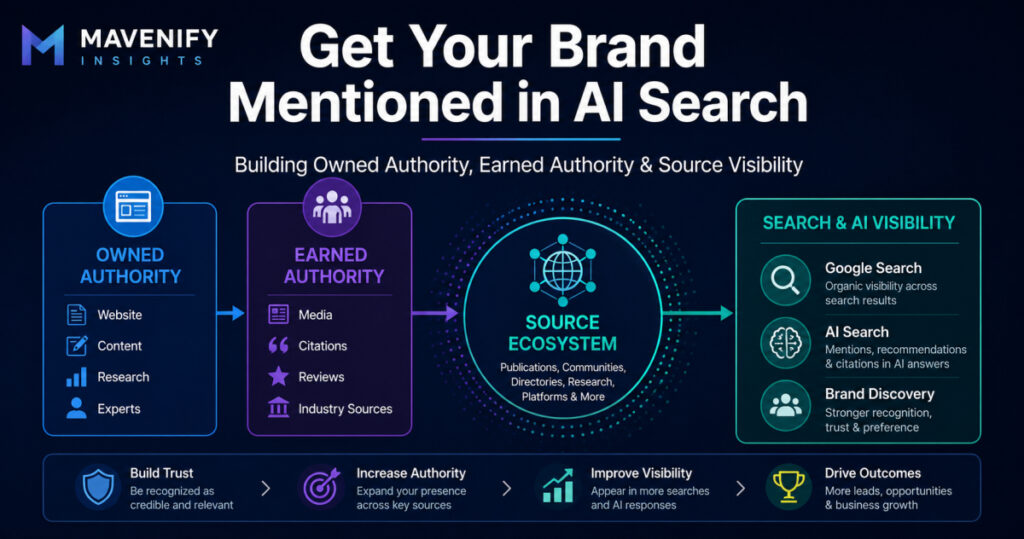
A stronger strategy therefore combines owned authority—what the business publishes itself—with earned authority—what credible independent sources say, reference, or validate about the organization.
Why Do Some Brands Get Mentioned in AI Search While Others Don’t?
There is no single publicly documented set of factors that determines whether a brand will appear within every AI-generated response. Different platforms can use different retrieval systems, search technologies, models, data sources, and methods for selecting and presenting information.
However, brands that are clearly associated with a relevant subject, publish useful information, maintain a credible digital presence, and receive independent recognition across the web can create a stronger information environment around their organization. The following factors should therefore be viewed as strategic areas to strengthen—not as guaranteed AI ranking factors.
1. Strong Relevance to the User’s Question
A brand needs a meaningful relationship with the subject being discussed. Clear service information, focused expertise, relevant content, industry experience, and supporting evidence can help establish why an organization belongs within a particular topic or problem space.
Trying to associate a company with unrelated high-volume topics simply to increase visibility can dilute rather than strengthen that context.
2. Clear Brand and Entity Information
Search and retrieval systems benefit from being able to distinguish which organization is being discussed and how it relates to people, services, products, industries, locations, and areas of expertise.
Consistent organization information, strong About and service pages, expert profiles, appropriate structured data, contextual internal links, and credible external references can strengthen this entity clarity.
3. Depth of Topical Authority
A business that consistently publishes useful information around a genuine area of expertise can build a more complete topical footprint than one relying on a single optimized service page or article.
Strong topical coverage can include foundational guides, comparisons, implementation resources, research, FAQs, case studies, industry applications, expert perspectives, and answers to narrower questions that arise throughout the customer journey.
4. Credible Third-Party Validation
What a company says about itself and what independent sources say about it serve different purposes. Relevant media coverage, industry references, interviews, reviews, expert citations, partnerships, and other credible mentions can provide additional context surrounding a brand.
The objective is not to manufacture mentions across hundreds of websites. Independent references are most meaningful when they come from sources that have a legitimate reason to discuss the organization.
5. Information Worth Citing
Brands can strengthen their information footprint by publishing material that gives other people and organizations a reason to reference them. Original research, proprietary data, useful frameworks, benchmarks, experiments, detailed case studies, expert analysis, and genuinely new observations can all create citation opportunities.
Repeating information already available across hundreds of competing websites gives publishers fewer reasons to treat the business as an original source.
6. Consistency Across the Digital Ecosystem
Important facts about a company should remain reasonably consistent across its website and relevant external profiles. Conflicting names, descriptions, services, locations, leadership information, or other core details can create unnecessary ambiguity.
Consistency does not mean copying the same company description everywhere. It means maintaining an accurate underlying identity while adapting the presentation naturally to different audiences and platforms.
7. Technical Accessibility and Discoverability
Valuable information still needs to be accessible. Crawlability, indexability, internal linking, page availability, robots directives, canonicalization, and other technical foundations can affect whether important website information can be discovered and processed.
AI visibility should therefore be built on top of sound technical SEO rather than treated as a substitute for it.
Does Having a Famous Brand Guarantee AI Visibility?
No. Brand recognition can contribute to a stronger digital footprint, but relevance remains important. A widely known organization may not be the most useful source or recommendation for every specialized question.
Smaller businesses can still strengthen their visibility by developing genuine expertise within focused topics, publishing distinctive information, earning relevant third-party recognition, and building clear associations with the problems and markets they serve.
How to Increase Your Chances of Being Mentioned in AI Search
No optimization technique can guarantee that a brand will appear within a particular AI-generated response. Businesses can, however, strengthen the signals, information, relationships, and evidence available about their organization across the wider web.
The most durable approach combines owned authority—the information and expertise a business publishes itself—with earned authority—credible recognition, references, citations, reviews, and coverage from independent sources.
1. Define What You Want Your Brand to Be Known For
Start by identifying the subjects, services, problems, industries, and areas of expertise that genuinely represent the organization. A business does not need to become associated with every topic in its market.
Clear positioning creates a foundation for content, entity relationships, external authority building, and the types of discovery queries where the brand could reasonably be relevant.
2. Strengthen Your Core Brand Entity
Make important facts about the organization clear across its website and relevant external profiles. This can include the company name, description, services, leadership, expertise, markets served, contact information, and relationships with important products, people, or methodologies.
Strong About pages, service pages, expert profiles, structured data, internal links, and accurate third-party profiles can contribute to a clearer representation of the organization.
3. Build Deep Topical Coverage
Develop useful resources around the subjects the organization wants to be associated with. Instead of publishing disconnected articles based only on keyword volume, map the important concepts, questions, comparisons, use cases, problems, and decision points surrounding each core topic.
Connect these resources through contextual internal links so the relationship between the brand, its expertise, and the wider subject becomes clear.
4. Publish Information Others Have a Reason to Cite
One of the strongest ways to expand a brand’s information footprint is to contribute something worth referencing. Original surveys, benchmarks, proprietary data, experiments, research, frameworks, case studies, expert analysis, and useful datasets can give journalists, publishers, customers, and industry professionals a reason to cite the org
The information does not always need to be large-scale academic research. A well-documented analysis based on genuine business experience can be valuable when the methodology, context, and limitations are transparent.
5. Earn Relevant Media and Industry Coverage
Digital PR can extend brand authority beyond the company’s own website. Expert commentary, interviews, contributed insights, research coverage, podcasts, industry publications, event participation, and journalist relationships can create independent references around the organization.
Prioritize publications and communities relevant to the market rather than treating every media placement as equally valuable.
6. Become a Source for Expert Commentary
Subject-matter experts within the organization can contribute useful perspectives when journalists, publishers, researchers, podcasts, or industry communities need informed commentary.
The objective should be to provide genuinely useful expertise rather than turning every contribution into a promotional pitch. Strong expert visibility can create relationships between people, organizations, and areas of knowledge across the wider web.
7. Strengthen Reviews and Independent Customer Evidence
Genuine reviews, testimonials, customer stories, and independent discussions can provide additional evidence about how a business performs in the real world. Where appropriate, encourage customers to share authentic feedback on platforms relevant to the industry and market.
Never manufacture reviews, fake community discussions, or artificial recommendations in an attempt to influence search or AI systems. These practices create reputational risk and undermine the credibility the strategy is intended to build.
8. Be Present in the Sources That Matter to Your Market
Identify the publications, directories, communities, professional networks, comparison resources, industry organizations, and other sources that customers genuinely use when researching your category.
The objective is not to place the brand everywhere. It is to build accurate and credible visibility within the parts of the digital ecosystem that have a legitimate relationship with the organization’s market.
9. Make Your Best Information Easy to Discover
Valuable research, case studies, expert insights, service information, and other important resources should be technically accessible and connected through sensible site architecture and internal links.
Use descriptive page titles, headings, contextual links, appropriate structured data, indexable content, and clear organization so important information does not become buried within the website.
Individual AI search platforms may also provide specific guidance for making website content accessible to their search systems.
10. Monitor Mentions, Sources and Competitors
Build a repeatable set of commercially relevant prompts and monitor how the brand appears across the AI search experiences that matter to the target audience. Record mentions, citations, linked sources, competitors, context, and changes over time.
When competitors consistently appear and your brand does not, investigate the sources supporting those results. The gap may reveal opportunities involving content, topical coverage, third-party authority, entity clarity, market relevance, or original information.
Think in Terms of Source Ecosystems, Not Just Backlinks
Traditional link building often focuses on obtaining a hyperlink from one website to another. AI-era authority building requires a broader perspective. A relevant publication might mention the brand, quote an expert, cite original research, discuss a methodology, review a product, reference a case study, or link directly to a resource.
These signals should not all be treated as interchangeable or assumed to influence every AI system in the same way. The strategic objective is to build a credible source ecosystem in which the brand and its expertise are represented accurately across both owned and independent information sources.
Which Third-Party Sources Matter for AI Visibility?
Not every external mention carries the same strategic value. A reference from a source that is relevant, credible, and connected to the subject can provide more meaningful context than dozens of placements on websites created primarily for link building.
The sources worth pursuing depend on the business, industry, audience, geography, and type of information being validated. Rather than asking where a brand can obtain the most mentions, businesses should ask which independent sources genuinely matter within their market and customer research journey.
1. Industry Publications
Specialist publications can help establish relationships between a brand and the subjects, industries, or problems it serves. Opportunities may include expert commentary, research coverage, contributed insights, interviews, case studies, or references within editorial content.
Relevance should take priority over publication size alone. A respected niche publication read by the organization’s target market can be strategically valuable even if it has a smaller overall audience.
2. News and Media Coverage
Legitimate media coverage can provide independent information about an organization, its people, research, products, milestones, or market activity. Businesses can create stronger opportunities for coverage by contributing genuinely newsworthy information rather than distributing promotional announcements with little editorial value.
Original data, market research, expert analysis, significant company developments, and timely commentary can provide stronger foundations for earned media.
3. Reviews and Customer Platforms
Reviews can provide independent evidence about customer experiences with a company, product, or service. Businesses should focus on the review platforms that genuinely influence decisions within their industry and target market.
Review acquisition should remain authentic and compliant with the relevant platform’s policies. Artificial reviews can damage both reputation and trust.
4. Professional and Expert Profiles
Professional networks, author pages, speaker profiles, industry associations, conference appearances, and other credible expert profiles can provide additional context about the people associated with an organization.
These signals become more meaningful when expert profiles connect with genuine work, publications, research, experience, or contributions within the relevant subject area.
5. Relevant Business and Industry Directories
Established directories can help communicate factual information about an organization, particularly when the directory serves a real industry, professional, geographic, or customer need.
Avoid treating directory submission as a volume exercise. Hundreds of low-quality listings provide little strategic value compared with accurate representation on a smaller number of trusted and relevant platforms.
6. Research Citations and Data References
When businesses publish original research, benchmarks, surveys, datasets, or experiments, other organizations may reference those findings within articles, reports, presentations, research, or industry commentary.
These citations can extend the reach of the organization’s expertise beyond its own website and create durable associations between the brand and the information it originated.
7. Communities and User Discussions
Forums, professional communities, social platforms, and other discussion environments can contain valuable first-hand experiences and recommendations. Their relevance varies significantly by market and topic.
Brands should participate transparently where appropriate rather than attempting to seed artificial recommendations. Genuine community reputation develops through useful participation and real customer experiences.
8. Market-Specific Sources
Businesses targeting a particular country or region should identify the publications, directories, associations, communities, review platforms, and industry resources that genuinely influence that market.
Market-specific authority can help establish stronger contextual relevance without requiring the organization to misrepresent its physical presence or create artificial local signals.
Quality, Relevance and Independence Matter More Than Volume
Third-party authority building should not become a race to accumulate mentions. Evaluate opportunities based on their relevance to the subject, credibility with the intended audience, editorial independence, geographic importance where applicable, and whether the reference provides meaningful context about the organization.
A smaller source ecosystem containing credible, relevant references can create a stronger foundation than widespread placement across unrelated or low-quality websites.
Should You Pay for Brand Mentions?
Paid advertising, sponsorships, partnerships, and legitimate promotional placements can all play a role in marketing, but they should not be presented as independent editorial validation when they are not.
Businesses should distinguish clearly between earned coverage, owned content, and paid exposure. The objective of an AI visibility strategy should not be to manufacture the appearance of independent authority through undisclosed promotional placements.
How to Find the Sources AI Search Is Already Using
Businesses do not need to guess blindly about which sources may matter within their category. AI search results themselves can provide useful clues about the websites, publications, experts, datasets, and other sources being surfaced for commercially relevant questions.
By systematically reviewing those results, businesses can identify recurring sources, understand where competitors are gaining visibility, and uncover gaps within their own content and authority footprint. This should be treated as research rather than an attempt to reverse-engineer a fixed algorithm, because results and source selection can change over time.
1. Build a Commercially Relevant Prompt Set
Start with questions that reflect how potential customers actually research the market. Include discovery questions, comparisons, recommendations, problem-based searches, alternatives, requirements, and evaluation queries rather than testing only the company name.
Organize prompts into categories so visibility can be evaluated across the customer journey instead of relying on isolated examples.
2. Record Which Brands Appear
Track the organizations, products, experts, or services mentioned across relevant responses. Look for patterns rather than treating one appearance as a permanent ranking position.
If particular competitors repeatedly appear across related questions, investigate what information and authority exist around those brands that may be missing from your own digital presence.
3. Identify the Sources Being Cited
Where the platform provides citations or source links, record the domains and individual pages supporting relevant responses. Pay particular attention to sources that appear repeatedly across multiple questions.
These sources can reveal which publications, research resources, directories, company pages, expert content, or other information environments are currently influential within that discovery journey.
4. Separate First-Party and Third-Party Sources
Determine whether the information comes directly from company websites or from independent sources discussing those companies.
If competitors are being surfaced primarily through their own content, the gap may involve content depth, structure, relevance, or technical accessibility. If independent publications repeatedly support competitor visibility, the opportunity may involve digital PR, expert contributions, reviews, research, or broader earned authority.
5. Analyze Why the Source May Be Useful
Do not assume that a source matters simply because it appeared once. Examine what the page actually contributes. It may provide original research, a detailed comparison, first-hand experience, structured product information, expert commentary, current statistics, or a particularly clear answer to the question.
Understanding the informational value of the source is more useful than mechanically attempting to obtain a link from the same domain.
6. Identify Your Authority Gaps
Compare the recurring source ecosystem with the organization’s existing digital footprint. Look for missing publications, weak topical coverage, limited expert visibility, absent customer evidence, insufficient original information, unclear entity relationships, or markets where competitors have stronger independent recognition.
These gaps can then inform content development, digital PR, partnerships, research, expert positioning, and other authority-building initiatives.
7. Turn the Findings Into an Outreach Strategy
Once strategically important sources have been identified, determine whether there is a legitimate reason for the organization to contribute to them. Opportunities might include providing expert commentary, sharing original data, contributing research, participating in an interview, offering a relevant case study, or developing a resource genuinely useful to the publication’s audience.
Outreach should lead with the value being contributed rather than asking publishers simply to “mention our company for AI visibility.”
Build an AI Source Map
A practical way to organize this research is to create an AI Source Map connecting important prompt categories with the brands, citations, domains, experts, and information types that repeatedly appear.
Over time, the map can reveal which sources influence different stages of discovery, where competitors have stronger authority, which content formats are repeatedly surfaced, and where the organization has realistic opportunities to strengthen its presence.
| Track | What to Record |
| Prompt | The question being tested |
| Intent | Discovery, comparison, recommendation, evaluation or research |
| Platform | The AI search experience tested |
| Brands Mentioned | Companies appearing in the response |
| Sources Cited | Domains/pages referenced |
| Source Type | Brand site, publication, review, research, community, directory, etc. |
| Your Brand | Mentioned / not mentioned |
| Competitors | Which competitors appear |
| Opportunity | Content, PR, research, entity, review or authority gap |
| Date & Market | When and where the test was performed |
The purpose of an AI Source Map is not to create another vanity score. It is to turn AI visibility into a research process that can guide concrete decisions across SEO, content, digital PR, brand authority, and market development.
Common Mistakes When Building Brand Mentions in AI Search
As AI visibility becomes a marketing priority, businesses are being exposed to tactics that promise fast mentions, guaranteed citations, or preferential treatment within AI-generated answers. Many of these claims oversimplify how different AI search experiences discover, retrieve, and present information.
A stronger strategy focuses on building genuine relevance, useful information, credible authority, and an accurate digital footprint rather than attempting to manufacture signals specifically for AI systems.
1. Trying to Manipulate AI Systems With Keyword Stuffing
Repeating brand names, services, locations, or target phrases throughout content does not create genuine authority. Excessive repetition can reduce readability and weaken the usefulness of the page.
Keywords remain useful for understanding language and search demand, but they should support clear communication rather than become a mechanism for forcing brand associations.
2. Creating Fake Reviews or Recommendations
Artificial reviews, fabricated testimonials, fake community discussions, and undisclosed promotional recommendations should never be used to manufacture the appearance of brand popularity.
Businesses should build customer evidence through genuine experiences and transparent participation on platforms relevant to their audience.
3. Buying Large Volumes of Low-Quality Mentions
Placing a brand across unrelated websites, low-quality directories, syndicated pages, or questionable publications simply to increase mention volume does not create meaningful market authority.
Prioritize sources with genuine relevance, credibility, audience value, and a legitimate reason to reference the organization.
4. Publishing Generic Content at Scale
Increasing publishing volume does not automatically increase AI visibility. Hundreds of articles that reproduce information already available elsewhere may expand the website without strengthening its authority or distinctiveness.
Content strategy should prioritize useful coverage, original expertise, evidence, research, real examples, and information that contributes something meaningful to the subject.
5. Assuming Backlinks and Brand Mentions Are the Same Thing
A hyperlink, an unlinked brand mention, an expert citation, a customer review, and an editorial recommendation represent different types of signals and context. They should not be treated as interchangeable.
The broader objective is to develop a credible source ecosystem around the organization rather than optimizing every external reference solely for link acquisition.
6. Treating Schema as an AI Mention Shortcut
Structured data can help make certain information and relationships more explicit, but schema markup does not guarantee that an independent AI platform will mention, recommend, or cite a brand.
Structured data should accurately reinforce information that genuinely exists on the website and form part of a broader entity and technical strategy.
7. Testing Only Branded Prompts
Asking an AI system questions that already contain the company name provides limited insight into genuine discovery. A brand may naturally appear when explicitly requested while remaining absent from the unbranded questions potential customers use to discover providers.
Measurement should therefore include non-branded discovery, comparison, problem, recommendation, and evaluation prompts.
8. Copying Whatever Competitors Are Doing
Competitor analysis can reveal useful gaps, but reproducing another company’s articles, backlinks, directory profiles, or messaging does not automatically reproduce its visibility.
Instead, investigate why particular sources or competitors may be useful within the discovery journey and identify where the organization can contribute stronger information, expertise, evidence, or market relevance.
9. Expecting Immediate Results
Building meaningful authority across owned and independent sources takes time. New content needs to be discovered, relationships need to develop, third-party references need to be earned, and search and AI systems can reassess information at different rates.
AI visibility should therefore be approached as an ongoing search and authority strategy rather than a short campaign designed to produce guaranteed mentions within a fixed number of days.
10. Promising Guaranteed ChatGPT or AI Recommendations
No business can reliably control whether an independent AI platform will recommend a particular company for a specific prompt. Outputs can vary by platform, query, context, location, available information, and changes to the underlying systems.
Agencies should distinguish between improving the conditions for AI discovery and claiming control over the output of systems they do not operate.
How Mavenify Builds Brand Authority for AI Search
Mavenify approaches brand visibility as part of Search Intelligence Infrastructure™, connecting what a business publishes about itself with how that business is represented and validated across the wider digital ecosystem.
We describe these two dimensions as Owned Authority and Earned Authority. Owned Authority includes the website, content, entity information, expert profiles, research, case studies, structured data, and other information controlled by the organization. Earned Authority includes credible third-party coverage, citations, reviews, expert references, industry recognition, and other independent signals surrounding the brand.
These signals can then be evaluated through an AI Source Map—a structured view of the prompts, brands, sources, competitors, and information environments appearing across strategically relevant AI discovery journeys.
From AI Source Mapping to Authority Building
Source mapping allows strategy to begin with evidence. Instead of blindly acquiring backlinks or publishing more articles, businesses can identify where competitors are being discovered, which sources repeatedly influence relevant queries, and which authority gaps exist within their own digital footprint.
Those findings can inform technical SEO, content development, original research, digital PR, expert positioning, review strategy, entity optimization, partnerships, and market-specific authority building.
The Mavenify Search Intelligence Model
Our approach can be summarized as a continuous intelligence cycle:
Prompt Universe → AI Source Map → Authority Gaps → Owned & Earned Authority → Visibility → Commercial Outcomes
The objective is not simply to increase the number of times a brand name appears within generated responses. It is to strengthen visibility for the questions that influence real customer discovery and connect that visibility with measurable business outcomes.
Frequently Asked Questions About Getting Mentioned in AI Search
How Do I Get My Brand Mentioned in AI Search?
There is no guaranteed method for securing a brand mention in an AI-generated response. Businesses can improve the conditions for discovery by strengthening their website, topical authority, entity clarity, original information, expert signals, technical accessibility, and credible third-party presence.
The objective should be to create a strong information environment around the brand rather than attempting to manipulate individual AI platforms.
Can I Get My Business Recommended by ChatGPT?
Businesses can strengthen the information available about their organization, but they cannot control whether ChatGPT recommends a particular company for a specific query. Responses can depend on the question, available information, retrieval processes, product features, location, context, and changes to the underlying systems.
Claims of guaranteed ChatGPT recommendations should therefore be treated cautiously.
Do Brand Mentions Help With AI Search Visibility?
Brand mentions can contribute to the wider information environment surrounding an organization, particularly when they occur within relevant and credible contexts. However, an unlinked mention, editorial citation, review, expert reference, backlink, and recommendation are different types of signals and should not be assumed to influence every AI search system in the same way.
Are Backlinks Important for Getting Mentioned in AI Search?
Backlinks remain useful for traditional search visibility, discovery, referral traffic, authority building, and relationships between information sources. For broader AI visibility, businesses should also consider credible brand mentions, expert citations, reviews, original research, industry coverage, and other forms of third-party validation.
Does Digital PR Help With AI Search Visibility?
Digital PR can help expand a brand’s presence across credible independent sources through research coverage, expert commentary, interviews, industry publications, data citations, and other earned media opportunities.
These activities can strengthen the broader authority footprint surrounding a brand, although no particular media placement can guarantee inclusion within an AI-generated response.
Does Schema Markup Help AI Systems Understand My Brand?
Appropriate structured data can make certain information about an organization, person, product, article, or other entity more explicit to systems that support that markup. It should accurately represent visible information and complement strong website content and entity signals.
Schema markup should not be treated as a shortcut for obtaining AI mentions or recommendations.
Should I Create Content Specifically for ChatGPT?
Businesses generally do not need a separate content library written exclusively for ChatGPT. Content should address genuine audience needs while providing clear information, sufficient context, evidence, expertise, and useful structure.
A strong resource should remain valuable whether someone discovers it through Google Search, an AI-powered search experience, a third-party publication, or directly on the website.
Which Websites Should Mention My Brand?
Prioritize sources that have genuine relevance to the organization’s industry, audience, expertise, or target market. Depending on the business, these may include industry publications, reputable media, professional organizations, research sources, review platforms, relevant directories, expert communities, and market-specific resources.
Quality, relevance, independence, and context are more important than accumulating the largest possible number of mentions.
How Can I Find Which Sources AI Search Uses for My Industry?
Test a structured set of commercially relevant prompts and record the brands, citations, domains, experts, and source types appearing across the results. Repeated patterns can be organized into an AI Source Map to identify competitor advantages and gaps within the organization’s own authority footprint.
How Long Does It Take to Improve Brand Visibility in AI Search?
There is no universal timeframe. Results can depend on existing authority, technical health, content depth, competitive conditions, third-party recognition, market relevance, and how individual search and AI systems discover and reassess information.
Building search authority should therefore be treated as an ongoing strategy rather than a campaign promising mentions within a fixed number of weeks.
Build a Brand That Search Systems Can Understand—and Markets Can Trust
Getting mentioned in AI search is not about discovering a hidden prompt, adding a particular schema property, or publishing hundreds of AI-generated articles. It starts with building a digital presence that clearly communicates what the organization represents and contributes useful information to the subjects it genuinely understands.
But visibility should not stop with AI-generated answers. Traditional organic search remains a major discovery channel, and many of the foundations that support AI visibility—technical accessibility, useful content, entity clarity, topical authority, credible backlinks, expert signals, and third-party recognition—also strengthen the broader search ecosystem.
The strongest strategy therefore connects SEO and AI Search rather than treating them as competing disciplines. Businesses need to understand where customers search, which sources influence those journeys, how competitors gain visibility, and where stronger owned and earned authority can create a competitive advantage.
Search behaviour will continue to evolve. Building a credible, well-connected and measurable information footprint gives businesses a stronger foundation regardless of whether the next customer discovers them through a traditional search result, an AI-generated answer, an industry publication, or another emerging search experience.
Build Your Search Intelligence Infrastructure™
Mavenify helps businesses strengthen visibility across traditional search and AI-powered discovery through one connected Search Intelligence strategy. We combine technical SEO, content and topical authority, entity optimization, AI source intelligence, earned authority, and commercial measurement to identify where visibility is being won—and where competitors are getting there first.