

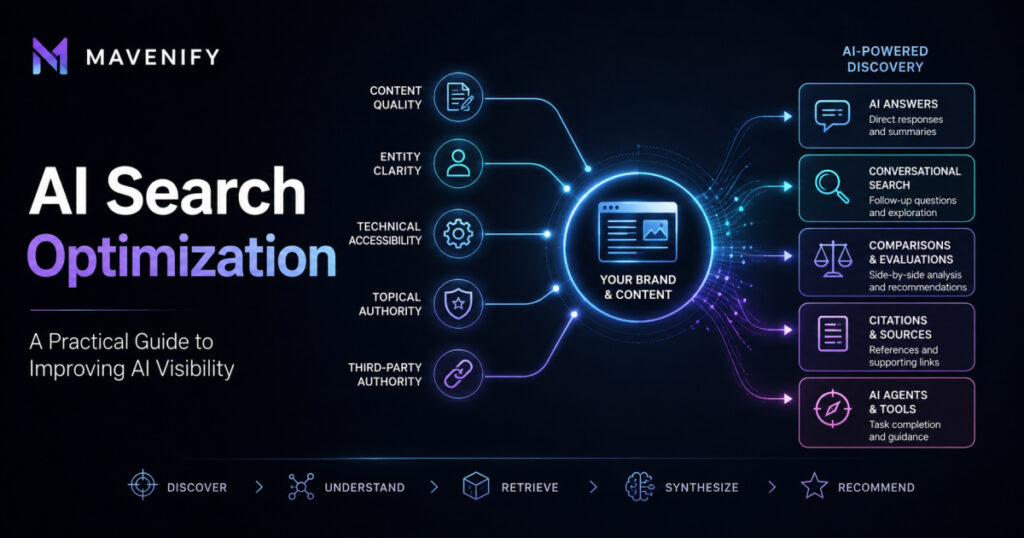
AI-powered search is changing how people discover information, evaluate businesses, compare solutions, and make decisions online. Instead of relying only on lists of traditional search results, users can increasingly receive synthesized answers, recommendations, comparisons, and summaries directly within AI-powered search experiences.
AI Search Optimization is the practice of improving a brand’s digital presence so its information is easier for search and AI systems to discover, understand, retrieve, evaluate, and potentially reference when responding to relevant queries. It combines established SEO foundations with stronger attention to content structure, entity clarity, topical authority, credible external signals, and the broader information environment surrounding a brand.
However, AI Search Optimization is not about finding a technical shortcut that guarantees citations in ChatGPT, Google AI experiences, or other AI platforms. Different systems use different models, indexes, retrieval methods, and source-selection processes. The practical objective is to build a clear, authoritative, technically accessible, and well-supported digital presence that improves the conditions for visibility across both traditional and AI-powered discovery.
Table of Contents
What Is AI Search Optimization?
AI Search Optimization refers to the process of improving content, technical accessibility, entity information, authority signals, and digital relationships to strengthen a brand’s visibility within AI-powered search and discovery environments.
Traditional SEO often focuses on helping webpages become discoverable and competitive within search engine results. AI Search Optimization builds on those foundations while also considering whether information can be clearly interpreted, retrieved, connected with relevant entities and topics, and supported by credible evidence across the wider web.
This can include optimizing content around real user questions, strengthening semantic relationships between pages, clarifying organizational and expert entities, implementing appropriate structured data, earning credible third-party mentions, maintaining technically accessible content, and monitoring how a brand appears across different AI search experiences.
Is AI Search Optimization the Same as GEO?
The terms AI Search Optimization and Generative Engine Optimization (GEO) are often used to describe overlapping areas of practice. Both are concerned with visibility within search experiences that use generative AI, retrieval systems, large language models, or AI-generated responses.
In this guide, AI Search Optimization is used as the broader practical discipline of improving visibility across AI-assisted discovery environments, while GEO refers more specifically to optimization for generative search experiences and generated answers. In practice, the strategies can overlap substantially with each other and with modern SEO.
How Is AI Search Optimization Different From Traditional SEO?
AI Search Optimization and traditional SEO share many of the same foundations. Technical accessibility, useful content, search intent, internal linking, authority, structured information, and strong user experiences remain important. The difference is not that AI search requires businesses to abandon SEO, but that discovery is increasingly happening through additional interfaces and information-retrieval experiences.
Traditional search often directs users toward individual webpages that compete within ranked results. AI-powered search can instead synthesize information from multiple sources, answer complex questions directly, surface brands within comparisons, and help users continue a discovery journey through conversational follow-up questions.
This means optimization increasingly needs to consider not only whether a webpage can rank for a target query, but whether the underlying information is clear, specific, well-supported, connected to relevant entities, and useful within a broader retrieval context.
SEO Remains the Foundation
AI Search Optimization should not be treated as a replacement for SEO. Search engines and AI-powered discovery systems can still depend on crawlable webpages, understandable site architecture, high-quality information, internal and external links, and signals that help establish relevance and credibility.
A website with serious technical problems, thin content, unclear positioning, or weak authority is unlikely to solve those problems simply by adding an “AI optimization” layer.
AI Search Can Change the Discovery Journey
A traditional search journey may involve entering a query, reviewing several results, visiting websites, and refining the search. AI-powered discovery can compress parts of that process by allowing users to ask detailed questions and receive synthesized information before deciding which sources, brands, or products to investigate further.
As a result, visibility can extend beyond earning a blue-link ranking. A business may also want its expertise, products, services, research, or brand to be accurately represented when relevant AI-powered experiences summarize or compare information.
The Goal Is Broader Than a Single Ranking Position
Traditional SEO measurement often emphasizes keyword positions, organic traffic, impressions, and conversions. Those metrics remain useful, but AI visibility can introduce additional questions: Is the brand being mentioned? Is its information represented accurately? Which sources are being cited? Which competitors appear instead? What kinds of prompts trigger brand discovery?
These signals require a broader measurement framework rather than reducing AI Search Optimization to another ranking report.
Does AI Search Require Completely Different Content?
No. Creating a separate library of “AI content” is generally unnecessary. Content should first be genuinely useful to the people it is intended to serve. Clear definitions, direct answers, strong supporting detail, logical structure, original expertise, evidence, and accurate information can improve usability while also making important information easier for different systems to interpret.
The objective is not to write mechanically for large language models. It is to publish information that remains valuable when encountered through a webpage, a search result, an AI-generated answer, or another discovery interface.
How Do AI Search Systems Discover and Select Information?
AI-powered search systems do not all discover, retrieve, rank, or generate information in the same way. Some experiences are closely connected with traditional search indexes, while others may combine model knowledge with web retrieval, external data sources, proprietary indexes, or other information-retrieval systems.
Because these architectures differ and many details are proprietary, there is no universal formula that determines which source will appear in an AI-generated response. However, businesses can strengthen several underlying conditions that make their information easier to discover, interpret, evaluate, and retrieve.
1. Content Must Be Discoverable and Accessible
Before information can become useful within many search and retrieval environments, systems need to be able to access and process it. Crawlability, indexability, internal linking, sensible site architecture, server availability, and technically accessible content therefore remain important foundations.
Important information should not be unnecessarily hidden behind interactions, blocked resources, authentication requirements, or technical implementations that make discovery difficult.
2. Information Needs Clear Context
Retrieval is not only about matching exact phrases. Systems may need to understand what a document discusses, which entities it refers to, what questions it answers, and how those concepts relate to a user’s request.
Descriptive headings, clear definitions, focused sections, contextual internal links, consistent terminology, and coherent topic coverage can make important information easier to interpret without reducing content to repetitive keyword usage.
3. Specific Passages Can Matter
AI-powered experiences may surface or synthesize information from specific sections of a webpage rather than treating every page as one indivisible unit. This makes it useful to structure important explanations so they remain understandable within their immediate context.
A section answering a specific question should therefore provide a clear response and sufficient supporting detail rather than depending entirely on information located elsewhere on the page.
4. Entities and Relationships Provide Meaning
Information becomes more useful when systems can distinguish the people, organizations, products, services, places, and concepts being discussed and understand relevant relationships between them.
Clear organization information, expert attribution, contextual links, structured data, consistent descriptions, and supporting external references can contribute to this broader entity context.
5. Authority and Supporting Evidence Matter
Strong claims are more useful when they can be supported by evidence. Original research, first-hand expertise, transparent methodologies, credible citations, case studies, expert authorship, and reputable third-party references can strengthen the usefulness and credibility of information.
This does not mean that a simple domain-authority score determines AI visibility. Different systems can evaluate and retrieve information differently, and the relevance of a source to a particular question can matter alongside broader authority.
6. Freshness Can Matter When the Query Requires It
Some questions depend heavily on current information, while others can be answered effectively with stable evergreen resources. Businesses should therefore maintain information that changes over time—such as product details, pricing, statistics, policies, leadership information, and market data—when freshness is relevant to the user’s question.
Updating a publication date without meaningfully reviewing the underlying information should not be treated as a freshness strategy.
7. Selection Is Not the Same as Guaranteed Citation
Even when content is technically accessible, relevant, authoritative, and clearly structured, there is no guarantee that a particular AI system will cite or mention it. Generated responses can vary by platform, query wording, location, available sources, system updates, and other factors outside a publisher’s control.
AI Search Optimization should therefore improve the overall probability and quality of discovery rather than promise deterministic placement within generated answers.
What Influences Visibility in AI Search?
AI search visibility is rarely the result of a single optimization factor. It can depend on how accessible a website is, how clearly its information is structured, how strongly a brand is associated with relevant topics and entities, and whether important claims are supported by credible evidence.
The relative importance of these factors can vary between platforms and queries, so they should not be treated as a universal ranking-factor checklist. Instead, they provide a practical framework for identifying areas a business can strengthen across its digital presence.
1. Technical Accessibility
Search and retrieval systems need reliable access to important website content. Crawlability, indexability, internal linking, page availability, mobile usability, site performance, and clean technical implementation provide the foundation on which broader search visibility is built.
Technical SEO alone does not create AI visibility, but technical barriers can prevent otherwise valuable information from being discovered or processed effectively.
2. Content Relevance and Information Quality
Content should answer real questions with information that is accurate, specific, useful, and appropriately detailed. Pages created primarily to repeat keywords or imitate competitor content provide little reason for users—or retrieval systems—to prefer that information.
Strong resources often combine direct answers with deeper explanation, examples, evidence, practical guidance, and original expertise where appropriate.
3. Entity Clarity
Search systems benefit from being able to distinguish which organization, person, product, service, or concept a piece of information refers to. Clear entity information can therefore strengthen the context surrounding both individual pages and the wider brand.
Organization information, expert attribution, service relationships, structured data, consistent profiles, and contextual internal linking can all contribute to that clarity.
4. Topical Authority
Publishing one optimized article about a subject rarely demonstrates comprehensive expertise. Stronger topical coverage develops when a website addresses the important concepts, questions, comparisons, problems, methodologies, and applications surrounding a subject in a coherent way.
These resources should connect logically through site architecture and contextual internal links, creating a useful body of information rather than a collection of disconnected keyword-targeted pages.
5. Brand Authority and Third-Party Validation
A brand’s digital footprint extends beyond its own website. Relevant media coverage, industry references, expert contributions, reviews, partnerships, citations, backlinks, professional profiles, and other credible third-party signals can provide additional context about an organization and its expertise.
The objective should be genuine authority and corroboration rather than manufacturing large volumes of low-quality mentions simply to create signals.
6. Information Structure and Extractability
Important information should be easy for both users and systems to locate within a page. Descriptive headings, concise definitions, focused sections, tables where appropriate, lists when they improve comprehension, and clear relationships between questions and answers can make complex information easier to navigate and interpret.
Extractability should not become an excuse for writing fragmented or unnatural content. The strongest pages combine clear information structure with enough context and depth to remain genuinely useful.
Is There a Single AI Search Ranking Algorithm?
No. “AI search” describes a growing range of products and experiences rather than one universal search engine. Different platforms can use different models, retrieval systems, indexes, ranking processes, data sources, and methods for generating or citing responses.
Businesses should therefore be cautious of anyone claiming to know a universal set of AI ranking factors or a guaranteed formula for appearing in generated answers. A more durable strategy is to strengthen the underlying quality, accessibility, authority, and clarity of the information available about the brand.
How to Optimize for AI Search: A Step-by-Step Framework
AI Search Optimization works best as a coordinated strategy rather than a collection of isolated tactics. Technical accessibility, content quality, entity clarity, topical coverage, authority, and measurement all contribute to the information environment surrounding a brand.
The following framework focuses on practical actions businesses can take without relying on speculative “AI ranking hacks” or attempting to optimize for proprietary systems they cannot control.
1. Establish Strong Technical SEO Foundations
Start by ensuring important content can be discovered, crawled, rendered, and indexed appropriately. Review robots directives, XML sitemaps, canonicalization, internal links, HTTP status codes, mobile usability, page performance, JavaScript dependencies, and other technical factors that can affect accessibility.
AI optimization should not become a separate technical layer that distracts from fundamental search accessibility. If important information is difficult for search engines to access, fixing that problem should come before experimenting with AI-specific tactics.
2. Map the Questions Your Audience Actually Asks
Traditional keyword research remains useful, but conversational discovery introduces a wider range of questions than short search queries alone may reveal. Map the problems, comparisons, objections, requirements, use cases, and follow-up questions that potential customers may ask throughout their decision journey.
Instead of creating a separate page for every minor query variation, organize related questions around meaningful topics and user needs. This creates deeper resources while reducing unnecessary content duplication.
3. Create Content That Provides Direct and Complete Answers
Important questions should receive clear answers without forcing users to navigate through unnecessary introductions or vague marketing language. Direct answers can then be supported by explanations, examples, evidence, limitations, and practical guidance where the subject requires greater depth.
This approach improves usability regardless of whether the information is discovered through traditional search, an AI-generated response, or directly on the website.
4. Build Topic Clusters, Not Isolated Articles
Identify the major subjects connected to the organization’s genuine expertise and build comprehensive coverage around them. A cluster might contain a broad pillar resource alongside definitions, comparisons, implementation guides, common problems, measurement frameworks, industry applications, and related concepts.
Connect those resources through contextual internal links so their relationships are explicit. Over time, this creates a coherent information architecture around the subject rather than a collection of pages competing independently for keywords.
5. Strengthen Entity and Brand Clarity
Make it easy to understand who the organization is, what it does, which services or products it provides, which people are associated with it, which markets it serves, and which subjects genuinely represent its expertise.
Strengthen core organization pages, expert information, service relationships, structured data, internal links, and important external profiles. Consistency should reinforce accurate identity rather than repeating identical marketing descriptions across every platform.
6. Add Original Information and First-Hand Expertise
Content becomes more valuable when it contributes something beyond information already available across dozens of competing pages. Original research, internal data, experiments, expert observations, proprietary frameworks, case studies, benchmarks, examples, and first-hand experience can create information worth referencing.
Businesses do not need large research departments to contribute original value. Even clearly documented experience, methodology, outcomes, or lessons from real work can make content more distinctive and useful.
7. Support Important Claims With Evidence
Statistics, technical claims, research findings, and other verifiable statements should be supported by appropriate sources where possible. Prefer original research, official documentation, primary data, or authoritative sources over repeatedly citing articles that themselves summarize someone else’s work.
Transparent sourcing helps readers evaluate information and creates a stronger evidence trail around the content.
8. Build Credible Authority Beyond Your Website
Website optimization alone cannot create every signal associated with a brand. Digital PR, industry coverage, expert commentary, relevant backlinks, partnerships, professional profiles, reviews, interviews, community participation, and other legitimate third-party references can strengthen the broader information environment surrounding an organization.
Focus on relevance and credibility rather than sheer mention volume. Ten meaningful references from sources connected to the organization’s market can be more valuable strategically than hundreds of placements created solely for link building.
9. Measure AI Visibility and Refine the Strategy
Track how the brand appears across relevant AI-powered discovery experiences alongside conventional SEO metrics. Depending on the available tools and platforms, this can include brand mentions, citations, linked sources, prompt categories, competitor appearances, referral traffic, branded search demand, organic visibility, and resulting conversions.
AI-generated outputs can vary between queries, users, locations, and repeated tests, so individual prompts should not be treated as definitive ranking positions. Look for patterns over time and use those observations to identify gaps in content, authority, entity clarity, and market coverage.
Should You Create Content Specifically for AI Search?
Businesses should create content for real audience needs rather than maintaining a separate library written exclusively for AI systems. The same resource can serve users, traditional search engines, and AI-powered discovery when it provides accurate information, clear structure, sufficient context, genuine expertise, and useful evidence.
AI Search Optimization should influence how information is organized and supported, but it should not result in unnatural writing designed primarily to satisfy assumptions about large language models.
How to Optimize Content for AI Search
Content optimization for AI search is not about rewriting every page into short, disconnected answers. The objective is to make important information easy to identify and understand while preserving the depth, context, and expertise that make the content valuable in the first place.
A useful approach is to structure content so individual sections answer specific questions clearly, while the complete page provides the supporting explanation, evidence, examples, and relationships needed for deeper understanding.
1. Answer Important Questions Early
When a section is built around a specific question, provide the core answer near the beginning rather than delaying it behind several paragraphs of background information.
The answer does not always need to be one sentence. Complex questions may require nuance, but readers should be able to understand the central point before moving into the supporting detail.
2. Use Descriptive Headings
Headings should communicate what the following section actually explains. Clear H2 and H3 structures help readers navigate long resources and create logical boundaries between related concepts.
Avoid vague headings such as “The Future” or “Things to Consider” when a more descriptive heading can communicate the subject directly.
3. Make Important Passages Understandable in Context
A useful section should contain enough context to make sense without requiring the reader to reconstruct its meaning from several unrelated parts of the page.
This does not mean repeating the same definitions throughout an article. Instead, make pronouns, entities, comparisons, statistics, and claims sufficiently clear within the sections where they matter.
4. Use Lists and Tables When They Improve Understanding
Lists can work well for steps, requirements, examples, or grouped considerations, while tables can make structured comparisons easier to understand. These formats should be used because they improve communication, not because they are assumed to receive preferential treatment from AI systems.
Forcing every answer into a list or table can make content less natural and remove important context.
5. Include Evidence Close to the Claim
When a statistic, research finding, technical statement, or other important claim depends on external evidence, place the supporting reference close to the relevant information.
Prefer primary sources where practical, and clearly distinguish established facts from interpretation, opinion, forecasts, or the organization’s own observations.
6. Demonstrate Experience Rather Than Claiming Expertise
Generic statements such as “we are experts” provide little evidence of expertise. Content becomes more credible when it demonstrates knowledge through real examples, methodologies, observations, case studies, original data, experiments, and practical explanations.
Where first-hand experience exists, explain what was done, what was observed, and what limitations or context affected the outcome.
7. Keep Time-Sensitive Information Current
Review content containing statistics, product information, platform capabilities, pricing, regulations, market data, or other information that can materially change over time.
Meaningful updates should improve the accuracy or usefulness of the resource. Simply changing a publication or modification date without reviewing the underlying information does not make content more current.
8. Avoid Writing for an Imaginary “LLM Algorithm”
There is no universal paragraph length, sentence structure, keyword density, FAQ count, or formatting pattern that guarantees inclusion within AI-generated answers.
Content should be clear and well structured, but businesses should be cautious of rigid recommendations presented as universal “LLM optimization” rules without credible supporting evidence.
Should Every Article Include FAQs for AI Search?
No. FAQs are useful when they address genuine questions that are not already answered effectively elsewhere on the page. Adding repetitive questions simply to increase the number of potential answer passages can make an article longer without making it more useful.
FAQ sections should therefore be driven by audience needs and content gaps rather than treated as a mandatory AI Search Optimization technique.
Strengthening Your Brand and Technical Foundation for AI Search
AI search visibility depends on more than the quality of an individual article. Search and retrieval systems encounter information about organizations across websites, structured data, external sources, professional profiles, publications, and other parts of the digital ecosystem.
Businesses should therefore strengthen both the technical accessibility of their information and the clarity of the entities, relationships, and authority signals surrounding the brand.
Make Your Organization Easy to Understand
Clearly communicate who the organization is, what it offers, which markets or industries it serves, and how its services, products, people, and areas of expertise relate to one another.
Core pages such as About, Services, Contact, author profiles, and relevant company information should provide consistent and useful context rather than relying entirely on promotional language.
Strengthen Expert and Author Signals
Where content reflects genuine subject-matter expertise, connect it with the people responsible for that knowledge. Author biographies, professional experience, credentials, areas of expertise, and contributions can help readers understand why a person is qualified to discuss a subject.
Authorship should represent real involvement rather than attaching expert names to content solely to manufacture credibility.
Use Structured Data Appropriately
Implement structured data that accurately represents visible content and relevant entities. Depending on the page, appropriate markup may include Organization, Person, Article, Product, LocalBusiness, BreadcrumbList, and other supported schema types and properties.
Structured data can make information more explicit for search systems, but it should not be presented as a mechanism that guarantees inclusion or citation within AI-generated responses.
Keep Important Content Technically Accessible
Review whether important information can be crawled, rendered, indexed, and reached through internal links. Check robots directives, canonical tags, XML sitemaps, status codes, JavaScript implementation, page availability, and other technical factors that can unintentionally restrict discovery.
Important business information should also remain available in accessible webpage content rather than existing only inside images, videos, scripts, or interfaces that make the underlying information difficult to process.
Individual AI search platforms may also provide their own crawler and publisher guidance.
Build Consistent External Brand Signals
Review how the organization is represented across relevant third-party sources. Company profiles, professional networks, industry publications, partner websites, reputable directories, interviews, reviews, and media coverage can contribute additional context about the brand.
Consistency does not require identical descriptions everywhere. The important details should remain accurate while each profile or reference can be written naturally for its audience.
Earn Mentions Where Your Audience and Industry Already Exist
Authority building should focus on relevant environments rather than maximizing the number of backlinks or brand mentions. Industry publications, expert commentary, research contributions, partnerships, podcasts, professional communities, events, and credible media coverage can all provide meaningful third-party validation.
These references can strengthen brand discovery even when every mention does not contain an optimized backlink.
Do Backlinks Still Matter for AI Search?
Backlinks remain valuable within the broader search ecosystem because they can support discovery, authority, referral traffic, and relationships between information sources. However, AI visibility should not be reduced to accumulating a particular number of links or achieving a third-party authority score.
Brand mentions, citations, expert references, original research, relevant coverage, and other forms of external validation can also contribute to the broader information environment surrounding an organization. The value of these signals can depend on their relevance, credibility, context, and the systems processing them.
How to Measure AI Search Visibility
Measuring AI search visibility is more complex than checking a traditional keyword ranking. AI-generated responses can vary based on the platform, prompt wording, location, context, system updates, and other factors, while some AI experiences provide limited reporting to website owners.
Businesses should therefore measure AI visibility through a combination of brand presence, source visibility, referral data, traditional search performance, and commercial outcomes rather than relying on a single “AI visibility score.”
1. Track Brand Mentions Across Relevant AI Platforms
Monitor whether the brand appears when users ask commercially relevant questions about products, services, providers, comparisons, or problems the organization can solve.
Rather than testing random prompts, create a consistent set of prompt categories based on real customer journeys and repeat those tests over time to identify broader patterns.
2. Monitor Citations and Linked Sources
Where an AI search experience displays citations or source links, track which domains and pages are being referenced for strategically important topics.
This can reveal whether the organization’s own content is being surfaced, which third-party sources influence the conversation, and which competitors or publishers consistently receive visibility.
3. Measure AI Referral Traffic
Use analytics data to identify referral visits from AI and conversational platforms where those referrals are visible. Review landing pages, engagement, conversions, and assisted journeys rather than measuring referral volume alone.
Not every AI interaction will produce a measurable website visit, so referral traffic should be treated as one part of the measurement framework rather than a complete representation of AI visibility.
4. Track Prompt-Level Competitor Visibility
Compare which brands appear across strategically relevant prompt categories. If competitors are repeatedly mentioned while your organization is absent, investigate the content, authority, entities, third-party references, and sources associated with those results.
The objective is not to copy competitors mechanically, but to understand which information gaps or authority gaps may be contributing to the difference.
5. Monitor Branded Search Demand
Changes in branded searches can provide additional context about how awareness and discovery are developing across channels. Users exposed to a brand through an AI-generated answer, publication, social platform, advertisement, or other source may later search for that brand directly.
Branded search growth cannot automatically be attributed to AI visibility, so it should be interpreted alongside campaign activity, referral data, mentions, and other evidence.
6. Connect Visibility With Business Outcomes
Ultimately, AI visibility should contribute to meaningful business objectives. Track enquiries, qualified leads, assisted conversions, sales opportunities, revenue, newsletter subscriptions, product adoption, or other outcomes relevant to the organization.
A brand appearing frequently in AI-generated responses has limited commercial value if that visibility occurs for irrelevant questions or never contributes to meaningful engagement.
What Should an AI Search Visibility Report Include?
A useful AI search visibility report can combine prompt-category tracking, brand mentions, citations, competitor appearances, visible AI referral traffic, landing-page performance, traditional organic visibility, branded demand, and resulting conversions.
Reporting should also document the prompts, platforms, locations, dates, and testing methodology used. Because generated responses can vary between tests, transparent methodology is more useful than presenting individual AI outputs as fixed ranking positions.
Common AI Search Optimization Mistakes to Avoid
As interest in AI search grows, businesses are being exposed to a rapidly expanding list of supposed optimization techniques. Some are extensions of sound SEO and content practices, while others rely on assumptions about proprietary systems that cannot be reliably verified.
Avoiding the following mistakes can help businesses focus resources on improvements that create lasting value across search and digital discovery.
1. Treating AI Search Optimization as a Replacement for SEO
AI-powered discovery does not eliminate the need for strong technical SEO, useful content, internal architecture, search intent alignment, and authority building. These foundations continue to support how information is discovered and understood across the web.
Businesses that neglect conventional SEO while pursuing isolated “AI optimization” tactics risk weakening the foundation those tactics depend on.
2. Chasing Unproven AI Ranking Factors
Claims about ideal paragraph lengths, keyword frequencies, FAQ counts, special formatting patterns, or other universal “LLM ranking factors” should be treated cautiously unless supported by credible evidence.
AI platforms differ significantly, and many details about their retrieval and source-selection processes are proprietary. Strategies should therefore prioritize durable information quality over speculative tricks.
3. Creating Large Volumes of Generic AI-Generated Content
Generative tools can support research, ideation, analysis, and content workflows, but producing large quantities of repetitive content does not automatically create topical authority or AI visibility.
Content should contribute useful information, genuine expertise, evidence, original perspectives, or meaningful synthesis rather than simply increasing the number of indexed pages.
4. Optimizing Only Your Own Website
A brand’s visibility is influenced by a wider digital information environment. Focusing exclusively on on-site content can overlook relevant third-party publications, industry references, expert profiles, reviews, partnerships, citations, and other sources through which a brand may be discovered or validated.
A mature AI Search Optimization strategy should therefore consider both owned content and credible external presence.
5. Assuming Schema Guarantees AI Citations
Structured data can help search engines interpret certain information more explicitly, but adding schema does not guarantee that a brand or webpage will be cited within an AI-generated response.
Schema should accurately describe visible information and support broader entity clarity rather than being treated as a shortcut to AI visibility.
6. Measuring Success With a Handful of Prompts
Testing several prompts manually can provide useful observations, but individual AI responses can change between sessions, users, locations, platforms, and repeated queries.
Measurement should use a consistent and sufficiently broad prompt set, documented methodology, competitor comparisons, citations, referral data, search performance, and business outcomes where possible.
7. Promising Guaranteed AI Mentions or Citations
No agency, consultant, or optimization technique can reliably guarantee that an independent AI platform will mention, recommend, or cite a particular business for specific prompts.
Businesses should evaluate AI Search Optimization providers based on their methodology, transparency, technical capability, content strategy, authority-building approach, and measurement framework rather than guarantees involving systems the provider does not control.
How Mavenify Approaches AI Search Optimization
Mavenify approaches AI Search Optimization as part of Search Intelligence Infrastructure™, connecting traditional search visibility with the technical, semantic, content, entity, and authority foundations increasingly relevant to AI-powered discovery.
Rather than treating AI visibility as a collection of isolated tactics, we examine the complete information environment surrounding a business: how its website is structured, how its expertise is represented, which topics it owns, how its entities are connected, where external validation exists, and how competitors appear across relevant search and AI discovery journeys.
The strategy can combine technical SEO, content architecture, entity optimization, topical authority development, structured data, digital PR and third-party authority signals, AI visibility monitoring, and conversion-focused measurement.
The objective is not to manufacture mentions inside individual AI platforms. It is to build a stronger search intelligence foundation that makes the organization more discoverable, understandable, credible, and competitive as search behaviour continues to evolve.
From Search Rankings to Search Intelligence
Search visibility can no longer be evaluated through rankings alone. Businesses need to understand where customers discover information, which sources shape those journeys, how their brand is represented, where competitors are gaining visibility, and whether that discovery ultimately contributes to commercial outcomes.
Mavenify’s Search Intelligence approach brings those signals together so optimization decisions can be based on evidence rather than assumptions about individual algorithms.
Frequently Asked Questions About AI Search Optimization
What Is AI Search Optimization?
AI Search Optimization is the practice of improving a brand’s content, technical accessibility, entity clarity, authority, and digital presence to strengthen its visibility across AI-powered search and discovery experiences. It builds on established SEO principles while considering how information may be retrieved, interpreted, synthesized, and referenced within AI-generated responses.
How Is AI Search Optimization Different From SEO?
SEO traditionally focuses on improving visibility within search engine results, while AI Search Optimization also considers discovery through generated answers, conversational search, AI-assisted comparisons, and other AI-powered experiences. The two disciplines overlap significantly, and strong SEO foundations remain important for AI search visibility.
Is AI Search Optimization the Same as GEO?
AI Search Optimization and Generative Engine Optimization (GEO) overlap considerably. GEO generally focuses on visibility within generative search experiences and generated answers, while AI Search Optimization can be used more broadly to describe optimization across AI-assisted discovery environments. In practice, many of the underlying strategies are shared.
Can You Optimize a Website for ChatGPT?
Businesses can improve the accessibility, clarity, authority, and usefulness of information available about their brand, but there is no guaranteed method for making ChatGPT mention or recommend a particular website. AI systems can use different models, retrieval processes, sources, and product features that change over time.
How Do I Get My Business to Appear in AI Search Results?
Start by strengthening the fundamentals: technically accessible pages, useful and well-structured content, clear organization and entity information, comprehensive topical coverage, appropriate structured data, credible external references, and genuine authority within the subjects relevant to the business.
These improvements can strengthen the conditions for discovery, but they cannot guarantee inclusion in a particular AI-generated response.
Does Schema Markup Improve AI Search Visibility?
Structured data can make certain information and relationships more explicit for search systems, but schema markup does not guarantee AI visibility or citations. It should accurately represent information that genuinely exists on the page and form part of a broader technical and entity strategy.
Do Backlinks Matter for AI Search Optimization?
Backlinks can remain valuable for discovery, authority, referral traffic, and relationships between information sources. However, AI Search Optimization should also consider relevant brand mentions, citations, expert references, industry coverage, original research, reviews, and other credible third-party signals.
How Long Does AI Search Optimization Take?
There is no universal timeline. Results can depend on the website’s existing technical health, authority, content coverage, competitive environment, brand presence, and the AI platforms being evaluated. AI Search Optimization is better treated as an ongoing search strategy than as a one-time campaign with a guaranteed timeframe.
How Can I Measure My Company’s AI Visibility?
Measurement can combine brand mentions across relevant prompt categories, citations and linked sources, competitor appearances, visible AI referral traffic, branded search demand, organic search performance, and resulting conversions. Because generated responses can vary, trends across a documented set of prompts are more useful than treating individual outputs as fixed rankings.
Will AI Search Replace Google SEO?
AI-powered search is changing how people discover and evaluate information, but this does not mean established SEO practices become irrelevant. Technical accessibility, useful content, authority, site architecture, and clear information remain valuable foundations as search interfaces continue to evolve.
Building Visibility for the Next Generation of Search
Search discovery is expanding beyond traditional lists of ranked webpages. Users can now research problems, compare solutions, evaluate companies, and continue complex discovery journeys through AI-assisted search experiences.
Businesses do not need to abandon SEO or chase speculative optimization techniques to respond to this change. They need stronger information architecture, useful content, clear entities, credible authority, technically accessible websites, and measurement systems capable of understanding visibility across multiple discovery environments.
AI Search Optimization brings these elements together. Done well, it creates a stronger digital information foundation that can support visibility across traditional search today while preparing the organization for increasingly AI-assisted discovery journeys.
Build Your AI Search Visibility Strategy
Mavenify helps businesses understand how they are being discovered across traditional and AI-powered search—and where competitors may be gaining visibility instead. Through Search Intelligence Infrastructure™, we connect technical SEO, content authority, entity optimization, AI visibility, and commercial measurement within one search strategy.