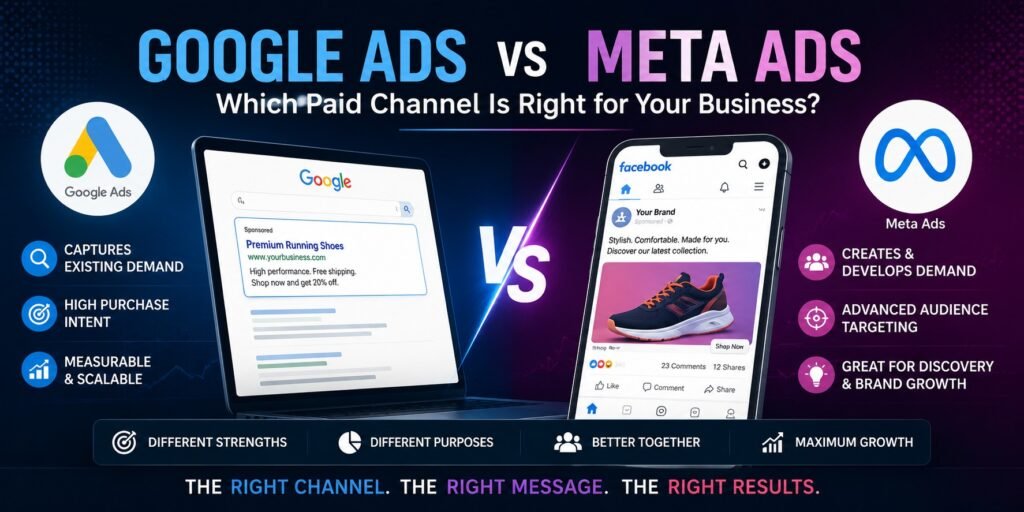
Google Ads and Meta Ads are two of the most widely used paid advertising channels, but they play very different roles in a growth strategy. Google Ads can capture people who are already searching for a solution, while Meta Ads can introduce offers to audiences based on their interests, behaviours, demographics, and engagement patterns. The right choice is therefore not simply about which platform is more popular or delivers cheaper clicks. It depends on how demand is created, captured, converted, and measured across the customer journey.
A strong performance marketing strategy looks beyond individual advertising platforms. It considers where potential customers are in the buying journey, what type of message they need, how quickly they are likely to convert, and whether the resulting customer acquisition economics can support profitable growth. In some businesses, Google Ads may be the stronger starting point. In others, Meta may provide a more effective way to generate demand. For many businesses, the most scalable approach is to use both as connected parts of a broader paid growth strategy.
This guide compares Google Ads and Meta Ads across intent, targeting, creative requirements, buying cycles, conversion measurement, and scalability. More importantly, it explains how to determine which channel—or combination of channels—makes the most sense for your business.
Table of Contents
Google Ads and Meta Ads Serve Different Growth Functions
Google Ads Captures Existing Demand
Google Ads is particularly powerful when potential customers already know what they need and are actively searching for it. Someone searching for terms such as “commercial accounting software,” “emergency plumbing service,” or “B2B cybersecurity company” is demonstrating a level of intent that can make search advertising highly valuable.
The role of Google Ads in this context is primarily demand capture. The business does not necessarily need to create awareness from scratch because the prospect has already expressed a need through their search behaviour. The advertising system helps place the business in front of that existing demand at a moment when the prospect may be ready to evaluate options or take action.
Meta Ads Creates and Develops Demand
Meta Ads operates differently. Instead of relying primarily on an explicit search query, businesses can reach audiences based on characteristics, interests, behaviours, engagement signals, and interactions with content or the brand.
This makes Meta particularly useful for demand generation. A potential customer may not be actively searching for a product or service yet, but a relevant message, offer, demonstration, or piece of creative can introduce the problem, establish interest, and move that person further into the buying journey.
The Difference Matters to the Growth Strategy
The distinction between demand capture and demand generation is important because businesses often evaluate both platforms using the same metrics without considering their different roles.
A search campaign may generate a higher immediate conversion rate because it reaches people who are already looking for a solution. A Meta campaign may initially generate fewer direct conversions while playing a valuable role in creating awareness, developing consideration, building remarketing audiences, and influencing future conversions.
A scalable paid growth system therefore evaluates each channel according to the job it is expected to perform, rather than assuming that every campaign should produce the same type of immediate response.
Understanding paid search vs paid social also helps businesses assign the right role to each channel instead of judging both platforms against the same performance criteria.
Google Ads vs Meta Ads: The Key Differences
Search Intent
The biggest difference between Google Ads and Meta Ads is the way users enter the advertising environment. Google Ads can reach people when they actively express a need through a search query, making intent a central part of the channel’s value. Meta Ads generally reaches people before or outside that active search moment, allowing businesses to introduce a product, service, problem, or opportunity based on audience signals and engagement.
This means Google Ads can be particularly effective for businesses with established search demand, while Meta Ads can be valuable when the goal is to create awareness and stimulate interest that may not yet exist.
Audience Targeting
Google Ads and Meta Ads also approach audience targeting from different directions. Search advertising can use the intent expressed through a user’s query alongside factors such as location, device, audience signals, and previous interactions. Meta’s strength is its ability to build audiences using demographic, interest, behavioural, engagement, and first-party signals.
The practical implication is that Google can be highly effective when you already know what your potential customer is searching for, while Meta can provide more flexibility when the objective is to identify, reach, and develop audiences around a particular problem or offer.
Creative and Messaging
Creative requirements are another major difference between the two platforms. Search advertising typically relies heavily on the relevance and clarity of the message presented alongside a user’s query. The advertiser needs to communicate value quickly and align the message with the intent behind the search.
Meta is much more visually driven. Images, video, hooks, storytelling, demonstrations, testimonials, offers, and different creative concepts can significantly influence how audiences respond. This makes creative testing an important component of a Meta-led growth strategy.
For this reason, businesses should not simply copy the same campaign message from Google Ads into Meta Ads and expect the same results. Each platform requires messaging that reflects how users discover and interact with the offer.
Buying Cycle
The customer’s buying cycle should also influence the choice between Google Ads and Meta Ads. A business selling an urgent service may benefit from capturing high-intent searches, while a business selling a considered product or a solution that requires education may need repeated exposure before the prospect is ready to convert.
Longer buying cycles can therefore create opportunities for Meta to introduce the brand, educate the audience, build familiarity, and support remarketing, while Google can capture demand when prospects eventually move into active research.
The strongest approach is not necessarily to choose the platform with the lowest initial cost per click. It is to understand how each channel contributes to the complete path from first interaction to revenue.
Conversion and Measurement
Both platforms can provide detailed campaign data, but meaningful performance measurement requires more than tracking clicks or form submissions. Businesses need to understand which campaigns generate qualified opportunities, customers, revenue, and sustainable acquisition economics.
This is where a broader performance marketing system becomes important. Tracking should connect advertising activity with downstream business outcomes so that budget decisions are based on actual performance rather than surface-level engagement metrics.
When Google Ads Makes More Sense
When Customers Are Already Searching for a Solution
Google Ads can be a strong starting point when there is clear and consistent search demand for the products or services a business offers. If potential customers are actively searching for solutions, search advertising can place the business in front of them at a highly relevant stage of the buying journey.
This is particularly useful for businesses where the customer’s need is already understood and the search itself signals commercial intent.
When Immediate Demand Capture Matters
Businesses with a shorter buying cycle can often benefit from Google’s ability to capture existing demand. A prospect searching for a specific service may already be comparing providers, evaluating prices, or looking for a business they can contact.
In these situations, appearing at the right moment can be more valuable than spending a long period building awareness before the prospect takes action.
When the Offer Is Easy to Search For
Google Ads also tends to work well when customers naturally describe the product, service, problem, or solution using recognisable search terms. The clearer the relationship between what people search for and what the business sells, the easier it becomes to build campaigns around relevant demand.
However, strong search demand alone does not guarantee profitable advertising. The landing page, offer, conversion experience, lead quality, sales process, and customer value all influence whether the traffic ultimately produces sustainable returns.
When Meta Ads Makes More Sense
When the Market Needs to Be Created
Meta Ads can become particularly valuable when potential customers are unlikely to search for the product or service until they have first been exposed to the problem, opportunity, or brand.
Instead of waiting for someone to search, businesses can use paid social to introduce an idea and create interest among relevant audiences. This makes Meta useful for products, services, and offers where awareness and consideration play a significant role in the buying journey.
When Creative Can Drive Demand
Some offers are easier to communicate visually than through a search advertisement. Demonstrations, before-and-after transformations, product experiences, customer stories, educational content, and strong visual concepts can all help audiences understand why an offer is relevant to them.
In these situations, the creative itself becomes part of the acquisition strategy rather than simply supporting the advertisement.
When Retargeting and Audience Development Matter
Meta can also support the stages between initial awareness and conversion. Businesses can build audiences from interactions with their content, website, advertisements, and other available first-party signals, then use those audiences to develop subsequent campaigns.
This creates an opportunity to move prospects through multiple stages rather than treating every advertising interaction as an isolated conversion event.
When Businesses Should Use Google Ads and Meta Ads Together
Capture Demand With Search
Google Ads and Meta Ads don’t have to compete for the same role. In a well-structured paid growth strategy, Google can capture demand from people who are actively searching for a solution while other channels help create and develop demand before that search happens.
This allows businesses to meet prospects at different stages of the customer journey rather than relying on a single source of acquisition.
Create Demand With Paid Social
Meta can complement search by reaching potential customers earlier in the decision-making process. A prospect may discover a brand through a relevant piece of content or creative, engage with the offer, and later conduct a Google search when they become ready to evaluate their options.
This means the original Meta interaction may contribute to a later search conversion even when the final click is attributed to Google. Looking at the channels independently can therefore hide part of the customer journey.
Connect Both Through a Shared Conversion Strategy
The real advantage of using both platforms comes from connecting them through a consistent conversion strategy. The audience, offer, messaging, landing experience, tracking framework, and business objectives should work together even when the advertising platforms are different.
When the channels operate as parts of the same system, businesses can evaluate not only which platform generates conversions, but also how different channels contribute to the overall acquisition journey.
How to Choose the Right Paid Channel
Start With the Customer, Not the Platform
The right advertising channel should begin with the customer rather than the platform. Before deciding between Google Ads and Meta Ads, businesses should understand how potential customers discover solutions, what triggers their buying decisions, how much consideration is required, and where they are most likely to engage with a relevant offer.
The Google Ads or Meta Ads decision should therefore be based on customer behaviour and buying intent rather than simply choosing the platform with the largest audience or the lowest advertising cost.
A channel may look attractive because it has a large audience or low advertising costs, but those advantages mean little if the audience does not have the right intent or commercial potential. The objective is to find the environment where the business can reach the right people with the right message at the right stage of the buying journey.
Evaluate Economics Before Scaling
Channel selection should also be evaluated against the economics of customer acquisition. Click-through rates and cost per click can help diagnose campaign performance, but they should not be the final criteria for deciding where to invest.
Businesses should consider conversion rates, customer acquisition cost, lead or customer quality, average customer value, margins, and the ability of a channel to generate additional volume without making acquisition increasingly expensive.
A channel that produces inexpensive traffic is not necessarily the best channel. The better channel is the one that can consistently contribute valuable customers at an acquisition cost the business can sustain.
Consider the Role Each Channel Plays
The final decision should consider the role a channel plays within the broader acquisition system. Google Ads may be responsible for capturing high-intent demand, while Meta may help create awareness, develop audiences, and bring prospects into the consideration journey.
This means the question should not always be “Which platform is better?” A more useful question is “Which role does each platform need to play in our growth strategy?”
When that question is answered first, businesses can build a channel mix based on customer behaviour and commercial objectives rather than platform preference.
Building a Scalable Multi-Channel Paid Growth Engine
Connect Channels Around One Customer Journey
Using multiple paid channels does not automatically create a stronger growth strategy. The channels need to work together around the same customer journey, with consistent positioning, clear conversion paths, and shared business objectives.
Google Ads may capture a prospect when they are actively searching, while Meta can introduce the brand or reinforce consideration earlier in the journey. When these interactions are connected, each channel can contribute to a broader acquisition process instead of operating as an isolated campaign.
Build Around Measurement and Learning
A multi-channel system also needs a consistent measurement framework. Businesses should be able to understand where customers originated, how different touchpoints influenced their journey, and which channels are contributing to profitable outcomes.
This creates a continuous learning cycle. Campaign performance informs audience strategy, audience behaviour informs creative decisions, and conversion data informs future channel and budget allocation. Over time, the system becomes more informed rather than simply larger.
Scale the System, Not Just the Spend
The final step is scaling what has been validated. Increasing budgets across multiple platforms without understanding the underlying economics can quickly increase costs without producing proportional growth.
A scalable paid growth engine instead expands deliberately. Businesses can increase investment in proven campaigns, test new audiences, introduce additional creative, explore complementary channels, and improve the conversion journey while monitoring the economics of acquisition.
The objective is not to spend more money across more platforms. It is to create a multi-channel acquisition system that can generate additional customers efficiently as the business grows.
Conclusion
There is no universal winner in the Google Ads vs Meta Ads debate. The right paid channel depends on how customers discover solutions, how much buying intent exists, how the offer needs to be communicated, and what economics the business needs to achieve.
Google Ads can be highly effective for capturing existing demand, while Meta can be powerful for creating awareness, developing audiences, and influencing consideration. For many businesses, the strongest approach is not choosing one over the other, but connecting both within a broader acquisition strategy.
The key is to evaluate every channel according to the role it plays in the customer journey and the value it ultimately contributes to the business. When audience strategy, creative, conversion experience, measurement, and optimization work together, paid advertising becomes much more than a collection of campaigns.
A scalable performance marketing strategy is built around this connected approach: the right audience, the right channel, the right message, and a conversion system capable of turning paid demand into sustainable business growth.
Frequently Asked Questions About Google Ads and Meta Ads
Is Google Ads better than Meta Ads?
Neither platform is universally better. Google Ads can be stronger when customers are actively searching for a solution, while Meta Ads can be more effective when businesses need to create demand, build awareness, or reach audiences before they begin actively searching.
Is Meta Ads cheaper than Google Ads?
There is no fixed answer. Advertising costs vary by industry, audience, competition, geography, offer, creative quality, and campaign objective. A lower cost per click does not necessarily mean a lower customer acquisition cost, so businesses should evaluate channels based on the quality and value of the customers they generate.
Should a business use Google Ads and Meta Ads together?
Using both can be effective when each platform has a defined role within the customer journey. Google Ads can capture existing demand while Meta can help create and develop demand, build audiences, and support remarketing. The two can work together when measurement and conversion strategy are properly connected.
Which is better for B2B businesses, Google Ads or Meta Ads?
It depends on the product, audience, buying cycle, and level of existing demand. Google Ads can be valuable for capturing high-intent searches, while Meta may support awareness and consideration. B2B businesses should evaluate both channels based on qualified opportunities and customer economics rather than lead volume alone.
How do I choose the best paid advertising platform for my business?
Start with customer behaviour rather than the platform itself. Understand how your audience discovers solutions, what level of buying intent exists, how the offer needs to be communicated, how long the buying cycle is, and what acquisition economics the business can support. Those factors should determine the channel mix.
Build a Smarter Paid Growth System
The goal of paid advertising isn’t simply to appear in more places or generate more clicks. It is to create a reliable path from audience discovery to customer acquisition and measurable business growth.
If your business needs a paid acquisition strategy that connects audience targeting, channel selection, creative, conversion experience, measurement, and continuous optimization, Mavenify’s Performance Marketing System™ is designed to bring those elements together into one connected growth system.