

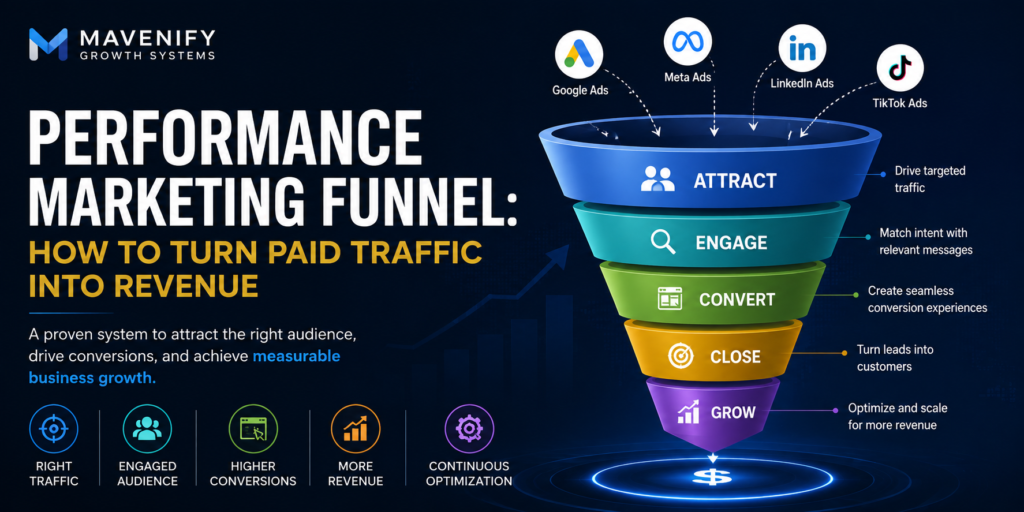
A performance marketing funnel is designed to do more than generate clicks. It creates a measurable path that moves the right audience from paid advertising to engagement, conversion, and ultimately revenue. While advertising platforms can help businesses reach potential customers, the quality of the journey after the click often determines whether that investment produces meaningful business results.
Many businesses focus heavily on campaign metrics such as impressions, clicks, click-through rates, and cost per click. These numbers can reveal how an advertising campaign is performing at the acquisition level, but they don’t necessarily show whether the traffic is generating qualified opportunities or customers. A campaign can attract inexpensive traffic and still deliver poor returns if the landing experience, conversion process, or follow-up system isn’t aligned with the audience’s needs.
A well-designed funnel connects these moving parts into a single growth system. It aligns audience targeting, advertising, messaging, landing experiences, conversion architecture, measurement, and optimization around a common commercial objective. Instead of asking how much traffic a campaign can generate, businesses can focus on how effectively their investment turns relevant traffic into measurable revenue.
In this guide, we’ll examine how a performance marketing funnel works, the stages involved, the metrics that matter at each stage, common problems that prevent paid traffic from converting, and the principles businesses can use to build a funnel capable of supporting profitable growth.
Table of Contents
What Is a Performance Marketing Funnel?
A performance marketing funnel is the structured journey that connects paid customer acquisition with measurable business outcomes. It begins when a potential customer encounters an advertisement and continues through the stages that influence whether that person engages with the offer, takes a desired action, becomes a customer, and generates revenue.
Unlike a traditional marketing funnel that may primarily describe movement from awareness to consideration and conversion, a performance marketing funnel strategy is built around measurable actions and continuous optimization. Each stage provides data that can be used to understand what is working, identify where potential customers are being lost, and improve the overall efficiency of the journey.
For example, a business may discover that its advertisements generate strong engagement but attract low-intent visitors. Another business may receive highly relevant traffic but lose potential customers because its landing page doesn’t communicate the offer clearly. A B2B company might generate a large number of leads while discovering that only a small percentage are qualified enough to become genuine sales opportunities.
These differences matter because more activity does not automatically mean better performance. The purpose of a performance marketing funnel is to connect acquisition, customer experience, conversion, and revenue so that businesses can optimize the entire journey rather than treating each marketing activity as an isolated campaign.
How Does a Performance Marketing Funnel Work?
A performance marketing funnel works by connecting each stage of the customer journey so that the outcome of one stage informs decisions at the next. Rather than optimizing advertising in isolation, businesses evaluate how effectively traffic moves from the initial interaction through engagement, conversion, customer acquisition, and revenue.
A simplified funnel can be represented as:
Attract → Engage → Convert → Qualify → Generate Revenue → Optimize
The exact journey will vary depending on the business model. An ecommerce company may move from an advertisement to a product page and purchase within minutes, while a B2B company may require several interactions, a lead qualification process, a sales conversation, and a proposal before revenue is generated.
What remains consistent is the need for continuity between each stage. The audience targeted by the campaign should be relevant to the offer, the advertising message should align with the landing experience, the conversion process should make the desired action clear, and the resulting data should feed back into future campaign and funnel decisions.
This creates a continuous performance loop:
Paid Traffic → Engagement → Conversion Data → Revenue Data → Insights → Optimization
The more accurately that loop is measured, the easier it becomes to identify where the funnel is losing efficiency and where additional investment can produce stronger returns.
The 6 Stages of a Performance Marketing Funnel
A performance marketing funnel is not a single campaign or landing page. It is a connected sequence of experiences that moves a potential customer from initial exposure to measurable business value. Each stage has a different role, and weaknesses at any point can reduce the effectiveness of everything that follows.
The six stages below provide a practical framework for understanding how paid traffic can be converted into revenue.
1. Attract the Right Audience
The first stage of a performance marketing funnel is attracting people who have a genuine likelihood of becoming customers. This requires more than maximizing impressions or generating the cheapest possible clicks. Audience selection, targeting, keyword intent, creative messaging, geography, demographics, and campaign objectives all influence the quality of traffic entering the funnel.
Different advertising platforms can also capture different types of demand. Google Ads and Meta Ads, for example, can play different roles within a paid acquisition strategy. Search advertising can reach people actively looking for a solution, while platforms such as Meta can help businesses introduce products and services to audiences based on interests, behaviours, demographics, and other signals. The right channel therefore depends on where relevant demand exists and how that demand is expressed.
2. Match the Message to Audience Intent
Getting the right audience into the funnel is only the beginning. The message they encounter needs to reflect why they clicked in the first place. Someone searching for a specific service is likely to respond differently from someone discovering a brand while browsing social media, so the advertisement, offer, and landing experience should be aligned with the user’s level of intent.
This alignment is often referred to as message match. When the promise made in an advertisement is consistent with what the visitor finds after clicking, the transition feels natural. When the message changes completely, visitors may question whether they’ve reached the right destination and leave before taking action.
For search campaigns in particular, keywords can provide valuable signals about what a potential customer is looking for. A highly specific search can indicate a different level of intent from a broad informational query, which means the advertising message and destination should be designed accordingly.
3. Create a Conversion-Ready Landing Experience
Once someone clicks an advertisement, the landing experience becomes responsible for continuing the journey. A high-performing paid traffic funnel should take visitors to a page that is relevant to the advertisement, communicates the value proposition clearly, and makes the next step obvious. This is where Revenue Focused Web Infrastructure becomes an important part of the customer journey.
This is where many paid campaigns lose efficiency. Businesses may invest heavily in targeting and advertising while sending every visitor to a generic homepage that contains multiple competing messages and no clear conversion path. The result can be strong traffic numbers without a corresponding increase in enquiries, bookings, purchases, or qualified leads.
A conversion-ready experience should reduce unnecessary friction while giving visitors enough information and confidence to take the intended action. Page structure, messaging, calls to action, forms, trust signals, mobile usability, and the overall user journey all influence what happens after the click.
4. Turn Interest Into Conversion
The next stage is turning interest into a measurable action. Depending on the business model, that action could be a purchase, enquiry, consultation booking, demo request, registration, phone call, or another event that indicates meaningful intent.
The conversion process should be designed around the action the business actually values. A form with ten unnecessary fields may create friction for a lead-generation campaign, while an ecommerce checkout with too many steps can create unnecessary abandonment. The objective is not simply to make conversion possible but to make the desired action clear, relevant, and easy to complete.
This is where conversion architecture becomes important. Every element of the experience—from page hierarchy and messaging to calls to action and trust signals—should help move the visitor toward the next appropriate step without creating unnecessary barriers.
5. Connect Conversions to Revenue
A conversion is not always the same thing as revenue. A lead submission, for example, only becomes commercially valuable when that lead has a realistic opportunity to become a customer. This makes lead quality, customer acquisition cost, sales conversion rates, customer value, and revenue attribution important parts of a performance marketing funnel.
Businesses should therefore look beyond the number of conversions generated by a campaign. Two campaigns can produce the same number of leads while generating very different commercial outcomes if one attracts prospects who are significantly more likely to purchase or have a higher customer value.
Connecting advertising data with downstream business results makes it possible to identify which audiences, campaigns, offers, and channels are actually contributing to growth. This allows marketing investment to be evaluated based on business value rather than activity alone.
6. Optimize the Entire Funnel
Optimization should not stop once an advertisement generates clicks or conversions. A change that improves one part of the funnel can sometimes create a different problem further down the journey. For example, lowering the cost per lead may increase lead volume while simultaneously reducing lead quality.
Effective optimization therefore requires looking at the relationship between acquisition, conversion, and revenue. Businesses can test different audiences, messages, offers, landing experiences, calls to action, follow-up processes, and campaign structures as part of a broader performance marketing strategy designed to identify which combinations produce stronger commercial outcomes.
The objective is to create a continuous improvement cycle in which performance data informs the next decision. Over time, this can help businesses improve efficiency, identify scalable opportunities, and allocate more budget toward the parts of the funnel that consistently produce valuable customers.
Why More Paid Traffic Doesn’t Always Mean More Revenue
Generating more traffic can make a campaign look successful on the surface, but traffic volume alone doesn’t determine whether paid marketing is producing profitable growth. If the people entering the funnel aren’t relevant, or if the experience after the click doesn’t move them toward a meaningful action, increasing traffic can simply increase advertising costs without improving revenue.
More Traffic Does Not Always Mean Better Traffic
A campaign can generate thousands of visitors while attracting relatively few people who are genuinely interested in the product or service. Broad targeting, weak audience signals, poorly matched keywords, or messaging designed primarily to maximize clicks can all increase traffic without improving the quality of potential customers.
This is why businesses should evaluate traffic quality alongside traffic volume. A smaller audience with stronger purchase intent can often create more commercial value than a much larger audience with limited interest or low buying intent.
The Post-Click Experience Can Limit Performance
Even highly relevant traffic can fail to convert when the experience after the advertisement doesn’t meet the visitor’s expectations. A mismatch between the ad and landing page, unclear value proposition, complicated forms, weak calls to action, or a lack of trust signals can introduce friction at precisely the point where the visitor is considering taking action.
When this happens, increasing the advertising budget doesn’t necessarily solve the problem. More visitors simply enter the same inefficient journey. Improving the conversion experience first can make the existing traffic more valuable before additional budget is committed.
Leads Are Not the Same as Revenue
Lead generation is an important objective for many businesses, but a lead only becomes commercially valuable when there is a realistic opportunity for that prospect to become a customer. A campaign generating 100 low-quality leads may be less valuable than one generating 30 qualified prospects with a much higher likelihood of closing.
This makes downstream metrics important when evaluating a performance marketing funnel. Businesses should understand not only how many leads or conversions a campaign generates, but also how those conversions progress through the sales process and how much revenue they ultimately produce.
Scaling Before Fixing the Funnel Can Increase Waste
One of the most common mistakes in paid acquisition is increasing the budget as soon as a campaign begins generating conversions. If the underlying funnel has weaknesses, scaling can amplify those weaknesses instead of creating proportional growth.
A better approach is to identify where performance is being lost, improve that stage, and then test whether the improved economics can support additional volume. Scaling should be the result of a healthy funnel, not a substitute for one.
Performance Marketing Funnel vs Traditional Marketing Funnel
The two approaches may look similar because both describe how people move from initial awareness toward a purchase. The difference is in what the business measures and how the information is used to improve performance.
A traditional funnel often focuses on progressing audiences through stages such as awareness, consideration, and conversion. A performance marketing funnel connects those stages directly to measurable actions, customer acquisition costs, revenue, and ongoing optimization.
| Traditional Marketing Funnel | Performance Marketing Funnel |
| Focuses on audience progression | Focuses on measurable business outcomes |
| Often emphasizes awareness and consideration | Connects acquisition with conversion and revenue |
| Measures activity across funnel stages | Connects performance data across stages |
| Optimization may happen periodically | Continuous testing and optimization |
| Conversion is often a major endpoint | Revenue and profitability remain central |
The distinction is important because a business doesn’t necessarily grow by moving more people through a funnel. It grows by moving the right people through an efficient journey that produces valuable customers.
How to Build a Performance Marketing Funnel
Building a performance marketing funnel starts with the business outcome, not the advertising platform. Before deciding how much to spend or which campaign type to launch, businesses need to understand who they want to reach, what action they want those people to take, and how that action contributes to revenue.
1. Define the Business Outcome
The first step is to define what the funnel is expected to achieve. Depending on the business model, the objective might be online purchases, qualified leads, consultation bookings, demo requests, applications, or another measurable commercial outcome.
This objective should be specific enough to determine what success looks like. A campaign designed to generate qualified B2B opportunities should not be evaluated using the same criteria as an ecommerce campaign designed to generate immediate purchases. Defining the desired outcome first gives every subsequent funnel decision a clear direction.
2. Identify the Highest-Value Audience
The next step is identifying the audience most likely to generate meaningful business value. This involves understanding customer needs, pain points, buying behaviour, search intent, demographics, interests, and the circumstances that influence a purchase decision.
The goal isn’t to reach everyone who could theoretically buy from the business. It is to identify the audiences where the combination of relevance, intent, and commercial value creates the strongest opportunity for growth.
3. Choose the Right Acquisition Channels
Once the audience is defined, businesses can determine where that audience is most likely to be reached effectively. Google Ads, Meta Ads, LinkedIn, and other paid channels offer different ways to reach potential customers, and the best choice depends on the business model, audience behaviour, buying cycle, and available demand.
Channel selection should therefore be based on the economics and intent of the opportunity rather than simply choosing the platform with the largest audience. A channel capable of generating inexpensive traffic isn’t necessarily the channel capable of generating the most valuable customers.
4. Build the Offer and Message
The offer needs to give the audience a clear reason to take the next step. Strong performance marketing isn’t simply about presenting a product or service; it is about communicating why that solution is relevant to the specific problem or need the audience is experiencing.
The message should remain consistent across the advertisement, landing page, and conversion experience. When the promise made in the advertisement is carried through to the next stage, visitors can immediately understand what they are being offered and why it is relevant to them.
5. Create the Conversion Experience
With the audience, channel, and offer defined, the next step is creating the experience that turns interest into action. This includes the landing page, calls to action, forms, product or service information, trust signals, and other elements that influence whether a visitor feels confident enough to proceed.
The conversion experience should remove unnecessary friction while providing enough information to support the decision. Its purpose isn’t to force every visitor to convert immediately, but to make the intended next step clear and appropriate for the visitor’s level of intent.
6. Implement Tracking and Measurement
A funnel cannot be optimized effectively without reliable measurement. Businesses need to understand where visitors come from, which actions they take, where they leave the journey, and how those actions ultimately connect with leads, customers, and revenue.
Tracking should therefore extend beyond advertising-platform metrics. Depending on the business model, measurement may need to connect campaign data with website conversions, CRM activity, sales outcomes, customer acquisition costs, and revenue so that marketing performance can be evaluated across the entire customer journey.
7. Build Follow-Up and Remarketing
Not every visitor will convert during the first interaction. Depending on the buying cycle, potential customers may need additional information, reminders, proof, or multiple interactions before they are ready to take action.
Follow-up and remarketing can help businesses reconnect with relevant prospects who have already interacted with the brand. The objective is not simply to show the same advertisement repeatedly, but to provide a more relevant next step based on where the prospect is in the customer journey.
8. Measure Revenue, Not Just Conversions
Once the funnel is generating conversions, businesses need to understand what those conversions are worth. Measuring revenue, customer acquisition cost, customer value, and downstream sales performance provides a much clearer picture of whether advertising investment is producing sustainable returns.
This is particularly important for businesses with different levels of customer value. If one campaign generates fewer conversions but attracts customers who spend significantly more, optimizing purely for conversion volume could lead the business toward the wrong allocation of budget.
9. Optimize Before Scaling
The final step is to identify where the funnel can improve before increasing the amount of traffic entering it. Businesses should examine campaign performance, audience quality, landing-page behaviour, conversion rates, lead quality, sales outcomes, and revenue contribution to determine where the greatest opportunities exist.
Once the funnel demonstrates consistent economics, additional budget can be introduced gradually while monitoring whether performance remains sustainable. Scaling should be treated as a controlled process rather than simply increasing spend because a campaign happens to be generating conversions.
Which Metrics Matter in a Performance Marketing Funnel?
A performance marketing funnel should be measured at more than one level. Advertising platforms provide useful data about reach, engagement, and acquisition costs, but those metrics only tell part of the story. To understand whether a funnel is actually contributing to business growth, businesses need to connect campaign performance with conversions, customer acquisition, and revenue.
The most useful approach is to evaluate metrics according to where they sit within the funnel.
Acquisition Metrics
Acquisition metrics help businesses understand how effectively their campaigns are attracting attention and bringing potential customers into the funnel. Common measures include impressions, click-through rate (CTR), cost per click (CPC), and cost per thousand impressions (CPM).
These metrics are useful for diagnosing campaign performance, but they should not be treated as the final measure of success. A low CPC, for example, may indicate that a campaign is generating inexpensive traffic, but it doesn’t tell you whether those visitors are relevant, whether they convert, or whether they eventually generate revenue.
Conversion Metrics
Conversion metrics show what happens after visitors enter the funnel. Depending on the business model, these can include conversion rate, cost per lead (CPL), cost per acquisition (CPA), form completion rate, booking rate, purchase rate, or other actions that indicate meaningful intent.
Conversion data helps identify whether the experience between the advertisement and the desired action is working effectively. If a campaign generates strong traffic but produces a low conversion rate, the issue may exist in the offer, message match, landing experience, targeting, or conversion process rather than the advertising campaign alone.
Revenue Metrics
Revenue metrics take the analysis one step further by connecting marketing activity with actual commercial outcomes. Depending on the business, these may include customer acquisition cost (CAC), return on ad spend (ROAS), revenue per visitor, average customer value, customer lifetime value, or the value generated from qualified leads.
These metrics help businesses determine whether the economics of the funnel support profitable growth. A campaign that produces a high volume of conversions may still be inefficient if the cost of acquiring those customers is too high, while a campaign with a higher acquisition cost can be valuable if it consistently attracts customers with significantly greater value.
The key is to evaluate metrics in context rather than optimizing one number in isolation. A funnel should ultimately be judged by how effectively its investment contributes to valuable business outcomes.
Common Performance Marketing Funnel Mistakes
Even well-funded campaigns can underperform when the funnel around the advertising is not designed properly. Businesses often focus heavily on campaign setup and budget allocation while overlooking the experience that determines what happens after someone clicks.
These are some of the most common problems that prevent paid traffic from becoming meaningful business results.
Sending Every Campaign to the Homepage
A homepage is designed to serve multiple audiences and provide an overview of a business. It is rarely the most relevant destination for every paid campaign. Sending highly targeted traffic to a generic homepage can force visitors to search for the information they were expecting to find immediately after clicking an advertisement.
A stronger approach is to create a destination that reflects the campaign’s specific audience, intent, offer, and desired action. The closer the connection between the advertisement and the landing experience, the easier it is for visitors to understand what to do next.
Optimizing for Clicks Instead of Business Outcomes
Clicks are an important indicator of campaign engagement, but they are not the final objective of a revenue-focused funnel. A campaign can achieve a strong click-through rate while attracting visitors who have little interest in purchasing, submitting an enquiry, or taking another commercially valuable action.
Optimization should therefore move beyond the advertising platform whenever possible. Businesses need to understand whether the traffic produces qualified leads, customers, and revenue rather than assuming that stronger engagement automatically means stronger business performance.
Ignoring Message Match
When an advertisement promises one thing but the landing experience communicates something different, visitors may question whether they have reached the right destination. This disconnect can create friction and reduce the likelihood of conversion even when the original targeting was accurate.
The messaging should therefore remain consistent across the advertisement, landing page, offer, and conversion experience. Consistency helps visitors understand that the solution they clicked on is the same solution they are being asked to consider.
Measuring Leads Instead of Qualified Leads
A high lead volume can create the impression that a campaign is performing well, but the number of leads alone doesn’t reveal their commercial value. Some leads may have low purchase intent, poor fit, insufficient budget, or little likelihood of becoming customers.
Businesses should therefore distinguish between lead quantity and lead quality. Connecting marketing data with sales outcomes can reveal which campaigns are producing genuine opportunities and which are simply generating activity that looks positive inside the advertising platform.
Scaling Before Fixing Conversion Problems
Increasing advertising spend can amplify both the strengths and weaknesses of a funnel. If a campaign is generating relevant traffic but losing potential customers because of a weak landing experience or conversion process, sending more visitors into that same journey can increase waste rather than revenue.
Before scaling, businesses should identify the stage creating the greatest constraint and improve it. Once the funnel demonstrates stronger and more consistent economics, additional traffic can be introduced while monitoring whether conversion rates, acquisition costs, lead quality, and revenue remain sustainable.
Treating Advertising and the Website as Separate Systems
Paid advertising and the website often get managed by different teams or evaluated using different metrics. This can create a disconnect where campaigns are optimized for traffic while the website is expected to handle conversion without considering the audience, message, or intent generated by those campaigns.
A stronger approach treats acquisition and the post-click experience as connected parts of the same growth system. The advertising should attract the right audience, while the website and conversion experience should give that audience a clear path toward the intended action.
How Paid Marketing and SEO Can Work Together
Paid marketing and SEO are often treated as competing approaches, but they can serve different roles within the same growth system. Paid campaigns can provide immediate access to targeted audiences, while organic search can build longer-term visibility and demand capture.
The strongest strategy isn’t always about choosing one over the other. It’s about understanding where each channel creates the most value and using the information from one channel to improve decisions across the broader acquisition system.
Use Paid Campaigns to Understand Demand
Paid campaigns can provide businesses with real-time information about which messages, offers, audiences, and search terms generate engagement and conversions. This information can help identify areas of demand that may deserve greater attention across the broader marketing strategy.
For example, a paid campaign may reveal that a particular service, problem, or customer segment consistently generates strong engagement and conversion rates. Those insights can then inform content, landing pages, organic search priorities, and other long-term acquisition initiatives.
Use SEO to Build Long-Term Search Visibility
Paid advertising can provide immediate visibility, but organic search can create a more sustainable source of qualified traffic over time. A strong SEO strategy helps businesses build visibility around the questions, problems, products, and services their target audiences are actively researching.
This can make SEO particularly valuable when a business wants to reduce its dependence on continuously purchasing every visit. Instead of viewing paid and organic search as separate activities, businesses can use both to create multiple paths through which potential customers can discover and evaluate the brand.
Connect Search Intelligence With Paid Acquisition
The relationship between paid advertising and organic search becomes even more valuable when businesses use search data as a broader source of customer intelligence. Search behaviour can reveal the language people use, the problems they are trying to solve, the questions they ask, and the level of intent behind different searches.
That information can influence not only SEO and content strategy but also advertising messages, landing-page positioning, offers, and conversion experiences. The result is a more connected approach to understanding demand rather than treating each acquisition channel as an isolated system, which is the foundation of Search Intelligence Infrastructure™.
The Mavenify Approach to Performance Marketing
At Mavenify, performance marketing is not treated as a standalone advertising activity. Paid campaigns are only one component of a broader growth system that connects audience acquisition, web infrastructure, conversion architecture, measurement, and continuous optimization.
The objective is to build a system where each component supports the next. Advertising attracts relevant prospects, the website provides a focused experience, conversion architecture turns intent into action, and performance data reveals where the journey can be improved. This creates a connected path from paid traffic to measurable business outcomes rather than optimizing each activity in isolation.
This approach also changes how performance is evaluated. Instead of focusing primarily on impressions, clicks, or lead volume, the emphasis moves toward the quality of opportunities generated, customer acquisition economics, conversion performance, and the revenue produced by the overall system.
For businesses looking to build this kind of connected acquisition and conversion infrastructure, Performance Marketing System™ brings these components together into a structured approach designed to turn paid acquisition into a measurable growth engine.
Frequently Asked Questions About Performance Marketing Funnels
What is a performance marketing funnel?
A performance marketing funnel is a measurable customer journey that connects paid acquisition with engagement, conversion, customer acquisition, and revenue. It allows businesses to evaluate and optimize the complete path from advertising spend to business outcomes.
What are the main stages of a performance marketing funnel?
The main stages typically include attracting the right audience, matching messaging to intent, creating a conversion-ready experience, generating meaningful conversions, connecting those conversions to revenue, and continuously optimizing the funnel.
How is a performance marketing funnel different from a traditional marketing funnel?
A traditional marketing funnel often focuses on moving audiences through awareness, consideration, and conversion. A performance marketing funnel places greater emphasis on measurable actions, customer acquisition economics, revenue, and continuous optimization across the entire journey.
Why is my paid traffic not converting?
Poor conversion can result from several factors, including low-quality traffic, weak message match, an irrelevant landing experience, unclear offers, excessive conversion friction, or a disconnect between marketing and sales. Identifying the specific stage where prospects are being lost is essential before increasing advertising spend.
What metrics should I track in a performance marketing funnel?
Important metrics depend on the business model, but commonly include click-through rate, cost per click, conversion rate, cost per lead, cost per acquisition, customer acquisition cost, return on ad spend, customer value, and revenue.
Should I focus on Google Ads, Meta Ads, or both?
There isn’t a universally best platform. The right channel depends on audience behaviour, search or purchase intent, business model, offer, customer journey, and campaign economics. Businesses should select channels based on where they can consistently acquire valuable customers rather than simply where they can generate the most traffic.
Conclusion
A successful performance marketing funnel is not built around generating the maximum number of clicks. It is built around creating a measurable and connected journey that turns the right traffic into valuable customers and revenue.
From audience targeting and message alignment to landing experiences, conversion architecture, measurement, and optimization, every stage influences the performance of the next. Improving one part of the system can create meaningful gains, but sustainable growth comes from understanding how the entire funnel works together.
The most important shift is to stop viewing paid advertising as an isolated campaign and start treating it as part of a revenue-focused growth system. When acquisition, web infrastructure, conversion, and measurement are connected, businesses can make better decisions about where to invest, what to optimize, and when to scale.
Paid traffic is the input. Revenue is the outcome. The funnel is what connects the two.
If your paid campaigns are generating traffic but the revenue isn’t scaling with your advertising investment, the problem may not be the advertising platform. It may be the system around it.
Build a Performance Marketing Funnel Designed for Revenue
Paid campaigns can generate traffic, but sustainable growth depends on what happens after the click. If your advertising is generating visitors without consistently producing qualified opportunities and revenue, it may be time to look beyond the campaign itself and examine the system supporting it.
Mavenify’s Performance Marketing System™ connects paid acquisition, conversion-focused web infrastructure, conversion architecture, measurement, and continuous optimization to create a more accountable path from advertising investment to business growth.
Ready to turn paid traffic into measurable revenue?