

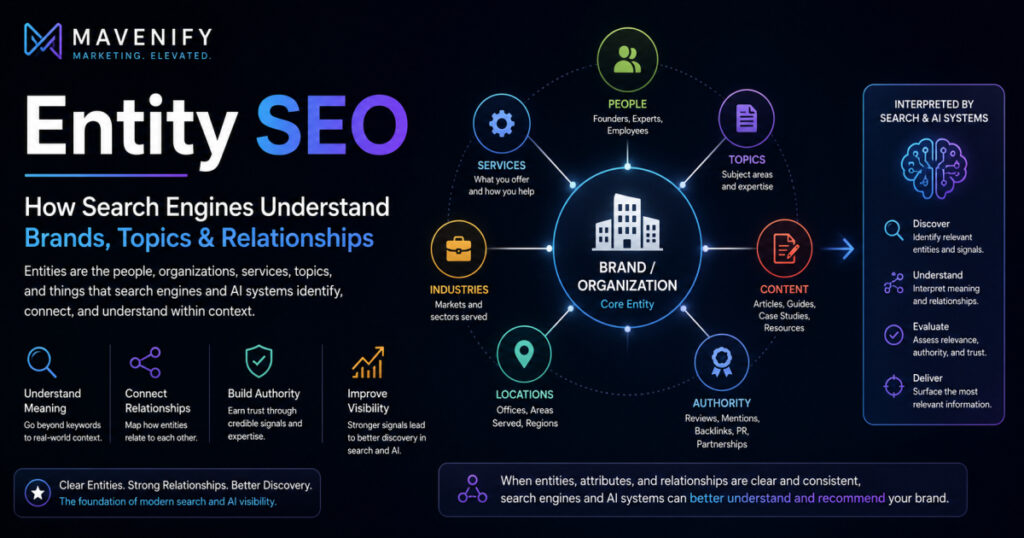
Entity SEO is the practice of helping search engines and AI systems understand the people, organizations, products, services, places, concepts, and relationships represented across a brand’s digital presence. Rather than relying only on individual keywords, entity-based optimization focuses on establishing clear meaning and context around what a business is, what it offers, and how it relates to relevant topics.
Modern search systems increasingly interpret information through context and relationships. A company can be connected with its services, founders, locations, industries, expertise, content, and other identifiable entities. When these relationships are communicated consistently across website content, structured information, internal links, and credible external sources, search systems have more context for understanding the brand and its relevance.
This guide explains what entities are in SEO, how entity-based search differs from traditional keyword optimization, how search engines understand entities and relationships, the role of structured data and knowledge graphs, and why entity clarity is becoming increasingly relevant as search expands into generative and AI-powered discovery.
Table of Contents
What Is an Entity in SEO?
In SEO, an entity is a distinct and identifiable person, place, organization, product, concept, event, or other thing that can be understood independently of the specific words used to describe it. The same entity may be referenced using different names, phrases, attributes, or contextual information while still representing the same underlying thing.
For example, a company is more than the collection of keywords appearing on its website. It can have a name, website, founders, services, locations, customers, industry relationships, social profiles, mentions, reviews, and other attributes that collectively provide context about what that organization represents.
Entities vs Keywords: What’s the Difference?
A keyword is a word or phrase that people use when searching or that appears within content. An entity represents the underlying person, organization, place, product, concept, or other identifiable thing that those words may refer to.
For example, the phrase “Apple” can refer to a fruit or to a technology company. Understanding the surrounding entities and context helps a search system determine which meaning is relevant. Entity-based search therefore goes beyond matching words by attempting to understand the concepts and relationships represented by those words.
Why Do Entities Matter for Search?
Entities help search systems organize information around meaning rather than relying exclusively on exact wording. By identifying entities and their relationships, search systems can better interpret ambiguous language, connect related information, understand topical context, and return results that more closely match a user’s intent.
For businesses, clearer entity information can help search systems understand fundamental questions such as who the organization is, what it offers, where it operates, which subjects it is associated with, and how different parts of its digital presence relate to one another.
How Do Search Engines Understand Entities?
Search engines can use multiple signals to identify entities, distinguish between different meanings, and understand how entities relate to one another. These signals can come from the content of a webpage, links between pages, structured information, contextual references, authoritative external sources, and information available across the wider web.
Entity understanding is therefore not created by a single SEO tactic. It develops from the broader context surrounding an entity and the consistency with which its attributes and relationships can be understood across relevant sources.
1. Entity Recognition
Search systems first need to identify that a piece of information refers to a particular entity. Names, descriptions, attributes, surrounding language, links, and contextual information can all help distinguish one entity from another.
This is especially important when names are ambiguous. Two businesses may have similar names, or the same word may refer to a company, person, product, or general concept. Clear contextual information helps reduce that ambiguity.
2. Context and Semantic Relationships
Entities become more useful when their relationships are understood. A business may be connected with particular services, industries, locations, employees, products, methodologies, or areas of expertise.
These relationships create semantic context. Rather than interpreting each webpage as an isolated collection of words, search systems can use contextual signals to better understand how different concepts and entities relate to one another.
3. Information Across Multiple Sources
Search engines are not limited to information published on a company’s own website. Relevant information may also appear within authoritative publications, industry websites, business profiles, directories, social platforms, reviews, databases, partner websites, and other credible sources.
When important information about an organization is represented consistently across reliable sources, search systems have additional context for understanding that entity. Conflicting or unclear information can make those relationships harder to interpret.
4. Structured Data
Structured data provides machine-readable information that can help search engines understand the meaning and relationships represented on a webpage. Schema markup can identify information such as an organization, person, product, article, event, location, or other supported types and properties.
Structured data should reinforce information that is genuinely present and accurate on the page. It is not a substitute for useful content, authority, or broader entity signals, and implementing schema markup does not by itself guarantee rankings, Knowledge Graph inclusion, or AI-search visibility.
5. Links and Internal Information Architecture
Links can provide additional context about relationships between pages, topics, and entities. Descriptive internal links can help users and search systems understand how an article relates to a service, how a service relates to an industry, or how multiple resources contribute to a broader topic.
A coherent site architecture can therefore strengthen semantic clarity by connecting related information rather than leaving important pages isolated from one another.
6. Knowledge Graphs and Connected Information
Knowledge graphs organize information around entities and the relationships between them. Instead of treating information only as separate documents, a knowledge graph can represent connections between people, organizations, places, concepts, products, and other identifiable things.
Google’s Knowledge Graph is one well-known example of entity-based information organization, but entity SEO should not be reduced to trying to obtain a Knowledge Panel. The broader objective is to make important entities and their relationships clearer across a brand’s digital presence.
Does Schema Markup Create an Entity?
Not by itself. Schema markup can explicitly describe an entity and provide structured information about its attributes and relationships, but the markup does not automatically establish that entity as authoritative or independently recognized by search systems.
A stronger entity presence develops through the combination of clear website information, consistent identity signals, relevant content, structured data, internal relationships, and credible external corroboration.
What Is Entity SEO?
Entity SEO is the process of strengthening the clarity, consistency, context, and authority surrounding the entities that matter to a business. The objective is to help search systems understand not only which keywords a webpage targets, but also who or what the content represents, how different entities are connected, and why those relationships are relevant.
In practice, Entity SEO can involve clarifying organizational identity, defining important attributes, connecting related topics and services, implementing appropriate structured data, strengthening internal information architecture, maintaining consistent information across external sources, and building credible associations around the subjects for which a brand wants to be recognized.
1. Establish a Clear Primary Entity
A business should clearly communicate its identity across its website. Core information such as the organization name, description, services, locations, areas of expertise, contact information, and important people should be presented consistently and without unnecessary ambiguity.
The About page, homepage, contact information, organization schema, professional profiles, and relevant external properties can collectively reinforce this identity.
2. Define Important Attributes
Search systems need context about an entity beyond its name. Attributes can help describe what an organization does, where it operates, which industries it serves, who is associated with it, and other characteristics that distinguish it from similarly named or related entities.
These attributes should emerge naturally from accurate website content and supporting information rather than being created solely for search engines.
3. Build Clear Relationships Between Entities
Businesses exist within networks of relationships. An organization can be connected with its services, people, locations, industries, products, methodologies, clients, content, and areas of expertise.
Website architecture, contextual internal links, structured information, and clear content can help communicate these relationships. For example, an industry page can connect a business with a particular market while relevant case studies and service pages provide additional supporting context.
4. Maintain Consistency Across the Digital Presence
Important identity information should remain reasonably consistent across the organization’s website and credible external properties. Significant discrepancies in names, descriptions, locations, profiles, or other core information can create unnecessary ambiguity.
Consistency does not mean every description across the web must be identical. Different platforms can use different wording while still communicating the same underlying facts and relationships.
5. Strengthen Authority Around Relevant Topics
Entity clarity explains what a business is; authority helps establish why that business may be relevant or credible within a particular subject area. Useful expert content, case studies, original insights, reputable backlinks, industry coverage, citations, reviews, partnerships, and other external references can contribute to this broader context.
Authority should be built around subjects genuinely connected to the organization’s expertise rather than attempting to associate the brand with every high-volume topic in its market.
6. Reinforce Meaning With Structured Data
Appropriate structured data can make important information more explicit for search engines. Organization, Person, Article, Product, Service, LocalBusiness, and other relevant schema types can describe entities and selected relationships when they accurately reflect the visible content and business.
Structured data works best as a reinforcement layer. It should support an already clear digital presence rather than attempting to compensate for vague content, inconsistent information, or weak authority.
Is Entity SEO a Replacement for Keyword SEO?
No. Keywords remain valuable for understanding how people search, what language they use, and which topics or needs have demand. Entity SEO adds another layer by helping search systems interpret the meaning, context, and relationships behind that language.
A modern search strategy can therefore combine keyword research with entity understanding, topical coverage, technical SEO, structured information, and authority building rather than treating keywords and entities as competing approaches.
Entity SEO vs Traditional Keyword SEO
Entity SEO and traditional keyword SEO focus on different layers of search understanding. Keyword SEO helps businesses understand the words and phrases people use when searching, while Entity SEO focuses more broadly on the meaning, identity, context, and relationships represented by those words.
The two approaches work best together. Keywords can reveal demand and search intent, while entities provide additional context about the people, organizations, products, services, places, and concepts involved in that search journey.
| Area | Traditional Keyword SEO | Entity SEO |
| Primary Focus | Search terms and queries | Entities, meaning and relationships |
| Core Question | What are people searching for? | What does this information represent and how is it connected? |
| Content Strategy | Keywords, intent and relevant topics | Entities, attributes, relationships and topical context |
| Optimization | Titles, headings, content, links and search intent | Identity clarity, semantic relationships, structured information and consistency |
| Site Architecture | Connects pages around keywords and topics | Connects entities, topics, services and supporting information |
| Authority | Rankings, backlinks and content relevance | Credible associations, expertise, mentions, citations and external corroboration |
| Role in Modern SEO | Captures and aligns with search demand | Adds contextual and semantic understanding |
Do Keywords Still Matter in Entity-Based Search?
Yes. Entity-based search does not eliminate the importance of keywords. Search queries still provide valuable information about customer language, demand, intent, problems, and topics, while keyword research can help businesses determine which information their audiences are actively seeking.
The difference is that modern optimization should not stop at inserting target phrases into individual webpages. Keywords can be mapped to broader topics and entities, allowing content to address the relationships, questions, attributes, and context surrounding the underlying subject.
Example: From Keyword Optimization to Entity Understanding
Consider a business targeting the keyword “AI search optimization.” A keyword-focused approach might create a relevant page, optimize its title and headings, address search intent, and build internal and external links to that resource.
An entity-focused approach would also consider the broader relationships surrounding the topic: the organization providing the service, its expertise in AI search, related concepts such as Generative Engine Optimization and Entity SEO, supporting articles, relevant methodologies, case studies, expert contributors, and credible external references.
Together, these signals create a richer information environment than optimizing a single page around one phrase in isolation.
Why Does Entity SEO Matter for AI Search?
AI-powered search increases the importance of clear context because users can ask complex questions involving multiple concepts, requirements, brands, products, locations, and relationships within a single prompt. For a system to retrieve and present useful information, it needs enough context to distinguish relevant entities and understand how they relate to the user’s request.
Entity SEO can support this clarity by making important information about a business, its expertise, services, people, topics, and relationships easier to interpret across its digital presence. This does not guarantee inclusion in an AI-generated answer, but it can strengthen the information environment from which search and retrieval systems may understand a brand.
1. AI Search Often Depends on Context, Not Just Exact Keywords
Conversational prompts can contain far more context than traditional short-form search queries. A user might describe an industry, business problem, location, budget, technology requirement, preferred approach, and desired outcome within the same request.
Clear entity relationships can help provide context around whether a business, service, product, or piece of information is relevant to those more detailed discovery scenarios.
2. Clear Entities Can Reduce Ambiguity
Names and terminology can be ambiguous. Organizations may share similar names, products may have multiple versions, and the same phrase may represent different concepts depending on context.
Consistent identity information, descriptive content, relevant relationships, structured data, and credible external references can provide additional signals that help distinguish one entity from another.
3. AI Discovery Can Surface Brands Without a Branded Query
In traditional branded search, a user may already know which company they want to find. AI-assisted discovery can introduce organizations during broader research, comparison, or recommendation journeys where the user did not begin by searching for a particular brand.
This makes it increasingly useful for businesses to establish clear associations with the problems, services, industries, locations, and topics for which they genuinely want to be discovered.
4. Entity Relationships Add Context to Content
An article becomes more meaningful when its relationship with the organization, author, services, related topics, supporting resources, and evidence is clear. These connections help create context beyond the words appearing within an individual document.
Strong internal architecture can reinforce these relationships by connecting educational content with relevant service pages, methodologies, industry resources, case studies, and other supporting information.
5. External Corroboration Can Strengthen Entity Context
A business’s own website is naturally a first-party source about that organization, but information available elsewhere can provide additional context. Relevant media coverage, industry references, professional profiles, reviews, partnerships, citations, and other credible sources can reinforce important facts and associations.
This is one reason modern search strategy increasingly overlaps with digital PR, reputation building, expert positioning, and broader brand authority.
6. Entity Clarity Can Support Retrieval and Interpretation
Clearly structured information can make it easier for search and AI systems to identify important facts, concepts, and relationships within content. Descriptive headings, concise definitions, contextual links, structured data, and coherent topic coverage can all contribute to that clarity.
However, Entity SEO should not be treated as a technique for manipulating AI systems into mentioning a brand. The objective is to create accurate, useful, well-supported information that can be reliably understood within the appropriate context.
Does Entity SEO Guarantee AI Citations or Recommendations?
No. There is no reliable method for guaranteeing that a particular AI search platform will cite, mention, or recommend a business. AI systems differ in their retrieval methods, indexes, models, source-selection processes, and response generation, and these systems continue to evolve.
Entity optimization should therefore be treated as part of a broader search strategy that also includes technical SEO, high-quality content, topical authority, credible external signals, and strong brand positioning.
How to Build an Entity SEO Strategy
An effective Entity SEO strategy starts by identifying the entities that matter to the business and then making their attributes, relationships, and supporting information clear across the digital presence. The goal is not to create as many entities or schema properties as possible, but to build an accurate and coherent information environment around the organization and its areas of expertise.
Entity optimization should also be integrated with technical SEO, content strategy, internal architecture, authority building, and brand development. The following steps provide a practical framework for implementing that approach.
1. Identify Your Core Business Entities
Start by mapping the entities that are genuinely important to the organization. These may include the company itself, founders or subject-matter experts, services, products, locations, industries, methodologies, technologies, and major topics associated with the business.
Prioritize entities that have a meaningful relationship with the organization and its customers. Creating artificial associations with unrelated topics simply to expand semantic coverage can weaken the clarity of the overall information architecture.
2. Define the Attributes of Each Important Entity
For each core entity, identify the information required to describe it accurately. For an organization, this might include its name, description, services, areas of expertise, locations, people, contact information, and relevant profiles. A service entity may instead require a clear definition, target audience, problems addressed, methodology, related industries, and supporting evidence.
These attributes can then inform what information should appear across relevant pages rather than leaving important relationships implicit or scattered throughout the website.
3. Map Relationships Between Entities
Once the important entities are identified, map how they relate to one another. A company may provide several services, serve particular industries, employ specific experts, publish content about relevant topics, and use a defined methodology to solve customer problems.
These relationships can guide website architecture and internal linking. Instead of treating pages as isolated SEO assets, the site becomes a connected information system in which services, industries, people, content, and evidence reinforce one another.
4. Strengthen Core Entity Pages
Important entities should have clear and useful destinations where appropriate. An organization’s About page should explain who the business is, while service pages should clearly define what is offered, industry pages should establish market relevance, and expert profiles should demonstrate genuine experience and subject knowledge.
Avoid creating thin pages simply because an entity exists. A dedicated page is useful only when there is enough meaningful information to satisfy a real user or search need.
5. Implement Relevant Structured Data
Use structured data where an appropriate schema type accurately represents the visible content. Depending on the website, this may include Organization, Person, Article, Product, LocalBusiness, BreadcrumbList, and other applicable schema types and properties.
Schema should remain accurate, consistent with the visible page, and technically valid. More markup is not automatically better; structured data is most useful when it clarifies information that genuinely exists.
6. Build Topic Clusters Around Areas of Expertise
Develop connected content around the subjects for which the organization has genuine expertise and commercial relevance. A strong topic cluster can include a comprehensive pillar resource supported by articles answering narrower questions, comparisons, implementation topics, industry applications, and related concepts.
Contextual internal links should connect these resources so users can move naturally between them while search systems can better understand how the individual topics contribute to the broader subject.
7. Strengthen External Entity Signals
Review how the organization and its important people or products are represented across relevant external sources. Business profiles, industry publications, professional networks, partner websites, reputable directories, interviews, reviews, and media coverage can provide additional context about an entity.
Focus on accuracy and credibility rather than trying to create profiles everywhere. A smaller number of relevant, trustworthy references is generally more useful than large-scale placement across low-quality websites.
8. Monitor and Refine Entity Clarity
Entity optimization is not a one-time implementation. Businesses change services, people, locations, positioning, products, and areas of expertise, while search technologies and structured-data requirements also evolve.
Periodically review important entity information, structured data, internal relationships, external profiles, broken links, outdated descriptions, and content architecture to ensure the digital presence continues to represent the organization accurately.
What Should an Entity Map Look Like?
An entity map can begin as a simple visual or spreadsheet showing the organization’s primary entity at the center and its most important relationships around it. These might include services, people, industries, locations, methodologies, products, customers, content topics, and supporting evidence.
The purpose is not to replicate a search engine’s Knowledge Graph. It is to give the business a practical model for deciding which relationships should be communicated through content, site architecture, structured data, internal links, and external authority signals.
Common Entity SEO Mistakes to Avoid
Entity SEO can become unnecessarily complicated when businesses focus on technical terminology instead of improving the clarity and credibility of their digital presence. Many common mistakes come from treating entities, schema, and semantic optimization as shortcuts rather than components of a broader search strategy.
1. Treating Schema Markup as the Entire Entity Strategy
Structured data can make information more explicit, but adding schema does not automatically establish authority, create a recognized entity, or improve search visibility. Markup should reinforce accurate information already communicated through the website and broader digital presence.
Entity SEO requires attention to content, relationships, site architecture, consistency, authority, and external context alongside structured data.
2. Creating Unnecessary or Artificial Entity Associations
Businesses should not attempt to associate themselves with every popular topic, technology, industry, or concept simply to appear more semantically relevant. Relationships should reflect genuine expertise, services, experience, or business activity.
Clear and defensible associations create a stronger information environment than a large network of loosely related topics.
3. Publishing Inconsistent Business Information
Conflicting organization names, descriptions, locations, service information, professional profiles, or other important facts can create unnecessary ambiguity around an entity.
Core information should remain accurate and reasonably consistent across the website and important external sources, while still allowing descriptions to be adapted naturally for different platforms and audiences.
4. Building Content Without Clear Relationships
Publishing large volumes of disconnected content does not automatically establish topical authority. Articles should have a clear relationship with the organization’s expertise and connect naturally with relevant services, supporting resources, industry information, and other related topics.
A smaller, well-connected content ecosystem can provide clearer context than hundreds of isolated articles created solely to target keywords.
5. Ignoring People and Expert Entities
Organizations are often connected with founders, employees, authors, specialists, and other people whose expertise contributes to the credibility of the business. Generic or anonymous content can miss opportunities to communicate these relationships where genuine expertise exists.
Useful author profiles, biographies, credentials, contributions, and connections between experts and their subject areas can provide additional context for both readers and search systems.
6. Assuming Entity SEO Means Getting a Google Knowledge Panel
A Google Knowledge Panel can be a visible result of Google’s understanding of certain entities, but obtaining one should not be treated as the primary objective of Entity SEO.
The broader objective is to make important entities and relationships clear, accurate, credible, and useful across the digital ecosystem. A business can benefit from stronger entity clarity without ever displaying a Knowledge Panel.
How Mavenify Approaches Entity SEO
Mavenify approaches Entity SEO as part of a broader search intelligence framework rather than as an isolated schema or semantic SEO exercise. We focus on how an organization’s identity, expertise, services, content, authority, and digital relationships work together to create clearer signals across traditional and AI-powered search environments.
Within Search Intelligence Infrastructure™, entity optimization can include entity mapping, semantic content architecture, structured data, topical authority development, contextual internal linking, organization and expert signals, and external authority building.
The objective is to create a connected digital information environment in which important business entities are easier to identify, understand, contextualize, and evaluate—not to manufacture artificial signals for individual algorithms or AI platforms.
Frequently Asked Questions About Entity SEO
What Is Entity SEO?
Entity SEO is the practice of improving the clarity, context, relationships, and authority surrounding important entities such as organizations, people, products, services, places, and concepts. It complements keyword-based SEO by helping search systems better understand what information represents and how different entities are connected.
What Is an Entity in SEO?
An entity is a distinct and identifiable person, organization, place, product, concept, event, or other thing that can be understood independently of the exact words used to describe it. Search systems can use contextual information and relationships to distinguish between entities and understand their relevance.
What Is the Difference Between Entities and Keywords?
Keywords are words or phrases used in searches or content, while entities represent the underlying people, organizations, products, places, or concepts those words refer to. Keywords help reveal search demand and language; entities add meaning, identity, context, and relationships.
Is Entity SEO Better Than Keyword SEO?
Entity SEO and keyword SEO should not be treated as competing approaches. Keyword research remains valuable for understanding search demand and intent, while entity optimization adds contextual and semantic understanding. A strong modern SEO strategy can incorporate both.
Does Schema Markup Help With Entity SEO?
Yes, structured data can help search engines interpret information about entities and selected relationships more explicitly. However, schema markup should reinforce accurate information already present on the website and does not by itself establish authority, guarantee rankings, or ensure recognition of an entity.
Does Entity SEO Help With AI Search?
Entity SEO can support clearer understanding of a brand, its expertise, services, topics, and relationships across the digital ecosystem. This may strengthen the context available to search and retrieval systems, but it does not guarantee citations, mentions, or recommendations within AI-generated responses.
Do I Need a Google Knowledge Panel for Entity SEO?
No. A Knowledge Panel is not a requirement for Entity SEO. The broader objective is to establish clear, accurate, and credible information about important entities and their relationships across the website and relevant external sources.
How Can a Business Improve Its Entity SEO?
Businesses can improve entity clarity by defining core entities and attributes, strengthening About and service pages, connecting related content through internal links, implementing appropriate structured data, maintaining accurate external profiles, developing topical authority, and earning credible third-party references.
How Long Does Entity SEO Take to Work?
There is no universal Entity SEO timeline. Search systems continuously discover, process, and reassess information from different sources, while the strength of an organization’s existing website, content, authority, and external presence can vary considerably. Entity optimization is better treated as an ongoing component of search strategy than as a one-time campaign with a guaranteed timeframe.
Building Search Visibility Around Meaning, Not Just Keywords
Keywords remain an important part of SEO, but modern search increasingly depends on understanding the meaning and relationships behind those words. Organizations, people, services, products, locations, topics, and expertise form a connected information environment that search systems can use to interpret relevance and context.
Entity SEO helps businesses make that environment clearer. By strengthening identity information, semantic relationships, structured data, content architecture, topical authority, and credible external signals, organizations can build a more coherent digital presence for both traditional and AI-powered discovery.
The objective is not to optimize for entities instead of users or keywords. It is to create accurate, authoritative, and well-connected information that makes the business easier for people and search systems to understand.
Build a Stronger Search Intelligence Foundation
Mavenify helps businesses connect technical SEO, entity optimization, content authority, and AI search visibility within a unified search strategy. If your digital presence needs stronger structure, clearer signals, or a more future-ready approach to search, we can help identify where the biggest opportunities exist.