
Most businesses don’t have a traffic problem. They have an acquisition system problem.
They run paid campaigns, generate clicks, test different audiences, adjust budgets, and produce new creative—but the results often remain inconsistent. One campaign performs well for a few weeks, another becomes expensive, and scaling usually means increasing spend without knowing whether profitability will hold.
A strong performance marketing strategy takes a different approach.
Instead of treating advertising as a collection of individual campaigns, it connects audience intelligence, channel selection, creative strategy, conversion experience, measurement, optimisation, and budget allocation into one measurable growth system.
The objective isn’t simply to generate more clicks or impressions.
It’s to build a paid acquisition engine that can attract the right audiences, convert demand efficiently, learn from performance data, and scale without allowing customer acquisition costs to rise uncontrollably.
That distinction matters because sustainable paid growth doesn’t come from finding one winning advertisement. It comes from building a system capable of repeatedly finding, converting, and scaling profitable demand.
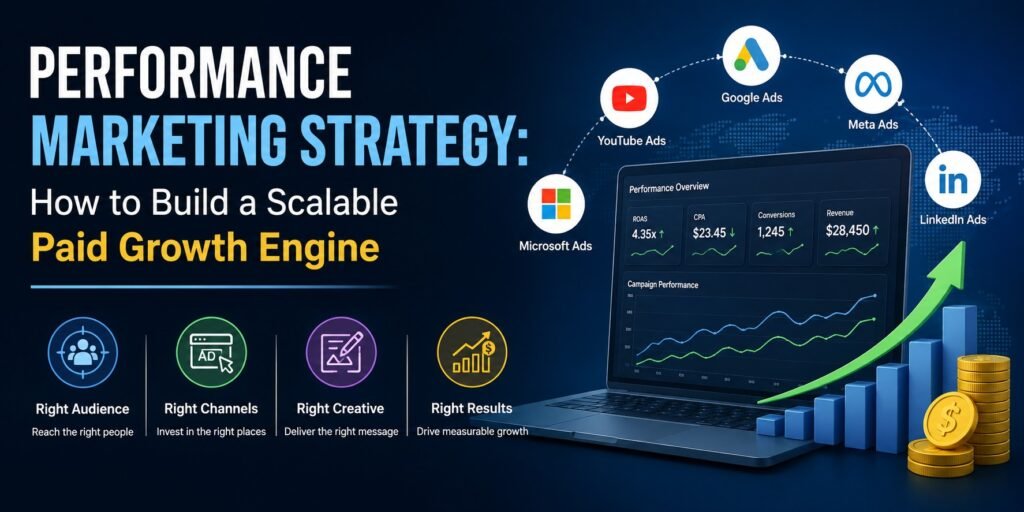
In this guide, we’ll explore what a modern performance marketing strategy looks like, how to choose the right performance marketing channels, how to structure a paid acquisition strategy, and how continuous performance marketing optimization can turn paid media into a scalable growth engine.
Table of Contents
What Is a Performance Marketing Strategy?
A performance marketing strategy is a structured approach to paid customer acquisition where advertising decisions are guided by measurable business outcomes rather than surface-level campaign metrics.
Instead of focusing only on impressions, clicks, or traffic, a strong strategy connects advertising activity to outcomes such as qualified leads, purchases, customer acquisition cost (CAC), return on ad spend (ROAS), conversion rate, revenue contribution, and overall marketing efficiency.
This makes performance marketing fundamentally different from simply buying media.
A campaign can generate thousands of clicks and still be commercially ineffective if those visitors don’t convert. Conversely, a smaller campaign can become highly valuable when it consistently reaches the right audience, generates qualified demand, converts efficiently, and produces customers at a sustainable acquisition cost.
That is why a modern paid growth strategy needs to consider the entire customer acquisition journey:
Audience → Channel → Message → Campaign → Landing Experience → Conversion → Measurement → Optimization → Scale
Each stage influences the next.
If the audience is wrong, better creative won’t solve the problem. If the landing experience is weak, increasing traffic only increases wasted spend. If conversion tracking is inaccurate, optimisation decisions are based on incomplete data. And if a campaign is scaled before its economics are understood, higher spend can simply amplify inefficiency.
A scalable performance marketing strategy therefore treats paid media as an interconnected system rather than a collection of individual advertisements.
The Difference Between Running Ads and Building a Paid Growth Engine
What a Scalable Paid Growth Engine Actually Considers
A scalable paid growth engine begins by understanding who the business needs to reach and where those audiences are most likely to engage. Audience research should go beyond basic demographics and consider search behaviour, purchase intent, customer needs, interests, objections, and the stage of the buying journey.
The next consideration is where that audience can be reached effectively. Different performance marketing channels serve different purposes. Search can capture existing demand, paid social can create and shape demand, display and video can expand reach and awareness, and retargeting can reconnect with people who have already shown interest. The right channel mix depends on the audience, offer, sales cycle, and business objective.
Connecting Message, Campaign, and Conversion Experience
Once the audience and channels are established, the messaging needs to create a clear reason to engage. The advertisement should communicate a relevant problem, opportunity, benefit, or solution rather than simply promoting a product or service. Strong performance marketing connects the message in the advertisement with the experience that follows the click.
That experience matters because generating traffic is only one part of acquisition. If users reach a confusing, slow, or poorly structured landing page, even a well-performing campaign can produce weak commercial results. The landing experience should therefore reinforce the campaign message and make the next action clear.
Measuring What Actually Drives Growth
A performance marketing system also needs to distinguish between activity and meaningful business outcomes. Clicks, impressions, and engagement can help diagnose campaign behaviour, but they do not necessarily indicate whether advertising is generating profitable growth.
The more important question is which conversions contribute to the business. Depending on the business model, this could mean qualified enquiries, booked consultations, purchases, subscriptions, or revenue. Connecting campaign data with these outcomes makes it possible to understand how efficiently customers are being acquired rather than simply how much traffic advertising generates.
Optimizing and Scaling With Data
Once reliable conversion data is available, performance marketing becomes an ongoing process of learning and improvement. Campaigns, audiences, creative, offers, landing experiences, and budgets can be evaluated against actual performance and adjusted based on evidence.
This is also what makes scaling different from simply increasing advertising spend. A campaign should be scaled when its economics, conversion performance, and underlying demand support additional investment. The objective is to increase acquisition while maintaining sustainable efficiency, rather than allowing higher budgets to create proportionally higher costs.
The Core Components of a Scalable Performance Marketing Strategy
Audience and Market Intelligence
A scalable performance marketing strategy starts with understanding the people behind the numbers. Before selecting channels or allocating budget, businesses need a clear view of who they want to acquire, what problems they are trying to solve, what influences their decisions, and how they move toward a purchase.
Audience intelligence also helps identify differences between high-value and low-value prospects. A campaign can appear successful when it generates a large volume of leads, yet produce poor business results if those leads have little purchase intent or low customer value. Understanding the audience therefore allows campaigns to optimize not just for volume, but for quality and commercial potential.
Choosing the Right Performance Marketing Channels
There is no universal channel mix that works for every business. The right performance marketing channels depend on factors such as audience behaviour, buying intent, product complexity, sales cycle, geographic market, available creative assets, and business objectives.
Search advertising can capture existing demand when people are actively looking for a solution. Paid social can reach defined audiences and create demand through targeted creative. Video can communicate complex value propositions, while retargeting can bring interested prospects back into the conversion journey. The objective is not to be present everywhere, but to invest where the strongest combination of audience fit and commercial opportunity exists.
Creative and Messaging Strategy
Even the right audience and channel cannot compensate for weak messaging. Creative needs to communicate a relevant problem, compelling value proposition, and clear reason to act within the limited attention available in a paid environment.
Performance creative should also be treated as something to test and learn from rather than a one-time asset. Different messages, offers, formats, angles, and calls to action can reveal what resonates with specific audience segments. These insights can then inform future campaigns and improve the efficiency of the overall paid acquisition strategy.
Conversion Experience and Landing Pages
The advertising campaign is only the beginning of the customer journey. Once someone clicks an advertisement, the landing experience determines whether that interest develops into a meaningful action.
The message, offer, page structure, trust signals, calls to action, and conversion process should work together to remove friction. When the experience is aligned with the original advertisement, businesses can make better use of the traffic they are already paying to acquire.
Measurement and Attribution
A scalable performance marketing system needs reliable measurement. Without accurate tracking, businesses cannot confidently determine which campaigns, audiences, channels, or customer journeys are contributing to revenue.
Measurement should extend beyond surface-level metrics and connect marketing activity with meaningful commercial outcomes. Depending on the business, this may include qualified leads, purchases, customer acquisition cost, return on ad spend, customer lifetime value, and revenue contribution.
Building a Paid Acquisition Strategy That Can Scale
Start With Economics Before Increasing Spend
A scalable paid acquisition strategy should begin with the economics of the business, not the size of the advertising budget. Before increasing spend, businesses need to understand how much they can reasonably afford to spend to acquire a customer while still maintaining a healthy return.
This means looking beyond individual campaign metrics and understanding the relationship between customer acquisition cost (CAC), conversion rate, average customer value, margins, and return on ad spend (ROAS). When these numbers are understood, advertising decisions can be based on commercial viability rather than assumptions.
For example, a campaign generating a strong number of conversions may still be unprofitable if the cost of acquiring those customers is higher than the value they generate. Conversely, a campaign with a higher acquisition cost can sometimes be more valuable when it attracts customers with greater lifetime value.
Build a Testing and Learning Framework
Performance marketing becomes more scalable when every campaign contributes to a continuous learning process. Instead of making isolated changes based on short-term fluctuations, businesses should systematically test different audiences, messages, creative concepts, offers, landing experiences, and campaign structures.
The purpose of testing is not simply to find a winning advertisement. It is to understand why something performs better and determine whether that insight can be applied elsewhere. A successful audience may reveal a new customer segment, while a high-performing message may reveal a stronger value proposition that can influence other parts of the marketing funnel.
Over time, these insights create a performance marketing feedback loop where campaign data continuously improves targeting, messaging, conversion experiences, and budget allocation.
Scale What Works Without Destroying Efficiency
Scaling paid acquisition requires more discipline than simply increasing the daily budget. When spending increases too quickly, campaigns can reach less qualified audiences, frequency can rise, creative can fatigue, and acquisition costs can increase.
A more sustainable approach is to scale gradually while monitoring the metrics that determine profitability. Businesses can increase investment in proven audiences and campaigns, expand into relevant channels, introduce new creative variations, and test additional market segments while maintaining control over acquisition economics.
The goal is not maximum advertising spend. The goal is maximum sustainable growth from profitable demand. A paid growth engine becomes truly scalable when additional investment can generate additional customers without causing efficiency to deteriorate beyond acceptable levels.
Performance Marketing Optimization: What to Improve First
Optimize Campaign Performance Before Increasing Budget
Performance marketing optimization should begin with identifying where performance is being lost rather than simply increasing or reducing advertising spend. Campaign data can reveal whether the problem is coming from audience quality, creative performance, targeting, bidding, channel selection, or the offer itself.
A campaign with a high click-through rate but a low conversion rate may have a message that attracts attention without attracting the right intent. Similarly, a campaign with strong conversion rates but high acquisition costs may require better audience targeting, creative testing, budget allocation, or channel-level optimization.
Optimize the Conversion Journey
Paid acquisition does not end when someone clicks an advertisement. Every stage between the initial interaction and the final conversion can influence acquisition efficiency. The landing page, offer, form, checkout experience, follow-up process, and overall customer journey all contribute to the final outcome.
This is why optimization should consider the complete conversion path rather than treating advertising performance in isolation. Improving the experience after the click can sometimes produce greater gains than making another adjustment inside the advertising platform itself.
Use Data to Guide Budget Allocation
Budget allocation should be based on evidence rather than assumptions. As campaigns generate enough data, businesses can identify which audiences, channels, campaigns, and offers are producing the strongest combination of volume, quality, and profitability.
This does not mean automatically moving all available budget toward the campaign with the highest ROAS. A broader view should consider acquisition cost, conversion volume, customer quality, scalability, attribution, and potential lifetime value before deciding where additional investment should go.
Turn Optimization Into a Continuous Process
The most effective performance marketing systems treat optimization as an ongoing process rather than a one-time campaign adjustment. Markets change, audiences evolve, creative becomes less effective, competitors adjust their offers, and customer behaviour shifts over time.
Continuous testing and analysis allow the paid acquisition strategy to adapt to these changes. Instead of relying on a campaign that worked in the past, businesses can build a system that continually learns what is working now and where the next opportunity for improvement exists.
This systems-based approach is at the core of Mavenify’s Performance Marketing System™, where paid acquisition, conversion, measurement, testing, and optimization work together as one connected growth engine.
How AI Is Changing Performance Marketing
Faster Audience and Campaign Analysis
Artificial intelligence is changing how performance marketing teams analyze audiences, campaigns, and customer behaviour. Instead of relying entirely on manual analysis, AI can process large volumes of performance data and help identify patterns across audiences, creative, channels, and conversion behaviour.
This can help marketers identify emerging opportunities faster, understand which segments are responding to specific messages, and detect performance changes that may otherwise take longer to recognize. AI does not replace strategic decision-making, but it can make the process of turning campaign data into useful insights significantly faster.
AI-Assisted Creative and Messaging Testing
AI can also accelerate the development and testing of advertising creative. Multiple messaging angles, headlines, concepts, and variations can be developed and evaluated more efficiently, allowing marketers to learn which ideas resonate with different audience segments.
The goal is not to produce unlimited variations simply because AI makes production easier. Effective performance marketing still requires a clear understanding of the customer, the offer, positioning, and business objective. AI becomes most valuable when it supports a strong strategy rather than replacing one.
Moving From Manual Optimization to Intelligent Systems
The larger opportunity is to connect AI with the broader performance marketing system. Campaign data, audience signals, conversion behaviour, creative performance, and customer outcomes can provide a continuous stream of information that supports faster decisions and more informed optimization.
This creates the potential for performance marketing to become increasingly adaptive. Instead of relying on periodic manual reviews, businesses can use intelligent tools to identify patterns, prioritize opportunities, support experimentation, and help teams respond more quickly to changes in performance.
However, technology alone does not create a scalable paid growth engine. The underlying strategy, measurement framework, customer experience, and commercial objectives still determine whether increased automation actually produces better business outcomes.
Building a Long-Term Performance Marketing Engine
Connect Paid Acquisition With Organic Growth
Paid and organic marketing are often treated as separate activities, but they can become significantly more valuable when they inform each other. Paid campaigns can reveal which messages, audiences, offers, and search terms generate meaningful engagement, while organic channels can build visibility and demand without requiring every interaction to be purchased.
The insights generated through paid campaigns can therefore influence broader marketing decisions. High-performing messaging can inform content, landing pages, email campaigns, and organic search strategies, while organic audience behaviour can reveal opportunities for future paid campaigns.
Turn Campaign Data Into Business Intelligence
A mature performance marketing strategy should generate more than campaign reports. Over time, the data collected through paid acquisition can reveal how different audiences respond to offers, which customer segments are most valuable, what objections prevent conversion, and which messages consistently influence buying decisions.
These insights become increasingly valuable when they are connected with other business data. Marketing performance can then contribute to decisions around positioning, customer acquisition, product offers, sales processes, and future growth investments rather than remaining isolated inside advertising platforms.
Create a System That Improves Over Time
The ultimate goal of a scalable paid growth engine is not to find a campaign that works today. It is to create a system that becomes more informed and efficient as it operates.
Every campaign can contribute new information about audiences, creative, channels, conversion behaviour, and economics. That information can feed the next round of testing and optimization, creating a continuous cycle of learning and improvement.
When strategy, data, technology, creative, conversion infrastructure, and disciplined optimization work together, performance marketing becomes more than a paid advertising function. It becomes a measurable growth system designed to support sustainable customer acquisition and long-term business growth.
Conclusion
A scalable performance marketing strategy is not built by simply increasing advertising spend or finding a single campaign that performs well. It is built by connecting audience intelligence, channel selection, creative strategy, conversion experience, measurement, testing, and continuous optimization into one coordinated system.
The strongest paid growth engines are designed around business economics. They measure the quality and value of customers, learn from campaign data, improve the conversion journey, and allocate investment toward opportunities that can support sustainable growth.
As advertising platforms become more automated and AI continues to accelerate analysis, creative development, and optimization, the competitive advantage will increasingly come from how well businesses connect these technologies with their broader growth strategy.
For businesses looking to move beyond disconnected campaigns and build a more measurable, scalable approach to customer acquisition, Mavenify’s Performance Marketing System™ brings paid acquisition, conversion strategy, measurement, optimization, and growth intelligence together as one connected system.
Frequently Asked Questions About Performance Marketing Strategy
What is a performance marketing strategy?
A performance marketing strategy is a structured approach to paid customer acquisition that connects advertising channels, audience targeting, creative, conversion experiences, measurement, and optimization to measurable business outcomes such as qualified leads, customers, revenue, customer acquisition cost, and return on ad spend.
What are the main performance marketing channels?
Common performance marketing channels include paid search, paid social, display advertising, video advertising, retargeting, and other measurable digital acquisition channels. The right mix depends on the target audience, buying journey, business model, market, and commercial objectives.
How do you create a scalable paid growth strategy?
A scalable paid growth strategy starts with clear business economics and audience intelligence, followed by appropriate channel selection, compelling creative, a strong conversion experience, reliable measurement, continuous testing, and disciplined budget allocation. Scaling should happen after the underlying acquisition economics have been validated.
What should businesses measure in performance marketing?
Important performance marketing metrics can include conversion rate, customer acquisition cost, cost per acquisition, return on ad spend, customer lifetime value, qualified lead volume, and revenue contribution. The right metrics depend on the business model and the action being optimized.
How does AI improve performance marketing?
AI can help performance marketing teams analyze large volumes of campaign data, identify audience and creative patterns, accelerate testing, support optimization, and improve decision-making. Its greatest value comes when it is integrated into a clear strategy and reliable measurement framework rather than used as a replacement for strategic thinking.
Build a Paid Growth Engine Designed to Scale
Paid advertising should do more than generate clicks. When strategy, audience intelligence, conversion infrastructure, measurement, and optimization work together, paid acquisition can become a predictable and scalable contributor to business growth.
If you’re ready to move beyond disconnected campaigns and build a performance marketing system around measurable growth, Mavenify can help you design the infrastructure behind it.