

Content has never been easier to produce.
With AI tools, businesses can research topics, generate drafts, create outlines, repurpose existing material and publish content at a speed that was difficult to achieve just a few years ago.
But producing more content does not automatically create more authority.
A website can publish hundreds of AI-assisted articles and still struggle to earn visibility, trust, qualified traffic or meaningful brand recognition. The problem is usually not content volume. It is the absence of a connected strategy behind that content.
An AI content strategy should therefore be about much more than using AI to write faster. It should connect research, expertise, content architecture, topical authority, search visibility, brand credibility and continuous improvement into one coordinated system.
This is where an AI Content & Authority System™ becomes valuable.
Instead of treating every article, landing page or piece of content as an isolated asset, the system connects content around the subjects a business needs to be known for. AI can help accelerate research and execution, while human expertise, strategic direction and editorial judgment ensure that the resulting content is useful, credible and aligned with business goals.
The objective is not simply to publish more.
It is to build digital authority that compounds over time.
Table of Contents
What Is an AI Content & Authority System?
An AI Content & Authority System™ is a connected approach to using AI, strategic content, expertise and authority-building activities to establish a business as a trusted source within its market.
It goes beyond creating individual blog posts or using AI to increase publishing volume. The objective is to build a structured content ecosystem in which different pieces of content work together to demonstrate expertise, answer important audience questions and strengthen the business’s overall digital presence.
A strong system connects content research, topic selection, content creation, optimization, internal relationships and authority signals into a continuous process. Instead of treating every new article as a separate SEO task, it considers how that article contributes to the broader body of knowledge a business is building.
AI can make this process more efficient by helping with research, analysis, content planning and production. But the technology is only one part of the system. The strategy determines what should be created, the expertise determines what makes the content valuable, and the authority-building process determines how that knowledge becomes associated with the business over time.
The result is a content ecosystem designed not simply to attract visitors, but to help a business become more visible, more credible and more recognizable for the subjects that matter to its growth.
How an AI Content & Authority System Differs From Traditional Content Marketing
Traditional content marketing often focuses on maintaining a publishing schedule and creating content around relevant keywords. While consistency can be useful, publishing regularly does not necessarily mean that a business is building meaningful authority.
An AI Content & Authority System takes a broader view. It considers the relationship between individual topics, the depth of coverage across a subject, the expertise demonstrated through the content and the signals that reinforce the business’s credibility beyond its own website.
This means a business may publish fewer pieces of content while creating a much stronger overall resource. Each piece has a defined role, connects to related information and contributes to a larger understanding of the subject.
AI makes this approach more scalable, but it does not replace the underlying strategy. The goal is not to use AI to produce more content for its own sake. The goal is to use AI to build a smarter, more connected and more authoritative content ecosystem.
Why Businesses Need More Than Content to Build Digital Authority
Publishing useful content can help a business become more visible, but visibility alone does not establish authority. A visitor may discover one helpful article through search and still have no reason to believe that the business has deeper expertise in the subject.
Digital authority develops when a business consistently demonstrates knowledge across the topics that matter to its audience and its market. The individual pieces of content need to support one another, reinforce the brand’s expertise and give people multiple ways to understand what the business knows and why that knowledge is valuable.
This becomes particularly important as people increasingly discover information through different digital experiences. A potential customer might read an article, explore a service page, encounter the brand in an industry publication and later see the business referenced in an AI-generated answer. Each interaction contributes to the broader perception of the business.
That is why authority should not be viewed as the result of a single high-performing article. It is the cumulative effect of relevant expertise, consistent content, strong topic coverage, credible signals and connected digital experiences.
Authority Is Built Through Consistency and Depth
A business does not become authoritative simply because it has published content about a particular subject. It needs to demonstrate sufficient depth to show that the subject is genuinely understood.
For example, a company that provides cybersecurity services might publish an introductory article explaining common cybersecurity risks. That can answer an important question, but it represents only one part of the subject.
A stronger authority-building approach would also address the challenges businesses face when evaluating security risks, implementing security controls, responding to incidents, meeting relevant requirements and choosing appropriate solutions. Content can then connect these different areas so that visitors can move from a broad understanding of the subject to increasingly specific information.
Over time, this creates a much stronger representation of the business’s knowledge than a collection of unrelated articles ever could.
The same principle applies regardless of industry. Authority comes from demonstrating meaningful expertise repeatedly and comprehensively around the subjects a business wants to be known for.
The Role of AI in Building Content Authority
AI can significantly improve how businesses research, plan and produce content, but its greatest value comes from making an effective content system more intelligent and scalable.
AI can help identify patterns across search queries, organize large amounts of information, uncover content opportunities and support the development of comprehensive topic plans. It can also assist with drafting, editing, repurposing and updating content, allowing teams to spend more time on strategy and expertise rather than repetitive production tasks.
However, using AI effectively requires a clear understanding of where automation adds value and where human judgment remains essential.
Content created primarily to increase publishing volume can easily become repetitive or disconnected from the actual needs of an audience. An authority-focused approach uses AI differently. The technology supports the research and production process while people provide the experience, perspective, judgment and original insight that make content genuinely useful.
This distinction becomes even more important for subjects where expertise and trust influence purchasing decisions. Readers need more than an efficiently generated explanation. They need information that reflects a real understanding of their problems and provides enough context to help them make better decisions.
AI Should Accelerate Expertise, Not Replace It
The strongest AI content strategies begin with knowledge rather than generation.
A business already has valuable information inside its team, customer conversations, processes, experiences and industry knowledge. AI can help organize and expand that knowledge into a more scalable content system, but it should not be used to manufacture expertise that the business does not possess.
For example, an experienced professional can provide the practical insights, examples and lessons that distinguish a useful article from a generic overview. AI can then help structure those insights, identify related questions, suggest areas that need greater explanation and support the editorial process.
This creates a better balance between efficiency and authenticity.
AI provides scale. Human expertise provides substance. Strategy connects the two.
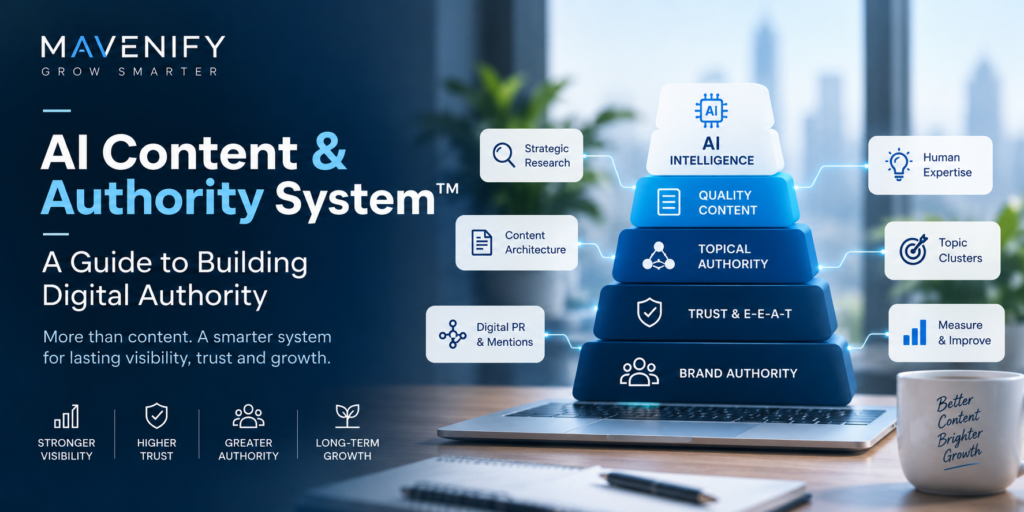
The Core Elements of an AI Content & Authority System™
An effective AI Content & Authority System™ brings several connected disciplines together rather than treating content creation as a standalone marketing activity. Each element has a specific role, but the real value comes from how these elements work together to strengthen the business’s authority over time.
The system begins with understanding what the business should be known for and what its audience needs to understand. From there, content can be structured around important subjects, supported by genuine expertise, connected through a clear information architecture and reinforced by credible signals beyond the website.
The core elements include strategic content research, topical authority, content architecture, expert-driven content, E-E-A-T, entity and brand authority, digital PR and continuous content optimization.
Strategic Content Research
Before creating content, businesses need to understand where content can create the greatest value.
Strategic research looks beyond individual keywords to understand the questions customers ask, the problems they are trying to solve, the subjects competitors cover and the gaps where better information could provide a meaningful advantage.
This helps determine not only what content should be created, but also why it should exist and how it should contribute to the broader authority strategy.
Topical Authority
Topical authority comes from demonstrating meaningful depth around a subject rather than publishing disconnected articles whenever a new keyword appears.
A business can establish stronger topical coverage by addressing the important questions surrounding a subject, from broad educational concepts to specific problems, comparisons and practical considerations.
When these resources are thoughtfully connected, they create a deeper knowledge environment for both the audience and search systems to understand.
Content Architecture
The relationship between content matters almost as much as the content itself.
A well-structured content architecture establishes clear relationships between broader pillar resources and more focused supporting content. Internal links help readers discover related information while creating a logical structure across the website.
This is where an individual article stops being an isolated asset and becomes part of a larger content ecosystem.
Expertise and E-E-A-T
Authority cannot be created simply by producing a large amount of content or using language that sounds authoritative.
Content becomes more credible when it demonstrates why the business or author is qualified to discuss the subject. First-hand experience, expert perspectives, original insights, relevant credentials, supporting evidence and transparent information can all contribute to that credibility.
E-E-A-T—experience, expertise, authoritativeness and trustworthiness—is therefore an important consideration when developing content designed to establish long-term authority.
Entity and Brand Authority
A business’s authority extends beyond the pages it controls.
Search engines and AI-powered discovery systems can encounter information about a company across websites, publications, directories, industry resources and other digital environments. Consistent information and credible references can help reinforce how the business and its expertise are understood across that wider ecosystem.
This makes brand authority an important part of a content strategy rather than something that exists separately from it.
Digital PR and Third-Party Recognition
Publishing on your own website is only one way to demonstrate expertise.
Relevant mentions, expert contributions, industry publications, interviews, original research and other credible third-party references can expose the business’s knowledge to audiences beyond its own website.
These activities can complement owned content by creating additional evidence that the business is recognized within its field.
Continuous Content Optimization
An authority system should not end when an article is published.
Performance data can reveal which topics are attracting relevant visitors, which resources are generating engagement, where users are encountering friction and which subjects may require greater depth.
Those insights can then inform future content, updates and optimization. Over time, the system becomes increasingly informed by evidence rather than relying entirely on assumptions about what an audience might need.
How to Build Topical Authority With an AI Content Strategy
Building topical authority starts with deciding which subjects a business needs to be associated with and then developing sufficient depth around those subjects.
The process should begin with the business itself. Its products, services, customers, expertise and competitive position provide the context for deciding which topics are commercially important. From there, research can reveal the questions, problems and subtopics that audiences explore before making a decision.
AI can make this research process considerably more efficient by helping organize large amounts of information, identify relationships between topics and surface patterns that might otherwise take considerable manual effort to uncover.
But research is only the beginning.
The resulting topics need to be organized into a logical structure that reflects how people actually understand the subject.
Start With the Topics That Matter to the Business
Not every topic that attracts search traffic deserves a place in an authority strategy.
A business should prioritize subjects that connect meaningfully to its expertise, audience and commercial objectives. This creates a stronger relationship between educational content and the products or services the business ultimately provides.
For example, a web development company may be able to write about hundreds of general technology topics. But if its objective is to establish authority around high-performance, growth-focused websites, its content strategy should concentrate on the subjects surrounding website performance, conversion, architecture, integrations, analytics and sustainable digital growth.
This keeps content aligned with the business rather than allowing keyword opportunities to dictate the entire strategy.
Build Depth Around Each Core Subject
Once the important subjects have been identified, the next step is to understand what the audience needs to know about them.
A broad topic may contain dozens of related questions, comparisons, challenges and practical considerations. Some deserve comprehensive resources, while others may only require concise supporting content.
The objective is not to create content for every possible variation of a keyword. It is to build enough meaningful coverage that the business demonstrates genuine understanding of the subject.
This is where topic clusters become useful. A central resource can establish the broader concept while supporting resources explore specific aspects in greater detail. When these pages are connected logically, they create a stronger content structure and make it easier for visitors to continue learning.
Connect Content Into a Knowledge Ecosystem
Topical authority becomes more powerful when content is connected rather than published as a series of independent articles.
A visitor reading about one aspect of a subject should be able to discover related information that helps answer the next question naturally. Internal links provide those pathways while helping establish relationships between different pieces of content.
This is also why a strong content strategy for SEO should consider the entire website rather than optimizing individual pages in isolation.
The goal is to create an environment where each valuable resource strengthens the usefulness of the resources around it.
How Content Architecture Turns Individual Articles Into an Authority System
A strong content strategy does not end with deciding which topics to publish. It also needs to determine how those topics relate to one another.
When content is planned as a connected structure, a broad resource can introduce a subject while more focused resources answer the specific questions that arise from it. This creates clear pathways for readers and helps the website develop greater depth around important areas of expertise.
The structure also makes content easier to maintain. When related resources have clearly defined roles, it becomes easier to identify gaps, update outdated information and determine where new content can strengthen an existing subject rather than duplicate it.
Use Pillar and Supporting Content to Build Depth
A pillar resource provides a comprehensive introduction to a broad subject, while supporting content explores individual aspects of that subject in greater detail.
For example, a comprehensive resource about conversion rate optimization can explain the overall discipline, while separate resources can explore landing pages, forms, conversion funnels and experimentation in greater depth.
This approach gives the audience different levels of information depending on what they need. Someone discovering the subject for the first time can start with the broader resource, while someone looking for a specific solution can move directly into a more focused topic.
The relationship between those resources is what makes the structure valuable. Each page has its own purpose, but together they create a more complete understanding of the subject.
Make Internal Links Part of the Content Strategy
Internal linking should not be treated as something added after an article has been written.
When content is planned as an authority system, links can be considered as part of the information architecture from the beginning. A page should naturally point readers toward related resources that provide additional context, answer a follow-up question or help them move further through the subject.
This creates a better experience for readers while strengthening the connections between related content across the website.
The most useful internal links are therefore not simply links placed because a page needs an internal link. They are contextual pathways that help the reader discover the next useful piece of information.
How to Create Content That Demonstrates Real Expertise
Authority depends on more than covering a subject comprehensively. The content itself needs to demonstrate that the business understands the subject well enough to provide useful guidance.
This is where many content programs struggle. Information can be technically accurate while still feeling generic because it simply repeats explanations that readers can find on dozens of other websites.
A stronger AI content strategy looks for opportunities to bring the business’s own knowledge into the content. That might come from customer experiences, professional expertise, original observations, internal processes, case studies, data or lessons learned from working directly within the industry.
The purpose is not to make every article promotional. It is to make the information more useful by incorporating perspectives that generic content cannot easily reproduce.
Combine AI Efficiency With Human Expertise
AI can help research and organize information quickly, but it does not automatically know what a business has learned through years of experience.
That knowledge needs to be deliberately incorporated into the content process.
For example, an experienced consultant may recognize a common misconception that frequently causes clients to make poor decisions. A subject-matter expert may know which implementation challenges are routinely overlooked. A business may also have internal data or customer insights that provide a perspective unavailable in generic online content.
An effective AI content marketing process can use AI to help structure and scale these insights without removing the human perspective that makes them valuable.
The result is content that is efficient to produce but still grounded in genuine knowledge.
Make the Content Useful Beyond the Search Query
A useful piece of content should not stop at answering the exact question that brought the visitor to the page.
It should help the reader understand what the answer means, what they should consider next and how the information relates to the broader problem they are trying to solve.
This is one reason a strong content marketing strategy should focus on helping the audience make better decisions rather than simply maximizing the number of keywords covered.
When content consistently provides that level of usefulness, it becomes more likely to earn attention, engagement, references and continued readership over time.
E-E-A-T and the Role of Trust in Content Authority
Content authority is closely connected to the signals that help people understand whether a business is qualified to provide reliable information.
This is where E-E-A-T — Experience, Expertise, Authoritativeness and Trustworthiness — becomes important. These concepts help frame what makes content and the sources behind it more credible, particularly when the information can influence important decisions.
For an AI content strategy, E-E-A-T is especially relevant because AI makes it possible to produce large amounts of content without necessarily demonstrating that the organization behind it has genuine knowledge of the subject.
The solution is not to avoid AI. It is to make sure AI-assisted content is grounded in real experience, credible expertise and information that readers can reasonably trust.
Experience Adds Depth That Generic Content Cannot Replicate
First-hand experience can make content substantially more useful because it brings practical knowledge into subjects that might otherwise be explained only at a theoretical level.
A business can demonstrate experience through examples, case studies, original observations, lessons learned, implementation details and explanations of how a particular challenge was handled in practice.
This gives readers information that goes beyond what they could get from a generic summary of existing material.
For businesses investing in AI content marketing, this distinction matters. AI can help organize and communicate information, but genuine experience has to come from somewhere. The more effectively a business incorporates its own knowledge into its content, the more differentiated that content can become.
Expertise Should Be Demonstrated, Not Simply Claimed
Saying that a company is an expert does not make its content authoritative.
Expertise needs to become visible through the quality and depth of the information being provided. Clear explanations, accurate details, informed recommendations, relevant examples and appropriate supporting evidence can all help demonstrate knowledge.
The author or organization behind the content should also be clear when that context is important to understanding why the information can be trusted.
This creates a stronger foundation for topical authority because the business is not merely covering a subject repeatedly. It is demonstrating why its perspective deserves attention within that subject.
Trust Is the Foundation of Long-Term Authority
Trust is ultimately what turns visibility into credibility.
A business may attract visitors through search, but if its content is inaccurate, misleading, overly promotional or difficult to verify, increased visibility will not necessarily translate into lasting authority.
Trust therefore needs to be considered throughout the content experience, from the information presented on an individual page to the broader reputation of the business across the digital ecosystem.
A strong content marketing strategy should consequently treat trust as an ongoing responsibility rather than a box to check during content production.
How AI Content Strategy and Topical Authority Work Together
An effective AI content strategy should not treat every topic as an independent opportunity. The stronger approach is to identify the subjects where the business has something meaningful to contribute and then build sufficient depth around those subjects.
This is where topical authority becomes an important part of the strategy.
Topical authority develops when a website consistently demonstrates meaningful knowledge across the different aspects of a subject. A single article may answer one question, but a connected body of useful content can demonstrate a much broader understanding.
AI can support this process by helping businesses analyze large amounts of information, identify related questions, organize topics and uncover areas where content coverage may be incomplete. The strategic decisions still need to come from the business’s objectives, audience and expertise.
Think in Topics, Not Just Keywords
Keywords are useful for understanding how people search, but they should not become the entire foundation of a content strategy.
A single subject can have many different search queries associated with it. Someone researching conversion rate optimization, for example, may eventually need information about landing pages, forms, testing, analytics, user behavior and conversion funnels.
Creating separate content around these connected needs can provide much greater value than repeatedly targeting variations of the same keyword.
This is why a mature content strategy for SEO should map the broader subject before deciding which individual pages to create. The objective is to understand the information landscape and determine where each resource belongs within it.
Identify Gaps in Existing Content Coverage
Topical authority also requires identifying what is missing.
A website may already have several articles about an important subject while still leaving significant questions unanswered. Some content may be too shallow, some may overlap heavily and some may no longer reflect current information.
AI can help analyze existing content and organize large topic sets, making it easier to identify these gaps. But the final decision should still consider whether filling a particular gap provides genuine value to the audience and strengthens the business’s expertise.
Over time, this process turns content planning into a continuous effort to deepen and improve the knowledge the website provides, rather than simply adding more pages.
Build Authority Through Connected Coverage
The strongest topical strategies create relationships between broad and specific information.
A comprehensive resource can establish the context for a subject, while supporting pages answer narrower questions in greater detail. Internal links then connect these resources so that readers can move naturally between related information.
This structure also gives each new piece of content a clear role. Instead of asking whether another article can be published, the business can ask whether the new resource fills an important gap, strengthens an existing subject or provides information that the current content ecosystem does not yet offer.
That is the point where AI content marketing becomes more strategic: AI is helping expand and organize a body of knowledge rather than simply increasing the number of articles being published.
Building a Content Ecosystem That Supports Search and AI Discovery
A content ecosystem gives a business a structured way to organize its knowledge so that important information can be discovered, understood and connected across the website.
This matters because modern discovery does not happen through one channel alone. People may find a business through traditional search results, AI-powered search experiences, industry publications, social platforms or recommendations from other websites. The content supporting the business needs to make sense across those different discovery environments.
A strong AI content strategy therefore considers not only what individual pages say, but also how the pages collectively communicate the business’s expertise.
When related content is organized around clear subjects, connected through meaningful relationships and supported by consistent information about the business, the website becomes a stronger representation of what the organization knows and what it offers.
Create Clear Relationships Between Related Topics
A content ecosystem should make it easy to understand how different subjects relate to one another.
A broad resource might explain a major concept, while more focused pages address specific questions, problems or applications within that subject. Those relationships should be reflected in the site’s structure and internal linking.
This approach also helps prevent content from becoming fragmented. Instead of creating a new article every time a keyword opportunity appears, businesses can build upon existing knowledge and determine where a new resource genuinely adds value.
For a content strategy for SEO, this creates a more coherent structure in which important pages support one another rather than competing for attention.
Make Content Useful for Both People and AI-Powered Discovery
AI-powered discovery systems need to interpret information about businesses, subjects and relationships across the web. Clear, well-structured content makes that information easier to understand.
This does not mean writing content specifically for an AI system at the expense of human readers. The better approach is to make the underlying information clear, consistent and useful for people first.
Well-defined topics, meaningful internal relationships, clear explanations and credible supporting information can help create a stronger digital knowledge base around the business.
This is also where AI content marketing needs to move beyond simply producing articles. The objective is to create a connected body of useful information that consistently communicates the business’s expertise.
Connect Owned Content With the Wider Digital Ecosystem
A business’s authority is not limited to what it publishes on its own website.
Industry publications, expert contributions, third-party references, interviews, reviews and other external mentions can provide additional context around the business and its expertise.
When these external signals align with the knowledge presented through the company’s own content, they can contribute to a more consistent representation of the brand across the digital ecosystem.
That makes content authority a broader discipline than blogging. The website provides the knowledge base, while the wider digital ecosystem helps reinforce that knowledge and the business behind it.
AI Content Strategy vs. Traditional Content Marketing: What’s the Difference?
Traditional content marketing can be highly effective when it is built around a clear audience, useful information and consistent execution. The challenge is that many businesses still approach it primarily as a publishing activity: identify a topic, create an article, publish it and move on to the next one.
An AI content strategy expands that approach by connecting content research, production, optimization and authority building into a more integrated system. AI can help accelerate parts of the workflow, but the larger objective is to create a body of knowledge that becomes increasingly useful and authoritative over time.
The difference is therefore not simply whether AI is being used. It is how content is planned, connected and improved.
| Traditional Content Marketing | AI Content Strategy |
| Often centered on a publishing calendar | Centered on strategic authority and business objectives |
| May focus heavily on individual keywords | Considers broader topics and relationships between them |
| Content is often evaluated page by page | Content is evaluated as part of a connected ecosystem |
| Production can depend heavily on manual research | AI can accelerate research, analysis and production |
| New content is frequently prioritized | Existing content is also analyzed and improved |
| Primarily focused on owned content | Can connect owned content with broader authority-building activities |
| Success may be measured through traffic and engagement | Success can include visibility, authority, qualified traffic and business outcomes |
Neither approach needs to exclude the other.
A strong content marketing strategy can provide the foundation for consistent communication with an audience, while AI can make research, planning, production and optimization more efficient. The important shift is from viewing AI as a content generator to treating it as an intelligence and productivity layer within a broader strategy.
The Goal Is Better Content, Not More Content
AI makes it tempting to measure success by output. If a team can produce ten articles instead of three, it can feel like the strategy has become more efficient.
But higher output does not necessarily mean higher value.
If additional content does not address meaningful audience needs, strengthen topical coverage or contribute something genuinely useful, increasing production can simply create a larger library of average information.
A more mature AI content marketing approach asks whether each new resource has a clear purpose within the broader content ecosystem.
That may mean creating a new article, expanding an existing resource, consolidating overlapping pages or updating information that has become outdated.
The objective is not to win a race to publish the most content.
The objective is to build the most useful body of knowledge around the subjects that matter to the business and its audience.
How to Measure the Success of an AI Content & Authority System™
Building authority is a long-term process, so success should not be judged by a single metric or by how many pieces of content are published.
An effective AI content strategy should be measured by whether the content ecosystem is becoming more visible, more useful and more valuable to the business over time.
Traffic can provide useful information, but it does not tell the whole story. A page can attract thousands of visitors and generate little commercial value, while a smaller resource can attract a highly relevant audience and contribute directly to qualified enquiries.
The measurement framework therefore needs to look at both content performance and business impact.
Measure Visibility and Content Performance
Search visibility can help show whether the website is gaining recognition for the subjects it is targeting. Changes in impressions, rankings, clicks and organic traffic can indicate whether content is becoming more discoverable.
However, these metrics should be evaluated in context.
A growing number of impressions may indicate greater visibility, but if the content is appearing for irrelevant searches, the increase may not represent meaningful progress. Similarly, traffic growth is more valuable when it comes from visitors who are genuinely interested in the business’s expertise and offerings.
This is why a strong content strategy for SEO should connect visibility metrics with the quality and relevance of the traffic being generated.
Measure Engagement and Content Quality
Engagement can provide additional insight into whether content is actually helping visitors.
Time spent engaging with content, interactions with important pages, movement between related resources and return visits can help identify whether people are finding the information useful.
These signals should not be interpreted in isolation, but they can reveal where content is successfully holding attention and where improvements may be needed.
A content ecosystem that consistently helps visitors find useful answers should create stronger pathways into the broader website rather than ending the user journey after a single article.
Measure Authority and Business Outcomes
The ultimate purpose of an authority-building system is not simply to increase the size of a website’s content library.
Businesses should also look for evidence that their growing authority is contributing to meaningful outcomes. This can include qualified organic leads, enquiries influenced by content, branded searches, relevant mentions and engagement from audiences that matter commercially.
Over time, the relationship between content and revenue can become clearer when Website Analytics and Conversion Tracking are connected to the wider content strategy.
This allows businesses to identify which subjects are attracting valuable audiences and where additional investment can produce the greatest return.
Use Performance Data to Improve the System
Measurement should feed back into strategy rather than simply being reported at the end of each month.
If a topic is generating strong visibility but weak engagement, the content may need to better match the audience’s intent. If a page attracts highly relevant visitors but does not lead them toward an appropriate next step, the broader website experience may need attention.
Likewise, if several resources around a subject are performing well, that may indicate an opportunity to deepen coverage and strengthen topical authority further.
This creates a continuous cycle:
Research → Create → Publish → Measure → Learn → Improve
The value of an AI Content & Authority System™ increases as that cycle becomes more informed by real performance data.
How to Keep an AI Content & Authority System Current
Building authority is not a one-time content project. Topics evolve, customer expectations change, competitors publish new information and search experiences continue to develop.
A content ecosystem that remains unchanged can gradually lose relevance even if it once performed well. Maintaining authority therefore requires an ongoing process of reviewing, improving and expanding the information a business provides.
The goal is not to constantly rewrite everything.
It is to identify where meaningful improvements can make the content more accurate, useful and aligned with what the audience needs today.
Update Content When the Information Changes
Some subjects naturally become outdated faster than others.
Industry developments, product changes, regulations, statistics, technologies and customer expectations can all affect whether previously published information remains useful.
Regular content reviews can identify resources that need updated facts, clearer explanations or additional context. In some cases, a relatively focused update may be enough. In others, a page may need substantial restructuring because the underlying subject has changed.
This makes content maintenance an important part of a long-term content marketing strategy, rather than an activity that only happens when rankings decline.
Expand Where the Audience Needs More Depth
Performance data can also reveal where an existing topic deserves greater coverage.
A page may attract strong interest but leave important questions unanswered. Visitors may repeatedly move from one resource to another, search for related information or engage heavily with one particular aspect of a broader subject.
These patterns can reveal opportunities to create additional supporting resources or strengthen existing ones.
Over time, this process can deepen topical authority without requiring the business to constantly search for completely new subjects.
Consolidate Content When More Is Not Better
Maintaining authority also means recognizing when additional content is unnecessary.
Several pages may cover very similar subjects, compete for the same search intent or provide little additional value when kept separate. In those situations, consolidating information into a stronger resource may create a better experience than continuing to publish more pages.
An effective AI content strategy should therefore include decisions about what to create, what to improve and what to consolidate.
AI can help identify similarities and patterns across a large content library, but the final decision should consider the purpose, quality and usefulness of each resource.
How AI Can Scale Content Research, Creation and Optimization
AI can make an authority-focused content operation significantly more efficient, particularly when a business has a large number of topics, pages and data points to manage.
The value comes from using AI across the workflow rather than treating it as a tool that simply generates finished articles. Research, topic analysis, content planning, outlining, optimization, updating and repurposing can all benefit from intelligent assistance.
This allows content teams to spend less time on repetitive tasks and more time on the strategic and expert work that gives the content its value.
Use AI to Accelerate Content Research
Research can become time-consuming when a business needs to understand a large topic landscape.
AI can help organize search questions, identify related concepts, summarize large information sets and highlight relationships between subjects. This can make it easier to identify potential content gaps and determine how different resources should fit into the wider content ecosystem.
The important point is that AI-assisted research should still be evaluated by people who understand the business and its audience. Not every suggested topic deserves to become content, and not every piece of information surfaced by an AI system is automatically appropriate to publish.
Use AI to Support Content Creation
Once the strategy and research are established, AI can help accelerate parts of the content production process.
It can assist with outlines, first drafts, content expansion, restructuring, editing and repurposing. This can be particularly useful when a business needs to maintain a large and consistent library without allowing production effort to become a bottleneck.
However, the final content should still reflect the business’s knowledge, perspective and standards.
The strongest AI content marketing programs use AI to improve efficiency while keeping strategic direction and editorial judgment firmly in place.
Use AI to Improve Existing Content
AI can also support the optimization of content that already exists.
Large websites may contain hundreds or thousands of pages, making it difficult to manually identify every opportunity for improvement. AI can help analyze content for outdated information, overlapping subjects, missing topics, weak explanations or opportunities to strengthen connections between related resources.
This creates an important shift in how businesses think about content production.
Instead of constantly asking what should be published next, an AI content strategy can also ask:
What existing knowledge can we make better?
That question can uncover significant opportunities without requiring the business to continually increase its publishing volume.
The Role of Brand Authority and Digital PR in Content Strategy
A business’s authority is not built entirely on its own website.
Publishing valuable content gives a business a place to demonstrate its expertise, but recognition from relevant third parties can strengthen that authority by showing that the business is also being discussed, referenced or trusted beyond its own digital properties.
This is where brand authority and digital PR become important parts of an AI content strategy.
Rather than treating Digital PR as a completely separate activity, businesses can use it to extend the reach of the expertise already being developed through their content. Original research, expert commentary, industry insights and genuinely useful resources can create opportunities for the business to be referenced by relevant publications and communities.
Turn Expertise Into Something Worth Referencing
Not every piece of content is equally likely to earn external attention.
Generic explanations are easy to reproduce, which makes them difficult to differentiate. Original research, proprietary insights, expert perspectives, useful data and strong points of view give other people a reason to reference the business.
For example, a business could publish research based on its own customer data, explain an emerging industry trend from direct experience or provide expert commentary on a problem its audience regularly faces.
These assets can support both the company’s content marketing strategy and its wider authority-building efforts because the same expertise can be useful to audiences on the company’s website and to third parties looking for credible information.
Build Authority Beyond Your Own Website
External recognition can help reinforce the expertise demonstrated through owned content.
Relevant industry publications, professional organizations, expert interviews, podcasts, conferences and other credible sources can introduce the business to audiences that may never have discovered it through its own website.
The objective should not be to collect mentions simply for the sake of having more links or citations. The strongest opportunities are those that place the business’s expertise in front of a relevant audience and reinforce what the brand is already known for.
This creates a stronger connection between topical authority on the website and broader brand recognition across the digital ecosystem.
Consistency Strengthens Brand Recognition
Authority becomes easier to build when a business consistently communicates the same areas of expertise across its digital presence.
The subjects covered on the website, the expertise demonstrated in external publications and the information presented across other digital properties should reinforce one another rather than creating conflicting impressions.
Over time, this consistency can make it easier for audiences and discovery systems to associate the business with the subjects it has chosen to specialize in.
How to Create an AI Content Strategy That Supports Business Growth
An effective AI content strategy should ultimately connect content activity with the broader goals of the business. Visibility and traffic are useful outcomes, but they are not the end goal if the business needs qualified leads, stronger brand recognition or increased revenue.
The strategy should therefore begin with the business objectives and work backward to determine what role content needs to play. Some businesses may need to establish expertise in a new market, while others may need to strengthen visibility around existing services or build greater trust with prospects who are already researching a purchase.
When those objectives are clear, content becomes easier to prioritize. Instead of producing articles simply because there is another keyword to target, the business can focus its resources on subjects that have strategic importance.
Align Content With Commercial Objectives
Content should have a clear relationship with the business, even when its immediate purpose is educational.
A resource may introduce a potential customer to a problem, help them understand available solutions or answer questions they have before contacting a provider. Different pieces of content can support different stages of that journey while contributing to the same broader objective.
This does not mean every article should aggressively promote a service. In fact, excessive promotion can reduce the usefulness and credibility of educational content.
The stronger approach is to make the connection naturally. When a reader needs additional information or is ready to explore a solution, the website should provide an appropriate next step.
Prioritize Topics Based on Opportunity
Not every possible content idea deserves equal investment.
An effective content marketing strategy should consider the relevance of a topic to the business, the needs of the audience, the existing level of coverage and the potential value of establishing stronger authority around it.
This creates a more focused publishing strategy. Instead of attempting to cover everything, the business can concentrate its resources on the subjects where stronger expertise and deeper content coverage can create a meaningful advantage.
AI can assist with identifying patterns and opportunities across large amounts of information, but strategic prioritization still requires an understanding of the business, its market and its customers.
Create Content That Supports the Customer Journey
People rarely move from discovering a business to becoming a customer after reading one piece of content.
They may first encounter an educational resource, then compare approaches, investigate a specific problem, evaluate potential providers and eventually look for evidence that supports their decision.
A well-designed content ecosystem can support those different stages by providing relevant information at each point.
This is where the broader AI Content & Authority System™ becomes more valuable than a standalone publishing process. Content can attract attention at the beginning of the journey while deeper resources, expert information and relevant service content help build confidence as the visitor moves closer to a decision.
AI Content & Authority as a Continuous Growth System
Building digital authority is not something a business completes after publishing a certain number of articles.
Markets evolve, customer questions change, competitors develop new ideas and new ways of discovering information continue to emerge. A successful AI content strategy therefore needs to operate as a continuous system that learns from performance and becomes stronger over time.
New content can expand the business’s knowledge ecosystem, while existing content can be updated, consolidated or strengthened as new information becomes available. Performance data can reveal where audiences are engaging, which topics are gaining visibility and where additional depth may be needed.
This creates a cycle in which research informs content, content generates data and that data improves the next stage of the strategy.
Connect Content Authority With the Wider Growth System
Content becomes more valuable when it works alongside the other systems responsible for attracting, converting and retaining customers.
Search visibility can help people discover the business. A strong website gives those visitors an effective environment in which to explore its expertise. Conversion optimization can improve the journey from information to enquiry, while analytics provide the evidence needed to understand what is actually contributing to growth.
The relationship works in both directions.
For example, search data can reveal new questions that deserve content. Conversion data can show which subjects attract commercially valuable audiences. Customer conversations can uncover problems that should be explained more clearly. Those insights can then feed back into the content marketing strategy.
An authority system therefore becomes more powerful when it is connected to the rest of the digital infrastructure rather than operating as an isolated content function.
Build Authority That Compounds Over Time
A useful article can continue attracting visitors long after it is published. A strong topic cluster can become more valuable as additional resources strengthen its coverage. Original insights can generate references and recognition that reinforce the credibility of the business.
These effects can accumulate.
The objective is to create a body of knowledge that becomes increasingly difficult to replicate because it reflects the business’s expertise, experience, relationships and understanding of its audience.
AI can help accelerate that process, but the long-term advantage comes from the system being built around it.
The strongest AI content marketing strategy is not designed to publish faster for a few months. It is designed to build authority that becomes more valuable over time.
AI Content & Authority System™
At Mavenify, the AI Content & Authority System™ is designed around this broader approach to authority building.
Rather than treating AI, SEO and content marketing as separate activities, the system connects strategic research, expert content, topical authority, content architecture, AI-assisted optimization and broader authority signals into a coordinated growth infrastructure.
The objective is to help businesses establish meaningful expertise around the subjects that matter to their customers while creating a content ecosystem that can evolve as search, AI discovery and customer behavior continue to change.
What Google Says About AI Content and Search
Using AI to support content creation is not inherently the problem. The important question is whether the resulting content provides genuine value to people.
Google’s current guidance for generative AI features in Search emphasizes creating unique, useful and trustworthy content for people, rather than producing content simply to increase the number of pages on a website.
This distinction is particularly important for businesses developing an AI content strategy. AI can make content production significantly faster, but speed alone does not create authority. The content still needs to provide information, experience or perspective that is genuinely useful to the audience.
Google’s guidance also makes clear that websites do not need to create content specifically for AI search systems. Existing SEO fundamentals continue to matter, while unique and useful content remains important for visibility in Google’s generative AI experiences.
“Create unique content that is helpful, reliable, and people-first.”
That principle reinforces one of the most important ideas behind an AI Content & Authority System™: AI should help businesses research, organize and scale valuable knowledge, but the end result still needs to serve people first.
Avoid Turning AI Into a Content Volume Machine
The temptation to use AI primarily for volume is understandable. When a business can produce content much faster, it can seem logical to publish as much as possible.
But more pages do not automatically create more authority.
Google’s current spam guidance specifically warns against scaled content abuse, including using generative AI to create many pages primarily for manipulating search rankings when those pages provide little value to users.
That makes strategic oversight even more important.
A responsible AI content marketing approach uses AI to increase the efficiency of a quality-driven process rather than replacing that process with automated publishing.
Frequently Asked Questions About AI Content & Authority
Is AI-generated content good for SEO?
AI-generated content is not automatically good or bad for SEO. Its value depends on whether the resulting content is useful, accurate, trustworthy and genuinely relevant to the audience.
AI can be useful for research, organization, drafting and optimization, but businesses should avoid using it simply to produce large volumes of generic content. A strong AI content strategy combines AI efficiency with human expertise, editorial judgment and a clear purpose for every piece of content.
What is the difference between AI content and AI content marketing?
AI content refers to content created with the assistance of artificial intelligence, while AI content marketing describes the broader strategy of using AI within content planning, research, creation, optimization and distribution.
The distinction is important because generating content is only one part of building authority. A strategic approach considers the audience, business objectives, topical coverage, content relationships and the expertise that needs to be demonstrated.
How does AI help build topical authority?
AI can help businesses research subjects, identify related questions, organize topics and uncover potential gaps in existing content coverage.
However, topical authority comes from meaningful depth and useful coverage, not from the number of pages produced. AI can make the process of building that coverage more efficient, but the underlying strategy and expertise still determine whether the content provides real value.
Does every business need an AI content strategy?
Not every business needs to use AI in exactly the same way, but businesses that rely on content for visibility, education, lead generation or authority can benefit from a structured approach to content.
The appropriate level of AI involvement depends on the size of the content operation, the complexity of the subject matter, available expertise and the business’s objectives. The technology should support the strategy rather than become the strategy itself.
How often should a business publish new content?
There is no universal publishing frequency that guarantees stronger results.
A business should prioritize creating useful content that addresses meaningful audience needs and strengthens its coverage of important subjects. In many cases, improving existing resources can be more valuable than continually publishing new ones.
A thoughtful content marketing strategy should therefore balance new content with updating, expanding and consolidating the content that already exists.
Can AI replace human content writers and subject-matter experts?
AI can automate and accelerate many parts of the content workflow, but it does not remove the need for strategic direction or genuine expertise.
Subject-matter experts provide experience, judgment, original perspectives and practical knowledge that give content its substance. Writers and editors can ensure that information is communicated clearly and appropriately for the audience.
The strongest approach is usually to use AI to make those people more efficient rather than treating AI as a complete replacement for expertise.
How long does it take to build digital authority?
Digital authority develops gradually.
The timeline depends on factors such as the competitiveness of the market, the business’s existing reputation, the quality and depth of its content, the strength of its digital presence and how consistently the authority-building system is executed.
Rather than expecting authority to appear after a fixed number of articles, businesses should focus on building a useful and increasingly connected body of knowledge that becomes stronger over time.
Conclusion: Build Authority, Not Just Content
AI has changed how quickly businesses can research, create and optimize content. But speed alone does not create authority.
The businesses that benefit most from AI content will be those that use the technology within a thoughtful system—one that combines strategic research, genuine expertise, topical authority, strong content architecture, trustworthy information and continuous improvement.
An effective AI content strategy is therefore not about publishing as much as possible. It is about deciding what the business should be known for, creating useful resources around those subjects and connecting those resources into a larger knowledge ecosystem.
When AI supports that process rather than replacing the thinking behind it, content becomes more than a collection of search-optimized pages.
It becomes an asset that can strengthen visibility, credibility and customer trust over time.
The goal is not to create more content. It is to build a business that is increasingly recognized for what it knows.
Build a Content & Authority System That Compounds
If your business is producing content but struggling to turn that activity into meaningful authority, the problem may not be how much you publish. It may be how the pieces fit together.
Mavenify’s AI Content & Authority System™ brings strategy, AI-assisted content development, topical authority, expertise, content architecture and authority building together into a connected growth system.
The objective is simple: build a stronger digital presence around the subjects that matter to your business, your customers and your long-term growth.
Build authority for what comes next.