

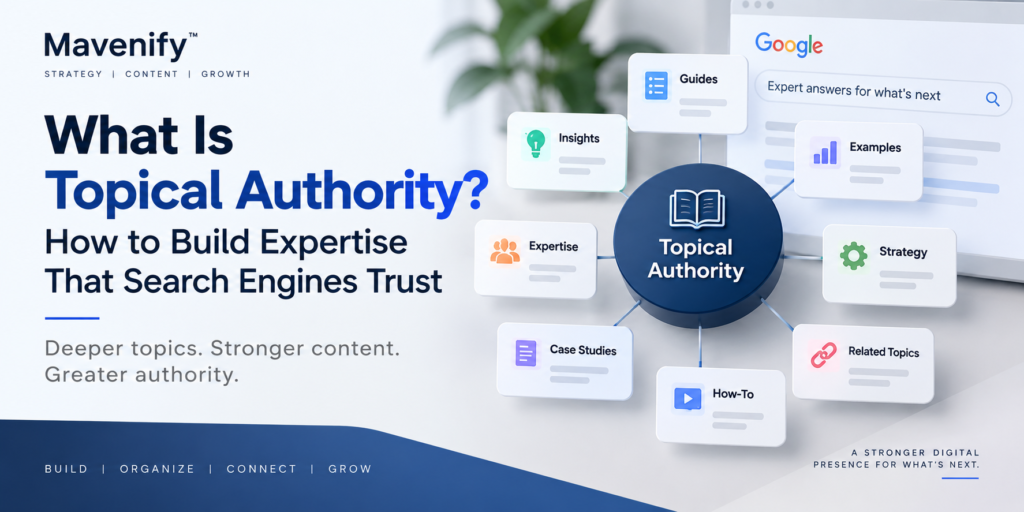
Search visibility is no longer just about whether a website can rank for individual keywords. Businesses increasingly need to demonstrate meaningful expertise across the subjects they want to be discovered for.
This is where topical authority becomes important.
A website can publish dozens of articles targeting related keywords and still fail to establish a strong position within its subject area if those pages are shallow, disconnected or created without a clear understanding of the audience.
Building topical authority takes a different approach. It involves developing meaningful coverage around important subjects, connecting related information and demonstrating expertise in ways that help both people and search systems understand what a business knows.
AI has also changed how businesses can approach this process. With the right AI content strategy, research, topic discovery and content planning can become more efficient. But technology alone does not create authority. The underlying content still needs depth, relevance, expertise and a clear strategic purpose.
In this guide, we’ll explore what topical authority means, how it works, why it matters for SEO and how businesses can build it through a structured, connected content strategy.
Table of Contents
What Is Topical Authority?
Topical authority is the depth and breadth of knowledge a website demonstrates around a particular subject. A site develops stronger topical authority when its content consistently addresses the important questions, problems and related concepts within an area of expertise.
It is different from simply having a large number of pages about the same subject. Instead, AI Content & Authority System™ approaches authority as a connected process involving strategic content, expertise and meaningful topic coverage.
A website could publish 100 articles that mention digital marketing without demonstrating meaningful expertise in digital marketing. If those articles are repetitive, shallow or disconnected, the volume of content alone does little to establish authority.
A stronger approach is to build comprehensive coverage around a defined subject. One resource may explain the fundamentals, while other resources explore specific strategies, challenges, comparisons, examples and practical applications. When those resources are useful individually and connected logically, they collectively demonstrate greater depth.
Search engines can then find more contextual information about the subject across the site, while visitors can move naturally from one resource to another as their questions become more specific.
Topical Authority Is About Depth, Not Content Volume
The goal of building topical authority is not to publish as many pages as possible.
It is to create enough useful and relevant coverage that the website demonstrates a genuine understanding of the subject.
For example, a business specializing in performance marketing could publish a general guide to paid advertising. That provides a starting point, but deeper topical coverage might also address campaign strategy, audience research, Google Ads, Meta Ads, attribution, landing pages, remarketing and performance measurement.
Each resource answers a different need while contributing to the broader subject.
This creates a much stronger foundation than publishing unrelated articles simply because individual keywords appear to offer search opportunities.
Topical Authority vs. Keyword Targeting
Keyword targeting focuses primarily on the phrases people use when searching.
Topical authority takes a broader view by considering the subject behind those searches and the different information a person may need to understand it.
This does not make keywords irrelevant. They remain useful for understanding search demand and intent. The difference is that keywords become inputs into a broader content strategy rather than the sole reason for creating a page.
A business trying to build topical authority should therefore ask not only, “Which keyword should we target?” but also, “What does our audience need to know about this subject, and how can our content demonstrate that we understand it?”
That shift from individual keywords to connected subject coverage is one of the foundations of modern topical authority SEO.
Why Topical Authority Matters for SEO
Search engines need to understand what a website is about, which subjects it covers and whether its content provides useful information for people searching for those subjects.
A website with strong topical authority gives search engines a broader body of relevant information to interpret. Instead of relying on a single page to establish relevance, the site can demonstrate knowledge through multiple connected resources that address different aspects of the same subject.
This can also create a better experience for visitors. Someone who lands on one article can discover related resources that answer the questions they are likely to have next. The website becomes a useful destination rather than simply a collection of pages created to capture individual searches.
Topical Relevance Helps Establish Subject Expertise
Relevance is not only about including a keyword on a page. A resource becomes more useful when its content is clearly connected to the subject the visitor is researching.
For example, a website discussing website performance could explain page speed in one resource, Core Web Vitals in another, mobile performance in another and the relationship between technical performance and user experience in another.
When these resources are connected and each contributes meaningful information, the website demonstrates broader knowledge around the subject.
This is one reason topical authority SEO focuses on the relationship between content pieces rather than treating every page as an independent ranking opportunity.
Topical Authority Can Strengthen the Entire Content Ecosystem
One strong resource can attract attention, but a connected collection of useful resources can create a much stronger foundation for long-term organic visibility.
As the website expands its coverage, new content can strengthen existing subjects rather than starting from zero each time. Internal links can connect related resources, while updates and additional depth can improve the usefulness of the overall ecosystem.
This makes topical authority a long-term asset. The objective is not simply to rank one page for one query, but to develop a website that consistently demonstrates knowledge across the subjects that matter to the business.
Topical Authority Supports More Than Rankings
Although SEO is an important reason to develop topical authority, the benefits extend beyond rankings.
A visitor who finds several useful resources around the same subject may develop greater confidence in the business’s knowledge. Someone researching a complex purchase may also be more likely to consider a company that consistently demonstrates an understanding of the problem they are trying to solve.
Over time, this can connect organic visibility with brand credibility, qualified traffic and customer trust.
How to Build Topical Authority Step by Step
Building topical authority requires more than publishing a series of related articles. The process starts with identifying the subjects that matter most to the business, understanding what the audience needs to know and then creating a structured body of content that addresses those needs in meaningful depth.
The most effective approach is deliberate rather than purely volume-driven. Each new resource should have a clear purpose, contribute something useful and strengthen the relationship between the business and the subject it wants to be recognized for.
Identify Your Core Topics
Start by identifying the broad subjects that are closely connected to the business’s expertise, services and audience.
These core topics should be commercially relevant, but they should also be areas where the business can provide genuine knowledge. A topic may have significant search demand, but if the business has little meaningful expertise to contribute, it may not be the right foundation for an authority-building strategy.
The goal is to identify the subjects where the business has both relevance and something valuable to say.
Map the Questions Around Each Topic
Once the core topics are established, map the questions and subtopics that surround each one.
Think about what someone would want to know before, during and after researching the subject. They may need definitions and introductory information first, followed by comparisons, practical guidance, common problems, implementation considerations and more advanced information.
This process creates a topical map that shows how different pieces of content can work together.
AI can make this research more efficient by helping analyze search queries, related concepts and existing content. However, the final structure should be guided by audience needs and business expertise rather than generated purely from keyword variations.
Create Comprehensive Content Around the Topic
With the topical map established, create resources that address the most valuable areas in sufficient depth.
Not every subtopic needs its own article. Some subjects may be best handled within a broader resource, while others deserve dedicated pages because they represent distinct questions or search intents.
The important thing is that the resulting content provides meaningful coverage without creating unnecessary duplication.
This is where content depth becomes more important than content volume. A smaller collection of genuinely useful resources can establish stronger expertise than dozens of shallow pages.
Connect Related Content With Internal Links
Once related resources exist, connect them through contextual internal links.
A visitor reading about one aspect of a subject should be able to discover another resource when it provides useful additional information. These relationships also help establish how different pages fit within the broader topic.
Internal linking should therefore be based on relevance and usefulness rather than simply trying to increase the number of links on a page.
Over time, these connections create a stronger content structure in which individual pages contribute to a much broader demonstration of expertise.
Topic Clusters and Their Role in Building Topical Authority
A topic cluster is a structured group of related content built around a broader subject. Instead of treating every article as an independent piece of content, a topic cluster organizes resources so they collectively provide deeper coverage of an important area.
The structure typically starts with a broad, comprehensive resource and then expands into more focused content that addresses specific questions or subtopics. Those resources are connected through relevant internal links, creating a logical path through the subject.
This approach is particularly useful when a business wants to build topical authority because it allows the website to demonstrate both breadth and depth rather than relying on a small number of isolated pages.
Start With a Strong Pillar Resource
The pillar resource provides the broader context for the subject.
It should explain the central concept comprehensively enough to help readers understand the topic while also creating logical pathways toward more specific resources.
The supporting content can then address individual questions, use cases, problems or related concepts in greater detail. Each page has a distinct purpose, but all of them contribute to the same broader subject.
This creates a more organized content ecosystem and gives the business a clear structure for expanding its coverage over time.
Build Supporting Content Around Specific Questions
Supporting content should exist because it answers a meaningful question or addresses a distinct need within the broader topic.
For example, a business building authority around conversion optimization might have a comprehensive resource explaining the discipline as a whole, supported by more focused resources covering landing page optimization, form optimization, funnel optimization and A/B testing.
Each supporting resource can stand on its own while still contributing to the broader subject.
The key is to avoid creating multiple pages that essentially answer the same question with slightly different wording. Topical authority comes from useful coverage, not artificial expansion.
Connect the Cluster Through Contextual Internal Links
Internal links are what turn separate resources into a connected topic cluster.
Links should be placed where they help readers move naturally from one piece of information to another. A broader article might point to a detailed supporting resource, while that supporting resource can link back to the broader guide when additional context would be useful.
This creates relationships between pages instead of leaving them isolated within the website.
It also gives the business a clearer content strategy for SEO, because internal linking becomes part of the information architecture rather than an afterthought added once an article has been published.
How Internal Linking Strengthens Topical Authority
Internal linking plays an important role in turning individual pieces of content into a connected knowledge structure.
When related pages are linked contextually, visitors can move naturally from one subject to another without having to return to search results to find the next piece of information. This creates a smoother experience while making the relationships between different resources clearer.
For topical authority SEO, this matters because the strength of a content ecosystem is not determined only by how many pages it contains. The relationships between those pages also help demonstrate how different pieces of information contribute to the broader subject.
Link Related Content Where It Adds Value
The most useful internal links appear when another resource genuinely helps the reader understand the subject further.
For example, an article explaining a broad SEO concept might mention AI search optimization when discussing how search environments are changing. Linking that phrase to a detailed resource allows the reader to explore the subject without interrupting the main discussion.
The same principle applies across an entire content ecosystem. Links should provide additional context, answer a likely follow-up question or help the visitor move naturally toward a more detailed resource.
Use Descriptive Anchor Text
The words used for an internal link should give the reader a reasonable idea of what they will find after clicking.
Generic phrases such as “click here” provide little context. Descriptive anchor text is more useful because it establishes a clear relationship between the current discussion and the destination resource.
This also makes internal linking more strategic. When the anchor accurately describes the destination, each link becomes part of the site’s broader information architecture rather than simply another navigational element.
Avoid Linking Every Page to Everything
More internal links do not automatically create stronger topical authority.
If every page links to dozens of unrelated resources, the relationships become less meaningful and the reader can struggle to determine which information is actually relevant.
A stronger approach is selective and contextual. Link the pages that genuinely belong together, prioritize important relationships and make sure each link serves a clear purpose within the reader’s journey.
That creates a cleaner content ecosystem in which topical relevance is reflected through the connections between resources.
How to Demonstrate Expertise and Build Trust Through Content
Strong topical authority is not created simply by covering a subject from many different angles. The content also needs to demonstrate why the business is qualified to speak about that subject.
Readers are increasingly able to compare information from multiple sources before making a decision. If a page provides the same generic explanation found across many other websites, there may be little reason for the reader to trust that particular business over another.
Expertise gives content a stronger foundation. It brings practical experience, informed perspectives and original knowledge into the information being shared.
Bring First-Hand Experience Into Your Content
First-hand experience can make content considerably more useful because it introduces knowledge that cannot be created simply by summarizing existing information.
A business may have learned important lessons through working with customers, implementing solutions, solving recurring problems or operating within a particular industry. Those experiences can provide examples, insights and practical recommendations that make content more distinctive.
This is particularly valuable when using AI as part of content production. AI can help organize and communicate information efficiently, but the business’s own experience is what gives that information greater depth and authenticity.
Support Claims With Evidence
Trust also depends on how information is presented.
Where appropriate, important claims should be supported with reliable sources, relevant data, original research or clearly explained evidence. This helps readers understand where information comes from and gives them greater confidence in the conclusions being presented.
Not every statement requires an external citation, but claims that rely on statistics, research or industry findings should be treated with appropriate care.
A strong content marketing strategy should therefore consider credibility during the research and editorial stages rather than trying to add supporting evidence after the content has already been written.
Make Expertise Visible Across the Website
Expertise should not exist only within individual articles.
The broader website can reinforce it through clear author information, detailed service explanations, case studies, original research, expert commentary and other resources that demonstrate the organization’s knowledge and experience.
When these signals consistently support the same areas of expertise, they can strengthen the business’s overall content authority.
This is another reason topical authority should be viewed as a long-term process. The objective is to create a consistent body of evidence showing that the business understands the subjects it wants to be recognized for.
Common Mistakes That Prevent Businesses From Building Topical Authority
Building topical authority can take considerable time, particularly when a business is starting with a limited content library. Several common mistakes can weaken the strategy even when a website is publishing consistently.
The biggest problems usually come from treating content as a volume exercise rather than as a structured demonstration of expertise.
Publishing Content Without a Clear Topic Strategy
Creating articles whenever a new keyword appears can quickly produce a fragmented content library.
A page may perform well for an individual query while contributing very little to the business’s broader authority. When this happens repeatedly, the website accumulates content without developing meaningful depth around the subjects that matter most.
A stronger approach starts with the core subjects the business wants to be recognized for and builds content around them deliberately.
Prioritizing Volume Over Quality
AI has made it easier than ever to increase publishing frequency, but more content does not automatically mean greater authority.
Publishing large quantities of shallow or repetitive information can make it harder to distinguish the genuinely valuable resources from everything else on the site.
A thoughtful AI content strategy should prioritize usefulness, expertise and relevance over the number of articles produced.
Creating Multiple Pages That Answer the Same Question
Another common problem is creating several pages that target slightly different keyword variations while providing essentially the same information.
This can create unnecessary duplication and make the content ecosystem less clear.
Before creating a new page, businesses should consider whether the subject represents a genuinely different question or intent. If it does not, improving an existing resource may be more valuable than creating another similar page.
Ignoring Existing Content
Topical authority is not built exclusively through new content.
Older resources may contain valuable information that could be expanded, updated, consolidated or better connected with newer pages. Ignoring that existing knowledge can leave significant opportunities unused.
A mature content marketing strategy treats the existing content library as an asset that can continue to improve rather than assuming that every growth opportunity requires another article.
Treating Internal Linking as an Afterthought
When related pages are not connected, valuable content can remain isolated.
Internal linking should be considered while the content is being planned and written so that relevant relationships can be established naturally. This helps readers discover additional information and creates a more coherent structure across the site.
The objective is not to maximize the number of internal links. It is to make the relationships between related resources clear and useful.
How AI Can Help You Build Topical Authority More Efficiently
Building topical authority requires research, planning and ongoing content development, all of which can become difficult to manage as the number of subjects and resources grows.
AI can make this process more efficient by helping businesses analyze large amounts of information, identify relationships between topics and organize content opportunities. The important distinction is that AI should support the authority-building process rather than determine the strategy on its own.
When used correctly, AI can reduce repetitive work while allowing content teams to spend more time on expertise, editorial judgment and strategic decisions.
Use AI to Discover Related Topics
AI can help expand a core subject into the questions, concepts and subtopics that surround it.
For example, once a business identifies an important subject, AI can help organize related questions and concepts into groups. This can make it easier to identify areas that deserve deeper coverage and uncover potential gaps in the existing content library.
These suggestions should still be evaluated against the business’s audience, expertise and objectives. Not every related topic is necessarily worth covering.
The purpose is to make research more efficient while keeping the final topical structure strategically focused.
Use AI to Identify Content Gaps
A growing website can contain hundreds of pages, making it difficult to manually identify every gap or overlap.
AI can help analyze existing resources and surface subjects that appear underdeveloped, duplicated or disconnected. It can also help compare existing coverage against a broader topical map to identify areas where additional depth may be useful.
This can support a more efficient approach to build topical authority, because the next content opportunity can come from an identified knowledge gap rather than simply another keyword suggestion.
Use AI to Organize and Maintain Content
AI can also help manage an established content ecosystem.
It can assist with grouping related pages, identifying outdated information, finding potential internal linking opportunities and highlighting content that may benefit from expansion or consolidation.
This becomes increasingly valuable as the website grows. Without a structured process, important resources can become difficult to maintain and relationships between related pages can weaken over time.
AI can help surface those opportunities, while human review determines which changes are actually appropriate.
Keep Human Expertise at the Center
Efficiency should never come at the expense of expertise.
AI can identify patterns and accelerate research, but it does not automatically understand a company’s customers, experience, competitive position or unique perspective. Those elements need to remain central to the strategy.
The most effective approach is therefore to use AI as an intelligence and productivity layer while keeping strategic decisions, subject expertise and editorial standards under human control.
That balance allows businesses to scale their topical authority SEO efforts without turning authority building into a purely automated content exercise.
How to Measure Topical Authority and Content Performance
Topical authority is not something that can be reduced to a single score.
A business needs to look at how its content performs across visibility, engagement, topic coverage and business relevance. The objective is to understand whether the website is becoming more useful and recognizable for the subjects it has chosen to focus on.
This also means avoiding the assumption that rankings alone prove authority. A page can rank well for an individual query without the wider website demonstrating meaningful expertise around the subject.
Monitor Organic Visibility Across Related Topics
Organic visibility can provide useful evidence of whether content is gaining recognition across a subject area.
Instead of looking only at the ranking position of one page, businesses can examine how multiple related resources perform across relevant searches. Growth in impressions, clicks and rankings across a group of related topics can provide a stronger indication that the website’s overall coverage is expanding.
The quality of that visibility matters as well. Ranking for highly relevant searches from the audiences the business wants to reach is more valuable than generating impressions for unrelated queries.
Look at Content Engagement and User Behavior
Engagement can help reveal whether visitors are finding the content useful.
If readers regularly explore related resources, spend meaningful time engaging with information or continue deeper into the website, those behaviors can indicate that the content is answering their needs effectively.
These metrics should not be treated as standalone proof of topical authority, but they can help identify which subjects and resources are providing the greatest value.
Identify Gaps in Your Topical Coverage
Measurement should also reveal what is missing.
A business may have strong content around one part of a subject while leaving important questions unanswered elsewhere. Search performance, customer questions, website behavior and content analysis can all help identify areas where greater depth may be valuable.
This turns measurement into an input for the next stage of the strategy.
Instead of asking only whether existing content is performing, businesses can ask where the content ecosystem should become stronger next.
Connect Content Performance With Business Results
Ultimately, authority should contribute to meaningful business outcomes.
Organic traffic, qualified enquiries, branded searches, assisted conversions and engagement from relevant audiences can provide a clearer picture of whether the content strategy is contributing to growth.
A page that attracts fewer visitors but consistently introduces highly qualified prospects may be more valuable than a page with significantly higher traffic and little commercial relevance.
That is why content authority should be evaluated alongside business performance rather than treated as an isolated SEO objective.
How Long Does It Take to Build Topical Authority?
Topical authority is not something a website establishes overnight. It develops as a business consistently publishes useful, well-connected content and demonstrates meaningful expertise across a subject over time. The timeline can vary significantly depending on the competitiveness of the topic, the strength of the existing website, the quality of the content and how comprehensively the subject is covered.
A newer website entering a competitive market may need more time to establish credibility, while an established website with relevant expertise and existing content may be able to build authority more quickly. What matters most is not publishing a fixed number of articles within a certain period, but progressively improving the depth and quality of the website’s coverage.
Focus on Consistent Coverage Rather Than a Fixed Timeline
There is no universal number of articles or specific timeframe that guarantees topical authority. Publishing ten articles does not automatically create authority, just as publishing one exceptionally useful resource does not necessarily establish a website as an expert on an entire subject.
A stronger approach is to build coverage progressively. Start with the most important subject areas, address the questions and problems your audience actually cares about, and expand into related topics as your understanding of the content ecosystem develops.
This creates a more sustainable content authority strategy because each new resource can strengthen the overall knowledge structure rather than existing as an isolated piece of content.
Authority Builds Through Depth and Connected Content
The real progress often comes from the relationships between pieces of content. A detailed guide can introduce a subject, supporting articles can answer more specific questions, and internal links can connect those resources into a coherent topical structure.
Over time, this creates greater topical relevance across the website. Search engines have more context about the subjects the business covers, while users have a clearer path to finding deeper information.
For businesses, this also creates a useful compounding effect. Instead of continually starting from zero with every new article, future content can build on the expertise and structure already established.
Measure Progress Through More Than Rankings
Rankings can be useful indicators, but they should not be the only way to judge whether topical authority is developing. Increasing visibility across related searches, stronger engagement with informational content, more relevant pages appearing in search results and growing recognition around important subjects can all indicate progress.
The most meaningful signal is whether the website is becoming a genuinely useful destination for its chosen topics. When content consistently answers related questions, demonstrates expertise and connects users to deeper resources, the website is building an asset that can support organic growth over the long term.
The Role of Content Quality in Topical Authority
Topical authority is not created simply by covering a subject. The quality of that coverage matters just as much as its breadth. A website can publish dozens of pages around a topic and still fail to demonstrate meaningful expertise if the content is repetitive, shallow, outdated or written primarily to capture search traffic.
High-quality content gives topical coverage substance. It answers the question clearly, adds useful context, reflects genuine knowledge and gives the reader a reason to trust the information. When this quality is maintained across related content, individual pages begin to reinforce the authority of the broader topic.
Useful Content Is More Valuable Than Content Created for Rankings
A strong topical authority strategy starts with the audience rather than a publishing target. Instead of asking how many articles can be produced around a keyword, businesses should ask what information their audience actually needs and what expertise they can bring to the subject.
This distinction is particularly important as AI makes content production faster. Creating more pages has become easier, but producing genuinely useful information still requires research, judgment, experience and editorial oversight.
Google’s current guidance reinforces this principle. Its Search documentation emphasizes that scaled content created primarily to manipulate rankings can violate its spam policies, including when generative AI is used to produce large amounts of low-value content.
Original Experience Makes Content More Authoritative
Generic explanations are easy to reproduce. First-hand experience is much harder to replicate.
Businesses can make their content more authoritative by incorporating practical examples, lessons learned, original observations, processes, case studies and perspectives that come from actually working in the subject area. These elements give readers information they are less likely to find in another generic article.
For example, a marketing agency explaining conversion optimization can go beyond defining the concept by discussing patterns it has observed across real campaigns, common implementation problems and what tends to happen when businesses make particular changes.
That kind of content demonstrates expertise rather than simply claiming it.
Content Quality Must Be Maintained Across the Topic
One exceptional article does not automatically create topical authority if the rest of the content ecosystem is weak. Authority becomes more credible when the quality remains consistent across the supporting resources that surround the main topic.
A strong pillar page should therefore be supported by equally useful articles that explore specific questions in greater depth. Those resources should provide their own value while contributing to a larger, connected understanding of the subject.
This is where content depth becomes more meaningful than content volume. The objective is not to publish everything possible. It is to create enough genuinely useful coverage that the website becomes a dependable resource for the topic.
Topical Authority vs. Domain Authority: What’s the Difference?
Topical authority and domain authority are often discussed together in SEO, but they describe very different ideas. Understanding the distinction is important because a business does not necessarily need a broadly recognized website to demonstrate strong expertise in a specific subject.
Topical authority is about depth and relevance within a particular subject area. Domain authority, on the other hand, is commonly used as a third-party SEO concept to describe the overall strength or authority of a website or domain based on signals such as backlinks.
A website can therefore have strong authority around a specific topic without being a globally powerful domain. Likewise, a website with a strong backlink profile may still have weak topical coverage in an area it has only recently started publishing about.
Topical Authority Is Focused on Subject Expertise
When a website consistently publishes useful, connected information around a particular subject, it can develop strong topical relevance around that subject.
For example, a business specializing in technical SEO might publish comprehensive resources covering technical audits, crawling, indexing, structured data, site architecture, Core Web Vitals and related implementation questions. The value comes from how deeply and meaningfully those subjects are connected, not simply from the number of pages published.
This is the foundation of topical authority SEO: establishing clear and comprehensive expertise around the subjects that matter to the business and its audience.
Domain Authority Is a Third-Party Metric
Domain Authority is most commonly associated with third-party SEO tools rather than being a direct Google ranking factor. Different platforms calculate their own versions of domain-level authority using their own methodologies and datasets.
That means businesses should be careful about treating a Domain Authority score as proof that a website is authoritative in Google’s eyes.
A website’s authority should instead be evaluated through a broader picture that includes the quality and relevance of its content, its reputation, links and mentions, demonstrated expertise, user experience and ability to satisfy search intent.
A Strong SEO Strategy Can Develop Both
Topical authority and overall website authority are not competing strategies. They can strengthen each other.
As a business consistently creates valuable content around its core subjects, earns relevant mentions and links, improves its reputation and builds a stronger digital presence, both its topical relevance and broader website strength can develop.
The important distinction is that topical authority gives a business depth, while broader domain-level authority can provide additional credibility and reach. A sustainable SEO strategy should focus on building the underlying value rather than chasing a particular third-party metric.
Topical Authority vs. Domain Authority
| Topical Authority | Domain Authority |
| Focuses on expertise within specific subjects | Describes the broader strength of a website |
| Built through relevant, comprehensive content | Often influenced by backlinks and other third-party signals |
| Helps demonstrate topical relevance | Can indicate the competitive strength of a domain |
| Developed through connected content and expertise | Measured differently by different SEO platforms |
| Not represented by one universal Google score | Not a Google ranking metric |
The distinction matters because a business should not abandon a valuable topic simply because its website has a lower third-party authority score. Building genuine expertise and useful content can create a stronger foundation for long-term organic visibility.
What Google Says About Topical Authority and Helpful Content
Google does not publish a single ranking factor or score called “topical authority.” Instead, its guidance consistently emphasizes the underlying qualities that help a website become useful and trustworthy: creating valuable content for people, demonstrating appropriate expertise, avoiding content created primarily to manipulate rankings and maintaining a high standard of quality across the site.
That distinction matters. Businesses should not approach topical authority as something they can achieve by publishing a certain number of articles or reaching a particular SEO score. The stronger approach is to build genuine depth around subjects where the business has relevant knowledge and can provide useful information to its audience.
Google Emphasizes People-First Content
Google’s guidance encourages publishers to create content primarily to help people rather than content created mainly to attract search engine traffic. That principle fits directly into a topical authority strategy because useful expertise has to exist before a website can meaningfully demonstrate it.
A business building authority should therefore start with questions such as what its audience needs to understand, what problems it can genuinely help solve and what experience or knowledge it can contribute. Search optimization should support that process rather than become the reason the content exists.
Expertise Needs to Be Reflected in the Content
Topical authority becomes more credible when content reflects genuine knowledge rather than simply repeating information already available elsewhere.
That can mean explaining a complex subject clearly, incorporating first-hand experience, providing original examples, demonstrating how a process works or adding useful context that helps readers make better decisions.
Google’s current Search documentation also makes clear that content created using AI is not automatically a problem. The concern is whether the content provides value and complies with Google’s overall Search policies.
For businesses using AI as part of their content strategy, this reinforces an important principle: AI can help scale the process, but it should not become a substitute for expertise.
Quality Should Extend Across the Entire Website
Topical authority is stronger when the quality of a website’s content is consistent. A detailed pillar page surrounded by thin, repetitive or poorly researched supporting articles creates a very different experience from a genuinely connected library of useful resources.
This is why topical authority should be treated as a website-wide content system rather than an isolated SEO tactic. Every useful article can contribute to the broader subject expertise of the site when it serves a clear purpose and connects meaningfully with related resources.
Google’s Guidance Supports a People-First Approach to Authority
The practical takeaway is simple: build content that deserves to be trusted before trying to make it rank.
When a website consistently demonstrates knowledge, answers important questions, connects related information and gives people useful reasons to return, it creates the foundations of topical authority. Search visibility then becomes an outcome of building a stronger resource rather than the sole objective.
For businesses developing a long-term content strategy for SEO, this distinction is especially important. The goal is not to create the appearance of expertise. It is to build a website that genuinely contains and communicates expertise.
How to Create a Topical Map for Your Website
A topical map gives your content strategy structure. Instead of choosing article ideas one keyword at a time, you define the broader subjects your business needs to be known for and then map the important subtopics, questions and related concepts around them.
This helps turn topical authority from an abstract SEO concept into something you can actually build and manage.
Start With Your Core Topic
The first step is identifying the subjects that are directly connected to your business, expertise and customers.
A core topic should be broad enough to support meaningful content depth but specific enough to reflect what your business genuinely knows. For a digital growth agency, for example, a core topic might be conversion rate optimization, AI content strategy, performance marketing or search intelligence.
The goal is not to identify every topic that could generate search traffic. It is to establish the areas where your business has a legitimate reason to develop authority.
Expand the Topic Into Related Questions
Once the core topic is established, map the questions people ask around it.
Some questions will be introductory, while others will be highly specific. Some will help people understand a concept, while others will help them compare options, solve a problem or make a purchasing decision.
This creates layers of content around the central subject. Instead of one article trying to answer everything, individual resources can address different aspects of the topic while remaining connected to the broader subject.
Organize Topics by Search Intent and Importance
Not every subtopic deserves the same level of attention. A useful topical map should consider what the audience needs, how closely a subject relates to the business and where content can contribute to the wider customer journey.
Some topics may belong in a foundational guide. Others may deserve detailed supporting articles, comparison content, practical guides or commercially focused resources.
This is where a content strategy for SEO becomes more than keyword research. The objective is to determine not only what people search for, but how each piece of content contributes to the authority and usefulness of the overall website.
Connect the Topics Into a Content Structure
A topical map becomes much more powerful when the relationships between subjects are reflected in the website itself.
A core resource can introduce the broader subject, supporting resources can explore specific questions, and contextual internal links can help users move naturally between related information.
Google also explains that its systems use links to understand what pages are about and which pages may be helpful for a query. This makes internal linking more than a navigation exercise; it can help reinforce the relationships between related content.
The result is a connected content ecosystem rather than a collection of unrelated blog posts.
How Content Depth Strengthens Topical Authority
Content depth is one of the clearest differences between simply publishing around a subject and genuinely building topical authority.
Depth does not mean making every article as long as possible. It means covering the important dimensions of a subject so that readers can understand it from different perspectives and find useful answers to the questions that naturally follow.
A website demonstrates greater topical expertise when its content can address both the broad concept and the specific problems, questions and decisions connected to it.
Cover the Topic From Multiple Perspectives
A strong topic usually contains more than one type of search intent. Someone discovering a subject for the first time may need a definition, while someone with more experience may be looking for implementation advice, comparisons, examples or solutions to specific problems.
A comprehensive content ecosystem accounts for these different needs.
For example, a business building authority around conversion optimization could cover what conversion rate optimization is, how landing pages are optimized, how forms affect conversions, how funnels are analyzed and how experiments are designed. Each resource serves a different purpose while contributing to the same broader subject.
This creates content depth without requiring every individual article to answer every possible question.
Go Beyond Surface-Level Explanations
Thin content often explains what something is without helping the reader understand what to do with that information.
More authoritative content goes further. It explains why something matters, how it works, where it applies, what commonly goes wrong and what someone should consider before taking action.
This is where genuine expertise becomes visible. A business that understands a subject deeply should be able to explain it at different levels and provide useful context that goes beyond a basic definition.
Build Depth Around the Questions That Matter
Not every possible subtopic needs to become an article. A topical map should help determine which questions genuinely deserve deeper coverage.
The strongest opportunities are usually the ones that are closely connected to the core subject, important to the audience and capable of adding something meaningful to the existing content ecosystem.
This keeps the strategy focused. Instead of continuously expanding the website with loosely related topics, businesses can invest their resources in areas where deeper coverage can strengthen their topical relevance.
Let Each Resource Add Something New
Content depth becomes weaker when multiple pages simply repeat the same information using different keywords.
Every supporting resource should have a distinct purpose. One page might explain the fundamentals, another might address implementation, another might compare approaches, and another might answer a specific question that deserves detailed treatment.
When these resources are connected appropriately, the website becomes more useful as a whole. Readers can move from a broad understanding to increasingly specific information without repeatedly encountering the same explanation.
Topical Authority and Internal Linking: How They Work Together
Internal linking plays an important role in turning individual pieces of content into a connected topical resource. Without meaningful connections between related pages, even high-quality articles can remain isolated from the broader content ecosystem.
When internal links are placed naturally, they help readers discover related information while giving search engines additional context about the relationships between pages.
Connect Content That Solves Related Problems
The strongest internal links are created when one resource naturally leads to another.
For example, an article explaining the fundamentals of topical authority might introduce the concept of topic clusters and then point readers toward a deeper guide explaining how to build one. The link makes sense because the second resource answers the next question a reader is likely to have.
This is much more useful than adding links simply because two pages happen to contain similar keywords.
Use Descriptive Anchor Text
Anchor text should give readers a reasonable idea of what they will find when they follow a link.
Instead of using generic phrases such as “click here” or “learn more,” descriptive wording can provide additional context. For example, topic clusters tells the reader considerably more about the destination than a generic “read more” link.
The anchor should still feel natural within the sentence. It should not be awkwardly inserted just to include a target keyword.
Build Relationships Between Pillar and Supporting Content
Internal linking becomes especially valuable when it reflects the underlying structure of a topic cluster.
A broad pillar resource can link to more specific supporting content, while supporting pages can link back to the broader resource when readers would benefit from additional context. Related supporting pages can also connect with each other where their subjects genuinely overlap.
This creates a navigable knowledge structure in which each page has a clear relationship with other resources.
Avoid Creating an Artificial Link Network
More internal links do not automatically create more authority. Linking every article to every other article can make a website harder to navigate and dilute the relevance of individual connections.
The better approach is to ask a simple question before adding a link: Does this link help the reader understand the subject or take the next useful step?
If the answer is yes, the link is likely worth including. If the only reason for adding it is to distribute a keyword or satisfy an internal linking target, it is probably better left out.
How Topical Authority Supports AI Search and Generative Engines
Topical authority has become increasingly important as search experiences evolve beyond traditional lists of blue links. AI-powered search features can synthesize information from multiple sources, which makes it increasingly valuable for businesses to have a website that clearly demonstrates expertise across a subject rather than relying on isolated pages. Google’s guidance on optimizing for generative AI features reinforces this broader approach: established SEO best practices remain relevant for AI Overviews and AI Mode, and Google does not require separate optimization techniques to appear in these experiences.
Google’s current guidance on its generative AI search features reinforces an important point: traditional SEO fundamentals still matter. Google recommends making content accessible, useful and easy for its systems to understand rather than relying on a separate set of secret optimization techniques for AI search.
AI Search Needs Clear Signals of Expertise
When an AI-powered search system evaluates information about a subject, the usefulness of an individual page is only part of the picture. The broader context surrounding that page can also help establish what a website is knowledgeable about.
A business with a well-developed content ecosystem can provide that context through comprehensive topic coverage, consistent expertise, connected pages, clear entities and supporting evidence. This is where Generative Engine Optimization (GEO) becomes relevant, because AI search visibility depends on making a brand’s information easier to discover, understand, connect and retrieve.
This does not mean that publishing more pages automatically makes a brand more likely to appear in AI-generated answers. The underlying content still needs to be useful, trustworthy and relevant to the question being asked.
Connected Content Creates a Stronger Knowledge Ecosystem
AI search experiences are designed to help users understand subjects and find relevant information, rather than simply match a query to one keyword-focused page.
That makes connected content particularly valuable. A business can explain a broad subject in one resource, explore specific questions in supporting content and demonstrate practical expertise through examples, case studies and original insights.
Together, these resources create a knowledge ecosystem that gives both users and search systems more context about the business and the subjects it covers.
Topical Authority Can Support AI Visibility
Building topical authority should therefore be viewed as part of a broader search strategy rather than as a separate “AI optimization” trick.
Google’s current guidance on optimizing for generative AI features specifically notes that established SEO best practices continue to be relevant for visibility in Google’s AI experiences.
The practical implication is important: businesses should not abandon the fundamentals of good SEO simply because search is becoming more conversational and generative. Strong content, clear site structure, accessible pages, useful information and demonstrated expertise remain the foundation.
Build Authority for People First
The strongest approach is to create content that deserves to be discovered regardless of whether the visitor arrives through a traditional search result, an AI-generated answer, a referral or a direct visit.
When a business consistently provides useful information across an important subject, demonstrates genuine expertise and connects its resources into a coherent ecosystem, it creates a stronger foundation for both traditional search visibility and emerging AI-powered discovery.
How to Turn Topical Authority Into a Long-Term SEO Asset
Building topical authority is not a one-time content project. Once a website has established meaningful coverage around a subject, the next challenge is maintaining, improving and expanding that authority as the business, audience and search landscape evolve.
The strongest content strategies therefore treat authority as an ongoing asset rather than a publishing milestone. Existing content continues to improve, new resources fill genuine gaps and the relationships between pages become stronger over time.
Keep Expanding Where the Topic Demands More Depth
A topical map should not remain static. As customers ask new questions, products and services change, and the industry develops, new areas of the subject may become important.
The objective is not to publish simply because there is another keyword available. New content should expand the website’s understanding of the subject in a way that provides genuine value to the audience.
This creates a more sustainable form of authority building, where each new resource strengthens an existing area of expertise instead of creating another disconnected topic.
Refresh Content as the Subject Evolves
Authority can weaken when important information becomes outdated.
Refreshing an existing article can involve updating statistics, examples, recommendations, screenshots, processes or references when the underlying subject has changed. It can also mean improving sections that no longer answer the reader’s question as effectively as they once did.
This is often more valuable than continually creating new pages. A strong content ecosystem should become more useful over time, not simply become larger.
Strengthen Existing Content With New Connections
As a website grows, previously published content can reveal new opportunities for internal linking and deeper topic relationships.
A new article might provide useful context for an older guide, while an older page may provide the background a reader needs before exploring the new resource. Reviewing these relationships periodically can make the entire content ecosystem easier to navigate.
This also helps prevent valuable older content from becoming isolated simply because newer resources have been published around the same subject.
Use Performance Data to Guide the Next Topics
Content performance can help determine where the authority-building process should go next.
If certain topics consistently attract relevant visitors, generate engagement or support important business goals, they may justify deeper coverage. If another area receives little interest or overlaps heavily with existing resources, expanding it may not be the best use of content resources.
The result is a more intelligent content strategy: research, create, measure, improve and expand based on what the audience and business actually need.
Frequently Asked Questions About Topical Authority
Topical authority can seem complicated when viewed as an SEO concept, but the underlying idea is relatively straightforward: build meaningful expertise around the subjects your business wants to be known for and make that expertise easy for people and search systems to understand.
The questions below address some of the most common considerations businesses have when developing a topical authority strategy.
What is topical authority in SEO?
Topical authority is the perceived depth and relevance of a website’s expertise around a particular subject. It is built by creating useful, comprehensive and connected content that covers the important aspects of a topic rather than targeting isolated keywords.
It is not a single Google metric or score. Instead, it is better understood as the result of consistently demonstrating relevant knowledge across a subject.
How do you build topical authority?
You build topical authority by identifying the subjects most relevant to your business and audience, mapping the important questions around those subjects, creating high-quality content and connecting related resources through a logical content structure.
The process also involves maintaining existing content, filling genuine coverage gaps and demonstrating real expertise rather than simply increasing publishing volume.
How long does it take to build topical authority?
There is no fixed timeframe. The process depends on factors such as the competitiveness of the subject, the website’s existing content and authority, the depth of coverage and the quality of the resources being created.
The better goal is to build authority progressively rather than trying to reach an arbitrary number of articles within a specific period.
Is topical authority the same as domain authority?
No. Topical authority focuses on a website’s expertise within a particular subject, while Domain Authority is a third-party metric used by SEO platforms to estimate the overall strength of a domain.
A website can have strong topical expertise in a specific area without having a particularly high third-party Domain Authority score.
Does topical authority help with AI search?
A strong topical content ecosystem can support visibility across evolving search experiences because it gives search systems more useful information about a business, its expertise and the subjects it covers.
However, there is no separate “topical authority score” that guarantees visibility in AI search. Google says its existing SEO best practices remain relevant to its generative AI search features, reinforcing the importance of useful, accessible and well-structured content.
Does publishing more content increase topical authority?
Not automatically. Publishing large quantities of content without adding meaningful value can actually undermine a content strategy.
Google’s current spam policies specifically warn against scaled content created primarily to manipulate search rankings, including large amounts of AI-generated content that provide little value to users.
The objective should therefore be better topical coverage, not simply more pages.
How are topic clusters related to topical authority?
Topic clusters organize related content around a central subject. A broad pillar resource can provide foundational information while supporting pages explore specific questions, problems and subtopics in greater depth.
When those resources are connected naturally, they create the structured content ecosystem that helps demonstrate broader topical expertise.
Conclusion: Build Topical Authority Through Expertise, Not Volume
Topical authority is not something a business achieves by publishing the most articles or targeting the largest number of keywords. It is built by developing meaningful expertise around the subjects that matter to the business and its audience, then making that expertise accessible through useful, connected content.
A strong topical authority strategy brings together content depth, strategic topic coverage, internal linking, demonstrated expertise, content quality and continuous improvement. Over time, these elements create a content ecosystem that becomes more valuable than a collection of individual articles.
AI can make research, content development and optimization more efficient, but it does not change the fundamental objective. The content still needs to provide genuine value, demonstrate knowledge and help people make better decisions.
Google’s current guidance reinforces this direction. Its generative AI guidance explains that established SEO best practices remain relevant for AI search features, while its spam policies warn against producing large amounts of content primarily to manipulate rankings rather than help users.
The businesses most likely to build lasting authority are therefore not necessarily the ones producing the most content. They are the ones consistently producing useful content that demonstrates real expertise, connects naturally with related resources and becomes more valuable over time.
That is what turns content into a long-term SEO asset.
The Authoritative Principle Behind Topical Authority
One principle is worth keeping in mind throughout the entire process:
“Create unique content that is helpful, reliable, and people-first.”
That principle captures the foundation of topical authority remarkably well. The objective is not to manufacture the appearance of expertise for search engines. It is to create a website that genuinely deserves to be considered a useful resource within its subject area.
When businesses approach content this way, topical authority becomes the outcome of building something valuable rather than a metric they are simply trying to achieve.
Build Topical Authority With Mavenify
Building topical authority requires more than publishing a steady stream of articles. It requires a system that connects expertise, content strategy, topic coverage, internal linking, trust signals and ongoing optimization into one coherent digital ecosystem.
Mavenify’s AI Content & Authority System™ is designed around exactly that approach. Rather than treating content as a collection of individual blog posts, the system combines AI Content Strategy, Topical Authority SEO, semantic content architecture, E-E-A-T optimization, AI Retrieval Optimization (GEO), Entity SEO, Digital PR and intelligent content distribution to build lasting digital authority.
If you’re ready to move beyond isolated content and build a connected authority ecosystem around your expertise, Mavenify can help you develop the strategy, content architecture and authority infrastructure required to grow across search and AI-powered discovery.