

Search engines no longer evaluate websites simply by looking at individual pages in isolation. They increasingly need to understand how different pieces of content relate to one another, how deeply a website covers a subject, and whether the business behind that content demonstrates meaningful knowledge of the topic.
This is where topic clusters become valuable.
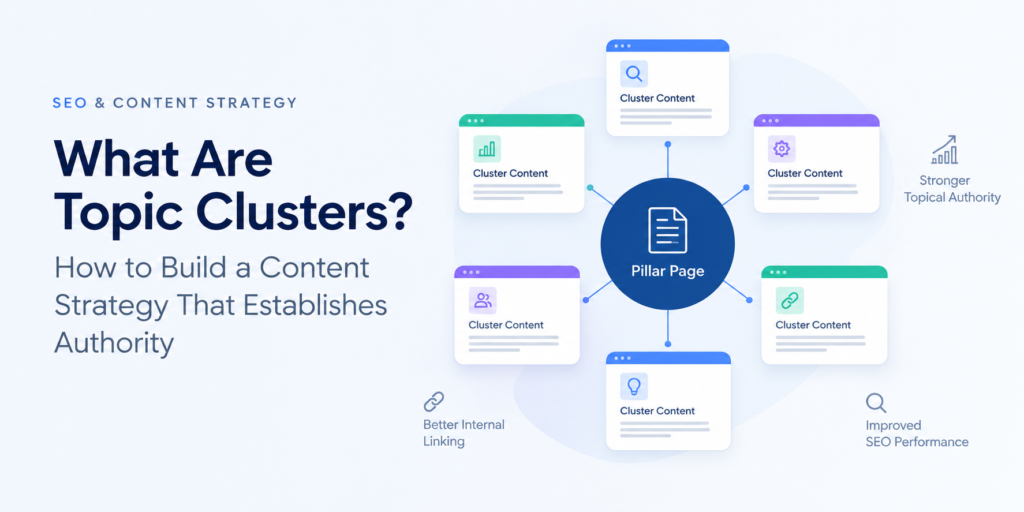
A topic cluster organizes related content around a central subject, usually through a comprehensive pillar page supported by more focused articles. Instead of publishing disconnected pieces of content, the approach creates a structured content ecosystem where each page contributes to a broader area of expertise.
For businesses, this can create a stronger foundation for topical authority, improve internal linking, make content easier to navigate and help search engines understand the relationships between related subjects.
But topic clusters are not simply a matter of publishing a pillar page and several supporting articles. A useful topic cluster starts with understanding the audience, identifying the important questions around a subject, deciding how those questions relate to one another and creating genuinely valuable content for each meaningful search intent.
In this guide, we’ll look at what topic clusters are, how pillar and cluster content work together, how to build a topic cluster strategy, how internal linking strengthens the structure, and how businesses can use connected content to build lasting topical authority.
Table of Contents
What Are Topic Clusters?
A topic cluster is a structured group of related content built around a central subject. The structure usually consists of one comprehensive pillar page that covers the broader topic and several supporting pages that explore specific subtopics in greater depth.
The purpose is to create meaningful relationships between these pages rather than treating every article as an independent piece of content. The pillar page provides the broad context, while cluster content addresses narrower questions, use cases and areas of search intent that naturally belong to the same subject.
For example, a business focused on conversion optimization might create a central guide covering conversion rate optimization and then publish supporting content about landing page optimization, form conversion, A/B testing and conversion funnels. Each article addresses a distinct need, but together they demonstrate broader coverage of the subject.
This structure can also contribute to topical authority by helping a website demonstrate depth around an important area of expertise. However, authority does not come simply from having a certain number of related pages. The content needs to be genuinely useful, relevant to the core topic and connected in ways that make sense to both readers and search engines.
How Does a Topic Cluster Work?
The basic model is relatively simple. The pillar page sits at the center of a broader topic, while cluster pages cover closely related subtopics. Internal links connect the relevant pages, allowing readers to move between the broad subject and more specific information.
This creates a content ecosystem rather than a collection of disconnected articles. Someone arriving on a detailed cluster article can discover the broader pillar guide, while someone reading the pillar page can explore specific questions through supporting content.
The important part is the relationship between the pages. A topic cluster should reflect how the subject is actually understood, not simply group articles together because they happen to contain similar keywords.
What Is the Difference Between a Pillar Page and Cluster Content?
A pillar page generally targets the broader subject and provides a comprehensive overview. Its purpose is to establish the context for the topic and guide readers toward more specific areas of information.
Cluster content is narrower. Each supporting page should have its own clear purpose and address a meaningful subtopic or search intent that deserves deeper treatment than the pillar page can reasonably provide.
The two work together because they serve different purposes. The pillar page provides breadth, while cluster content provides depth. When those pages are connected thoughtfully, the entire structure becomes easier to understand and navigate.
Are Topic Clusters Just a Content Marketing Tactic?
No. Topic clusters can be part of a content marketing strategy, but their value extends beyond publishing and promotion.
They also provide a way to organize a website’s information architecture, establish relationships between related content and create a clearer path through a subject. When the underlying content is strong, this structure can support SEO, user experience and the broader authority of a website.
The key is to build the cluster around real topics and audience needs, rather than creating multiple pages simply because a keyword tool suggests additional variations.
Why Topic Clusters Matter for SEO and Content Strategy
Publishing useful content is only part of building search visibility. As a website grows, it can become difficult for both users and search engines to understand which subjects the business genuinely covers and how different pages relate to one another.
Topic clusters provide a framework for solving that problem. By organizing related content around meaningful subjects, businesses can create clearer topical relationships, stronger internal linking and a more useful experience for people exploring a particular area.
Topic Clusters Create Deeper Topic Coverage
A single article can explain a subject, but it usually cannot answer every meaningful question a reader may have about it. Supporting content allows a business to explore important subtopics without making the main page unnecessarily long or difficult to navigate.
This creates depth around the subject. A visitor looking for a specific answer can find focused information, while someone who wants a broader understanding can return to the pillar page and explore the wider topic.
The result is a website that demonstrates knowledge through connected coverage, rather than relying on one page to establish expertise.
Topic Clusters Strengthen Internal Linking
Internal links are an important part of a topic cluster because they establish relationships between relevant pages.
A cluster article can link to the pillar page when readers need broader context, while the pillar page can direct readers toward more detailed resources. Related cluster pages can also link to one another when the relationship is genuinely useful.
This makes navigation more logical and gives search engines additional context about how the content on the website is connected.
Topic Clusters Help Align Content With Search Intent
People rarely search for a broad subject in exactly one way. They may begin with a general question, then move toward comparisons, implementation questions, examples, costs, tools or more advanced information.
A well-designed topic cluster can address these different intents without forcing everything into a single article.
The goal is not to create a page for every possible keyword variation. It is to identify the meaningful information needs surrounding a subject and create dedicated content where deeper coverage genuinely improves the experience.
Topic Clusters Make Content Strategy More Intentional
Without a clear structure, content strategies can become reactive. Businesses publish whatever topic seems interesting that week, resulting in a large collection of articles without a strong relationship between them.
Topic clusters encourage a different approach. Instead of asking only, “What should we publish next?”, the strategy starts with a broader question: “What subjects should our business become known for?”
That shift makes content planning more strategic and gives every new piece of content a clearer role within the larger authority-building system.
Pillar Pages and Cluster Content: How the Structure Works
The relationship between a pillar page and its supporting cluster content is what gives a topic cluster its structure. Each page has a distinct role, but the pages are designed to work together around the same broader subject.
A strong cluster does not require every article to link to every other article. Instead, the connections should reflect the relationships between the topics and help readers move naturally from broad information to more specific answers.
The Pillar Page Provides the Broader Context
A pillar page is typically the most comprehensive resource within a topic cluster. It introduces the main subject, explains its important concepts and provides enough context for readers to understand the wider topic.
It should not attempt to answer every possible question in exhaustive detail. Its role is to establish the foundation and direct readers toward deeper resources where appropriate.
For example, a pillar page about content marketing strategy could explain the overall process while linking to more focused resources about content planning, distribution, measurement and content formats.
Cluster Content Explores Specific Subtopics
Cluster content takes individual parts of the broader subject and explores them in greater depth.
Each page should have a clear reason to exist. It might answer a specific question, explain a process, address a particular audience need or explore a specialized aspect of the main topic.
This gives the content cluster depth without requiring the pillar page to become an unwieldy collection of every possible detail.
Internal Links Connect the Two Levels
The pillar page and cluster content should be connected through relevant internal links.
A supporting article can link back to the pillar page when a reader would benefit from broader context. The pillar page can link to supporting content when a reader needs more detailed information. In some cases, one cluster article can also link to another related article.
These links should be based on context rather than a predetermined requirement to link every page together. The objective is to create a useful information path, not an artificial network of links.
Each Page Should Still Stand on Its Own
Being part of a topic cluster does not mean that an article should depend on other pages to provide its value.
A strong cluster article should answer its specific question thoroughly enough that the reader does not need to visit another page simply to understand the basic answer. Links should provide additional context and useful next steps rather than compensate for incomplete content.
This distinction is important because topic clusters are ultimately about better content organization, not about manufacturing pages for SEO.
A Topic Cluster Should Reflect the Way the Subject Fits Together
The strongest clusters are based on genuine relationships between topics.
If two subjects are closely related and readers naturally move between them, connecting those pages makes sense. If two keywords happen to share a few words but represent completely different needs, putting them into the same cluster can make the structure less useful.
That is why topic clustering should begin with understanding the subject itself and the audience’s information needs, rather than starting with a list of keywords and forcing them into a predefined structure.
How to Build a Topic Cluster Strategy Step by Step
Building a topic cluster starts before the first article is written. The strongest approach begins by identifying the subjects where the business has genuine expertise, understanding what the audience needs to know and then organizing those needs into a logical content structure.
The goal is to create a connected body of content that becomes more useful as it grows. Each page should have a clear purpose, while the overall cluster should provide meaningful coverage of the broader subject.
Start With a Core Topic
Begin with a subject that is closely connected to the business, its expertise and the problems its audience is trying to solve.
The core topic should be broad enough to support several meaningful subtopics but focused enough that the resulting content remains relevant. Choosing a topic simply because it has high search volume can produce a large amount of traffic-oriented content without establishing meaningful authority.
A better question is whether the business has enough knowledge and value to contribute across the subject over the long term.
Identify the Important Subtopics
Once the core topic is established, identify the major questions, concepts and problems that naturally sit underneath it.
Keyword research can help reveal the language people use and the subjects they are searching for, but it should not be the only source of ideas. Customer questions, sales conversations, industry knowledge, existing content and real-world experience can reveal valuable subtopics that keyword data alone may miss.
The objective is to understand the information landscape around the topic, not simply collect a list of keywords.
Group Related Topics by Search Intent and Meaning
The next step is to determine which topics deserve their own pages and which can be addressed together.
Two closely related questions may be better handled within one comprehensive article. A subject that represents a distinct problem or search intent may deserve its own dedicated page.
This prevents a common problem with content strategies: creating dozens of thin pages that are technically related but provide little additional value.
Define the Pillar Page
After mapping the broader subject and its meaningful subtopics, determine what the central pillar page should cover.
The pillar should provide a strong overview of the subject while leaving room for supporting articles to explore specific areas in greater depth. It should also establish the terminology and concepts that connect the rest of the cluster.
A good pillar page becomes the central reference point for the topic, while the supporting content expands the areas where readers need more detail.
Create Cluster Content With a Clear Purpose
Each supporting article should answer a meaningful question or address a specific need within the broader topic.
Before creating a page, it should be possible to explain why that page needs to exist separately from the pillar and what additional value it provides. If the answer is simply that another keyword variation needs to be targeted, the topic probably needs further evaluation.
Useful cluster content adds depth to the overall subject rather than creating repetition.
Connect the Content Through Relevant Internal Links
Once the pages exist, connect them where the relationship is genuinely useful.
The pillar page should point readers toward relevant supporting resources, while cluster content can link back to the broader guide when additional context is helpful. Related cluster pages can also reference one another when they address connected concepts.
Over time, these relationships create a more coherent content architecture and make it easier for users to discover the information they need.
Review the Cluster as One System
A topic cluster should be evaluated as a complete system rather than judging every article independently.
Look for missing subtopics, unnecessary overlap, weak internal connections and areas where the content could provide more useful information. As the business develops new expertise or audience needs change, the cluster can also be expanded or refined.
This makes the content strategy an ongoing process rather than a one-time publishing exercise.
How to Create a Topic Map Before You Start Publishing
A topic map is the planning layer behind a strong topic cluster. It helps define the relationship between the main subject, its subtopics and the specific questions the audience may have before individual articles are created.
Without this step, content planning can become reactive. Businesses may publish several articles around the same subject without realizing that important areas are missing or that multiple pages are competing for the same purpose.
A topic map provides a clearer view of the entire subject and helps turn content ideas into a deliberate structure.
Define the Main Topic and Its Boundaries
Start by clearly defining the central subject the cluster will cover.
This should include deciding what belongs within the topic and what falls outside it. A broad subject can easily expand into unrelated areas, so establishing boundaries helps keep the cluster focused and commercially relevant.
The main topic should also connect naturally to the business’s expertise and the needs of its audience. A topic map built around subjects the business cannot meaningfully support will not create genuine authority, regardless of how extensive the content becomes.
Break the Main Topic Into Major Subtopics
Next, divide the core subject into the major areas that someone would reasonably expect to understand.
These might include fundamental concepts, strategies, processes, tools, problems, comparisons or implementation questions. The exact structure depends on the subject, so there is no universal number of subtopics that every cluster needs.
The important consideration is whether the map provides meaningful coverage of the subject rather than simply generating a long list of possible article titles.
Map Questions to the Right Content Format
Not every topic needs to become a standalone blog article.
Some questions may belong on the pillar page because they provide essential context. Others may deserve dedicated guides because they require a more detailed explanation. Comparisons, examples, case studies and practical resources may also have different roles within the cluster.
Thinking about the appropriate content format at the planning stage helps prevent unnecessary duplication and makes each page more purposeful.
Identify Relationships Between Subtopics
A useful topic map should show more than a hierarchy of topics. It should also reveal how different concepts relate to one another.
For example, one subtopic may naturally lead into another, while two seemingly separate areas may share an important concept. These relationships can later inform internal linking and help create a more connected content experience.
This is where a topic map becomes more valuable than a simple editorial calendar. An editorial calendar tells you when to publish. A topic map helps determine how the content fits together.
Identify Gaps Before Creating New Content
Mapping the subject can reveal areas where the existing website has weak or missing coverage.
A business may discover that it has several introductory articles but nothing addressing implementation. Another website may have advanced resources but lack foundational explanations for new visitors.
These gaps provide much better content opportunities than simply publishing another article because a keyword appears attractive.
Keep the Topic Map Flexible
A topic map should guide the strategy without becoming a rigid publishing plan.
New questions can emerge from customers, changes in the industry, search behavior and the business’s own experience. Some planned topics may turn out to be unnecessary, while others may deserve significantly more attention than originally expected.
The best topic maps therefore evolve alongside the content and the audience rather than remaining fixed after the initial research.
Topic Clusters and Keyword Research: How They Work Together
Keyword research remains useful when building topic clusters, but its role changes when the goal is to establish broader topical authority. Instead of treating every keyword as a separate content opportunity, keyword research can help reveal the different ways people search for and understand a broader subject.
The focus should therefore move from keyword collection to topic understanding. Search terms are useful signals, but the underlying questions, needs and relationships between those searches are what should shape the cluster.
Use Keywords to Discover What People Are Looking For
Keyword research can reveal the language people use when searching for information, products and solutions related to a topic.
This can help identify recurring questions, related concepts and areas of interest that may deserve deeper coverage. It can also uncover terminology that a business might not have considered when planning its content.
However, search volume alone should not determine whether a topic becomes a new page. A keyword with significant volume may represent the same underlying intent as an existing article, while a lower-volume question may address an important need for the business’s audience.
Group Keywords Around Meaning and Intent
Once keyword opportunities have been identified, the next step is to group them according to what the searcher is actually trying to accomplish.
Several different keywords can represent the same underlying need. Creating separate pages for each variation can result in repetitive content and an unnecessarily fragmented website.
Grouping related searches by meaning allows multiple keyword variations to be addressed naturally within a stronger, more useful page.
Don’t Turn Every Keyword Into a Separate Article
One of the biggest mistakes in topic cluster planning is assuming that every keyword deserves its own URL.
Search engines can understand variations and related concepts within the same piece of content, while readers generally benefit more from a comprehensive resource than from being sent across several nearly identical pages.
A new article should exist because it provides distinct value, not simply because a separate keyword has been discovered.
Use Search Intent to Decide Where a Topic Belongs
Search intent can help determine whether a subject belongs on the pillar page or deserves dedicated cluster content.
A broad informational query may be appropriate for the pillar, while a highly specific implementation question may warrant its own supporting article. A comparison or transactional query may require an entirely different type of page.
The important question is not simply which keyword should rank. It is what information would best satisfy the person behind that search?
Look Beyond Traditional Keyword Data
Keyword tools are valuable, but they are not the complete picture.
Customer conversations, sales questions, support requests, industry discussions, existing website analytics and subject-matter expertise can all reveal topics worth covering. These sources can uncover genuine information needs that may not be obvious from keyword research alone.
Combining search data with real audience and business knowledge creates a stronger foundation for a topic cluster because the resulting content is based on both search demand and actual usefulness.
Build the Cluster Around Topics, Not Keyword Variations
The ultimate purpose of keyword research within a topic cluster is to understand demand and language, not to manufacture pages.
When several searches represent one meaningful subject, they can often be addressed within the same resource. When a search represents a genuinely different question or intent, it may deserve dedicated content.
This approach creates a cleaner content architecture and allows the website to build depth around subjects rather than becoming a collection of pages targeting isolated keyword variations.
How Internal Linking Strengthens Topic Clusters
Internal linking is one of the mechanisms that turns a collection of related pages into a connected topic cluster. When relevant pages link to one another in meaningful contexts, readers can move through the subject more easily and search engines gain additional context about the relationships between the content.
The goal is not to maximize the number of internal links. It is to create connections that make the website’s information architecture clearer and more useful.
Link From the Pillar Page to Relevant Cluster Content
The pillar page should introduce the broader subject and direct readers toward supporting resources where deeper information is available.
For example, a comprehensive guide might briefly explain a specific concept and then link to a dedicated article that explores that concept in greater detail. This gives the reader an obvious next step without forcing the pillar page to cover every detail itself.
These links also help establish the relationship between the broader topic and its supporting subtopics.
Link Cluster Content Back to the Pillar Page
Supporting articles should not exist as isolated destinations. When a reader would benefit from understanding the broader subject, the cluster article can link back to the pillar page.
This creates a two-way relationship between the broad and specific levels of the cluster. Someone who enters through a detailed article can discover the larger resource, while someone starting with the pillar can move deeper into the subject.
Connect Related Cluster Content When the Relationship Is Useful
Not every supporting article needs to link to every other article. However, related cluster content can be connected when one subject naturally helps explain another.
For example, an article about creating a content strategy might naturally reference a separate guide about internal linking if understanding internal linking is important to implementing that strategy.
These contextual relationships can make the entire content ecosystem easier to navigate while giving readers additional resources at the point where they are most relevant.
Use Descriptive Anchor Text
The words used in an internal link provide useful context about the page being linked to.
Descriptive anchor text should tell readers what they can expect when they follow the link. It is generally more useful to link a relevant phrase that describes the destination than to use vague text such as “click here” or “read more.”
The anchor should still fit naturally into the sentence. There is no need to repeatedly use an exact keyword as anchor text simply because it happens to be the target page’s primary keyword.
Avoid Building an Artificial Link Network
A topic cluster can become less useful when internal linking is treated as a mechanical SEO exercise.
Adding links simply to increase the number of connections can overwhelm readers and make the structure harder to understand. It can also create relationships between pages that are technically related but not genuinely useful together.
A better approach is to ask whether the link helps the reader understand the subject, find a useful next resource or navigate to information that logically follows from what they are reading.
Internal Linking Should Evolve With the Cluster
Internal linking is not something that needs to be completed once and forgotten.
As new cluster content is published, older pages may gain new opportunities to reference it. Existing articles may also become more useful when updated with links to newer, more relevant resources.
Regularly reviewing the connections between pages helps the topic cluster remain coherent as the website grows.
How Topic Clusters Build Topical Authority
Topic clusters can help a website demonstrate depth by covering a subject from multiple relevant perspectives. Instead of relying on a single page to establish expertise, the website creates a connected body of useful information that addresses different aspects of the same broader subject.
This does not mean that publishing more pages automatically creates authority. The strength of a topic cluster comes from the quality, relevance and relationships between the content. A small, well-planned cluster can be more valuable than dozens of loosely related articles.
When a business consistently produces useful resources around an area it genuinely understands, its expertise becomes visible across the broader website. Individual articles contribute to the larger picture rather than carrying the entire burden of establishing credibility on their own. This connected approach is at the heart of an AI Content & Authority System™, where individual pieces of content work together to build broader expertise and digital authority.
Depth Comes From Meaningful Coverage
Topical depth is created when a website addresses the important dimensions of a subject rather than repeatedly discussing the same basic concept.
A strong cluster might cover foundational concepts alongside practical implementation, common problems, comparisons, examples and more advanced questions. The exact mix depends on the subject and what the audience actually needs.
This gives visitors multiple ways to explore the topic while demonstrating that the business understands more than one narrow aspect of it.
Expertise Becomes More Visible Across Related Content
One article can demonstrate knowledge, but a connected body of high-quality content provides more opportunities to demonstrate expertise.
When a business consistently produces useful resources around an area it genuinely understands, its expertise becomes visible across the broader website. Individual articles contribute to the larger picture rather than carrying the entire burden of establishing credibility on their own.
This is especially important for businesses operating in specialized industries where customers may need substantial information before they are ready to make a decision.
Topical Authority Is Not About Publishing the Most Content
There is no ideal number of articles required to establish topical authority.
Publishing more content can actually weaken a strategy when additional pages simply repeat existing information, target minor keyword variations or cover subjects outside the business’s genuine expertise.
A better approach is to identify the areas where meaningful coverage is still missing and create content that fills those gaps.
Content Quality Still Determines the Value of the Cluster
A well-organized cluster cannot compensate for poor content.
Each page should provide accurate, useful and sufficiently detailed information for its intended audience. The content should contribute something meaningful to the broader topic rather than exist only to create another internal link or target another search query.
The structure helps organize expertise, but the expertise and usefulness of the content create the underlying value.
Authority Strengthens When the Cluster Reflects Genuine Expertise
The strongest topic clusters are built around subjects where the organization has something meaningful to contribute.
That contribution might come from professional experience, original research, customer knowledge, proprietary processes, practical examples or a distinctive point of view. When those forms of expertise are consistently reflected throughout the cluster, the content becomes more credible and useful.
This is why topical authority should be viewed as the result of demonstrated expertise over time, rather than a technical outcome produced by content volume alone.
Topic Clusters, Semantic SEO and Content Relationships
Topic clusters work particularly well with the way modern search engines interpret meaning. Search is no longer dependent only on whether a page contains an exact keyword. Search systems can also consider related concepts, context and the relationships between different pieces of information.
This makes the relationships within a topic cluster valuable beyond simple navigation. When related content consistently covers the concepts that belong to a subject, the overall website can provide a clearer representation of that subject.
Semantic Relationships Connect Related Concepts
A subject is rarely made up of isolated keywords. It consists of concepts that have relationships with one another.
For example, a website discussing SEO may naturally cover topics such as search intent, technical optimization, internal linking, content quality, topical authority and search visibility. Understanding these relationships helps create content that reflects the subject more completely.
A topic cluster provides a practical structure for organizing those connected concepts across multiple pages.
Semantic SEO Goes Beyond Exact-Match Keywords
A page does not need to repeat the same keyword throughout its content to demonstrate relevance.
Useful content naturally includes terminology, concepts, questions and examples that belong to the subject. This gives search engines additional context while making the content more comprehensive for readers.
Topic clusters extend this principle across the website. Instead of trying to make one page cover every related concept, businesses can create several focused resources and connect them where the relationships are meaningful.
Related Content Helps Establish Context
When multiple pages explore closely connected aspects of a subject, the website provides more context around its overall area of expertise.
For instance, a page about topic cluster strategy may naturally connect to content about topical authority, internal linking and content architecture. Each page contributes its own perspective while reinforcing the broader subject.
The result is not simply a collection of pages targeting related terms. It is a network of information organized around a meaningful topic.
Don’t Confuse Semantic SEO With Keyword Stuffing
Semantic SEO does not mean adding every related keyword or phrase that can be found through a keyword tool.
Overloading content with related terms can make writing unnatural and does not automatically make a page more authoritative. Relevance comes from actually explaining the concepts that matter to the reader.
The best semantic optimization happens as a consequence of creating thorough, useful content that genuinely addresses the subject.
Content Relationships Should Reflect Real Relationships
The same principle applies to the structure of the cluster itself.
Two pages should be connected because they help explain related aspects of a subject, not because a content planner wants to increase the number of internal links. When the relationships reflect the subject accurately, the architecture becomes easier for both users and search engines to understand.
That makes semantic thinking useful not only for individual pages, but for designing the entire content ecosystem.
How to Avoid Keyword Cannibalization in Topic Clusters
One of the biggest risks when expanding a topic cluster is creating multiple pages that compete for the same underlying search intent. This is often described as keyword cannibalization, and it can make a content strategy more fragmented rather than stronger.
A well-designed topic cluster should give each important subject a clear home. Supporting articles can target specific questions and needs, while the pillar page addresses the broader topic. The objective is to create complementary pages rather than several pages attempting to accomplish the same thing.
Give Each Page a Distinct Purpose
Before creating a new cluster article, define exactly what the page is supposed to accomplish.
If an existing article already provides a comprehensive answer to the same underlying question, creating another page with slightly different wording may add little value. Instead, the existing content may need to be improved, expanded or reorganized.
Every page in the cluster should have a reason to exist that can be explained independently of its target keyword.
Separate Topics by Search Intent
Two pages can use different keywords while serving essentially the same intent. Conversely, similar keywords can sometimes represent genuinely different needs.
Looking at the purpose behind a search is therefore more useful than comparing keywords alone. A broad educational guide, a detailed implementation guide and a comparison page may all relate to the same subject while serving different intents.
Making those distinctions clear helps prevent unnecessary overlap.
Don’t Create Pages for Minor Keyword Variations
Slight differences in wording do not automatically justify separate articles.
Searchers may use several variations to ask essentially the same question. Creating a page for every variation can produce repetitive content and make the website harder to navigate.
Instead, related variations can often be addressed naturally within one stronger resource.
Review Existing Content Before Adding New Content
A topic cluster should always be planned against the content that already exists on the website.
Before publishing a new article, review whether another page already covers the subject, whether the new article would overlap with it and whether the existing page could be improved instead.
This simple step can prevent a growing content library from becoming unnecessarily fragmented.
Use Internal Links to Clarify Relationships
When two pages cover related but distinct subjects, internal linking can help explain how they fit together.
A broader article can reference a more specific resource, while the specific resource can link back to the broader guide for context. This makes the distinction between the pages clearer and provides a logical path for readers.
Internal links cannot solve genuine content duplication, but they can reinforce a well-designed structure where each page already has a distinct role.
Consolidate When Two Pages Serve the Same Purpose
Sometimes the best solution is not another article but a stronger existing resource.
If two pages substantially overlap and neither provides a meaningful reason to remain separate, consolidating the information can create a more comprehensive and useful page. The decision should be based on the content’s purpose, quality and search intent rather than simply on the number of URLs.
A topic cluster becomes stronger when every page has a clear role. More URLs do not necessarily mean more authority.
How to Create High-Quality Cluster Content That Adds Real Value
A topic cluster only becomes valuable when its individual pages are valuable on their own. The structure can help organize content, but it cannot make thin, repetitive or generic articles authoritative. Every cluster page should give the reader a clear reason to spend time with it.
The best cluster content adds depth that the pillar page cannot reasonably provide. It answers a specific need, brings useful expertise to the subject and gives the reader information they can actually use.
Give Every Article a Clear Job
Before creating a cluster article, define what the reader should be able to understand or accomplish after reading it.
One article might explain a specific concept, another might provide a practical process, while another could compare different approaches. When each page has a distinct purpose, the cluster becomes more useful and avoids unnecessary overlap.
This also makes content planning easier because you can evaluate a proposed article by asking whether it fills a genuine gap in the existing cluster.
Add Expertise That Goes Beyond the Obvious
Cluster content should not simply repeat information that readers can find everywhere else.
Businesses can make their content more valuable by incorporating practical experience, original observations, examples, data, lessons learned and clear explanations of why a particular approach works.
This is especially important when using AI to assist with content production. AI can help accelerate research and drafting, but the final content should still reflect the knowledge and perspective that makes the business worth listening to.
Match the Depth to the Topic
Not every cluster article needs to be extremely long.
A focused question may be answered properly in a few thousand words, while a complex subject may require considerably more detail. The appropriate length depends on what is necessary to satisfy the reader’s intent, not on an arbitrary word-count target.
This is another reason topic clusters are useful: depth can be distributed across several purposeful resources instead of forcing every related question into one enormous page.
Make Each Page Useful Without the Rest of the Cluster
Cluster content should work independently.
A reader may discover a supporting article directly through search, social media, a referral or an AI-powered search experience without ever seeing the pillar page first. The article therefore needs enough context to answer its specific question properly.
Links to other cluster resources should enhance that experience rather than compensate for missing information.
Keep the Content Connected to the Business
Authority is stronger when content demonstrates what the business actually knows.
The best cluster topics should connect naturally to the organization’s products, services, experience or areas of specialization. That does not mean every article should become promotional. Instead, the business’s genuine knowledge should shape the examples, explanations and perspective throughout the content.
Over time, this creates a content ecosystem that supports both audience education and broader brand authority.
How to Keep a Topic Cluster Organized as Your Content Grows
A topic cluster should become clearer as it grows, not more difficult to understand. Once a website has dozens or hundreds of related pages, maintaining the relationships between those pages becomes just as important as creating new content.
Without ongoing organization, clusters can develop duplicate topics, outdated information, broken internal relationships and gaps that remain unnoticed. Regularly reviewing the structure keeps the content ecosystem useful for both readers and search engines.
Maintain a Clear Relationship Between Core and Supporting Topics
As new content is added, each article should still have a clear relationship with the broader subject.
A new page may expand an existing subtopic, address a newly emerging question or provide a more specialized resource. Before publishing it, consider where it belongs within the existing structure and which pages should connect to it.
This prevents the cluster from gradually becoming a collection of loosely related articles.
Review for Content Overlap
Content overlap can become more common as a website expands.
Two articles that originally addressed different questions may eventually become similar after several rounds of content development. Regular reviews can identify these situations before they create unnecessary duplication.
Sometimes the right solution is to differentiate the pages more clearly. In other cases, updating, consolidating or redirecting content may create a stronger resource.
Keep Important Content Current
A topic cluster is only useful when its information remains reliable.
Facts change, recommendations evolve, products and services are updated, and new developments can make older explanations incomplete. Important pages should therefore be reviewed periodically rather than treated as permanently finished.
Updating existing content can also be more valuable than continually creating new pages when the existing resource already has a strong foundation.
Strengthen New Internal Linking Opportunities
Every new article creates potential relationships with existing content.
After publishing a new cluster page, review older relevant articles to determine whether they should reference it. Likewise, the new page should link to established resources where those links help readers understand the subject.
This creates a living internal linking structure rather than one that only reflects the website’s architecture at the moment the cluster was first created.
Keep the Cluster Focused on Business Relevance
A cluster can expand indefinitely if there are no clear boundaries.
Not every related subject needs to become part of the business’s content strategy. As the website grows, evaluate whether new topics genuinely support the audience, expertise and business objectives behind the cluster.
A focused authority system is generally more useful than an enormous collection of loosely connected content.
How Topic Clusters Fit Into a Broader Content Strategy
Topic clusters work best when they are part of a broader content strategy rather than treated as an isolated SEO technique. The cluster determines how content around an important subject is organized, while the wider strategy determines why that subject matters to the business and how the content supports the customer journey.
This distinction matters because a website can have a technically well-organized cluster without producing meaningful business results. The content still needs to reach the right audience, address genuine needs and support the broader goals of the organization.
Connect Topic Clusters to Business Expertise
The strongest clusters are built around subjects that the business genuinely understands.
A company should be able to contribute useful knowledge, practical experience or a distinctive perspective to the topics it chooses to cover. This creates a natural connection between content strategy and authority building.
Rather than asking which topics can generate the most articles, businesses should ask which subjects they want to become known for.
Build Clusters Around Audience Needs
Business relevance alone is not enough. The subject must also matter to the people the business wants to reach.
Customer questions, sales conversations, support interactions and search behavior can reveal the information people need before making decisions. These insights can shape the topics within the cluster and help determine which areas deserve deeper coverage.
When business expertise and audience needs overlap, content has a stronger foundation for creating both value and authority.
Connect Informational Content to the Customer Journey
Not every piece of cluster content needs to generate a lead immediately.
Some resources introduce a subject to people who are still researching. Others help prospects evaluate options, understand implementation or make a more informed decision.
A well-planned content strategy can therefore use different types of cluster content at different stages of the journey. The important thing is that the relationship between the content and the customer’s needs remains clear.
Topic Clusters vs. Traditional Content Planning
Traditional content planning often focuses on individual article ideas and publishing schedules. Topic clustering adds another layer by considering how those articles relate to one another.
| Traditional Content Planning | Topic Cluster Strategy |
| Focuses on individual content ideas | Focuses on connected subject areas |
| Often organized around publishing schedules | Organized around topic relationships |
| Keywords may drive individual articles | Topics and search intent shape the structure |
| Internal links may be added later | Relationships are considered during planning |
| Success can be judged page by page | Content can be evaluated as a connected ecosystem |
Neither approach requires abandoning editorial planning. Instead, topic clusters give the editorial calendar a stronger strategic foundation.
Let the Strategy Guide What You Publish Next
Once the cluster is established, the next content opportunity should come from a meaningful gap rather than an arbitrary publishing target.
If an important question remains unanswered, an existing page needs deeper coverage or a new development creates a relevant information need, those are stronger reasons to create content than simply needing another article that month.
This keeps the content strategy focused and prevents the cluster from growing for the sake of growth.
What Google Says About Content, Topics and Helpful Search Results
Google’s guidance around helpful content reinforces an important principle behind topic clusters: content should be created primarily to provide useful information to people, not simply to increase the number of pages targeting search queries.
Google describes its systems as designed to prioritize helpful, reliable, people-first content. That means a topic cluster should not be evaluated by how many URLs it contains, but by whether the collection of pages provides meaningful value and demonstrates genuine knowledge of the subject.
Google’s guidance also emphasizes the importance of creating content with an intended audience, first-hand expertise and a clear purpose. These principles fit naturally with a topic cluster strategy because the structure should be built around subjects the business can genuinely contribute to and questions its audience actually needs answered.
Google’s advice can be summed up clearly:
“Create unique content that is helpful, reliable, and people-first.”
That principle is more important than any specific clustering formula. A perfectly structured cluster filled with generic or repetitive content will not create meaningful authority. The structure should support the quality of the information, not replace it.
Google’s guidance on creating helpful, reliable, people-first content
The same thinking applies when deciding whether to create another article. If a new page exists primarily because a keyword has been identified, but it does not provide a distinct and useful resource for the audience, it may not strengthen the cluster at all.
A strong topic cluster therefore follows the same fundamental principle as a strong content strategy: create the content people genuinely need, organize it logically, and demonstrate real expertise throughout the subject.
Common Topic Cluster Mistakes That Can Weaken SEO Performance
Topic clusters are designed to create stronger relationships between content, but poor planning can produce the opposite result. A cluster can become bloated, repetitive or difficult to navigate when pages are created without a clear purpose or when the structure is treated purely as an SEO tactic.
Avoiding these mistakes is just as important as understanding how to build the cluster in the first place.
Creating Content for Every Keyword Variation
One of the most common mistakes is treating every keyword variation as a separate content opportunity.
Different search terms can represent the same underlying question, meaning several articles may end up competing to provide essentially the same information. This adds unnecessary URLs without adding meaningful depth.
Keyword research should inform the cluster, but the content should ultimately be organized around topics, meaning and search intent.
Publishing Too Many Thin Cluster Pages
A large number of supporting articles does not automatically create topical authority.
When cluster pages contain little original information or simply repeat material already covered elsewhere, they can make the overall content ecosystem less useful. A smaller collection of genuinely valuable resources is often a stronger foundation than a large collection of shallow pages.
Every new article should therefore justify its place in the cluster by contributing something distinct.
Making the Pillar Page Too Broad
The opposite problem can also occur. Some businesses try to make the pillar page cover every conceivable aspect of a subject, leaving little reason for supporting articles to exist.
A pillar page should provide comprehensive context, but it should also create a logical path toward deeper resources. Trying to answer every detailed question on one page can make the resource unnecessarily long and difficult to use.
Ignoring Search Intent
Two topics can appear closely related from a keyword perspective while serving completely different purposes.
If search intent is ignored, businesses may create content that technically targets the right subject but fails to satisfy what people are actually looking for. Each page should be designed around the user’s underlying need rather than the keyword alone.
Adding Internal Links Without Context
Internal links are important to topic clusters, but more links do not necessarily mean a better cluster.
Links should appear where they help readers move naturally between related information. Adding links simply because two pages belong to the same cluster can make the content feel artificial and reduce the usefulness of the navigation.
Letting the Cluster Become Disconnected From the Business
A business can sometimes expand a cluster into subjects that are only loosely related to its actual expertise or offerings.
This can create a large content footprint without strengthening the authority the business is trying to establish. Topic selection should remain connected to the organization’s knowledge, audience and broader business objectives.
Failing to Maintain Existing Content
Creating new articles while allowing older resources to become outdated can gradually weaken the cluster.
Existing content should be reviewed for accuracy, overlap, missing information and internal linking opportunities. In some cases, improving an established resource will provide more value than creating another page.
A topic cluster should be treated as a living content system, not a publishing project that ends once all planned articles are live.
How to Measure the Performance of a Topic Cluster
A topic cluster should be measured as a connected content system rather than by looking at the performance of individual articles alone. One page may attract significant organic traffic, while another may play a supporting role by answering a narrower question and guiding readers toward a more commercially important resource.
The objective is to understand whether the cluster is becoming more visible, useful and valuable over time.
Measure Organic Visibility Across the Topic
Start by looking at how the website performs across the broader subject, rather than focusing on one target keyword.
Monitor impressions, clicks, rankings and the range of relevant queries generating visibility across the pillar and cluster pages. Growth across multiple related searches can provide a better indication of expanding topical coverage than the ranking of one keyword alone.
Measure How Pages Support One Another
Look beyond traffic and examine how visitors move between related resources.
Internal-link clicks can reveal whether readers are actually using the connections within the cluster. Pages that consistently help visitors discover other relevant resources may have an important supporting role even if they are not the highest-traffic pages.
This is one reason a cluster should not be judged solely by which article receives the most organic visits.
Measure Engagement and Conversion Outcomes
Traffic is useful, but it is not the final objective for most business websites.
Depending on the purpose of the cluster, useful measures may include engaged sessions, time spent with important resources, form submissions, consultation requests, purchases or other meaningful actions.
Connecting content performance with business outcomes requires reliable measurement across the website. Website Analytics and Conversion Tracking can help businesses understand how visitors interact with content, where they move next and which interactions ultimately contribute to meaningful conversions. This helps distinguish between a cluster that simply attracts visitors and one that contributes to growth.
Monitor Content Gaps and Overlap
Performance analysis should also reveal where the cluster needs improvement.
If an important topic receives impressions but lacks a strong dedicated resource, that may indicate an opportunity for deeper coverage. If several pages receive visibility for substantially the same searches, the structure may need consolidation or clearer differentiation.
Search data can therefore inform not only performance reporting, but the next stage of content planning.
Review the Cluster Over Time
Topic authority is not established through a single publishing cycle.
Track the cluster over meaningful periods and look for broader trends in visibility, engagement, content coverage and conversions. As new resources are added and existing pages are improved, the structure should become more useful and better aligned with audience needs.
The most useful question is not simply “Did this article rank?” but “Is this collection of content becoming a stronger resource around the subject?”
How to Improve and Expand a Topic Cluster Over Time
A topic cluster should evolve as the business, industry and audience change. Once the initial structure is in place, the goal is not to keep adding articles indefinitely. It is to identify where additional depth would genuinely improve the resource and where existing content can be strengthened.
This makes cluster development an ongoing process of expansion, refinement and consolidation.
Expand Into Meaningful Content Gaps
As a cluster matures, new gaps may become visible through search data, customer questions, industry developments and feedback from readers.
A missing topic is worth addressing when it represents a meaningful information need that is not adequately covered elsewhere in the cluster. The new resource should then be connected to the relevant pillar and supporting content.
This allows the cluster to grow in response to actual needs rather than an arbitrary publishing schedule.
Improve Existing Pages Before Creating New Ones
Sometimes the best opportunity is already sitting inside the cluster.
An older article may have strong visibility but lack important information, current examples or useful internal links. Improving that resource can strengthen the cluster without adding another URL.
This is particularly valuable when an existing page already matches the underlying search intent. Creating another article in that situation can create unnecessary overlap instead of improving coverage.
Use Performance Data to Prioritize Improvements
Not every page deserves the same level of attention.
Pages that already receive meaningful impressions but have weak engagement may need better content or a clearer user experience. Pages that perform well may benefit from stronger internal links and connections to newer resources. Areas with growing search demand may justify deeper coverage.
Using performance data in this way makes cluster maintenance more strategic and helps prioritize work where it can have the greatest impact.
Refresh the Connections Between Content
As the cluster changes, its internal linking structure should change with it.
New articles may become relevant to older resources, while some existing links may no longer represent the most useful next step for readers. Reviewing these connections periodically helps ensure that the cluster continues to reflect the current structure of the subject.
This also gives established pages opportunities to support newer content rather than leaving new resources isolated.
Consolidate Content When the Cluster Becomes Too Fragmented
Growth is not always about adding.
If several pages begin covering substantially overlapping subjects, combining them may create a stronger and more comprehensive resource. Consolidation can reduce unnecessary duplication while concentrating useful information and strengthening the clarity of the content architecture.
A mature topic cluster should therefore become more coherent over time, not simply larger.
Topic Clusters and AI Search: Why Connected Content Matters
Search is increasingly moving beyond traditional lists of blue links. AI-powered search experiences can synthesize information from multiple sources and present users with a more direct answer to their questions.
That makes a connected content strategy increasingly valuable. A business that consistently covers an important subject across related, useful resources has more opportunities to demonstrate the depth of its knowledge and provide clear context around the entities, concepts and questions associated with that subject.
AI Search Still Depends on Useful, Understandable Content
AI-powered search does not eliminate the fundamentals of creating good content.
Search systems still need to understand what a page is about, whether the information is useful and how the content relates to the broader subject. Clear organization, descriptive language, useful internal links and people-first content can all contribute to making that information easier to understand.
A topic cluster supports this by organizing related knowledge across a set of connected resources.
Connected Content Provides More Context Around a Subject
A single article can demonstrate knowledge about one question. A collection of related resources can demonstrate a much broader understanding of the subject.
For example, a business might have one page explaining a strategy, another covering implementation, another addressing common problems and another comparing alternative approaches. Each page provides a different piece of the picture while the connections between them provide additional context.
This is particularly useful as search systems become better at interpreting concepts and relationships rather than relying only on exact keyword matches.
Topic Clusters Can Support AI Retrieval Optimization
For businesses thinking about visibility in AI-generated search experiences, topic clusters can provide part of the underlying content structure needed to make expertise easier to discover and understand. Generative Engine Optimization (GEO) can complement this approach by helping businesses think about how their content, expertise and brand information can be understood and surfaced across AI-powered search experiences.
However, there is no special format or shortcut that guarantees inclusion in an AI-generated answer. The focus should remain on creating valuable, reliable content that clearly addresses the subject and provides information worth referencing.
This is another reason not to build clusters simply around keyword volume. The objective is to develop a useful knowledge ecosystem, not a collection of pages designed solely to capture variations of search queries.
Keep AI Search in Perspective
AI search is an important development, but businesses should not abandon traditional SEO fundamentals in response to it.
Strong technical foundations, useful content, clear site architecture, internal linking and a trustworthy brand remain important. A well-built topic cluster can support these fundamentals while also giving a business a stronger foundation for emerging search experiences.
The broader opportunity is therefore not to create a separate content strategy for every new search interface. It is to build a high-quality content ecosystem that can be understood and discovered across search environments.
How Topic Clusters Support a Long-Term Authority Strategy
A topic cluster becomes more valuable when it is treated as a long-term authority asset rather than a short-term SEO campaign. The initial structure gives the website a foundation, but continued improvement is what allows that foundation to become stronger as the business and its audience evolve.
The objective is not to eventually declare a cluster “complete.” There will always be new questions, changing expectations and opportunities to improve existing resources. What matters is maintaining a clear relationship between the content and the expertise the business wants to demonstrate.
Build Around Subjects You Want to Own
A long-term content strategy should prioritize the subjects that matter most to the business and its audience.
When a business consistently contributes useful information around a defined area of expertise, its content library becomes a stronger representation of what the organization knows. Over time, this can support broader brand recognition as well as organic visibility.
The focus should therefore be on building authority in meaningful areas of expertise, not attempting to become relevant for every possible topic.
Let the Cluster Grow With Your Expertise
Businesses learn and evolve. New services are introduced, new customer questions emerge and internal expertise develops.
The content ecosystem should be able to reflect those changes. A mature cluster can expand into new areas when they are genuinely relevant, while older resources can be updated when the business has new knowledge to contribute.
This creates a useful feedback loop between expertise and content: what the business learns can improve its content, and audience questions can reveal where additional expertise needs to be developed or communicated.
Connect Content With Broader Authority Signals
Content is one part of digital authority.
Recognition from relevant third-party sources, expert contributions, original insights, strong brand presence and other credibility signals can reinforce the expertise demonstrated through the content itself. The strongest authority strategies therefore connect what a business publishes with how its expertise is recognized beyond its own website.
This is where a topic cluster can become part of a much broader content and authority system, rather than remaining purely an SEO exercise.
Prioritize Compounding Value Over Publishing Volume
The biggest advantage of a well-designed cluster is that its value can compound.
A useful new article can strengthen the existing structure. An improved pillar page can give older cluster content better context. A new internal link can connect previously isolated resources. An updated example can make an established article more useful.
These improvements build upon one another. Over time, the website can become a deeper and more useful resource without needing to constantly increase its publishing volume.
Know When Not to Create Another Article
Long-term authority also requires restraint.
If an existing resource already answers a question effectively, another article may not improve the cluster. The better decision might be to update the existing page, strengthen its internal links or add information that is genuinely missing.
This mindset keeps the content ecosystem focused and protects it from becoming bloated simply because publishing more content feels like progress.
How Topic Clusters Can Turn Content Into a Compounding SEO Asset
The real value of a topic cluster often becomes clearer over time. A single article may attract search visibility for a particular question, but a connected collection of useful resources can continue creating opportunities as the website develops more depth around the subject.
Each improvement can contribute to the strength of the wider system. A new supporting article can fill a content gap, an updated pillar page can provide better context, and stronger internal connections can help readers discover resources that were previously harder to find.
Existing Content Can Become More Valuable
A topic cluster allows new content to build upon what has already been published.
When a new article addresses an important subtopic, it can add another layer of depth to the broader subject. Existing pages can then reference that resource where appropriate, creating additional pathways through the website.
This means the value of the content library is not limited to the performance of each newly published article. The relationships between the pages can create additional value across the existing ecosystem.
Authority Can Build Through Consistency
Authority is rarely established by one exceptional article.
Consistently publishing useful content around a defined area gives a business repeated opportunities to demonstrate what it knows. Over time, this creates a clearer picture of the organization’s expertise and the subjects it is qualified to discuss.
The consistency matters more than publishing frequency. A business does not need to publish every week if the content it does create is genuinely useful and connected to a coherent area of expertise.
Strong Clusters Create More Opportunities for Discovery
A broader content ecosystem can capture different stages of the research process.
Someone may first discover the business through a specific question, then explore a broader guide, investigate another related topic and eventually reach a commercial page. Each relevant resource becomes another potential entry point into the website.
The important thing is that these entry points lead somewhere useful. A cluster should help visitors continue their research rather than leave them at isolated pages with nowhere meaningful to go.
Compounding Does Not Mean Automatic Growth
A topic cluster does not become a successful SEO asset simply because enough pages have been published.
Its value depends on maintaining quality, relevance, accuracy and useful relationships between the content. Search behavior can change, competitors can publish stronger resources and previously useful information can become outdated.
Compounding therefore comes from continuous improvement, not passive accumulation.
Think of the Cluster as an Asset, Not an Article Count
The most useful way to evaluate a topic cluster is to consider what the entire system provides.
Does it answer the important questions around the subject? Does it demonstrate genuine expertise? Can readers move naturally between related resources? Are important gaps being addressed? Does the content support the broader goals of the business?
When the answer to these questions is consistently yes, the cluster becomes more than a collection of blog posts. It becomes a reusable knowledge asset that can support search visibility, audience education and long-term authority.
Frequently Asked Questions About Topic Clusters
Topic clusters can seem straightforward at first, but businesses often have questions about how many pages they need, how keywords fit into the structure and whether clustering is still useful as search evolves. The following answers address some of the most common practical questions.
How Many Articles Should Be in a Topic Cluster?
There is no fixed number of pages required for a topic cluster.
The right size depends on the complexity of the subject, the number of meaningful questions surrounding it and how much expertise the business can genuinely provide. A simple subject may need only a handful of supporting resources, while a broad and complex subject may justify substantially more.
The objective should be complete and useful coverage, not reaching a particular article count.
Do Topic Clusters Improve SEO Rankings?
Topic clusters do not guarantee higher rankings, and there is no specific ranking boost awarded simply because pages are organized into a cluster.
Their value comes from creating useful content, clearer relationships between related pages, stronger internal linking and more comprehensive coverage of important subjects. These elements can contribute to a stronger overall SEO foundation.
Does Every Topic Need a Pillar Page?
Not necessarily.
A pillar page is useful when there is a broad subject that can logically serve as the central resource for several related subtopics. Smaller or more focused subjects may not need a formal pillar-and-cluster structure.
The structure should reflect the complexity and relationships within the subject rather than being imposed on every part of a website.
Are Topic Clusters Still Relevant for AI Search?
Yes, although they should not be viewed as a special optimization technique for AI search.
Connected, useful content can help a website demonstrate broader knowledge around a subject and provide clearer context about related concepts. At the same time, businesses should continue following fundamental SEO and people-first content principles rather than creating clusters solely to influence AI-generated answers.
Can One Article Belong to More Than One Topic Cluster?
It can, when the relationships are genuinely meaningful.
Some resources naturally overlap multiple areas of expertise. In those situations, the article may support more than one broader subject through contextual links and relevant references.
However, forcing every page into multiple clusters can make the architecture confusing. The primary purpose and strongest topical relationship should remain clear.
Should Topic Clusters Be Built Before Writing Any Content?
Ideally, at least some planning should happen before publishing.
A basic topic map can reveal the main subject, important subtopics, potential content gaps and relationships between pages. This makes it easier to avoid duplicate content and gives new articles a clear role within the broader strategy.
That said, existing websites do not need to start from scratch. Existing content can be audited and reorganized into meaningful clusters over time.
Do Topic Clusters Replace Keyword Research?
No. Keyword research remains useful for understanding search demand, language and potential questions.
The difference is that keywords should inform the content structure rather than dictate it. A strong topic cluster uses keyword data alongside search intent, audience needs, business expertise and existing content to decide what deserves its own page.
How Often Should a Topic Cluster Be Updated?
There is no universal update schedule.
Important pages should be reviewed when information changes, new developments affect the subject or performance data reveals opportunities for improvement. Some subjects require frequent updates, while more stable topics may need less frequent review.
The important thing is to maintain the accuracy and usefulness of the cluster rather than updating pages simply to make them appear fresh.
Conclusion: Build Connected Content, Not Just More Content
Topic clusters give businesses a more strategic way to approach content. Instead of treating every article as an isolated opportunity, they create a structure where related resources work together to provide deeper coverage, clearer navigation and stronger evidence of expertise.
The most effective clusters are not built by chasing keyword variations or publishing as many pages as possible. They are built around subjects the business genuinely understands, questions the audience actually has and content that provides meaningful value. When those resources are connected through thoughtful internal linking and maintained over time, the entire content ecosystem can become more useful and more authoritative.
The real opportunity is therefore not to publish more content, but to build better relationships between the content that matters. A well-planned topic cluster can turn individual articles into a connected knowledge asset that supports organic visibility, audience trust and long-term business growth.
Build Topic Clusters That Establish Authority
At Mavenify, we approach content as a connected authority system rather than a collection of isolated blog posts. Our AI Content & Authority System™ combines strategic content architecture, topical authority, E-E-A-T, AI retrieval optimization, entity optimization and digital PR to help businesses build expertise that compounds over time.
If your website has valuable expertise but its content is fragmented, disconnected or difficult for search engines and customers to understand, a structured topic cluster strategy can turn that knowledge into a stronger digital authority asset.