

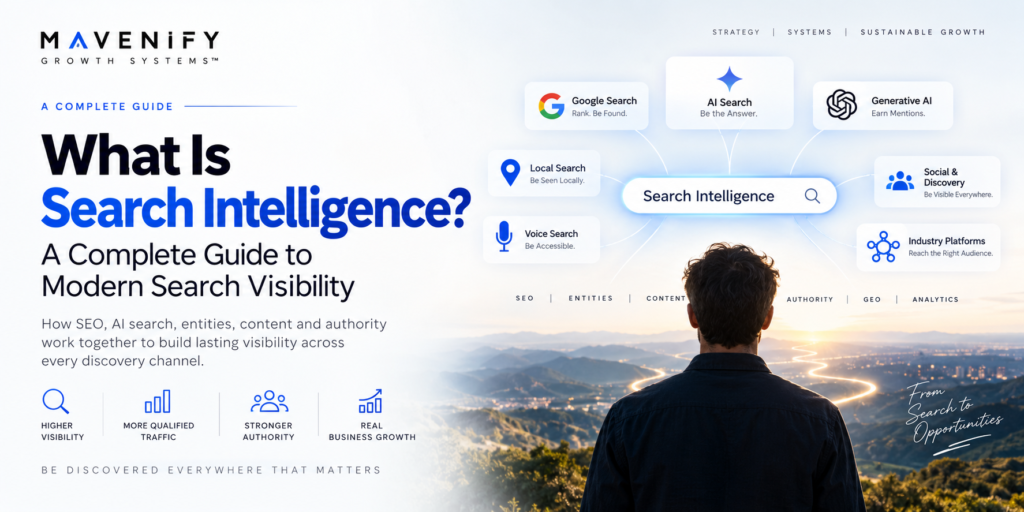
Search Intelligence has become increasingly important as the way people discover businesses, information and solutions continues to change. People no longer discover businesses only by typing a keyword into Google, scanning a page of blue links and clicking through to a website. They may now encounter a business through traditional search results, AI-generated answers, local results, voice search, social platforms, industry websites, recommendations and other digital discovery environments.
For businesses, this creates a different challenge.
It is no longer enough to ask, “How do we rank for this keyword?” The more useful question is: “How do we become visible, relevant and credible wherever potential customers are searching for solutions related to what we offer?”
This is where Search Intelligence comes in.
Search Intelligence brings together the different elements that influence modern search visibility—technical foundations, search intent, content, entities, semantic relationships, authority, AI search optimisation and measurement—into a connected approach rather than treating each discipline as a separate activity.
The idea is not to replace SEO with another acronym. Traditional SEO remains an important foundation. Instead, Search Intelligence expands the way businesses think about visibility by considering how search engines and discovery systems understand information, businesses, people, topics and relationships across the wider digital ecosystem.
A strong Search Intelligence strategy therefore looks beyond individual rankings. It considers whether a business can be discovered for the right searches, understood in the right context, recognised as relevant to a particular subject and consistently presented as a credible source across the places where its audience looks for information.
In this guide, we’ll explore what Search Intelligence means, how modern search is evolving, how its different components work together, how it differs from traditional SEO and how businesses can build a Search Intelligence strategy designed for sustainable visibility and growth.
Table of Contents
How Search Has Evolved Beyond Traditional SEO
For many years, SEO largely revolved around a familiar objective: help a webpage appear when someone searches for a relevant term, then make that result compelling enough for the searcher to click.
That objective still matters. SEO remains a fundamental part of how businesses build organic visibility. But the environment in which people discover information has become much broader.
Google Search itself now includes a growing range of search experiences and features, while Google’s documentation also provides specific guidance for AI features in Search. Google has stated that its generative AI features continue to rely on the underlying foundations of Search, while introducing new ways for people to explore information.
At the same time, a person researching a business may encounter information through traditional search results, AI-generated responses, local results, industry publications, social platforms, specialist directories or other digital environments.
This changes the question businesses need to ask.
Instead of thinking only about “How do we rank for this keyword?”, a broader Search Intelligence Strategy asks:
“How do we make our business understandable, relevant and discoverable wherever our potential customers are searching?”
That requires looking beyond individual keywords and considering the relationships between technical accessibility, search intent, content, entities, structured information, authority and the different environments in which information can be discovered.
This is the foundation of Search Intelligence Infrastructure.
It does not mean that SEO has become irrelevant. In fact, Google’s current guidance around generative AI features continues to emphasize the importance of established SEO fundamentals alongside newer search experiences.
The change is that businesses now need to think about search as a connected ecosystem rather than a single results page.
A company may need strong technical SEO to make its website accessible to search engines, useful content to answer relevant questions, clear entity information to establish what the business represents, authoritative external references to reinforce credibility and appropriate optimization for newer AI-driven discovery experiences.
Search Intelligence brings these elements together.
It is therefore better understood as an evolution in how businesses approach search visibility—not as a replacement for SEO, but as a broader framework for making a business discoverable and understandable across modern search environments.
To understand this shift in more detail, our guide to AI Search vs Google Search explores how the two discovery experiences differ and where their underlying principles overlap.
What Is Search Intelligence?
Search Intelligence is a connected approach to search visibility that brings together the technical, semantic, content, entity, authority and AI-search elements that help a business become discoverable and understandable across modern search environments.
Traditional SEO often focuses on improving a website’s ability to rank for relevant searches. Search Intelligence starts with that foundation but looks at the larger information system surrounding a business: what it offers, which topics it should be associated with, how its pages and entities relate to one another, how search engines interpret its information, what external sources say about it and how its visibility performs across different discovery environments.
This is why Search Intelligence Infrastructure is better understood as a system rather than a single tactic.
A technically strong website can still struggle to build meaningful visibility if its content does not address the right search intent. A large library of content can still underperform if the site’s information architecture is unclear. A business may publish useful information but remain difficult to understand as an entity. And strong organic rankings alone do not necessarily mean the brand is visible wherever its potential customers are researching solutions.
A Search Intelligence Strategy connects these areas so they work toward the same visibility objective.
At its foundation, that strategy asks several connected questions: Can search engines access and understand the website? Does the content answer the questions and needs behind relevant searches? Are the business, people, products and services represented clearly as entities? Are relationships between topics and pages easy to understand? Does the business demonstrate genuine expertise and authority? And is the brand prepared for newer discovery experiences, including AI-driven search?
This is also where Generative Engine Optimization becomes part of the broader picture rather than standing apart from SEO. GEO addresses visibility within generative search experiences, while Search Intelligence considers how GEO fits alongside technical SEO, semantic relationships, entities, content, authority and the wider search ecosystem.
The objective is not to optimize one isolated signal.
The objective is to build a digital presence that is technically accessible, contextually relevant, semantically connected and credible enough to be discovered across the search environments that matter to the business.
That distinction is important because search visibility is rarely created by one activity alone. It is the result of multiple systems working together.
To understand how those systems connect in practice, Mavenify’s Search Intelligence Infrastructure™ brings technical SEO, information architecture, semantic search, entity optimisation, content intelligence, authority and AI search readiness into one connected framework.
Why Search Intelligence Matters for Modern Businesses
Search visibility is no longer limited to whether a website can rank a page for a particular keyword. A business can have technically optimized pages and still miss valuable opportunities if its content, entities, website structure and authority are not working together.
This is why Search Intelligence matters.
When someone searches for a solution, their journey may begin with a broad informational query, move toward a comparison, continue through an AI-generated answer or industry resource and eventually become a branded search. The business needs to remain understandable and relevant throughout that journey.
A strong Search Intelligence Strategy therefore considers the entire path rather than optimizing individual pages in isolation.
For example, a business selling professional software might need to appear for searches about the problem its product solves, the category it belongs to, comparisons with alternatives, specific features, implementation questions and commercial queries. This broader search journey is also why understanding Entity SEO is important when building a modern search presence. It may also need its brand, products and expertise to be clearly understood by search systems when users ask more conversational questions.
This requires more than adding keywords to webpages.
The business needs an underlying Search Intelligence Infrastructure that connects its website architecture, content, entities, internal linking, structured information, technical SEO and authority signals.
The benefit is not simply more visibility. Better search intelligence can help businesses become visible for more relevant searches, communicate their expertise more clearly and create a more consistent digital presence across different discovery environments.
That consistency becomes increasingly important as search behaviour becomes more fragmented. People can discover the same business through a Google result, an AI answer, a local listing, an industry article or a recommendation from another source.
A modern search strategy therefore needs to account for where people search, what they are trying to understand and how the business is represented across those environments.
Search Intelligence vs Traditional SEO
Search Intelligence does not replace SEO. Instead, it expands the scope of what a business needs to consider when building search visibility.
Traditional SEO remains concerned with important foundations such as crawlability, indexing, relevance, technical performance, content quality and organic search visibility. Those fundamentals still matter even as search experiences evolve. Google explicitly states in its current guidance that SEO best practices remain relevant for its generative AI features in Search.
The difference is primarily one of scope and integration.
A traditional SEO program might focus heavily on improving rankings for a defined set of keywords and pages. A broader Search Intelligence Strategy asks how the entire digital presence works together to make the business discoverable, understandable and credible across different search environments.
| Traditional SEO | Search Intelligence |
| Often focuses on organic search performance | Looks at the broader search ecosystem |
| Strong emphasis on keywords and rankings | Considers keywords, intent, topics, entities and context |
| Optimizes individual pages and technical elements | Connects technical, content, semantic and authority systems |
| Primarily considers traditional search visibility | Considers traditional and AI-driven discovery environments |
| Content is often organized around keywords and topics | Content is connected through intent, entities, topics and relationships |
| Link building and authority are important components | Authority is considered alongside expertise, entities, content and external recognition |
| Performance is often measured through rankings and organic traffic | Performance can include visibility, qualified traffic, conversions and broader search presence |
The distinction does not mean one approach is “old” and the other is automatically “better.” A well-executed SEO foundation is actually one of the building blocks of Search Intelligence Infrastructure.
The difference is that Search Intelligence connects those foundations with the other systems required to understand how a business is represented across modern search.
For example, a company may rank well for its primary service keyword but still have weak visibility for related informational searches, comparison queries, entity-based searches or AI-driven questions. A Search Intelligence approach looks at those relationships rather than evaluating the website through one ranking position at a time.
The role of AI Search Optimization within this broader system is explored in more detail in our dedicated guide.
This broader perspective also changes how content is planned. This is also where Topic Clusters can help organize related subjects into a connected content structure rather than treating every page as an isolated SEO asset.
Instead of asking only which keywords should be included on a page, a Search Intelligence Strategy can examine the underlying search intent, related topics, entities, supporting content, internal relationships and the authority signals surrounding the subject.
The result is a more connected search ecosystem where technical SEO, content, semantic relationships, entities and authority reinforce one another.
That is particularly important as Google continues to develop AI-powered search features while maintaining the underlying importance of its Search systems and SEO fundamentals.
What Are the Components of Search Intelligence?
A Search Intelligence Strategy works because several disciplines support one another. None of them should be treated as an isolated checklist.
A technically strong website provides the foundation, but technical SEO alone does not explain what a business is known for. Content can demonstrate expertise, but content without a clear information architecture can become fragmented. Entities can clarify who or what a business represents, while authority and external recognition can provide additional context around its expertise.
Search Intelligence Infrastructure brings these elements together into a connected system.
The exact combination will vary by business, industry, search behaviour and commercial objectives, but a comprehensive approach commonly includes technical SEO, search intent, information architecture, semantic search, entity optimization, structured data, topical authority, internal linking, content intelligence, AI search optimization and authority development.
The important point is not simply to have each component.
The components need to work together.
For example, research into search intent can influence the site’s information architecture. That architecture can determine how content and internal links are organized. Content can strengthen topical coverage and demonstrate expertise. Structured data and entity information can provide additional machine-readable context. External references and digital authority can reinforce the credibility surrounding the business.
When these relationships are considered together, the business develops a much more coherent search presence.
Technical SEO Creates the Foundation
Technical SEO is still one of the foundations of Search Intelligence.
Search engines need to be able to access, crawl, understand and index the important parts of a website. Issues involving crawlability, indexation, site architecture, duplicate URLs, redirects, performance or mobile usability can interfere with visibility regardless of how strong the content may be.
Technical SEO therefore provides the infrastructure on which the rest of the system operates.
But technical health alone does not create search visibility.
A technically perfect website can still fail to attract relevant search demand if it does not address the questions people are asking or clearly communicate what the business offers.
This is why technical SEO should be viewed as the foundation, not the complete Search Intelligence Strategy.
Search Intent Connects Queries With Real Needs
People search because they want to accomplish something.
They may want to understand a concept, compare options, solve a problem, find a local business, evaluate a product or take a commercial action.
Understanding that underlying purpose is therefore essential.
A page optimized around the right keyword but written for the wrong intent can struggle to satisfy the searcher. A broader Search Intelligence Strategy looks at what the searcher is actually trying to accomplish and then determines what type of content, page or experience should address that need.
This also helps businesses avoid creating dozens of pages that target slightly different versions of the same query without adding meaningful value.
Information Architecture Organizes the Website
Information architecture determines how information is structured and connected across a website.
A clear architecture helps users navigate the site and helps search systems understand how different pages relate to one another.
For a business with multiple services, industries or knowledge areas, this becomes particularly important. The website should make it clear which pages represent core offerings, which pages provide supporting information and how those subjects relate to one another.
This is one reason Search Intelligence Infrastructure extends beyond individual-page optimization. The relationships between pages can be just as important as the content contained within each page.
Semantic Search Connects Meaning, Not Just Keywords
Search engines have become increasingly capable of interpreting relationships between words, concepts and entities rather than relying only on exact keyword matches.
Semantic search is concerned with meaning and context.
For example, a search about “running shoes for marathon training” involves more than the phrase itself. It connects concepts such as footwear, running, distance, training, performance and user needs.
A Search Intelligence Strategy therefore considers the broader subject and relationships surrounding a query rather than simply repeating the exact phrase on a page.
This helps create content that answers the underlying information need instead of treating keywords as isolated strings.
This broader understanding of meaning and relationships is closely connected to Entity SEO, which examines how search systems understand businesses, people, products and other entities.
Entity SEO Gives Search Systems More Context
A website can contain the right keywords and still provide incomplete context about what a business actually is, what it offers and how it relates to the topics it discusses. Search systems increasingly need to understand these relationships rather than simply match words appearing on a page.
This is where entities become important. An entity can represent a business, person, product, service, location, organisation or other identifiable concept. Entity optimisation helps connect those entities with the relevant topics, attributes and relationships that describe them.
For example, a digital marketing agency should not only be associated with phrases such as “digital marketing agency” or “SEO services.” Its website should make the business, its services, areas of expertise, people, brand information and relationships between those concepts understandable and consistent.
Within a Search Intelligence Strategy, entity optimisation therefore provides an important layer of context. It helps search systems move from understanding isolated terms to understanding who or what a business is, what it does and where it fits within a particular subject area.
Structured Data Makes Information More Explicit
Structured data provides another way to communicate important information about a website and its entities in a format that search systems can process more consistently.
Rather than relying entirely on the visible text of a page to interpret information, structured data can explicitly describe elements such as an organisation, product, service, article, person, location or other supported entity types.
The value is not simply adding schema markup to every page. The larger objective is consistency between the information presented to users and the information communicated through the site’s structured data. When those signals align, they can contribute to a clearer understanding of the website and its content.
Structured data should therefore be treated as part of the wider Search Intelligence Infrastructure, alongside information architecture, entity optimisation, technical SEO and content. It is one supporting signal within a larger system rather than a standalone shortcut to better visibility.
Topical Authority Connects Expertise Across Content
Search visibility is rarely built by publishing one page about a subject and expecting that page to establish complete expertise. Businesses often need multiple pieces of content that address different questions, intents and aspects of the same broader topic.
This is where topical authority becomes relevant.
A business demonstrating expertise around a subject can create a connected body of useful content covering foundational concepts, specific questions, practical problems, comparisons and more advanced considerations. The individual pages can then reinforce one another through logical information architecture and internal linking.
The objective is not simply to publish more content. It is to create a coherent knowledge structure that demonstrates depth and relevance around the subjects that matter to the business.
For example, a business providing conversion optimisation services could create content covering conversion rate optimisation, landing pages, forms, funnels, testing, analytics and measurement. Each topic addresses a different search need, while together they create a broader representation of the business’s expertise.
This is also where Search Intelligence Strategy connects content planning with the wider search system. Topic selection, search intent, internal linking, entities and authority should work together rather than being planned independently.
Internal Linking Connects the Information System
Internal linking is often treated as a technical SEO task, but its role within Search Intelligence is broader. Links between relevant pages help establish relationships between subjects, services and supporting information across a website.
A well-structured internal linking system can help users move naturally from a general question to a more specific topic, and eventually toward a relevant product or service. At the same time, it gives search systems additional context about how the site’s content is related.
For example, a broad article about Search Intelligence may naturally connect to more specific resources covering AI search, entity optimisation, topical authority or AI Search Optimization. Those pages can then connect to relevant service information where the user’s intent becomes more commercial.
This creates an information system rather than a collection of disconnected articles. In a mature Search Intelligence Infrastructure, internal links help connect technical foundations, content, entities, authority and commercial pages into a structure that both users and search systems can navigate.
Content Intelligence Aligns Content With Demand
Content should not be created simply because a keyword has search volume. A useful Search Intelligence approach looks at why people are searching, what information they need, how those needs relate to the business and where each piece of content fits within the wider information system.
This is where content intelligence becomes important. It brings together search demand, search intent, topics, questions, existing content, competitors and business priorities to determine what should be created, improved or connected.
For example, two keywords may appear closely related but represent very different stages of the user’s journey. One person may be looking for a definition, another may be comparing solutions, while another may already be evaluating a provider. Treating all three searches as the same content opportunity can result in pages that rank for a term but fail to satisfy the underlying need.
A strong Search Intelligence Strategy therefore uses content intelligence to connect demand with intent. The goal is not to produce the largest possible volume of content, but to build the right information around the subjects where the business needs to be discovered, understood and considered.
AI Search Optimization Extends Visibility Into New Discovery Environments
Search is increasingly expanding beyond conventional results pages. AI-powered search experiences can summarise information, answer questions conversationally and provide recommendations based on information gathered from multiple sources. Google also describes its generative AI search experiences as providing AI-powered overviews that help people explore information directly within Search.
This creates another consideration for businesses: how their information is represented and understood when people ask AI systems questions related to their products, services, expertise or industry. This is where AI Search Optimization becomes relevant.
AI Search Optimization addresses this part of the search ecosystem. It builds on many established principles of SEO, including technically accessible websites, useful content, clear information architecture, strong topical relevance and credible sources, while also considering how information may be retrieved and interpreted within AI-driven discovery experiences.
Generative Engine Optimization can be part of this work, but it should not be treated as an isolated replacement for SEO. Within Search Intelligence, AI search is one environment in a much broader visibility system that includes traditional search, local discovery, entities, content, authority and other channels.
The practical implication is important: businesses should build information that is clear, useful, consistent and supported by credible signals rather than trying to optimise for an imagined formula for appearing in AI-generated answers.
Authority and External Recognition Reinforce Trust
Search systems do not evaluate a website in isolation. Information about a business can also exist across industry publications, reputable websites, professional profiles, directories, media coverage, partner websites and other relevant sources.
Google’s guidance also emphasises that links can help its systems discover pages and understand their relevance, although they are only one part of how pages are evaluated.
These external references can help reinforce the broader picture of a business. When a company is consistently associated with a particular area of expertise across relevant and credible sources, those signals can contribute to how its authority and relevance are understood.
This does not mean that every mention or backlink automatically improves search visibility. Relevance, credibility, context and the quality of the underlying source matter. A large number of unrelated mentions is not a substitute for genuine recognition within the business’s industry or subject area.
Within Search Intelligence, authority therefore extends beyond conventional link building. Digital PR, expert contributions, industry recognition, brand mentions, authoritative citations and other forms of external validation can all contribute to a stronger digital footprint when they are earned naturally and connected to the business’s actual expertise.
The important distinction is that authority should be built around substance. A business first needs useful expertise, trustworthy information and a credible presence; external recognition then helps reinforce those signals across the wider search ecosystem.
Digital PR, expert contributions, industry recognition, brand mentions, authoritative citations and other forms of external validation can all contribute to a stronger digital footprint when they are earned naturally and connected to the business’s actual expertise.
How Search Engines Understand a Business
A search engine needs more than a collection of keywords to understand a business. It needs to build a broader picture of what the business is, what it offers, who it serves, where it operates and how its expertise connects with the topics people are searching for.
This understanding develops through multiple signals across the website and the wider digital ecosystem. The business name, services, website structure, content, entities, structured data, internal links, external references and other consistent information can all contribute to that picture.
For example, consider a company that provides accounting services for small businesses in Australia. A page targeting “small business accountant” provides one signal. But the wider website may also contain information about specific accounting services, industries served, locations, people within the organisation, expertise, resources and related topics. When these elements are clearly connected, they provide much more context than a single keyword ever could.
This is one of the central ideas behind Search Intelligence. Instead of optimising individual pages in isolation, businesses can build a connected digital information system in which their important entities, topics, services and expertise reinforce one another.
Establishing a Clear Business Entity
The first step is making the business itself clearly identifiable. Important information such as the organisation’s name, website, services, location, contact information and other core attributes should be presented consistently across the website and relevant external properties.
Consistency matters because conflicting information can make the digital representation of a business less clear. A company should not appear under significantly different names, descriptions or business details across important sources without a legitimate reason.
The same principle applies to the people and organisations associated with the business. Clear information about founders, experts, leadership teams and other relevant entities can provide additional context about who is behind the expertise presented on the website.
Connecting Services With Topics and Intent
Understanding a business also requires understanding what it actually does.
A service page should clearly explain the service, the problems it addresses, the people or businesses it is designed for and the outcomes it supports. Supporting content can then address the questions, challenges and information needs surrounding that service.
For example, a business offering conversion optimisation should not rely solely on a page targeting “conversion rate optimisation services.” Supporting content about landing pages, forms, funnels, A/B testing and conversion measurement can help establish the broader subject context.
This creates relationships between services, topics and search intent. Instead of treating each page as an independent ranking opportunity, Search Intelligence connects them into a coherent representation of the business and its expertise.
Building Consistency Across the Digital Ecosystem
A business’s identity does not exist only on its own website. Relevant information may also appear on professional profiles, industry publications, partner websites, directories, social platforms and other third-party sources.
When important information is consistent across these environments, the wider digital presence provides a clearer representation of the business.
The goal is not to create identical profiles everywhere or generate mentions simply for the sake of generating them. The goal is to ensure that the important facts about the business, its expertise and its services can be understood consistently wherever relevant information exists.
This is where the technical, content and authority elements of Search Intelligence Infrastructure begin to work together. Technical foundations make information accessible, content explains expertise, entities provide context and external recognition helps reinforce the business’s presence beyond its own website.
How Search Intelligence Works Across Modern Search
Search Intelligence becomes most useful when it is viewed as a system that operates across multiple discovery environments rather than a process designed exclusively for traditional Google rankings.
A potential customer may discover a business through a conventional search result, an AI-generated answer, a local result, an industry publication, a review platform, a social network or a recommendation from another website. Each environment presents information differently, but the underlying business signals can still influence whether the business is understood as relevant and credible.
The objective is therefore not to create a completely different strategy for every discovery channel. It is to build a strong underlying information system and then ensure that the business is represented consistently across the environments that matter to its audience.
Traditional Search Remains an Important Discovery Channel
Traditional search continues to play an important role in how people research businesses, products, services and problems. Technical accessibility, relevant content, search intent, information architecture and authority therefore remain fundamental parts of a modern search strategy.
A Search Intelligence approach does not move away from these foundations. Instead, it connects them with the additional signals that influence how businesses are understood beyond individual keyword rankings.
For example, ranking for a commercial search can bring a potential customer to a service page, while supporting informational content can help answer questions earlier in the research process. Internal linking can then connect those experiences and guide the user toward the next relevant piece of information.
AI Search Creates a More Conversational Discovery Experience
AI-powered search changes the way information can be presented to users. Instead of requiring someone to evaluate several individual results, an AI search experience may synthesise information from multiple sources into a conversational response.
For businesses, this makes clarity and consistency increasingly important. The information describing the business, its expertise, services and subject areas needs to be understandable enough to be retrieved and interpreted within these newer discovery experiences.
This is one reason Generative Engine Optimization belongs within the wider Search Intelligence framework. GEO can address visibility within generative discovery environments, but the underlying information still depends on many established foundations: accessible content, clear entities, useful information, strong topical relationships and credible external signals.
Local, Industry and Third-Party Discovery Add More Context
Not every customer begins their journey with a traditional web search. Depending on the business, discovery can also happen through local search platforms, industry directories, review websites, professional publications, partner websites or other third-party environments.
These sources can become particularly important when a business serves a defined geographic area or operates within a specialised industry. Consistent business information and relevant external references can help reinforce the relationship between the business, its location, services and area of expertise.
The appropriate channels will differ from one business to another. A local service provider may place greater importance on local discovery, while a B2B company may depend more heavily on industry publications, professional networks and specialist resources.
This is why Search Intelligence should begin with the audience and the actual discovery journey rather than assuming that every business needs to optimise every available channel.
Search Intelligence and AI Search
AI search is one of the most visible changes in the modern search landscape, but it should be understood as an extension of the wider search ecosystem rather than a completely separate discipline.
Traditional search generally presents users with a collection of results that they can evaluate and explore. AI search can instead synthesise information from multiple sources and present an answer or summary directly within the search experience. This changes how users may discover information and, consequently, how businesses need to think about visibility.
Google’s documentation explains that AI Overviews and AI Mode can help users explore information in new ways while still relying on web content and established Search fundamentals.
For businesses, the important question is no longer only whether a page can rank for a particular query. It is also whether the business has enough relevant, consistent and trustworthy information across its digital presence to be understood when an AI system is answering questions related to its products, services or expertise.
From Ranking for Keywords to Being Represented in Answers
Traditional SEO often focuses on the relationship between a query, a page and a search result. AI search introduces another layer: the possibility that information from multiple sources is combined into a response.
That does not make keywords irrelevant. Search queries still provide important signals about what people want to know. But the surrounding context becomes increasingly important. AI systems need to interpret concepts, entities, relationships and supporting information rather than simply identify a page containing a matching phrase.
This makes the underlying principles of Search Intelligence particularly relevant. A business with clear information architecture, well-connected content, identifiable entities, useful supporting resources and credible external references has a stronger foundation for being understood across different search experiences.
Content Quality and Context Matter More Than Content Volume
The emergence of AI search does not mean businesses should simply publish more AI-generated articles. Producing large volumes of similar content can create a website full of pages without adding meaningful expertise or value.
Instead, content needs to contribute something useful to the overall knowledge structure of the business. It should answer genuine questions, address relevant search intent, demonstrate subject knowledge and connect naturally with related information.
This is where AI Content and Authority System principles can complement Search Intelligence. Content creates the information that search systems can interpret, while authority, expertise and external recognition help provide context around why that information should be trusted.
Search Intelligence Connects SEO and GEO
Generative Engine Optimization is often discussed as though it replaces traditional SEO. In practice, the two address overlapping parts of a broader visibility challenge.
SEO provides important foundations: crawlable websites, useful content, relevant pages, logical architecture, internal linking and other established practices. GEO extends the conversation toward how information may be retrieved and represented within generative AI experiences.
Search Intelligence brings these elements together.
Rather than maintaining one strategy for Google and another completely disconnected strategy for AI search, businesses can build a common information and authority foundation that supports multiple discovery environments.
The result is a more durable approach to visibility: SEO and GEO become connected components of a larger Search Intelligence Strategy rather than competing alternatives.
Search Intelligence Strategy: How to Build One
A Search Intelligence Strategy should begin with the business, its audience and the way potential customers actually discover information—not with a list of keywords.
The purpose is to understand where visibility matters, what information the audience needs at different stages of its journey, how search systems may interpret the business and which parts of the digital presence need to work together to support that visibility.
A practical strategy therefore connects technical foundations, search intent, information architecture, content, entities, authority, AI search and measurement into one system.
Start With the Business and Audience
The first step is understanding what the business actually wants to be known for and who it needs to reach.
This includes the products or services offered, the markets served, the problems solved, the audiences targeted and the commercial outcomes that matter. Without this context, keyword research can easily become disconnected from business priorities.
The strategy should identify the subjects that are genuinely relevant to the business and then determine how potential customers search for information around those subjects.
Map Search Intent and the Customer Journey
Once the core business areas are clear, the next step is understanding the different intents behind relevant searches.
Someone discovering a problem may search for educational information. Someone evaluating solutions may compare different approaches. Someone who already understands what they need may search for a specific provider or service.
A Search Intelligence Strategy connects these different intents instead of treating them as unrelated keywords. The resulting content and website structure should help users move naturally from understanding a problem to evaluating options and, where appropriate, taking commercial action.
Build the Information Architecture
The website should then provide a logical structure for the subjects, services and supporting information identified during the strategy.
Core service pages, supporting resources, topic clusters and related information should have clear relationships. Internal linking can reinforce those relationships while helping users and search systems navigate the site.
This is where Search Intelligence Infrastructure provides the technical and structural foundation for connecting these elements into a coherent search system.
Develop Content Around Topics, Not Isolated Keywords
Content planning should reflect the wider subject areas and search intents identified during the strategy.
Instead of creating one article for every variation of a keyword, businesses can build connected resources around important topics, using Topic Clusters to organise related information around broader subject areas
This approach also makes it easier to identify gaps. If an important customer question has no useful resource, the content system can address it. If several pages overlap heavily, they can be consolidated or repositioned rather than allowing the website to accumulate unnecessary duplication.
Strengthen Entities and Authority
The next layer is making the business, its people, services and areas of expertise clearly identifiable.
Relevant structured data, consistent business information, useful author or expert information, credible content and relevant external recognition can all contribute to a stronger representation of the business.
Authority should be built around genuine expertise rather than manufactured signals. The objective is to create a digital presence that consistently communicates what the business knows, what it does and why its information is relevant.
Extend the Strategy Into AI Search
AI search should be incorporated into the same overall strategy rather than treated as an entirely separate project.
The business should consider whether its important information is clear, accessible, well structured, contextually connected and supported by credible sources. Content should answer genuine questions and provide enough context for the subject, entity and expertise to be understood.
Generative Engine Optimization can form part of this layer, particularly when the business wants to understand and improve its visibility across generative discovery experiences.
Measure What Actually Matters
Finally, the strategy needs a measurement framework.
Rankings and organic traffic can remain useful indicators, but they should not be the only measures of progress. Depending on the business, measurement may also include qualified organic traffic, conversions, visibility for strategic topics, branded search activity, engagement with important content and other indicators connected to commercial outcomes.
The goal is to understand whether the search system is becoming stronger over time—not simply whether a particular keyword moved up or down.
How to Measure Search Intelligence
A Search Intelligence Strategy needs a measurement framework that reflects how visibility actually contributes to business growth. Rankings are useful, but they represent only one part of the picture.
The more useful approach is to measure the progression from visibility to engagement to qualified outcomes. This helps distinguish between activity that simply produces more impressions and activity that is actually improving the business’s ability to attract and convert relevant audiences.
Measure Visibility Across Important Search Topics
Keyword rankings can still provide useful information, particularly for strategically important commercial and informational queries. However, the focus should be on meaningful topic coverage rather than tracking hundreds of keywords without context.
Businesses can monitor how their visibility changes across priority topics, search intents and important service areas. This provides a better view of whether the overall search presence is expanding.
For AI-driven discovery, measurement can also include monitoring how the brand, products, services or experts are represented when relevant questions are asked across the AI search environments that matter to the business.
Measure Organic Traffic and Engagement
Visibility only becomes useful when it brings relevant people to the website.
Organic traffic can therefore be evaluated alongside engagement indicators such as landing-page performance, engaged sessions, important page interactions and movement through the website.
The quality of the traffic matters as much as the quantity. A smaller increase in highly relevant visitors may be more meaningful to a business than a large increase in traffic that has little relationship to its products or services.
Measure Conversions and Commercial Impact
The strongest measurement layer connects search activity with business outcomes.
Depending on the business model, this could include completed forms, qualified leads, calls, enquiries, bookings, purchases or other meaningful conversion actions.
This also helps identify an important distinction: a page can perform well in search while producing little commercial value, while another page may attract fewer visitors but generate highly qualified opportunities.
A mature Search Intelligence Strategy therefore asks not only, “Did visibility increase?” but also, “Did the increased visibility attract the right audience and contribute to measurable business outcomes?”
Measure Authority and Content Growth
Search Intelligence can also be evaluated through the development of the broader information and authority system.
Businesses can monitor growth in strategically important content, coverage of priority topics, relevant referring domains, brand mentions, expert contributions and other signals that demonstrate increasing recognition within their subject area.
These measurements should be interpreted in context rather than treated as isolated targets. Publishing more articles or acquiring more links does not automatically mean that the underlying search system has improved.
Combine the Signals Into One View
The real value comes from bringing these measurements together.
A useful reporting framework can connect strategic visibility, organic traffic, engagement, conversions, content development and authority signals. This allows businesses to see not only what changed, but also which parts of the system may be contributing to that change.
Over time, this creates a feedback loop. Search data identifies opportunities, content and technical improvements address them, performance data reveals what worked, and the strategy is refined based on evidence.
That is the difference between simply reporting SEO metrics and using Search Intelligence as an ongoing decision-making system.
Common Search Intelligence Mistakes
Building a broader search visibility system does not automatically make the strategy effective. In many cases, businesses create problems by treating Search Intelligence as a collection of disconnected tactics rather than as one connected system.
Focusing Only on Keyword Rankings
Keyword rankings remain useful, but treating rankings as the entire objective can narrow the strategy too much.
A business may rank well for informational searches while attracting little qualified traffic, or generate significant traffic without producing meaningful enquiries or sales. Rankings need to be considered alongside search intent, traffic quality, conversions and the broader visibility of the business.
Publishing Content Without a Clear Information Structure
Creating content consistently is not the same as building a useful content system.
When articles are published without clear relationships between topics, services and user intent, the website can become difficult to navigate and harder to understand as a complete subject resource.
A stronger approach connects related content through logical architecture and internal linking, while giving every important page a clear purpose.
Treating AI Search as a Replacement for SEO
Another common mistake is assuming that optimisation for AI search requires abandoning established SEO practices.
AI search still depends on information available across the web. Technical accessibility, useful content, clear structure, relevant entities and credible information remain important foundations.
Generative Engine Optimization should therefore be incorporated into a broader Search Intelligence Strategy, rather than treated as a completely independent replacement for SEO.
Chasing Volume Instead of Relevance
More pages, more keywords, more backlinks and more mentions do not necessarily create a stronger search presence.
A Search Intelligence approach prioritises relevance. Content should address meaningful information needs, links should connect genuinely related resources, and external recognition should be relevant to the business and its expertise.
The question should always be whether an activity strengthens the overall information and authority system, not simply whether it increases a particular metric.
Ignoring the Website as Part of the Search System
Search visibility does not end when someone clicks a result.
If the website is slow, difficult to navigate, unclear about its services or poorly structured, increased visibility may not translate into meaningful business outcomes.
This is why Search Intelligence needs to connect with the website’s technical foundation, information architecture, conversion experience and measurement systems. Visibility works best when the destination is capable of turning that visibility into useful engagement and action.
Measuring Activity Instead of Outcomes
Publishing articles, building links and improving rankings are activities. They are not business outcomes by themselves.
A strong strategy measures whether these activities are improving relevant visibility, attracting the right audience, generating engagement and contributing to conversions.
This keeps the strategy focused on business value rather than creating an endless cycle of SEO activity without a clear understanding of its impact.
How Mavenify Approaches Search Intelligence Infrastructure™
Search Intelligence works best when it is treated as an interconnected system rather than a collection of isolated SEO activities.
At Mavenify, Search Intelligence Infrastructure™ brings together the technical, strategic, content and authority elements that influence how a business is discovered and understood across modern search environments.
The approach begins with understanding the business, its audience, commercial priorities and existing search presence. From there, the focus is on identifying the gaps between where the business is today and where it needs to become more visible.
That can involve technical SEO, information architecture, search intent analysis, semantic relationships, entity optimisation, content intelligence, internal linking, authority development and preparation for AI-driven discovery. The exact combination depends on the business rather than following a fixed checklist.
The important principle is that these elements should support one another. Technical improvements should make important information accessible. Content should address genuine search intent. Internal linking should connect related knowledge. Entities should provide context. Authority should reinforce expertise. Measurement should then show which parts of the system are creating meaningful results.
This is why Mavenify approaches search as an infrastructure problem rather than simply a ranking problem. The objective is to build a digital foundation that can support visibility as search continues to evolve.
Frequently Asked Questions About Search Intelligence
What Is Search Intelligence?
Search Intelligence is a broader approach to search visibility that connects SEO, search intent, content, entities, information architecture, authority and AI search into one connected system.
Rather than focusing only on individual keyword rankings, it considers how a business can become discoverable, understandable and credible across the different environments where potential customers search for information.
Is Search Intelligence the Same as SEO?
No. SEO remains an important foundation of Search Intelligence, particularly for technical accessibility, content relevance, information architecture and organic search visibility.
Search Intelligence expands that foundation by also considering entities, semantic relationships, topical authority, AI-driven discovery, external recognition and the wider digital ecosystem.
How Is Search Intelligence Different From GEO?
Generative Engine Optimization, or GEO, focuses specifically on visibility within generative AI and answer-driven search experiences.
Search Intelligence is broader. GEO can form one component of a Search Intelligence Strategy alongside traditional SEO, technical foundations, entities, content, authority, information architecture and measurement.
Why Are Entities Important to Search Intelligence?
Entities help provide context about businesses, people, products, services, locations and other identifiable concepts.
They allow the digital presence of a business to communicate more than individual keywords by establishing relationships between the business, its services, expertise and relevant subjects.
Does Search Intelligence Replace Traditional SEO?
No. Traditional SEO remains an important part of the system.
Search Intelligence builds on established SEO practices and connects them with additional elements that influence how businesses are discovered and understood across modern search and AI-driven discovery environments.
How Long Does Search Intelligence Take to Produce Results?
There is no universal timeframe because results depend on factors such as the current state of the website, competition, technical issues, content depth, authority, market and the scope of implementation.
Some improvements can produce relatively quick changes, while building stronger topical relevance, authority and broader search visibility generally requires consistent work over time.
The most useful approach is therefore to measure progress across visibility, qualified traffic, engagement, conversions, content development and authority rather than expecting one metric to change on a fixed schedule.
What Should a Search Intelligence Strategy Include?
A Search Intelligence Strategy should be based on the business and its audience rather than a fixed checklist. Depending on the situation, it can include technical SEO, search intent, information architecture, semantic search, entity optimisation, structured data, topical authority, internal linking, content intelligence, AI Search Optimization, authority development and measurement.
The specific priorities should be determined by the gaps and opportunities identified for the individual business.
Conclusion: Building a More Intelligent Search Presence
Search is no longer limited to a single results page or a simple relationship between keywords and rankings. People discover businesses through traditional search, AI-powered experiences, local platforms, industry resources and other digital environments.
That makes visibility a broader challenge.
Search Intelligence provides a framework for bringing these different elements together. Technical SEO creates the foundation, search intent connects visibility with real user needs, information architecture organises the digital experience, entities provide context, content demonstrates expertise, authority reinforces credibility and AI search optimisation extends the strategy into newer discovery environments.
The goal is not to chase every new search trend or replace SEO with another acronym. It is to build a connected digital presence that can remain useful as the way people search continues to evolve.
For businesses, that means moving beyond the question of “How do we rank for this keyword?” and thinking more broadly about how the brand can become discoverable, understandable, relevant and trusted across the search ecosystem.
That is the foundation of a modern Search Intelligence approach.
Build Your Search Intelligence Infrastructure™
Search visibility is becoming increasingly connected. Businesses need more than isolated SEO tactics to remain discoverable as search expands across traditional results, AI-powered experiences, local discovery and other digital channels.
Mavenify’s Search Intelligence Infrastructure™ brings technical SEO, search intent, information architecture, semantic search, entity optimisation, content intelligence, authority and AI search readiness into one connected system—built around your business, audience and growth objectives.