

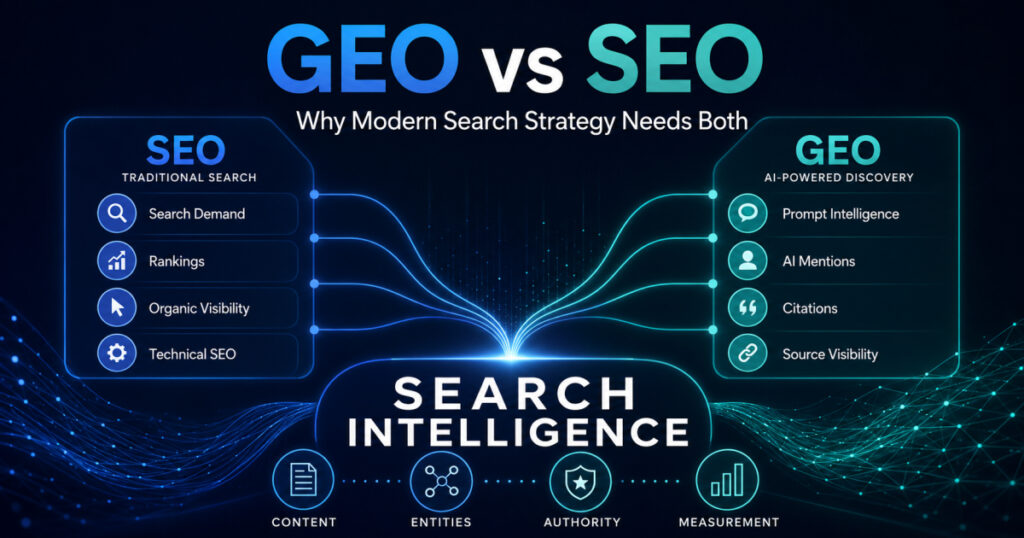
Search is no longer limited to a page of traditional organic results. People can now discover businesses and information through Google Search, AI-generated search experiences, conversational interfaces, answer engines, and other emerging discovery environments.
This shift has created growing interest in Generative Engine Optimization (GEO) and how it differs from Search Engine Optimization (SEO). While SEO focuses on improving visibility across traditional search engines, GEO extends search strategy into generative and AI-powered discovery experiences where information may be synthesized, cited, compared, or presented directly within generated answers.
The important distinction is that businesses should not think about GEO vs SEO as an either-or decision. Many of the foundations that support traditional organic visibility—including technical accessibility, useful content, authority, entities, links, and information architecture—also contribute to a stronger digital presence for AI-powered discovery. The opportunity is to build a search strategy capable of competing across both.
Table of Contents
What Is SEO?
Search Engine Optimization (SEO) is the practice of improving a website and its broader digital presence to increase relevant visibility within organic search results. It combines technical optimization, content strategy, information architecture, keyword and intent research, internal linking, authority development, user experience, and measurement.
The purpose of SEO is not simply to achieve rankings. Effective SEO connects search demand with useful information and business objectives, helping organizations become discoverable when potential customers research problems, compare solutions, evaluate providers, or look for specific products and services.
What Does SEO Optimize For?
SEO can influence visibility across many types of organic search experiences, including informational results, commercial pages, images, videos, local results, product experiences, featured results, and other search features depending on the business and query.
Successful SEO therefore requires understanding both what people search for and why they search for it, then building technically accessible and authoritative resources capable of satisfying that intent.
Is Traditional SEO Still Important?
Yes. The growth of AI-powered search does not make traditional SEO obsolete. Search engines continue to drive discovery, website visits, leads, transactions, and brand research across many customer journeys.
More importantly, many AI-powered search experiences still interact with the broader web and search ecosystem. Businesses should strengthen established SEO foundations while adapting their search strategy to new discovery environments rather than abandoning one for the other.
What Is Generative Engine Optimization (GEO)?
Generative Engine Optimization (GEO) is the practice of improving a brand’s digital presence so its information is easier to discover, understand, retrieve, and potentially reference within generative and AI-powered search experiences.
GEO can involve content structure, entity clarity, topical authority, technical accessibility, credible third-party references, original information, and other signals that strengthen the information environment surrounding a brand. The objective is not to manipulate large language models, but to make useful and authoritative information more accessible across emerging discovery experiences.
What Does GEO Optimize For?
GEO considers search journeys where users may receive synthesized answers, comparisons, recommendations, summaries, citations, or other generated responses rather than only a traditional list of webpages.
This means businesses need to think beyond whether a page ranks for a particular keyword. They may also need to understand whether their brand is being mentioned, which sources are being cited, which competitors appear, and how their expertise is represented across relevant AI-powered discovery journeys.
Does GEO Replace SEO?
No. GEO should be viewed as an extension of modern search strategy rather than a replacement for SEO. Strong technical foundations, useful content, crawlability, authority, internal linking, entity clarity, and information architecture remain relevant across both disciplines.
GEO introduces additional considerations around generative answers, source selection, brand mentions, citations, prompt-based discovery, and the wider source ecosystem surrounding an organization.
GEO vs SEO: What Is the Difference?
The clearest difference between SEO and GEO is the discovery environment each discipline emphasizes. SEO traditionally focuses on improving visibility within organic search results, while GEO focuses more specifically on visibility within generative and AI-powered search experiences.
The distinction becomes less rigid at the implementation level. Many activities that strengthen SEO can also improve the quality, accessibility, authority, and clarity of information available to AI-powered discovery systems. GEO therefore adds new dimensions to search strategy rather than creating an entirely separate marketing discipline.
| Area | SEO | GEO |
| Primary environment | Traditional organic search | Generative and AI-powered discovery |
| Typical discovery | Search results, webpages and search features | Generated answers, citations, mentions and comparisons |
| Query research | Keywords, topics and search intent | Prompts, questions, conversational journeys and intent |
| Content focus | Relevance, usefulness, depth and search intent | Clear, retrievable, contextual and authoritative information |
| Technical foundation | Crawling, indexing, rendering and site architecture | Builds on technical accessibility while considering AI retrieval environments |
| Authority | Backlinks, brand authority, expertise and trusted sources | Owned authority, earned authority, citations, mentions and source ecosystems |
| Entities | Important for semantic search and knowledge understanding | Important for brand, expert and topic clarity across AI discovery |
| Measurement | Rankings, impressions, clicks, organic traffic and conversions | Mentions, citations, source visibility, competitor presence, AI referrals and conversions |
| Desired outcome | Relevant organic visibility and business growth | Relevant AI discovery visibility and business growth |
The Biggest Difference Is the Interface, Not the Entire Foundation
SEO and GEO are often presented as competing strategies because users experience traditional search results and AI-generated answers differently. Behind that interface difference, however, both disciplines depend heavily on accessible information, relevance, authority, clear entities, useful content, and a trustworthy digital presence.
Businesses therefore gain more from identifying where SEO and GEO overlap and where additional GEO capabilities are required than from creating two disconnected optimization programs.
Where Do SEO and GEO Overlap?
SEO and GEO operate across different search experiences, but their foundations overlap considerably. Both depend on making useful information accessible, understandable, relevant, and credible enough to compete within increasingly complex discovery environments.
This overlap is why businesses should be cautious about separating SEO and GEO into completely independent strategies. Improvements to technical infrastructure, content quality, entity clarity, topical authority, and external credibility can support visibility across traditional search while also strengthening the information environment available to AI-powered discovery systems.
1. Technical Accessibility
Both SEO and GEO depend on important information being technically accessible. Search engines need to crawl, render, and index webpages, while AI-powered search experiences that retrieve information from the web also depend on being able to access relevant content through their available systems.
Robots directives, canonicalization, internal linking, status codes, XML sitemaps, JavaScript implementation, page availability, and site architecture therefore remain important foundations.
2. Search Intent and Audience Needs
Both disciplines begin with understanding what users are trying to accomplish. Traditional SEO often maps keywords and topics to search intent, while GEO can expand that research into conversational prompts, follow-up questions, comparisons, recommendations, and more complex discovery journeys.
The underlying objective remains similar: provide information that genuinely helps users complete the research or decision they are making.
3. High-Quality Content
Useful content remains central to both SEO and GEO. Pages should provide accurate information, sufficient depth, clear explanations, appropriate evidence, and genuine expertise rather than existing primarily to target search phrases.
GEO may place additional emphasis on passage clarity and information that remains understandable when retrieved within a broader generated response, but that should improve content structure rather than turn writing into disconnected snippets.
4. Topical Authority
Search visibility becomes stronger when a website develops meaningful depth around the subjects connected to its genuine expertise. Pillar resources, supporting articles, comparisons, research, case studies, implementation guides, and related content can collectively create a more complete topical footprint.
This supports traditional organic search while also giving AI-powered discovery systems a richer body of information through which the organization and its expertise can potentially be understood.
5. Entity Clarity
Modern search involves understanding more than keywords. Organizations, people, products, services, locations, and concepts exist as entities with relationships that provide meaning and context.
Clear organization information, expert attribution, contextual internal links, structured data, consistent external profiles, and relevant third-party references can strengthen entity understanding across both traditional and AI-powered discovery.
6. Authority and External Validation
SEO has long considered backlinks and external authority important parts of the search ecosystem. GEO broadens the strategic view by also considering brand mentions, citations, expert references, reviews, media coverage, research references, and other credible third-party information surrounding an organization.
These signals should not be assumed to influence every search or AI system identically. Their broader value lies in creating a stronger and more credible digital footprint around the brand.
7. Internal Linking and Information Architecture
Internal links help users and search systems discover related resources and understand how information across a website connects. Strong information architecture also prevents important expertise from becoming isolated within disconnected pages.
For both SEO and GEO, internal linking should reflect meaningful relationships between topics rather than being added mechanically for keyword optimization.
8. Original Expertise and Evidence
Original research, first-hand experience, proprietary data, case studies, experiments, expert observations, and documented methodologies can make content more distinctive and useful.
These assets can support organic search performance while also creating information that other publishers may reference, strengthening the earned authority and source ecosystem surrounding the brand.
SEO Creates Foundations That GEO Can Build Upon
Businesses with weak technical SEO, thin content, unclear positioning, limited authority, or poor information architecture should not expect GEO tactics to compensate for those weaknesses. In many cases, strengthening the underlying search foundation is the first step toward improving visibility across newer discovery experiences.
GEO can then extend that foundation through prompt intelligence, AI source analysis, citation and mention monitoring, earned authority development, and other capabilities specific to generative discovery.
Where Does GEO Go Beyond Traditional SEO?
The overlap between SEO and GEO is substantial, but GEO introduces additional questions that traditional SEO programs may not routinely address. These relate primarily to how brands appear within generated answers, which sources influence those answers, and how visibility can be measured across conversational discovery journeys.
1. Prompt Intelligence
Traditional SEO research commonly analyzes keywords, search volumes, topics, intent, and search-result behaviour. GEO expands this research into the conversational questions and multi-step prompts people may use within AI-powered discovery experiences.
Businesses can map recommendation prompts, comparisons, problem-based questions, evaluation criteria, follow-up questions, and other conversational journeys to understand where their brand could reasonably become relevant.
2. Brand Mentions Within Generated Answers
Traditional SEO visibility is often measured through rankings, impressions, clicks, and organic traffic. GEO introduces another dimension: whether the organization, its products, services, experts, or information appear within generated responses.
A mention should not automatically be treated as a recommendation. Businesses need to understand the context in which the brand appears and whether that visibility occurs during commercially relevant discovery journeys.
3. Citation and Source Visibility
Some AI-powered search experiences display citations or links to sources used within generated responses. GEO therefore considers not only whether the brand appears, but which webpages, publications, research sources, or other domains are being surfaced around important topics.
Source analysis can reveal where a company’s own content receives visibility, which independent sources influence the discovery journey, and where competitors have stronger representation.
4. AI Source Ecosystems
GEO expands authority analysis beyond a website’s backlink profile. Relevant publications, industry resources, reviews, expert commentary, research citations, directories, communities, and other independent sources can form part of the information ecosystem surrounding a brand.
Understanding this ecosystem helps businesses distinguish between Owned Authority—information they control—and Earned Authority—credible recognition and references developed beyond their own website.
5. Competitor Visibility Across AI Discovery
Traditional competitor analysis may compare keyword rankings, content, backlinks, organic traffic, and search-result visibility. GEO adds questions such as which competitors are repeatedly mentioned for relevant prompts, which sources support those appearances, and what information or authority gaps may explain the difference.
This allows AI visibility research to become competitive intelligence rather than a collection of isolated screenshots from individual prompts.
6. AI-Specific Technical Accessibility
Some AI search providers publish their own guidance about crawlers, publisher controls, or how website owners can manage access to content. Businesses may therefore need to understand how their technical configuration affects different search and AI discovery systems.
These considerations should extend established technical SEO rather than replace conventional crawling, indexing, rendering, canonicalization, and site architecture practices.
7. AI Visibility Measurement
GEO requires measurement beyond conventional keyword rankings. Depending on the platforms and available data, businesses can monitor prompt categories, brand mentions, citations, source visibility, competitor appearances, AI referral traffic, branded demand, and resulting conversions.
Because generated responses can vary between users, prompts, locations, and repeated tests, individual outputs should not be treated as permanent ranking positions. Consistent methodology and trends over time provide more useful intelligence.
GEO Adds New Signals to the Search Intelligence Picture
The value of GEO is not that it creates an entirely separate marketing channel. It adds new visibility signals to an existing search ecosystem: prompts alongside keywords, mentions alongside rankings, citations alongside backlinks, AI source ecosystems alongside traditional competitor analysis, and generated discovery alongside conventional search results.
When these signals are analyzed together, businesses gain a more complete understanding of how customers discover information and where their brand is gaining or losing visibility.
SEO vs GEO: Do You Need Both?
For most businesses that depend on search visibility, the practical answer is increasingly yes—but not as two disconnected programs.
SEO remains essential for capturing traditional search demand, building organic visibility, maintaining technical accessibility, developing content authority, and generating measurable website traffic. GEO extends that foundation into AI-powered discovery by examining prompts, mentions, citations, source ecosystems, and how brands are represented within generated experiences.
The appropriate investment in each area will vary by business. A company with significant technical SEO problems may need to prioritize its search foundation first, while an established brand with strong organic visibility may be ready to invest more heavily in AI source intelligence, earned authority, and generative discovery measurement.
When SEO Should Be the Immediate Priority
SEO should receive immediate attention when a website has serious crawling or indexing problems, weak site architecture, limited organic visibility, poor coverage of important search demand, thin commercial pages, or insufficient authority within its market.
Building an advanced GEO program on top of a weak search foundation can divert resources from problems that affect visibility across multiple discovery environments.
When GEO Becomes a Strategic Priority
GEO becomes increasingly important when customers are using AI-powered experiences to research the market, compare providers, evaluate products, seek recommendations, or understand complex buying decisions.
Businesses with established SEO programs can use GEO to identify whether their existing search authority carries into these newer discovery journeys—and where competitors or third-party sources are gaining visibility instead.
The Strongest Strategy Integrates Both
Rather than maintaining separate SEO and GEO roadmaps that compete for resources, businesses can build one search strategy around shared technical infrastructure, content, entities, authority, audience intelligence, and commercial measurement.
SEO can capture and strengthen established search demand while GEO expands visibility intelligence into emerging AI-powered discovery. Together, they provide a broader view of how a brand competes across modern search.
A Unified Search Intelligence Framework for SEO and GEO
The evolution of search makes it increasingly difficult to manage visibility through isolated tactics. Keyword rankings still matter, but they represent only one part of how customers discover information. Businesses also need to understand conversational demand, AI-generated discovery, source influence, brand authority, competitor visibility, and whether search exposure contributes to commercial outcomes.
A unified Search Intelligence approach connects these signals instead of treating SEO and GEO as separate marketing programs. The objective is to understand where demand exists, how information is discovered, why particular brands gain visibility, and what actions can strengthen performance across both traditional and AI-powered search.
1. Keyword Intelligence + Prompt Intelligence
Traditional keyword research reveals how people express demand through search engines, including search volume, intent, topics, questions, and commercial opportunities. Prompt intelligence expands that view into the longer, conversational, comparative, and recommendation-oriented questions people may use within AI-powered discovery.
Analyzing both provides a broader picture of customer demand rather than assuming that either keywords or prompts alone represent the complete search journey.
2. Technical Search Infrastructure
Websites need a technically reliable foundation that allows important information to be crawled, rendered, indexed, navigated, and understood. Technical SEO therefore remains a core component of modern search strategy.
GEO-specific accessibility considerations can then be evaluated alongside these foundations where relevant, creating infrastructure capable of supporting multiple search and discovery environments.
3. Content and Topical Authority
Content strategy should address the subjects, problems, questions, comparisons, and decisions that matter to the organization’s audience. Foundational resources can establish topic coverage while original research, expert perspectives, case studies, and practical experience add information that distinguishes the brand from generic competitors.
The objective is not maximum publishing volume. It is to develop a useful and connected body of knowledge around the areas where the organization has legitimate expertise.
4. Entity and Semantic Clarity
Organizations need to be clearly represented as entities connected with relevant people, services, products, industries, locations, expertise, and concepts. These relationships help create meaning beyond individual keywords.
Website architecture, structured data, expert attribution, internal links, consistent organization information, and credible external references can contribute to this broader semantic foundation.
5. Owned Authority + Earned Authority
Owned Authority includes the information and expertise an organization controls: its website, research, content, expert profiles, service information, case studies, data, and other first-party assets.
Earned Authority develops when independent sources provide credible validation through editorial coverage, citations, backlinks, reviews, expert references, partnerships, research mentions, and other relevant third-party recognition.
Together, these create a stronger information environment around the brand than either on-site optimization or external link acquisition can provide independently.
6. SEO Visibility + AI Visibility
Traditional search performance can be evaluated through rankings, impressions, clicks, organic traffic, landing-page performance, and conversions. AI visibility introduces additional signals such as prompt coverage, brand mentions, citations, source appearances, competitor presence, and identifiable AI referral traffic.
These datasets should complement one another rather than live inside disconnected reports.
7. Competitive Search Intelligence
Competitor analysis should extend beyond identifying who outranks the business for particular keywords. Organizations can also examine which competitors appear across AI discovery journeys, which sources support their visibility, where their topical authority is stronger, and which markets or customer intents they dominate.
These findings can expose opportunities across technical SEO, content, digital PR, entity development, authority building, and conversion strategy.
8. Commercial Outcomes
Visibility is valuable when it contributes to business performance. Search intelligence should therefore connect organic and AI discovery with qualified traffic, enquiries, leads, assisted conversions, sales opportunities, revenue, or other outcomes relevant to the organization.
This prevents SEO and GEO from becoming exercises in accumulating rankings, mentions, or visibility scores without understanding their commercial impact.
The Search Intelligence Model
A unified search strategy can therefore be represented as:
Keyword Intelligence + Prompt Intelligence → Technical Infrastructure → Content & Entities → Owned & Earned Authority → SEO + AI Visibility → Commercial Outcomes
This model does not assume that SEO and GEO influence every search system in the same way. Instead, it creates a common strategic infrastructure while allowing platform-specific optimization, measurement, and experimentation where necessary.
How Should Businesses Measure SEO and GEO Together?
Measuring SEO and GEO together requires preserving the metrics that make each discipline useful rather than combining everything into a single artificial score.
Traditional organic performance can be evaluated alongside emerging AI visibility signals, while both ultimately connect to customer behaviour and commercial outcomes.
| Measurement Area | Examples |
| Search Demand | Keywords, topics, search volume, intent |
| Organic Visibility | Rankings, impressions, SERP presence, clicks |
| Organic Performance | Traffic, landing pages, engagement, conversions |
| AI Demand | Prompt categories, questions, comparison and recommendation journeys |
| AI Visibility | Brand mentions, citations, source visibility, competitor presence |
| Authority | Backlinks, earned mentions, media coverage, citations, reviews |
| Brand Demand | Branded searches, direct discovery, awareness indicators |
| Commercial Impact | Enquiries, qualified leads, assisted conversions, opportunities, revenue |
Avoid Creating a Meaningless Combined Visibility Score
Combining every SEO and GEO metric into a single number can make reporting easier to present but harder to interpret. A score may hide whether visibility comes from commercially important searches, irrelevant prompts, branded queries, or isolated AI mentions.
Businesses should preserve enough detail to understand where visibility exists, why it is changing, who is winning instead, and what actions should happen next.
Common Misconceptions About GEO vs SEO
As GEO has gained attention, the relationship between SEO and generative search optimization has sometimes been oversimplified. GEO is occasionally presented as a replacement for SEO, while other interpretations suggest that nothing meaningful has changed and existing SEO practices are sufficient on their own.
Neither view captures the full picture. Search fundamentals remain important, but AI-powered discovery introduces additional interfaces, behaviours, source environments, and measurement requirements that businesses increasingly need to understand.
Misconception 1: GEO Is Replacing SEO
GEO does not make SEO obsolete. Traditional search continues to represent an important discovery environment, and technical accessibility, organic content, information architecture, authority, links, and search intent remain essential foundations.
GEO expands the search strategy into generative discovery rather than removing the need to compete within conventional organic search.
Misconception 2: GEO Is Just SEO With a New Name
There is substantial overlap, but GEO introduces additional areas of analysis. Prompt-based discovery, generated answers, brand mentions, citations, AI source ecosystems, and AI visibility measurement are not always captured within a traditional SEO program.
The practical distinction is therefore less about replacing established optimization methods and more about expanding what businesses monitor and optimize as search behaviour evolves.
Misconception 3: Keywords No Longer Matter
Conversational search does not eliminate keyword or search-demand research. Keywords continue to reveal how people express needs through traditional search engines and can provide valuable information about topics, intent, language, and commercial demand.
Prompt intelligence complements this information by examining longer and more conversational discovery journeys. Businesses can benefit from understanding both rather than choosing one research method over the other.
Misconception 4: Backlinks No Longer Matter Because AI Uses Mentions
Backlinks remain relevant within the broader search ecosystem and can contribute to discovery, referral traffic, authority, and relationships between information sources. GEO does not provide a reason to abandon legitimate link acquisition.
What changes is the breadth of authority analysis. Brand mentions, citations, reviews, expert references, research coverage, and other credible third-party signals can be evaluated alongside backlinks when examining the wider source ecosystem surrounding a brand.
Misconception 5: Schema Will Make AI Platforms Mention Your Brand
Structured data can help make certain information and entity relationships more explicit to systems that support it, but schema does not guarantee that a company will be mentioned, cited, or recommended within an AI-generated response.
Schema should accurately describe visible information and form part of a broader technical and entity strategy rather than being treated as an AI visibility shortcut.
Misconception 6: Businesses Need Separate Content for SEO and GEO
In most cases, businesses do not need one article written for Google and another version written for AI systems. High-quality resources can support multiple discovery environments when they address genuine audience needs with clear structure, sufficient context, expertise, evidence, and useful information.
GEO can influence how information is organized and where additional authority or source visibility is needed, but it should not result in duplicate libraries of mechanically rewritten content.
Misconception 7: More Content Means More Search and AI Visibility
Publishing frequency and page count are not substitutes for information quality or authority. Large volumes of generic content can create duplication, weak differentiation, maintenance burdens, and pages that contribute little new value.
Businesses should build sufficient topical coverage while increasingly investing in original research, first-hand experience, case studies, proprietary data, experiments, expert analysis, and other information that deserves to exist.
Misconception 8: GEO Results Can Be Guaranteed
No optimization provider can reliably guarantee that an independent AI platform will mention, cite, or recommend a particular business for a specific prompt. Generated responses can vary by platform, query, available information, location, context, and system changes.
Businesses should evaluate GEO strategies based on methodology, execution, measurement, and improvements to the underlying search and authority infrastructure rather than promises of guaranteed AI recommendations.
How Mavenify Integrates SEO and GEO
Mavenify approaches SEO and GEO through Search Intelligence Infrastructure™ rather than treating them as competing services. The objective is to build a search foundation capable of understanding and improving visibility across both established organic search and emerging AI-powered discovery.
This starts with traditional search fundamentals: technical SEO, keyword and intent intelligence, information architecture, content and topical authority, entity clarity, internal linking, external authority, and conversion measurement. GEO then expands that infrastructure through prompt intelligence, AI source mapping, brand mention and citation analysis, earned authority development, and AI visibility monitoring.
By analyzing these environments together, businesses can understand not only where they rank, but where they are discoverable, which sources influence that discovery, where competitors have stronger authority, and whether visibility contributes to commercial outcomes.
One Search Strategy, Multiple Discovery Environments
Customers do not organize their research journeys according to marketing-industry terminology. The same buyer may use Google Search, an AI assistant, industry publications, review platforms, and company websites while evaluating a single decision.
Search strategy should reflect that reality. Mavenify connects traditional search demand with emerging AI discovery signals so businesses can build authority and visibility around the complete research journey rather than optimizing individual channels in isolation.
Search Intelligence Is Broader Than GEO
GEO is an important component of modern search strategy, but it is not the entirety of Search Intelligence Infrastructure™. Traditional SEO remains a core part of the system alongside technical search infrastructure, content authority, entity intelligence, earned authority, competitor analysis, AI discovery, and commercial measurement.
The goal is therefore not to turn every SEO program into an “AI SEO” campaign. It is to expand search intelligence as customer discovery expands.
Frequently Asked Questions About GEO vs SEO
What Is the Main Difference Between GEO and SEO?
SEO primarily focuses on improving visibility across traditional organic search experiences, while GEO extends optimization into generative and AI-powered discovery where brands, information, and sources may appear within generated answers, citations, comparisons, and recommendations.
The two disciplines share many foundations, including technical accessibility, useful content, topical authority, entities, and external credibility. GEO adds additional considerations such as prompt intelligence, AI source visibility, brand mentions, citations, and generative discovery measurement.
Is GEO Replacing SEO?
No. GEO should not be treated as a replacement for SEO. Traditional organic search remains an important discovery channel, while many of the technical, content, and authority foundations developed through SEO can also support a stronger digital presence across newer search environments.
A modern strategy can preserve established SEO capabilities while expanding into AI-powered discovery where relevant to the audience.
Do I Need GEO If I Already Invest in SEO?
It depends on how customers discover and evaluate information within your market. Businesses with established SEO programs may benefit from examining whether their visibility extends into relevant AI-powered discovery journeys, particularly for comparisons, recommendations, research, and complex buying decisions.
GEO can identify additional gaps involving prompts, brand mentions, citations, source ecosystems, competitors, and earned authority that may not appear in a conventional SEO report.
Should SEO and GEO Be Managed Separately?
They can require different research and measurement techniques, but they should not operate as completely disconnected strategies. Technical infrastructure, content, entities, authority, audience needs, and commercial outcomes overlap substantially.
A unified search strategy can maintain SEO-specific and GEO-specific measurements while coordinating the underlying actions that support both.
Are Keywords Still Important for GEO?
Yes. Keywords remain useful for understanding traditional search demand, topics, language, intent, and commercial opportunities. GEO expands this research through prompt intelligence, which considers conversational questions, comparisons, recommendations, and follow-up journeys within AI-powered discovery.
Keywords and prompts provide different views of customer demand and can be more useful when analyzed together.
Are Backlinks More Important for SEO Than GEO?
Backlinks remain an important part of the traditional search ecosystem, but GEO encourages businesses to examine a broader authority footprint that can also include brand mentions, citations, research references, reviews, expert commentary, media coverage, and other credible third-party sources.
This does not make backlinks irrelevant. It expands the authority question from simply “Who links to us?” to “Where and how is our brand and expertise represented across the wider information ecosystem?”
Does GEO Require Different Content From SEO?
Usually not. Businesses should create useful resources for their audience rather than maintaining separate versions written for search engines and AI systems.
Strong content can support both when it provides clear information, appropriate depth, logical structure, evidence, expertise, and genuine value. GEO may identify additional questions or source gaps worth addressing, but it should not encourage duplicate content created solely for AI systems.
Can GEO Guarantee My Business Appears in ChatGPT or AI Search?
No. Businesses and optimization providers cannot reliably control whether an independent AI platform mentions, cites, or recommends a particular organization for a specific prompt.
GEO should improve the conditions for discovery through stronger information, authority, technical accessibility, source visibility, and measurement rather than promise guaranteed placement within systems the business does not control.
How Do You Measure GEO Compared With SEO?
SEO measurement commonly includes rankings, impressions, clicks, organic traffic, backlinks, landing-page performance, and conversions. GEO can add prompt coverage, brand mentions, citations, source visibility, competitor appearances, AI referrals, and other indicators of generative discovery.
Both should ultimately connect visibility with meaningful business outcomes rather than treating rankings or AI mentions as the final objective.
What Is Search Intelligence Infrastructure™?
Search Intelligence Infrastructure™ is Mavenify’s approach to connecting traditional SEO and AI-powered search visibility within a broader search strategy. It combines search and prompt intelligence, technical infrastructure, content and topical authority, entity clarity, owned and earned authority, competitive visibility, and commercial measurement.
GEO forms part of this infrastructure, but it does not replace the traditional SEO capabilities required to compete across established organic search.
The Future of Search Is SEO + GEO, Not SEO vs GEO
The distinction between SEO and GEO is useful because the interfaces, behaviours, sources, and measurements associated with traditional search and generative discovery are not identical. Businesses need to understand those differences as search continues to evolve.
But treating GEO and SEO as competing disciplines misses the larger opportunity. Technical accessibility, search intent, useful content, entities, topical authority, backlinks, credible third-party recognition, and strong information architecture remain valuable foundations. GEO expands that foundation into prompts, generated answers, citations, source ecosystems, and AI visibility.
The result is not the end of SEO. It is a broader definition of search strategy—one capable of understanding how customers discover information across both established and emerging environments.
Businesses that build this infrastructure can adapt as individual interfaces and platforms change without rebuilding their entire search strategy around every new search product.
Build Visibility Across Search and AI
Mavenify’s Search Intelligence Infrastructure™ brings SEO and AI-powered discovery into one connected strategy. We identify traditional search demand, emerging prompt journeys, technical and content gaps, entity relationships, authority opportunities, competitor visibility, and the commercial outcomes that matter to your business.