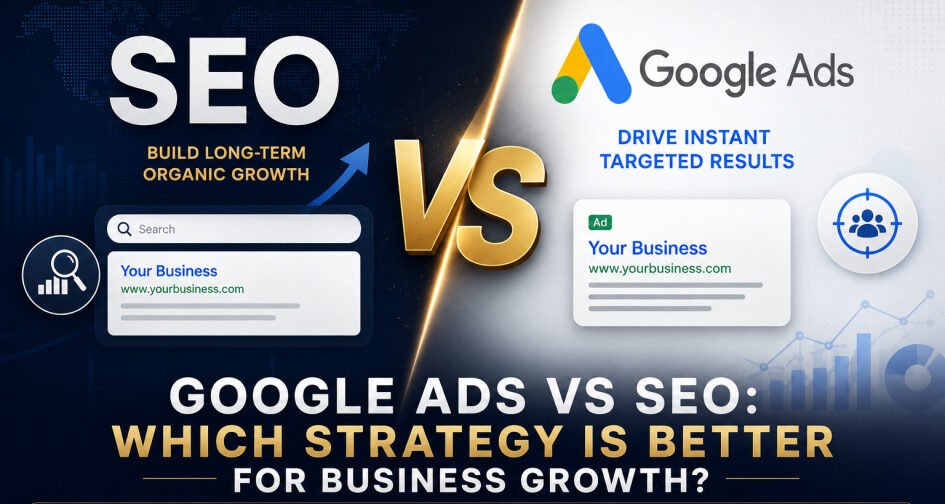
Google Ads vs SEO is one of the most common comparisons businesses make when deciding how to invest their digital marketing budget. While both strategies help attract customers through search, they work in very different ways and serve different business objectives. Understanding when to use SEO, Google Ads, or a combination of both can significantly influence your long-term growth strategy.
Google Ads provides immediate access to paid search visibility, allowing businesses to appear for relevant searches as soon as campaigns are launched. SEO focuses on improving organic visibility over time by strengthening technical foundations, creating useful content, building authority, and earning sustainable search traffic.
The right choice is rarely Google Ads or SEO. For many businesses, the better strategy is understanding how each channel contributes to customer acquisition and how they can work together within a connected search strategy.
Table of Contents
What Is SEO?
Search Engine Optimization (SEO) is the process of improving a website’s visibility within organic search results. Rather than paying for every click, businesses invest in technical optimization, AI Search Optimization content quality, search intent, topical authority, internal linking, user experience, and website credibility to increase their chances of appearing for relevant searches. Modern SEO is also evolving alongside Generative Engine Optimization (GEO) as AI-powered search becomes more prominent.
SEO is designed to create sustainable visibility over time. As a website becomes more authoritative and better aligned with user needs, it can attract qualified traffic without paying for every individual visit.
How SEO Generates Business Growth
Strong SEO helps businesses become discoverable when potential customers actively search for products, services, solutions, or information. Organic search can support every stage of the customer journey—from early research through to commercial intent—while also strengthening brand credibility and reducing long-term dependence on paid advertising.
SEO Is a Long-Term Investment
Unlike paid advertising, SEO typically requires time before meaningful results become visible. Technical improvements, content development, authority building, and search performance generally improve gradually rather than immediately.
The advantage is that successful SEO can continue generating qualified traffic long after individual optimization activities have been completed, making it a valuable long-term growth channel for many businesses.
What Is Google Ads?
Google Ads is Google’s online advertising platform that enables businesses to display ads across Google Search, YouTube, Google Maps, Google Shopping, Gmail, and millions of websites within the Google Display Network. Unlike SEO, which focuses on earning organic visibility over time, Google Ads allows businesses to gain immediate exposure by bidding on relevant search terms and audience segments.
Advertisers typically pay when users click on their ads, making Google Ads one of the most measurable digital marketing channels. Campaign performance can be tracked through metrics such as impressions, clicks, conversions, cost per acquisition (CPA), return on ad spend (ROAS), and overall return on investment (ROI).
How Google Ads Generates Business Growth
Google Ads helps businesses reach potential customers at the moment they are actively searching for products or services. By targeting specific keywords, locations, devices, demographics, and audience interests, businesses can quickly generate website traffic, enquiries, online sales, or phone calls without waiting for long-term organic rankings.
The platform also supports remarketing, allowing businesses to reconnect with previous website visitors and nurture potential customers throughout the buying journey.
Google Ads Delivers Immediate Visibility
One of the biggest advantages of Google Ads is speed. Well-structured campaigns can begin driving qualified traffic shortly after they are launched. This makes Google Ads particularly valuable for new businesses, product launches, seasonal campaigns, or organizations looking to generate leads while their long-term SEO strategy continues to build momentum.
However, paid visibility is directly tied to advertising spend. Once campaigns are paused, traffic from those ads typically stops. For this reason, many businesses use Google Ads to achieve immediate results while simultaneously investing in SEO to build sustainable organic visibility.
Google Ads vs SEO: Key Differences
While both SEO and Google Ads help businesses increase visibility in search results, they differ significantly in how they generate traffic, the time required to produce results, investment models, and long-term sustainability. Understanding these differences helps businesses choose the right strategy based on their objectives, budget, and growth stage.
| Factor | SEO | Google Ads |
| Visibility | Organic search results | Paid advertisements |
| Time to Results | Usually takes several months | Can generate traffic almost immediately |
| Cost Model | Investment in optimization and content | Pay per click or other bidding models |
| Long-Term Value | Builds sustainable organic traffic | Traffic continues only while campaigns are active |
| Click Costs | No direct cost per click | Each click is paid according to the auction |
| Credibility | Often perceived as more trustworthy by users | Clearly identified as sponsored content |
| Scalability | Grows gradually with authority | Can scale quickly with increased budget |
| Best For | Long-term growth and authority | Immediate traffic, lead generation, promotions, and testing |
Neither channel is inherently better than the other. SEO focuses on building long-term visibility and authority, while Google Ads provides immediate reach and measurable campaign control. The most effective strategy depends on business goals, competitive landscape, available budget, and expected timeframes for results.
Advantages of SEO
SEO offers several long-term advantages that make it one of the most valuable digital marketing investments for businesses seeking sustainable growth.
Key Benefits of SEO
Long-term organic visibility
SEO helps businesses build sustainable visibility in search results by improving website quality, creating valuable content, and strengthening topical authority. Unlike paid advertising, successful SEO continues generating qualified traffic long after the initial optimization work is completed.
Cost-effective customer acquisition
Once a website achieves strong organic rankings, businesses can attract visitors without paying for every click. This makes SEO one of the most cost-effective digital marketing channels for generating sustainable long-term growth.
Greater brand credibility
Users often trust organic search results more than paid advertisements. Consistently appearing in relevant searches helps establish authority, strengthen brand recognition, and build customer confidence.
Qualified organic traffic
SEO attracts users who are actively searching for products, services, or information related to your business. This often results in visitors with higher purchase intent and better conversion potential.
Supports the entire customer journey
SEO enables businesses to create content that educates, informs, compares solutions, and answers customer questions throughout every stage of the buying journey.
Improves website quality
Effective SEO encourages faster loading speeds, mobile-friendly design, better site structure, improved accessibility, and an enhanced user experience for both visitors and search engines.
Builds topical authority
Publishing comprehensive, high-quality content around your area of expertise helps search engines recognize your business as a trusted source, improving visibility across a broader range of relevant search queries.
Delivers long-term value
Unlike paid advertising, where visibility stops when campaigns end, SEO continues delivering value as rankings improve, authority grows, and content matures over time.
While SEO requires patience and consistent investment, it can become one of the most cost-effective acquisition channels over the long term by continually attracting qualified visitors without ongoing advertising costs for each click.
Advantages of Google Ads
Google Ads provides businesses with immediate access to highly targeted audiences and offers a level of campaign control that organic search alone cannot achieve.
Key Benefits of Google Ads
Immediate visibility
Businesses can start appearing in search results shortly after launching campaigns.
Highly targeted audiences
Campaigns can target users based on keywords, location, demographics, devices, and interests.
Flexible budget management
Daily budgets and bids can be adjusted at any time to align with business goals.
Rapid testing
Businesses can quickly test keywords, offers, creatives, and landing pages to improve performance.
Measurable performance
Every click, conversion, cost, and return can be tracked using detailed campaign reporting.
Scalable campaigns
Advertising budgets can be increased or decreased based on demand and business objectives.
Remarketing capabilities
Businesses can reconnect with previous website visitors and encourage them to return.
Support for promotions and launches
Google Ads is well suited for seasonal campaigns, new product launches, and time-sensitive offers.
Because campaigns can be launched, adjusted, and optimized quickly, Google Ads is particularly effective for businesses seeking rapid lead generation, immediate sales opportunities, or fast market validation. However, maintaining visibility requires continued advertising investment.
When SEO Is the Better Choice
SEO is often the better investment for businesses focused on sustainable growth, long-term brand authority, and consistent organic lead generation. While it requires patience and ongoing optimization, the long-term benefits can significantly outweigh the initial investment.
You’re building a long-term business.
SEO is ideal for businesses that want to create a sustainable source of organic traffic rather than relying solely on paid advertising.
You want to reduce customer acquisition costs over time.
As organic rankings improve, businesses can continue attracting qualified visitors without paying for every click, making SEO increasingly cost-effective.
You want to establish industry authority.
Consistently publishing valuable, search-optimized content helps position your business as a trusted source of expertise while strengthening topical authority.
Your customers research before buying.
If your audience compares options, reads guides, or searches for solutions before making a purchasing decision, SEO allows you to engage them throughout the buying journey.
You want long-term returns from your content.
High-quality SEO content can continue generating traffic, leads, and brand visibility for months or even years after publication.
When Google Ads Makes More Sense
Google Ads is the better choice when businesses need immediate visibility, rapid lead generation, or greater control over targeting and campaign performance. It is particularly effective for businesses with short-term objectives or time-sensitive marketing campaigns.
You need results quickly.
Google Ads can begin driving qualified traffic shortly after campaigns are launched, making it suitable for businesses that cannot wait for organic rankings to improve.
You’re launching a new product or service.
Paid campaigns provide immediate exposure while SEO efforts continue building long-term visibility in the background.
You’re running seasonal or promotional campaigns.
Limited-time offers, holiday promotions, and event-based campaigns often benefit from the speed and flexibility of paid advertising.
You want precise audience targeting.
Google Ads allows businesses to target users based on keywords, locations, devices, demographics, and audience signals, providing greater control over who sees their advertisements.
You want to test quickly.
Paid campaigns enable businesses to validate keywords, messaging, offers, and landing pages before making larger long-term marketing investments.
Why Most Businesses Need Both SEO and Google Ads
Businesses often compare SEO and Google Ads as though they are competing strategies. In reality, they serve different purposes and deliver the strongest results when used together as part of an integrated digital growth strategy.
Google Ads provides immediate visibility, enabling businesses to generate traffic, leads, and sales quickly. SEO builds long-term organic authority that continues delivering value long after the initial investment. Rather than replacing one another, these channels complement each other throughout the customer journey.
SEO builds long-term visibility, while Google Ads delivers immediate results.
Businesses can use Google Ads to generate enquiries while SEO establishes sustainable organic rankings that reduce long-term customer acquisition costs.
Google Ads provides valuable keyword insights for SEO.
Paid campaigns quickly reveal which keywords, ad copy, and landing pages generate the highest conversions. These insights can then inform SEO content strategies and long-term optimization efforts.
SEO improves the effectiveness of paid campaigns.
Well-optimized websites with relevant content, faster loading speeds, and stronger user experience often contribute to better landing page performance, higher Quality Scores, and improved conversion rates.
Together, they maximize search visibility.
Appearing in both paid and organic search results increases brand exposure, builds credibility, and creates multiple opportunities for potential customers to engage with your business.
An integrated strategy supports every stage of the customer journey.
Paid advertising captures immediate demand, while SEO nurtures users researching solutions, comparing options, and returning later to make informed purchasing decisions.
Businesses that combine SEO and Google Ads often develop a more resilient and sustainable growth strategy. While paid advertising generates immediate opportunities, SEO builds long-term authority and reduces dependence on ongoing advertising spend.
How Performance Marketing Extends Beyond Google Ads
While Google Ads is one of the most widely used paid advertising platforms, it represents only one component of a broader Performance Marketing strategy. Modern businesses often leverage multiple paid channels to reach different audiences, optimize customer acquisition, and maximize return on investment.
Performance Marketing includes multiple advertising channels.
Businesses can reach their audiences through platforms such as Google Ads, Meta Ads (Facebook and Instagram), LinkedIn Ads, Microsoft Ads, YouTube Ads, ecommerce advertising platforms, and remarketing campaigns, depending on their objectives and target market.
Each platform serves a different purpose.
Search advertising captures existing demand, while social media advertising helps create demand, build brand awareness, and engage audiences based on interests, behaviour, and demographics.
Data drives continuous optimization.
Performance Marketing relies on campaign data, conversion tracking, attribution, and ongoing testing to improve results over time. Every campaign provides insights that help refine targeting, messaging, creatives, and budget allocation.
Landing pages and conversion optimization are equally important.
Successful campaigns depend not only on attracting visitors but also on delivering relevant landing page experiences that convert traffic into enquiries, leads, or sales.
The objective is measurable business growth.
Rather than focusing on impressions or clicks alone, Performance Marketing measures success through meaningful business outcomes such as leads, revenue, return on ad spend (ROAS), customer acquisition cost (CAC), and overall profitability.
Businesses that adopt a broader Performance Marketing approach can diversify their customer acquisition strategy, reduce dependence on a single advertising platform, and continuously optimize campaigns using real performance data.
How Mavenify Integrates Search Intelligence and Performance Marketing
At Mavenify, we don’t treat SEO and Performance Marketing as isolated services. We believe sustainable business growth comes from building connected systems where every marketing channel strengthens the others. Our approach combines Search Intelligence Infrastructure™ with Performance Marketing System™ to create a unified acquisition strategy that balances immediate results with long-term growth.
Search Intelligence Infrastructure™ focuses on building long-term discoverability through technical SEO, AI search optimization, topical authority, content strategy, entity optimization, and sustainable organic visibility across traditional and emerging search platforms.
Performance Marketing System™ accelerates customer acquisition through data-driven paid advertising across Google Ads, Meta Ads, LinkedIn Ads, ecommerce advertising platforms, and conversion-focused campaign optimization.
Together, these systems create a stronger growth engine. Paid campaigns generate immediate traffic and valuable performance data, while Search Intelligence strengthens organic visibility, improves website authority, and reduces long-term dependence on paid advertising. This integrated approach enables businesses to capture demand today while building sustainable visibility for the future.
Rather than asking businesses to choose between SEO and Google Ads, Mavenify helps organizations develop connected growth systems that align search visibility, paid acquisition, content, and conversion optimization to achieve measurable commercial outcomes.
Frequently Asked Questions
Is SEO better than Google Ads?
Neither strategy is universally better. SEO is typically more effective for long-term organic growth and authority, while Google Ads provides immediate visibility and faster lead generation. The right approach depends on your business objectives, budget, industry, and growth timeline.
Can I do SEO and Google Ads together?
Yes. Many businesses achieve the best results by combining both strategies. Google Ads delivers immediate traffic while SEO builds long-term organic visibility and reduces reliance on paid advertising over time.
How long does SEO take to show results?
SEO is a long-term strategy. Depending on your industry, competition, and website authority, noticeable improvements may take several months. However, strong SEO continues delivering value long after the initial optimization work.
How quickly can Google Ads generate leads?
Well-structured Google Ads campaigns can begin generating traffic and enquiries shortly after launch. Results depend on factors such as targeting, competition, bidding strategy, budget, and landing page quality.
Does Google Ads improve SEO rankings?
No. Running Google Ads does not directly improve organic search rankings. However, paid campaigns can provide valuable keyword and conversion insights that help refine long-term SEO strategies.
Should small businesses invest in SEO or Google Ads?
Many small businesses benefit from combining both. Google Ads can generate immediate enquiries while SEO builds sustainable organic visibility that supports long-term business growth.
Conclusion
Comparing Google Ads and SEO isn’t about deciding which strategy is better—it’s about understanding how each contributes to business growth. Google Ads delivers immediate visibility and measurable campaign performance, while SEO builds long-term authority, sustainable organic traffic, and lasting brand credibility.
Businesses that combine both approaches often create stronger and more resilient acquisition strategies. By integrating paid advertising with long-term search visibility, organizations can generate immediate opportunities while continuously building valuable digital assets that support future growth.
At Mavenify, we believe the most effective digital strategies are built as connected systems rather than isolated marketing activities. By combining Search Intelligence Infrastructure™ with a Performance Marketing System™, businesses can create a scalable foundation that drives both short-term performance and sustainable long-term growth.